
Planning a Greenhouse Peach or Nectarine Tree
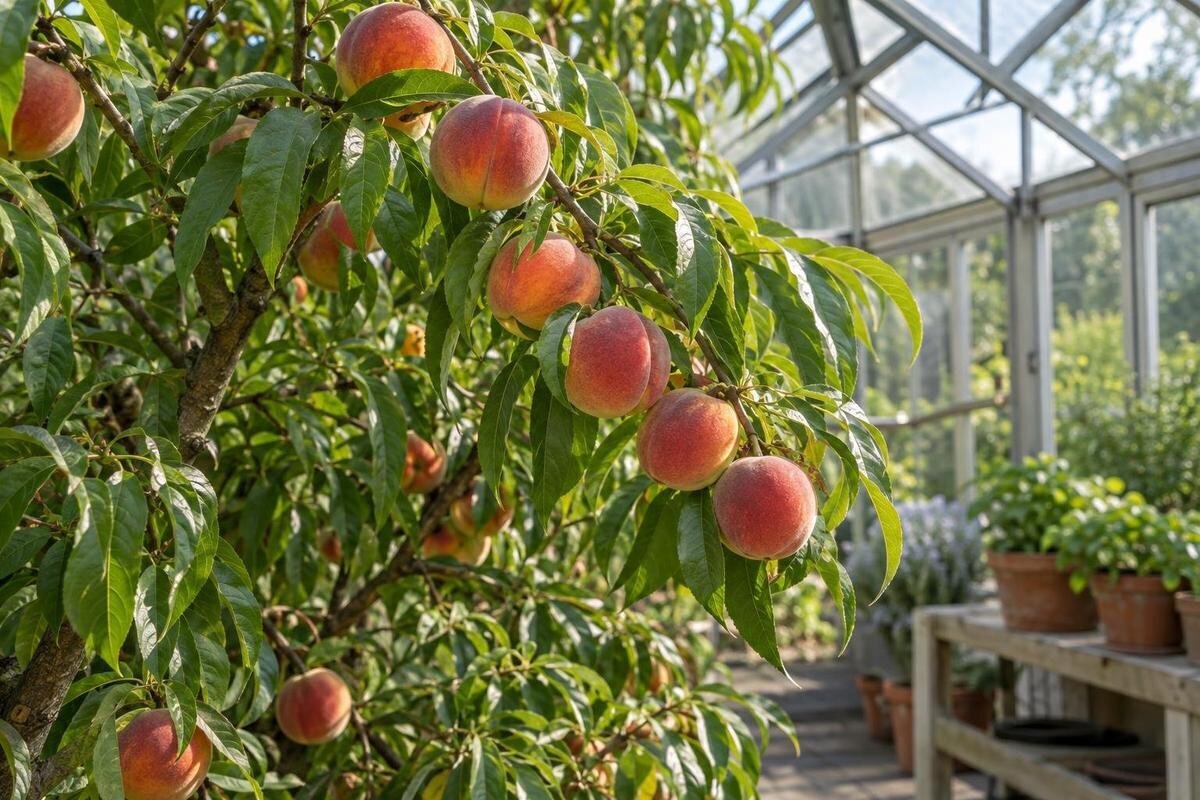
Growing stone fruit under cover
Peaches and nectarines can be grown under glass, but a greenhouse doesn’t remove a tree’s seasonal needs. A deciduous stone-fruit tree must receive suitable winter chill, flower at the right time and set fruit, while its developing canopy needs room for years to come. Cover changes light, temperature, airflow and pollinators’ access to blossom; it can also divert rainfall from the root zone, so watering needs planning. Before buying a tree, check its chill requirement and rootstock against your location, then sketch its mature shape inside the greenhouse. This guide weighs those long-term demands against the benefits of protection and explains when an in-ground or container tree makes sense.

01
Is a greenhouse right for a peach or nectarine tree?
An enclosed growing space is a tool, not a guarantee of an earlier or larger crop. It can keep direct rain off blossom and fruit, but glazing also changes winter and spring temperatures. Sunny days can warm a tree early while nights remain cold; flowers brought on early may still meet a later frost. Summer heat can rise quickly, and still, humid air can create other problems. A greenhouse changes the pattern of risk rather than removing it: the tree still needs adequate winter chill, light and a suitable flowering period. Rain shelter is useful only when it addresses a local problem; it cannot compensate for an unsuitable cultivar, inadequate chill or poor pollination. Consider whether that protection justifies year-round space and work, especially if an outdoor tree already grows well nearby.
Clarify what you want the cover to do: keep rain off blossom, extend a season, protect a trained tree or provide shelter for a container. Compare that benefit with your outdoor conditions and the space available for other crops. The Prestige Greenhouse range is listed from 3.77 m² to 28.08 m², showing how widely greenhouse footprints vary. Those figures alone do not establish internal height, ventilation or tree suitability; compare the actual layout and openings with your plan.
Match winter chill to the cultivar
Peaches and nectarines are deciduous, and their buds need a cultivar-specific amount of winter chilling before normal spring growth. Nursery labels may give chill hours or another measure; figures calculated by different methods are not directly interchangeable. A low-chill variety is not a no-chill variety. If chilling is insufficient, dormancy may break unevenly, flowering can be poor or extended, and fruit set becomes less reliable. Don’t assume an unheated greenhouse provides the same chill as nearby outdoor ground: glazing can warm the tree on sunny winter days and change its exposure. A sheltered corner can also experience different conditions from a weather station only a short drive away.
Use the exact cultivar name to confirm its chilling requirement and recommended climate with a reputable nursery or local horticultural service. Compare that requirement with records for your site over several winters, not a single season. Ask whether the published figure uses chill hours, chill portions or another method, and whether your local data were calculated the same way. Australian sites range from mild coastal settings to colder inland or elevated locations, so broad regional advice may not resolve the choice for your garden. Confirm that the rootstock suits your soil and intended training too. Heating the greenhouse is not a substitute for winter chilling; extra warmth may worsen a mismatch.
02
Choose a training form before planting
Choose training before planting because it determines where trunk and branches will occupy space. A fan-trained peach or nectarine spreads its framework along a plane, often against a support; it can make use of a long boundary but needs access for tying and pruning. An open-centred form spreads branches into the space around the trunk and needs clearance on more than one side. Neither stays small just because the tree arrives as a young whip or potted sapling. Training continues as new shoots develop, so allow time for regular selection and tying. Choose a cultivar and rootstock whose mature vigour suits the form, and ask a knowledgeable nursery which system fits that combination.
If you are considering a wall-side layout, check how much direct light that wall receives, whether branches can clear the eaves and roof, and whether you can reach the framework without stepping over other crops. The Wall Greenhouse range is listed from 3.69 m² to 14.34 m²; floor area alone does not tell you whether the orientation, internal height or opening arrangement suits a trained tree. Draw the tree first, then compare the drawing with actual dimensions. Don’t fix wires or other supports to glazing bars or the greenhouse frame unless the manufacturer or a qualified installer confirms the attachment is suitable.
Allow for the mature canopy and access
An apparently generous planting hole or gap between benches can become too tight as the canopy fills out. Measure expected spread, eventual height and distance from the roof, doors, paths and neighbouring crops. Include the branches you intend to retain, not just the trunk; leave room to stand or reach safely for pruning, tying, fruit thinning and harvest. A path that works while a young tree is small can disappear as laterals extend. The final outline depends on cultivar, rootstock and training, so ask the nursery for expected dimensions under your intended system rather than relying on a generic peach-tree size. Check that the mature canopy won’t shade other plants you want to keep.
Put measurements on a scaled floor plan along with the door swing, beds, water access and any neighbouring plants that need sun. The Spacious Greenhouse range is listed from 47 to 70 m², but total area doesn’t reveal usable width, eaves height or a clear route around a tree. Check the actual internal dimensions instead of treating floor area as canopy volume. Use the plan to see whether the trained canopy and working space can fit together before committing a bed to the tree.

03
Plan for light, ventilation and summer heat
Peaches and nectarines need good light to flower and ripen fruit, but a clear greenhouse can become much hotter than outdoors on a bright day. Check the site’s sun in winter, when the tree is leafless and flowers may open, and in summer when the canopy is full. Buildings and nearby trees cast moving shade, so a sunny planting spot at midday may not receive light for the rest of the day. Plan how you will open doors and vents during warm spells, and confirm that openings can create useful air movement through the tree canopy. A greenhouse’s floor area or name does not tell you how it performs at your site.
When comparing structures, ask for vent positions and dimensions, how openings are operated, and what shading or other heat-management options are compatible. Do not infer ventilation or light from a model name. The Pyramid Greenhouse range is listed from 5.53 m² to 18.9 m², but that footprint cannot answer questions about airflow, light transmission or headroom. Review product details, then consider the actual site and likely summer conditions. If hot spells make it difficult to manage heat, an outdoor position may be more reliable than enclosing the tree. A thermometer can help you observe conditions, but the response depends on the structure and local weather.
Check blossom pollination requirements
Many peach and nectarine cultivars are self-fertile, so one tree may set fruit without another variety; confirm this for the named cultivar. Self-fertile still means pollen must reach a receptive stigma; it does not mean every flower will set fruit. Blossom can open when insect activity is low, and a closed greenhouse may limit pollinator visits. Cold or frost during bloom, inadequate chilling and poor tree health can also reduce fruit set, so a light crop is not automatically evidence that a second tree is needed. Check pollination status and flowering time before you design the planting.
Keep access to flowers during bloom. If insects can enter and the weather allows, opening doors or vents may aid natural visits; if access is restricted, ask a local nursery whether hand transfer of pollen is practical for the cultivar. A small, clean brush can move pollen between open flowers, but success depends on the flowers being receptive and doesn’t overcome frost damage or insufficient chill. If the variety requires a compatible partner, check that both cultivars flower at the same time, not merely that they produce similar fruit. Then confirm that two canopies and their access requirements fit. Don’t add a second tree on a guess: it doubles the long-term space and pruning commitment.
04
Choose between in-ground and container growing
An in-ground tree makes a permanent claim on a bed and the soil beneath it; this can work for a planned fan or open-centred tree if the bed drains freely and the rootstock suits the soil. But a tree planted into greenhouse soil is harder to move if its canopy outgrows the house. Check soil drainage and condition before planting, and allow roots to occupy more than the original planting hole. Consider how the bed edge, paved paths, greenhouse base and nearby crops affect the root zone; don’t assume the ground under cover receives the same water as outside. If the planting position depends on the structure’s foundation or buried services, consult the installer or a qualified professional rather than guessing.
A container offers more control over placement and can restrain vigour when paired with appropriate rootstock, but it isn’t a no-maintenance shortcut. The tree depends on growing-medium volume and drainage, and a large established pot is awkward to shift. Allow room to inspect the trunk and canopy, tend the pot and water without wetting an aisle. If you intend to reposition the container, consider how you will move it as the tree grows. The Limited Edition Aluminium Greenhouses range is listed from 3.77 m² to 28.08 m²; compare the footprint with the pot, canopy and circulation space rather than assuming container culture makes any house large enough. Don’t size a container from the sapling’s dimensions. Ask a nursery about rootstock for container growing and ongoing pot care.
Plan the root zone, soil and watering
Greenhouse roofs divert rainfall, so an in-ground tree may receive little direct rain even during wet weather; plan watering rather than relying on the weather. Keep moisture reasonably consistent while shoots and fruit develop, but don’t leave roots in waterlogged soil. Containers dry more quickly and can need attention more often in warm, ventilated conditions. Check moisture around the root zone rather than judging from the surface, and ensure excess water can drain; don’t let a pot sit in standing water. Exact frequency varies with soil, pot, tree size, season and ventilation, so regular observation is more useful than a fixed schedule.
Before planting, verify that the bed drains and that watering equipment can reach the tree without blocking the path. The Aluminium Greenhouses range is listed from 3.77 m² to 28.08 m²; an area range can help compare footprints, but it doesn’t show where a water source sits or how much root space a layout leaves. Mark the route from the door to the tree, leave room around the trunk for watering and inspection, and plan for excess water to drain without pooling under benches. For an in-ground tree, ask a local horticultural adviser to assess heavy or poorly drained soil; for a pot, follow nursery advice on growing medium and feeding. Check the greenhouse floor plan rather than assuming an irrigation system is included.

05
Pruning and renewal of fruiting wood
Peach and nectarine crops depend on renewal of fruiting wood, not simply a large permanent framework. Fruit is generally borne on shoots that grew the previous season, so pruning needs to retain a balanced supply of suitable young wood while removing crowded or spent growth. The best approach differs between fan-trained and open-centred trees; learn the method for the cultivar and rootstock before making major cuts. If a tree needs aggressive pruning every year just to fit inside the greenhouse, reconsider whether its vigour and training form suit the available space. Repeated hard reduction may remove bearing shoots and provoke vigorous regrowth, adding shade and work.
Plan a yearly inspection for ties, damaged branches, crowded interior growth and suitable fruiting shoots, and leave room to reach the canopy with tools. Timing varies with local climate and disease risk, so follow guidance for your area rather than copying a calendar from a different region. The Limited Edition Aluminium Greenhouses with Storage listing covers 5.52 m² to 28.08 m². If built-in storage is part of the plan, verify its arrangement and the actual floor space left for the tree, tools and access. Storage can be convenient, but it should not narrow the path needed to inspect, prune or harvest. A steady yearly routine is easier than correcting dense growth with large cuts.
Allow for pests, disease and ongoing work
Cover does not make a peach tree pest-free. Insects can arrive with nursery stock or enter through doors and vents, so inspect new growth, leaf undersides and developing fruit regularly. Condensation and restricted air movement can leave foliage damp even when direct rain is excluded. Peach leaf curl and fruit rots are examples of issues for which local prevention advice may be needed; a greenhouse is not a cure. Start with sound planting stock and seek a local plant-health opinion if symptoms appear rather than guessing at a treatment. Any control product must be appropriate for a fruiting tree and for use in that structure.
Consider weekly and seasonal work as well as the purchase cost of a young tree: watering, venting, blossom checks, fruit thinning, harvesting, pruning and cleaning. The work changes through the year, with closer attention around bloom, hot weather and harvest. A greenhouse that’s easy to enter but leaves no route around the canopy becomes awkward as the tree matures. The T-Model Orangery Greenhouse is listed from 16.52 m² to 30 m²; the stated area is one comparison point, not a measure of usable workspace or airflow. Check actual dimensions, access and openings against the trained tree, and allow room for crops you want to keep. If you cannot manage care through hot spells or flowering, postpone planting or choose an outdoor crop better suited to the time available.
Frequently asked questions
Can peaches or nectarines grow in an unheated greenhouse?
Sometimes. The cultivar still needs enough winter chill, and even an unheated house may be warmer than the surrounding site on sunny winter days. Check local conditions against the named variety’s requirement; shelter alone does not make a site with insufficient chill suitable.
Do I need two trees for fruit?
Often not: many cultivars are self-fertile, but confirm the named variety. If it needs a pollination partner, the cultivars must flower at the same time and both canopies need room. Even a self-fertile tree may need insects or hand transfer of pollen for good fruit set under cover.
Will a greenhouse protect blossom from frost?
It may alter the tree’s exposure, but don’t treat it as frost-proof. A sunny greenhouse can bring blossom on earlier, and cold conditions can still damage flowers. Check how temperatures behave at your site rather than assuming glazing guarantees protection.
Can I grow a peach or nectarine in a pot?
Yes, if the cultivar and rootstock suit container growing and the pot provides enough growing medium, drainage and long-term root space. A container can help control placement or vigour, but it dries faster and becomes difficult to move as the tree grows. Ask a nursery about suitable rootstock and ongoing pot care.
How much greenhouse space does one tree need?
There is no single figure: mature spread, height, training system and rootstock all affect the space required. Include clearance from the roof and doors, room to prune and harvest, an access route and space for other crops. Base the plan on the trained mature tree, not its size at purchase.
A peach or nectarine will occupy greenhouse space for years, so plan around the mature tree rather than the sapling. Match the named cultivar’s winter-chill requirement to your site, select a suitable rootstock and training form, and put the canopy, pollination plan and access route on paper. Then compare greenhouse dimensions, light and ventilation with that drawing. A local nursery can help resolve questions about the tree; support attachments need advice from the greenhouse manufacturer or a qualified installer. Protected growing makes sense when the tree’s seasonal needs can be met and there is room for both its canopy and its care.
