
Planning a Greenhouse Kohlrabi Crop
Greenhouse crop guide
Growing kohlrabi in a greenhouse takes careful timing and spacing: each plant needs room for its swollen stem, and heat, uneven moisture or late picking can affect its crisp texture. In Australia, plan around local cool conditions rather than applying one national sowing month. An unheated greenhouse can extend a suitable season, but sunny days may still raise the temperature and cold nights remain possible. This guide explains how to choose a sowing window, stagger manageable batches, space plants and pick stems while they are still crisp.

What a greenhouse changes for kohlrabi
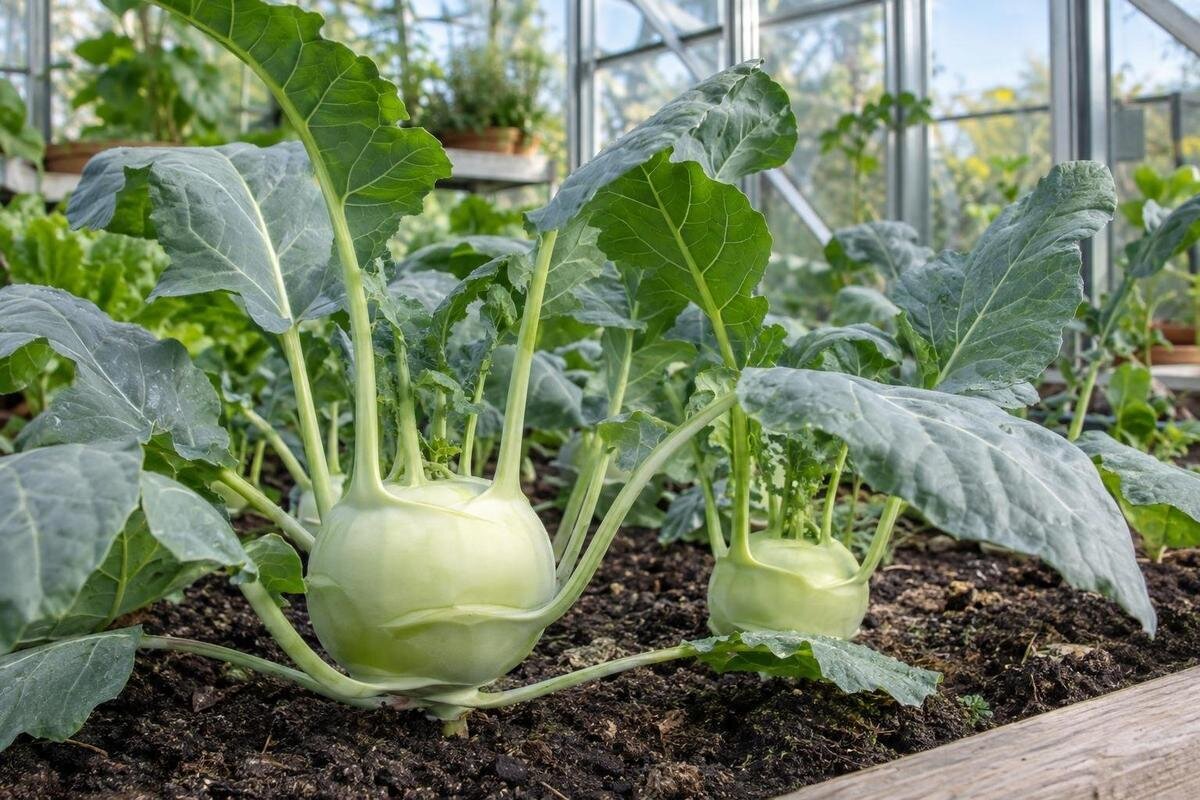
Kohlrabi is a brassica grown for its swollen stem, which develops just above the soil; the edible bulb is not a root. It generally gives its best texture when growth is steady and conditions are cool to mild. A greenhouse can make a useful shoulder-season space, but cover does not create a uniform winter climate. In sun, enclosed air may warm quickly, while an unheated structure can still become cold overnight. This matters particularly as the stem begins to swell: poor growing conditions can interrupt steady development and affect the harvest. Plan around the temperatures the crop will experience, rather than assuming any greenhouse is automatically suitable.
Use the structure when it extends a suitable growing window, provides a protected bed or lets you fit a crop between other plantings. In hot districts, an outdoor bed may be more suitable during warm weather, or you may need to wait for the cooler part of the year. In a cold district, a greenhouse may moderate conditions without removing frost risk. A bigger enclosure is not inherently cooler: the Spacious Greenhouse page lists models from 47 to 70 m², an area range rather than a temperature guarantee. Decide from the climate and management you can provide, not the model’s size alone. If the greenhouse cannot be ventilated or monitored, a cooler open-air site may suit this crop better.
Set sowing dates by local conditions
A single Australian sowing month will not suit every garden. In cooler temperate areas, autumn and spring can offer workable windows, depending on frost risk and heat; in warmer subtropical or tropical areas, the coolest part of the local year is usually more sensible. Inland sites can swing between hot days and cold nights, so use local conditions rather than relying only on a regional label. The goal is for seedlings to establish and swollen stems to develop in mild weather, with enough time left before a hot spell or severe cold slows growth. Check the seasonal outlook as well as the greenhouse conditions, because a sheltered spot can still experience sharp temperature changes.
Check the seed packet for locally recommended sowing seasons and maturity information, then compare them with recent temperatures and your greenhouse’s daytime warmth. If you are planning a crop in a Wall Greenhouse, with models listed from 3.69 to 14.34 m², take readings where the kohlrabi bed will sit. If possible, record temperatures at crop height for several days, including a sunny afternoon and an overnight low; one comfortable morning is not a reliable guide. Note when that part of the greenhouse is warmest, too. Use these observations to judge whether a later succession will have time to mature before summer heat.
Choose a variety and sowing method
Read the variety description before buying seed. Cultivars can differ in how quickly they mature and the size at which they are intended to be picked; use the packet’s timing and harvest guidance rather than expecting every kohlrabi to take the same number of weeks or reach the same diameter. Green and purple types can both be grown for their swollen stems, but colour alone is not a dependable guide to the crop’s timing. Check whether the stated maturity period is counted from sowing or transplanting, and use it as a guide rather than a promise, because local temperatures affect growth. If you want a continuous supply, choose a variety and sowing date that leave room for more than one batch to finish in mild conditions.
Direct sowing avoids transplanting and makes it easy to mark a short row; cover seeds at the depth stated on the packet and thin seedlings while small. Starting in trays can help you reserve a place in a crowded bed, but transplant young plants before their roots become congested. Set each seedling at about the depth it was growing in its plug, keeping the stem base uncovered so the swollen stem can form above ground. Avoid holding seedlings in small cells for too long, as crowded roots can make establishment harder. If trays and mature beds must share an enclosure, compare space for both: the T-Model Orangery Greenhouse page lists model areas from 16.52 to 30 m², but the exact layout determines clear growing room.
Stagger sowings for a steady harvest
Kohlrabi is easier to use when harvests do not arrive all at once. Sow a small batch, then repeat about every two to three weeks while the mild window is long enough for another crop to mature. Treat this interval as a planning starting point, not a fixed rule: the variety’s growth rate, changing weather and the time remaining in the season all affect whether the next sowing will finish. A handful of plants in each batch may suit a household better than a long row, especially if other brassicas are already using greenhouse beds. A succession does not have to occupy a new row every time: mark a short section, then reuse space once earlier plants are harvested.
Label each batch with the cultivar and sowing date, and record when plants reach the size you like. That note will improve the next cycle more than a calendar copied from a different climate. Stop sowing when the remaining mild period is shorter than the variety’s stated time to harvest, allowing for cool spells that may slow growth. The Limited Edition Aluminium Greenhouses listings cover areas from 3.77 to 28.08 m²; compare a chosen version’s usable bed length, not its whole listed area, when deciding how many batches can overlap. If the greenhouse also holds other crops, reserve their space before adding another kohlrabi row.

Space plants for well-shaped stems
Space plants for their mature stems as well as their leaves. As a practical starting point for standard-size kohlrabi, allow roughly 15–20 cm between plants and about 30–40 cm between rows; use the wider end for a larger cultivar, and follow packet instructions if they differ. Measure those distances centre to centre. The swollen stem forms above ground, so close spacing can leave neighbouring plants competing for light and room just where their stems need to expand. A simple marked grid in the bed is more reliable than estimating by eye after seedlings fill out. Even spacing also helps plants reach a similar harvest size, making picking easier.
Thin direct-sown seedlings early, while the extras are small, rather than waiting until their leaves overlap. If you intend to transplant the removed seedlings, lift them gently and replant them promptly; otherwise snip them at soil level to avoid disturbing the neighbours. The exact crop count depends on bed shape: a long, narrow bed may not take the same arrangement as two short beds separated by a path. The Pyramid Greenhouse listing covers models from 5.53 to 18.9 m², but calculate plant numbers from actual bed dimensions after allowing for paths, staging and other crops. Do not reduce each plant’s spacing simply to fill every corner.
Count beds, paths and working space
Measure the growing area inside the greenhouse and sketch it before sowing. Mark permanent benches, door clearance, paths, water containers and any existing crops first; then fit the kohlrabi rows into the remaining bed area. A greenhouse’s total floor area is not the same as plantable soil, and a layout that uses every spare strip may be awkward to water or harvest. Keep a clear route along the bed and avoid placing a new sowing where it will shade or crowd a crop that is already approaching harvest. Include the space needed to turn, carry a tray or reach a tap without stepping into the soil.
Decide whether the crop will go into a soil bed or a suitable container before you sow, because container position and access need to be counted as well. If a greenhouse listing includes storage, identify that space on the selected model’s plan rather than treating the whole enclosure as a growing bed. For example, Limited Edition Aluminium Greenhouses with Storage are listed from 5.52 to 28.08 m²; check the individual version’s layout to distinguish cultivation space from storage and working access. The product name does not tell you how much bed area remains. Keep seed trays and tools in a defined place so they do not take over the route between beds.
Keep soil fertile and moisture even
Kohlrabi needs fertile, well-drained soil that can retain moisture without staying waterlogged. Before sowing, loosen compacted soil and mix in mature compost if the bed needs organic matter; avoid large clods that make it hard to prepare a fine, even seedbed. If the soil has a history of brassica disease, do not assume fresh greenhouse cover has removed the problem. A bed prepared for one crop should also suit the next sowing, so clear old roots and plant debris rather than burying material that may harbour pests or disease. Avoid piling soil over the stem base as plants grow, because the swollen stem develops above ground.
Keep moisture reasonably even from establishment through stem swelling. Check the soil itself rather than watering to a rigid daily timetable: a warm sunny greenhouse can dry a bed faster than a cool spell, while overwatering poorly drained soil creates a different problem. Drying out and then receiving a heavy soak can undermine quality and may lead to splitting, so aim for steady watering around the root zone. Use mulch only if it suits the bed and keep it clear of the growing stem. If comparing the Bloomcabin Prestige Greenhouse range, listed from 3.77 to 28.08 m², base water planning on the planted bed area, not the full model area.
Prevent heat build-up under cover
Heat management is a central part of a greenhouse kohlrabi plan. On bright days, open the available vents and doors as conditions allow, and check temperatures near the crop rather than judging by how the outside air feels. If heat rises quickly, increase ventilation or use suitable shade where the structure and local conditions permit; avoid making a permanent change that leaves plants short of light during cooler weather. Do not rely on an unheated greenhouse to prevent cold nights either. The aim is to avoid long periods of stressful warmth while maintaining steady growth. Check at midday as well as early in the day, when the enclosure may feel cooler.
Air movement also matters when leaves are close together or the greenhouse stays damp. Correct spacing, prompt removal of diseased plant material and regular inspection all help you spot trouble early, though none can guarantee a pest- or disease-free crop. The Aluminium Greenhouses page lists model areas from 3.77 to 28.08 m²; those figures do not establish the ventilation available in a particular version. Check that version’s product details and consider how you will respond to hot afternoons before you base a succession plan on it. Include ventilation in your planning for overlapping batches, particularly if the later plants will remain under cover as the weather warms.

Harvest while stems are still tender
Check plants regularly once the stems begin to swell. Pick them at the diameter recommended for the variety; many standard types are best harvested while the stem is still modest rather than left to become oversized. A larger stem is not automatically a better harvest: some cultivars lose their crisp texture if they are left too long, particularly when growth has been stressed by heat or uneven moisture. If a few plants are ready before the rest, harvest those first and let the smaller ones continue. Check the stems themselves rather than waiting for the leaves to look mature; foliage size alone is not a reliable harvest measure.
Use a clean knife to cut the stem at the base, taking care not to nick neighbouring plants or damage later sowings. Trim leaves after picking if you are storing the stems, and use sound leaves promptly if you also want them for cooking. Inspect the crop at least a couple of times each week as harvest approaches; a warm spell can move plants from nearly ready to overgrown faster than expected. Plants in one batch may not swell evenly if they germinated at different times or occupy different parts of the greenhouse. Note the size and date of the best stems, then use that observation to set the next batch’s picking window.
Rotate brassicas and inspect for pests
Kohlrabi belongs to the brassica family, so include it in the same rotation group as cabbage, broccoli, cauliflower, pak choi and other related crops. Do not sow it repeatedly in the same bed after another brassica; rotate through non-brassica crops over several seasons, especially if clubroot or another soil-borne problem has occurred. Rotation cannot guarantee disease prevention, but repeatedly growing the same host group in a small protected bed makes it easier for pests and pathogens to persist. Keep a simple bed map so last year’s crop is not forgotten when the greenhouse is replanted. Include containers in the record if they contain soil taken from those beds.
Protected space does not keep every insect out. Inspect both sides of leaves for caterpillars, eggs and aphids, including young plants brought in from outside; remove pests by hand where practical and look for locally appropriate controls if the problem is persistent. Keep weeds and spent brassica leaves out of the bed, and clean tools between beds when disease is a concern. Leave room for inspection in the original layout: a dense sowing may appear to save space but makes it harder to find damage before it spreads. Check again after watering or harvesting, when leaf undersides may be easier to see.
Frequently asked questions
When should I sow kohlrabi in an Australian greenhouse?
There is no single month for every climate. Sow when local conditions are cool to mild and allow enough time for the chosen variety to mature before hot weather. Temperate districts may use autumn or spring windows; warmer districts often favour the coolest part of the year. Follow the seed packet and check greenhouse temperatures rather than relying on dates alone.
Does kohlrabi need a heated greenhouse?
Usually not. Kohlrabi is a cool-season crop, and timing and ventilation matter more than heating. An unheated greenhouse can still become cold overnight, while sunshine may overheat it during the day. Choose a season that suits your local climate and monitor conditions.
How far apart should I plant kohlrabi?
As a starting point for standard varieties, allow about 15–20 cm between plants and 30–40 cm between rows. Give larger cultivars more room, leave access for harvesting and follow the seed packet if it recommends different spacing.
Can I sow successive crops of kohlrabi?
Yes. Sow small batches about two to three weeks apart while there is enough mild weather left for each to mature. Adjust the interval to the variety’s maturity time, conditions in the greenhouse and how quickly the first sowing grows.
How do I know when kohlrabi is ready to harvest?
Pick it at the size recommended for the variety. Check the stems regularly once they swell; many standard types are best harvested while still modest, before they become oversized and lose crispness. Judge the stems themselves rather than foliage size alone.
Plan greenhouse kohlrabi around the local cool season and the space available for each batch. Use the seed packet to estimate sowing and harvest dates, leave measured room around each stem and maintain steady growth with even moisture. Pick plants at the variety’s recommended size, in several passes if necessary, rather than waiting for the whole batch to look alike. Recording which sowings produced crisp stems, and when they were ready, gives you a useful basis for adjusting the next crop to your greenhouse.
