
How Deep Should Greenhouse Growing Beds Be?
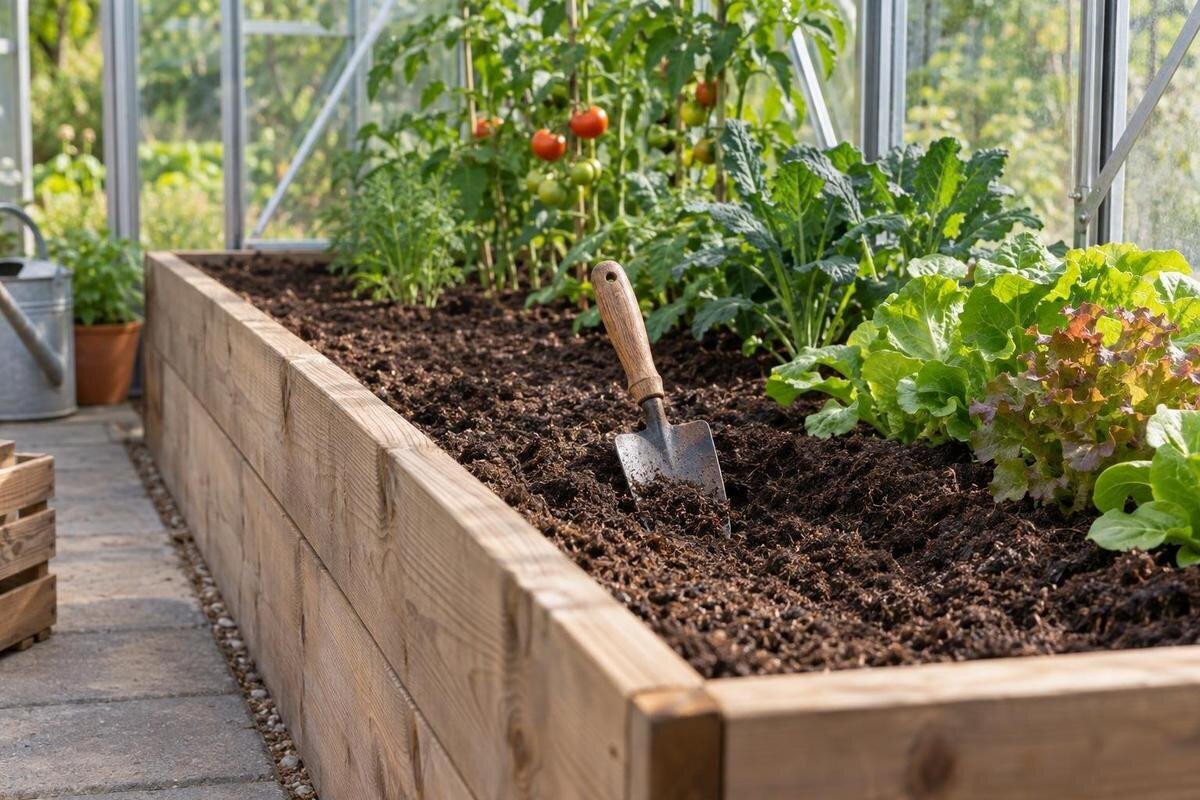
Greenhouse growing beds
Greenhouse bed depth means the usable depth of growing medium, not the height of the bed’s sides. For many vegetables, 20–30 cm is a practical starting range for shallow-rooted crops, 30–45 cm for a flexible mixed bed, and 45–60 cm may suit deeper-rooted crops when the root zone is confined. These are planning bands rather than universal minimums: crop variety, the material beneath the bed and drainage all affect what is enough. Measuring depth also lets you estimate the volume of medium needed.

Measure the growing depth inside the bed
The useful depth is the continuous layer of growing medium roots can occupy, measured from the planned surface down to the first barrier or unsuitable layer. Measure vertically through that layer, not from the ground to the top of a raised frame. A 40 cm-high frame filled to 30 cm provides about 30 cm of medium. Legs beneath an elevated bed do not add root space, nor does the unfilled gap above the medium. Record the frame height and growing depth as separate measurements so they cannot be confused when comparing bed designs. If roots can pass into workable soil below, record that additional rootable depth separately rather than assuming it is available. This distinguishes the medium you need to buy from the total soil profile the plants may be able to use.
Set the intended final fill level before ordering medium. Freshly placed material can settle, so decide whether your target is its initial or settled height, and check how the supplier quotes volume. Count the growing medium only: empty space above the fill line and a non-rootable base layer do not increase usable depth. If you are choosing a greenhouse as well, compare your sketch with the exact model plan. The Limited Edition aluminium greenhouse range is listed from 3.77 to 28.08 m²; that range gives area options, not the clear space available for beds and paths.
Match the root zone to the crops you plan to grow
Root depth is a planning range, not a single number that applies to every plant. Many leafy crops, including lettuce and spinach, can be grown in roughly 20–30 cm of loose, evenly moist medium. For a mixed vegetable bed, around 30–45 cm gives more room for crops with broader or deeper root systems, especially when a hard base prevents roots from growing further. Tomatoes, cucumbers and capsicums may root deeper where conditions allow, so a bed-depth estimate is not a ceiling on their possible root growth.
Harvested roots make variety especially important. Short carrot types may fit a shallower profile than long varieties; long carrots and parsnips need loose medium deep enough for the mature root, with room below it rather than a solid base immediately underneath. Check the variety description and allow for the actual root length. Potatoes are different: earthing-up and the chosen growing method affect the amount of medium needed, so simply making the bed deeper is not the whole calculation. The T-Model Orangery Greenhouse is listed with an area range of 16.52 to 30 m²; use the exact chosen model and layout to check whether separate crop zones and paths will fit.
Check what lies beneath a raised bed
A bed over open, workable ground can have a shallower constructed depth than a fully contained bed, because roots may continue below its sides. In that arrangement, the soil beneath the bed is part of the rootable profile, provided it is penetrable and drains. The raised border can still define a manageable growing area, but it does not make unsuitable ground usable. Compacted subsoil, paving or a dense barrier may prevent roots from reaching the soil below.
Identify the base before buying a large volume of medium. Ground-cover fabric, a liner or another separating layer should not automatically be treated as open soil; check whether roots and water can pass through it. Record the layer on your bed sketch so the volume calculation does not rely on access to soil that roots cannot reach. The Pyramid Greenhouse range is listed from 5.53 to 18.9 m², but that area range cannot show whether a bed will connect with the ground below. Confirm the particular base and bed arrangement before counting lower soil as extra root space.
Depth does not fix poor drainage
A deeper bed creates more room for roots, but it does not guarantee that water can leave. Drainage depends on the growing medium’s structure, the layer beneath it and whether there is a route for surplus water to escape. A deep bed over an impermeable base can stay wet; a shallow bed with free-draining medium may dry quickly. Check the profile after watering rather than judging it from the surface alone, and look for standing water or medium that remains saturated.
A layer of coarse gravel at the bottom is not an automatic drainage solution. Where fine medium meets much coarser material, water can remain held above the boundary until the upper layer is saturated; gravel also does not create an outlet. Use a suitable medium through the root zone and make sure any drainage route leads somewhere appropriate. Where a greenhouse roof excludes most rainfall, the bed’s water supply is mainly managed through irrigation, so depth is only one part of moisture management.

Choose a shared depth for mixed crops carefully
If several crop types will share one bed, decide whether the whole area needs the deeper profile or whether separate zones would work better. A row of long-rooted carrots beside shallow leafy crops does not always justify filling the entire bed to the same extra depth. A deeper section or separate container can keep the volume of medium manageable and make it easier to water crops with different root needs. Any divider should be planned so it does not unintentionally restrict roots that need to spread. Draw the crop zones with their intended filled depths before calculating quantities. For a bed with sections of different depths, work out each section’s volume separately, then add them together. Comparing that total with the volume of a uniformly deep bed shows exactly how much extra medium each arrangement requires, rather than leaving the choice as a rough estimate.
Changing crops through a rotation does not automatically mean changing the bed depth each time. The important questions are whether the planned roots can use the profile and whether water can drain through it. If the greenhouse plan also includes storage, the Limited Edition aluminium greenhouses with storage listing identifies a storage option; mark its planned footprint separately rather than counting the whole greenhouse area as growing space. Check the exact chosen model and layout before deciding how many beds can fit.
Calculate the growing-medium volume
For a rectangular bed, multiply its internal length by its internal width and its finished fill depth. Measure all three in metres; the result is cubic metres. Multiply by 1,000 to convert cubic metres to litres. For example, 30 cm of fill is 0.30 m, not 30 m, so convert centimetres before multiplying. Outside measurements include the bed walls and will overstate the amount of medium. The Bloomcabin Prestige Greenhouse listing gives an area range of 3.77 to 28.08 m², but a bed still needs its own three-dimensional volume calculation.
For an L-shaped bed, divide the plan into non-overlapping rectangles, calculate each part and add the results. Mark where one rectangle ends and the next begins so the corner is not counted twice. Where sections have different fill depths, use the depth for each section rather than applying the deepest measurement to the whole bed. If straight sides slope evenly inwards towards the base, use the average of the top and bottom internal widths rather than the widest measurement alone. Keep the measurements and calculation together: a note of length, width and filled depth makes it easier to revise the order if the layout changes. Calculate to the intended final fill line, then check whether the supplier’s quoted volume is loose, settled or compressed. There is no need to add an arbitrary percentage; the amount needed depends on the actual bed dimensions and how the medium is supplied.
Worked examples for common bed dimensions
For a bed with internal measurements of 1.2 m by 2.4 m and a 0.30 m fill depth, the calculation is 1.2 × 2.4 × 0.30 = 0.864 m³, or 864 litres. If the same bed is filled to 0.45 m, it holds 1.296 m³, or 1,296 litres. That extra 15 cm of depth adds 432 litres, showing why a modest change in bed depth can make a substantial difference to the volume required.
A smaller bed measuring 0.9 m by 1.8 m with a 0.25 m fill depth holds 0.405 m³, or 405 litres. Two identical beds would need 810 litres in total. If medium were sold in 50-litre units, one bed would require nine whole units, providing 450 litres. For both beds together, 810 ÷ 50 = 16.2, so seventeen units would provide 850 litres. Add the bed volumes before rounding up to whole units: rounding each bed separately would give eighteen units instead. These figures describe the calculated fill volume, before allowing for any difference between the supplier’s quoted volume and the filled result. The Spacious Greenhouse is listed from 47 to 70 m²; its area range can help compare greenhouse sizes, but it cannot be converted into a bed’s volume.
Fit beds and paths into the greenhouse footprint
Bed depth is vertical, but the bed also occupies floor area that could otherwise be a path or working space. Sketch the bed lengths and widths alongside door access, routes for carrying medium, and access to vents or other parts of the greenhouse. Use the bed’s outside dimensions for this layout drawing, even though the fill calculation uses its inside dimensions. The walls occupy space too. A bed accessible from both sides can often be around 0.9–1.2 m wide as a starting point; if you can reach it from one side only, make it narrower. Adjust widths to your reach rather than stepping on the growing medium. Check access to the centre and far corners of each proposed bed, not just the nearest edge, before settling on its width.
Compare the drawing with the measurements for the particular greenhouse model, not just a headline area. The Aluminium Classic Greenhouses are listed from 3.77 to 28.08 m²; use the selected model’s dimensions and openings to check that beds, paths and working access fit together. An area range does not establish the usable width of a bed or the space left beside it. Leave room for the growing system you have chosen rather than filling every available part of the plan.

Check bed height, access and support
Bed-wall height and filled depth are not interchangeable, and the bed’s position can affect access to the greenhouse. Leave room to reach the wall, clean the glazing and use doors or vents without a bed getting in the way. Choose bed materials suitable for prolonged contact with moist growing medium. If the bed’s weight will rest on a greenhouse floor, platform or frame, do not assume that it can carry the load; confirm the allowable support with the manufacturer, installer or a qualified professional before filling it.
For a wall greenhouse, include the adjoining wall when planning access around the beds. The wall greenhouse range is listed from 3.69 to 14.34 m²; check the particular model’s layout before positioning a deep bed beside the wall. On the plan, distinguish the bed edge, greenhouse frame and adjoining wall rather than treating them as a single boundary. This makes it clearer which surfaces remain accessible and where a bed could obstruct cleaning or maintenance. Check those clearances at the proposed bed height as well as at floor level. The bed and greenhouse need to work together as a measured layout, not simply fit within the same overall area.
Reassess depth when crops or conditions change
If roots reach a hard base quickly or are concentrated in a shallow layer, check the filled depth and what lies underneath before changing the bed. Restricted growth can also have other causes, including unsuitable moisture, compacted medium or crop-specific conditions, so a deeper bed is not automatically the answer. Compare the crop’s root needs with the actual rootable profile, and check whether water drains through the bed before adding more depth.
When you plan a different crop, note the filled depth, the base beneath the bed and how the medium behaves after watering. That record makes it easier to decide whether the next crop needs a deeper zone or can use the existing profile. A bed does not need to be made deeper or emptied simply because another season has passed. Change the depth when the intended crop and the available root space call for it, not as a substitute for checking other growing conditions.
Frequently asked questions
How deep should a greenhouse bed be for mixed vegetables?
For many mixed vegetable beds, 30–45 cm of usable growing medium is a practical starting range. A bed over open, workable ground may gain root space below it; one on a sealed or compacted base needs to contain the root zone itself. Allow more depth for crops with long roots, and check that excess water can drain away.
How deep should a bed be for tomatoes?
A usable depth of around 30–45 cm is a reasonable starting point for many tomato beds. More room can help where the growing medium is fully contained, but root depth also depends on the variety and growing conditions. If the bed is over open, workable soil, roots may be able to extend below it.
Can I grow carrots in a 20 cm-deep bed?
It may suit some shorter carrot varieties, but it is unlikely to provide enough room for every type. Compare the bed’s usable depth with the mature root length stated for the variety, and allow for loose growing medium beneath the root. Long carrots and parsnips generally need a deeper, unobstructed profile.
Does a deeper greenhouse bed drain better?
Not necessarily. Drainage depends on the growing medium, the base beneath it and whether surplus water has somewhere to go. A deeper bed can hold more water, so it may stay wet if the base is impermeable or the medium drains poorly. Adding gravel at the bottom is not a substitute for a working drainage route.
How do I calculate the volume of growing medium I need?
Multiply the bed’s internal length by its internal width and its filled depth, with all measurements in metres. The result is cubic metres; multiply by 1,000 for litres. For example, a 1.2 m × 2.4 m bed filled to 0.30 m holds 0.864 m³, or 864 litres.
The right depth is the depth your planned crops can use, with water able to drain and roots able to reach any suitable soil below the bed. Measure the finished medium rather than the wall, then calculate volume from the bed’s internal dimensions. This keeps the growing space, drainage and amount of medium tied to the actual bed rather than to a one-size-fits-all figure.
