
Root Barriers for Greenhouse Beds Near Established Plants
Greenhouse growing guide
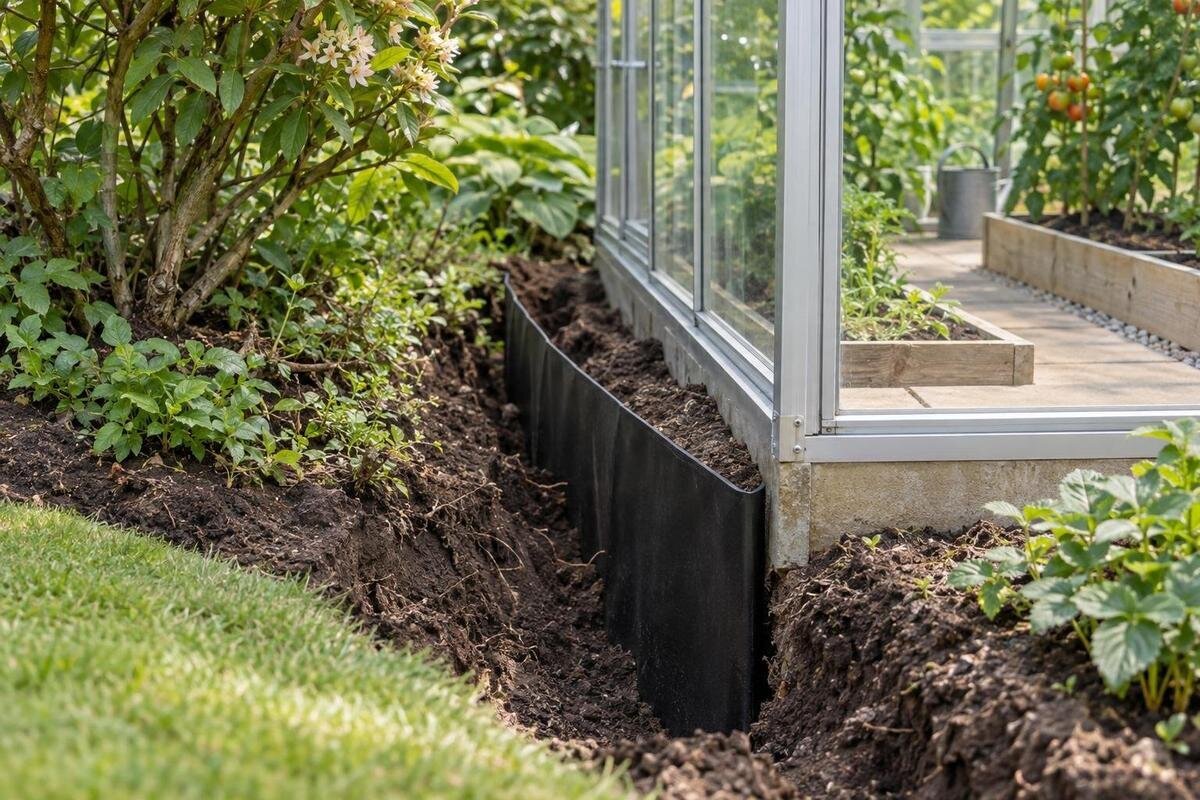
Roots from trees and shrubs can find their way into greenhouse beds, but a root in the soil is not by itself a reason to cut or install a barrier. First establish whether roots are entering the growing area, then map the bed, greenhouse footprint and nearby planting together. A suitable barrier may redirect roots, but its route, depth and joins must suit the site—and excavation must not compromise important roots that keep an established plant healthy and stable.

01
How roots reach greenhouse beds
An in-ground greenhouse bed remains connected to garden soil unless a suitable, continuous boundary separates it. Roots from a nearby tree or shrub can enter through the open underside, a gap at an edge or loose soil beside the greenhouse base. They grow where conditions provide moisture, oxygen and nutrients, but their direction and spread vary with species, age, soil structure, watering and past disturbance. There is no universal distance from a trunk at which roots stop. A greenhouse roof protects plants above ground; it does not seal the soil beneath the beds.
Finding roots in a bed also needs context. Fine roots may belong to crops or weeds, while a woody root may simply be passing through; neither observation alone proves that a neighbouring plant is reducing crop growth. Water stress, drainage, fertility, pests and disease can produce overlapping symptoms. Root intrusion becomes a practical concern when it takes up usable growing space, interferes with cultivation or appears to change how quickly the bed dries. A covered structure can make watering easier to control, but it does not separate growing soil from the ground outside.
Check the bed before choosing a barrier
Before digging, compare where crops are struggling with the bed’s position. Does the pattern follow the edge nearest the tree, or is it spread across the bed? Check the soil after watering and again as it dries; one observation is not enough to show root competition. Uneven growth can also reflect irrigation, drainage, fertility, pests or disease. Start with exposed bed sides, gaps and drainage outlets. If you need to inspect the soil, keep the inspection shallow and limited, use a hand tool carefully, and do not probe blindly into an established plant’s likely root zone or where services may run.
Sketch and photograph what you can see before disturbing it. Record which side roots appear on, whether the bed has an open base, and any obvious gap between the bed and surrounding ground. Fine roots are hard to identify from appearance alone and may belong to crops or weeds; a single root is not a reliable measure of competition. If you encounter woody roots, repeated growth from one direction or roots you cannot identify, stop rather than following them deeper. A horticultural adviser can help assess the bed, while an arborist is the person to consult if a nearby established tree may be affected.
02
Map the planting and greenhouse footprint
Map the whole arrangement, not just the spot where a root appeared. Mark tree trunks and shrubs, the proposed greenhouse outline, in-ground beds, paths, watering lines and access for installation. A canopy’s edge does not mark the end of a root system: roots can extend beyond it, and their distribution depends on site conditions. Draw the proposed barrier route, including where it would start and finish, so you can see how it relates to the bed and greenhouse. Before planning excavation, have buried services identified through the appropriate local process; a plan from above is not permission to dig.
If a mature or valued tree sits near the proposed trench, ask an experienced arborist to assess the likely root zone and the implications of excavation. There is no universal setback that makes every root cut safe, and a root’s importance cannot be judged by diameter alone. Use a dimensioned drawing for the exact greenhouse variant as one layer in the site plan. The Limited Edition Aluminium Greenhouses range is listed from 3.77 to 28.08 m², but that area span cannot show where a particular model’s base or bed edge sits. Compare the selected layout with the planting before committing to a barrier route.
Choose a barrier for the job
Barrier products are not interchangeable. A purpose-made root barrier should state what it is intended to resist and how it should be buried, joined and finished at the ends. Ordinary bed edging may only retain soil, and a weed membrane may serve a different purpose; neither should be assumed to stop roots. Check that the material is specified for permanent soil contact in the intended setting, and that its joints and edges can be installed as directed. Follow the product instructions, and ask the supplier or a suitably qualified professional if the site falls outside the situations those instructions cover.
A barrier may exclude or redirect roots from a defined growing area; it does not remove the neighbouring plant’s root system. A short or discontinuous piece may leave a route underneath, around an end or through a gap. Greater depth is not automatically a better answer: it may disturb more roots and still leave another route around the barrier. The right detail depends on the plant, soil and proposed line. When considering the T-Model Orangery Greenhouse, compare its dimensioned layout with the proposed boundary. Check whether the barrier can follow the intended route while leaving access to its ends and joins.

03
Plan the bed edge and barrier route
Draw the barrier line before choosing materials or beginning work. Show its start and finish, corners, joins and relationship to the bed and greenhouse perimeter. Roots may grow around an end or pass below a boundary, so a barrier protecting only one short section may not address entry from another side. Avoid wrapping a barrier around a trunk or enclosing a tree’s root area without professional advice: restricting part of a root system can create a different problem. If the proposed route would cross or surround roots, ask an arborist to review the plan rather than improvising on site.
Include everyday access in the drawing: room to reach all parts of the bed, move watering equipment, inspect the boundary and maintain the greenhouse. A narrow gap that cannot be reached may hide new root entry and make routine work awkward. For the Pyramid Greenhouse, use a dimensioned layout for the selected size to mark the beds, paths and any inspection space together. Pay particular attention to where the bed edge changes direction or meets the greenhouse perimeter. These details belong on the same drawing as the barrier’s ends and joins, rather than on separate plans that may conflict.
Raised beds are not automatically root-proof
Raised beds can make growing areas easier to define, but solid sides do not stop roots entering through an open base. Roots can arrive from below or through gaps. A liner or closed base changes drainage as well as root access, so it needs to suit the intended growing system rather than being added automatically. A container standing on soil may also have openings through which roots can reach. If separation matters, check what actually lies between the growing medium and surrounding ground, and how excess water will drain. More height above ground does not, by itself, create an underground barrier.
Raised beds or containers may be useful alternatives when excavating a continuous trench near an established plant would be risky, but they still need a suitable root boundary or a different position if roots can reach them. Consider the crops’ growing volume and watering needs, as well as whether the base arrangement could lead to standing water or difficult maintenance. When planning beds in the Limited Edition Aluminium Greenhouses with Storage, mark storage and growing areas separately on the selected model’s layout. Allow access for watering and checking beneath or around containers, rather than treating every space outside storage as available bed area.
04
Excavation near established roots
Excavation is where a planned boundary can become a real risk. Before trenching, make sure buried services have been identified and seek an assessment if roots may be in the route. If you meet a woody root, stop and get advice rather than cutting through, trimming it back or pulling it out. Root function and stability depend on the whole root system and the site; the apparent size of one root cannot establish whether it is safe to remove. Exposing or damaging roots can affect a plant even when its canopy looks healthy at the time.
Keep the plan flexible enough to move the bed or boundary if the ground differs from the sketch. Ask anyone installing the greenhouse or barrier to work from one agreed drawing that shows the greenhouse base, bed line, excavation route and services. Separate plans can otherwise put digging where the site assessment ruled it out. The Bloomcabin Prestige Greenhouse listing identifies a metal base, but that product detail does not replace a dimensioned layout or an assessment of roots below ground. Base details and the safety of a proposed excavation are separate questions.
Allow for drainage, watering and inspection
A barrier can affect more than root direction. A continuous buried sheet may change how water moves through soil, particularly where drainage outlets, ground levels or irrigated beds meet. Check whether the chosen product is intended for that setting and how its instructions address joints, the top edge and the lower termination. Do not add holes or cut-outs without checking that they will not defeat the barrier’s intended purpose. Keep irrigation directed at the bed rather than relying on water moving in from adjacent soil, and watch for pooling on either side after watering.
Plan for access to inspect the boundary without repeatedly digging beside the tree. A path or maintenance gap may matter more than adding a little bed width, especially where joins or ends need checking. When planning the interior of a Spacious Greenhouse, mark aisles, watering points and accessible inspection positions on the selected variant’s dimensioned layout. Check how you would reach each part of the boundary once the beds are planted, not just while the greenhouse is empty. A workable arrangement makes it easier to notice changes in moisture or signs of root entry without fresh excavation.

05
Monitor the bed after installation
Set a baseline before planting. Photograph the bed edge and barrier alignment, note the watering routine and where the soil is usually wet or dry, and record crop growth across the bed. These observations help distinguish later changes from conditions that were already present, but they do not diagnose the cause on their own. Follow the barrier maker’s maintenance directions, particularly where an edge is exposed or the boundary joins another structure. Do not pull at a root beyond the barrier or dig along its length to trace it.
After planting, check accessible bed edges and nearby plants during ordinary maintenance. If roots appear to bypass the boundary, note whether they seem to enter at an end, through a gap or from below, then seek advice before changing the installation. Decline in a tree or shrub after nearby work is a reason to ask an arborist for an assessment, not proof of a single cause. For a model from the Aluminium Greenhouses range, keep the selected layout with your baseline photographs and notes. Mark where changes appear so later observations can be compared without repeatedly disturbing the same patch of soil.
When there is no safe trench route
Sometimes there is no barrier route worth digging. If a safe line would cross substantial or unidentified roots, redesigning the growing area may be more sensible than forcing a trench through it. Options include shifting the greenhouse or in-ground bed, shortening the bed, or growing in separate containers whose root access is understood. Each alternative still needs appropriate drainage and watering; containers on open ground are not automatically isolated. Plan for crops and established planting together rather than trying to solve competition by damaging the nearby plant.
Revisit the footprint before finalising a greenhouse or bed system. If considering a Wall Greenhouse, compare a dimensioned drawing for the selected model with the root advice and your intended layout. Show the alternative bed positions as well as the original proposal, including the space needed for access and watering. This makes it easier to compare arrangements without assuming that a different greenhouse shape resolves the root issue. If the greenhouse is already in place, moving a bed or changing the growing system may still be less disruptive than cutting roots for a barrier whose route has not been assessed.
Frequently asked questions
Can tree roots grow into a greenhouse bed?
Yes. If an in-ground bed remains connected to garden soil, roots may enter from underneath or through a gap at the edge. A greenhouse roof does not isolate the soil. First check that the roots are not from crops or weeds, and remember that finding a root does not by itself prove that a tree is affecting crop growth.
Will a raised bed stop roots from a nearby tree?
Not if the base is open to the ground: roots can enter from below, even when the sides are solid. A liner or closed base changes drainage as well as root access, so choose one that suits the growing system. Check exactly what separates the bed from the surrounding soil rather than assuming extra height is enough.
How deep should a greenhouse root barrier be?
There is no single depth that works for every plant and site. Root spread depends on factors such as species, soil and watering, and a deeper trench may disturb more roots without preventing roots from going around the barrier. Follow the barrier maker’s site-relevant instructions and seek an arborist’s advice where established trees are involved.
Can I cut roots to make room for a barrier?
Do not assume a root is safe to cut based on its size or position. Its role depends on the wider root system and site, and cutting it may affect the plant’s stability or health. Stop if you encounter a woody root and get advice from an arborist before changing the route or proceeding.
What should I do if the planned barrier crosses a large root?
Pause the work rather than cutting through or digging along the root. Ask an arborist to assess the likely impact, then consider shifting the bed, changing its shape or using a different growing arrangement. The greenhouse footprint and bed layout may need to change if there is no suitable route that avoids important roots.
A useful root boundary starts with an accurate picture of what is happening below ground and where the greenhouse, beds and neighbouring plants sit. Choose a barrier only when its purpose and installation route fit that picture. If the route would put important roots at risk, adjust the bed or growing arrangement instead; preserving established planting is part of designing a workable greenhouse.
