
Seed Starting: Heated Propagator or Heated Greenhouse?
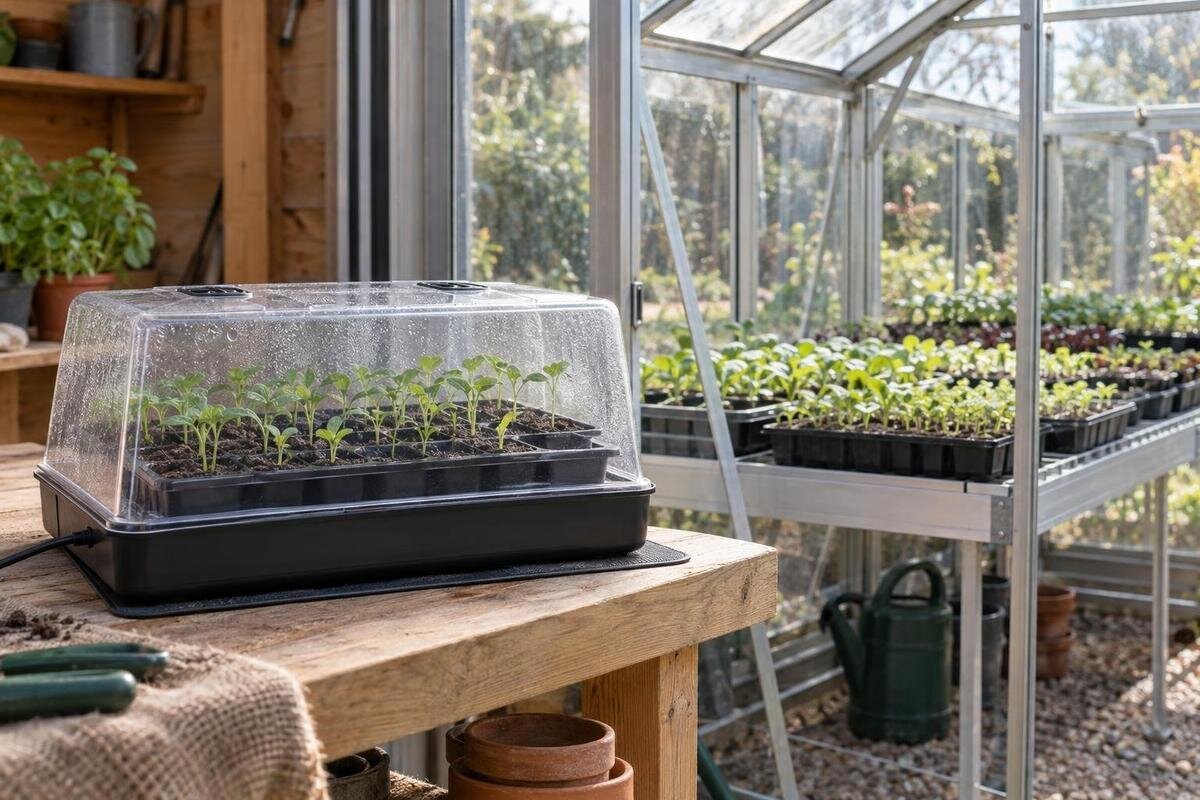
Seed raising and greenhouse heating
Choosing between a heated propagator and a heated greenhouse comes down to where warmth is needed, how many trays need it at once, and what seedlings need after they emerge. A propagator concentrates heat around a small sowing area; a greenhouse heater warms a much larger volume of air and the working space around it. Neither supplies the whole seed-raising environment by itself: crop-specific germination conditions, light, ventilation and somewhere to grow on all matter. Compare the set-up from sowing through potting on, not just the moment seeds germinate.

The two systems heat different areas
A heated propagator usually warms the base or growing medium beneath seed trays, often within a covered enclosure. That local heat can help provide the germination conditions required by a particular crop without warming all the air around it. Designs vary: some units have built-in temperature control, while others may need a separate compatible controller, and tray capacity is not universal. Check what the particular model includes, which container sizes it accepts and which part it is designed to warm. Do not assume the air under a lid, the mix in every tray and the surrounding room all reach the same temperature. The aim is to match warmth to seed-raising guidance, not to warm every nearby surface.
A greenhouse heater, by contrast, is intended to warm air across a larger area. Conditions at a seed tray can still vary with position, sunlight, ventilation, outside weather and the heater’s control, so a warmer reading beside the heater does not show that the whole bench is at the same temperature. A middle option is to run a suitable propagator inside an otherwise unheated greenhouse. This can provide warmth to seed trays without taking on the job of heating the whole structure. Follow the propagator’s instructions and monitor conditions where the trays actually sit.
How much space needs heating at once?
Count the trays that need warmth at the same time, not every seed you might sow over a season. A staggered plan can let a small propagator serve successive batches, while overlapping sowings may occupy the warm bench for longer. Think about germination and growing-on as separate space needs: emerging seedlings may need bright, ventilated room after leaving the heated unit. If you already have a suitable place for that second stage, there may be little reason to warm the whole greenhouse solely to start a modest batch. Include how long each batch occupies the heated area, not just the number of trays on sowing day.
If you are comparing greenhouse footprints, the Wall Greenhouse range is listed from 3.69 m² to 14.34 m². Those figures describe floor area, not usable bench length, tray capacity or the heating requirement of a particular site. Sketch where benches, access and other plants would go, then compare the warming area with your sowing plan. A large structure may still have only a modest bench available; one small propagator may be inadequate if several batches overlap. Allow room to handle trays, as the unit’s footprint is not the whole work area. The relevant scale is simultaneous need, not a product name or area figure alone.
What changes after seeds germinate?
Warmth that helps seeds start is not automatically the best setting for seedlings once they appear. Germination requirements vary by species, and some seedlings need different conditions after emergence. Use the seed packet or a reliable crop-specific growing guide for suitable conditions and timing; do not copy one control setting across unrelated crops. After emergence, assess the next requirements: enough light, room to develop, air movement and a steady moisture balance. A heated unit can keep the root area warm, but it cannot compensate for poor light or crowded, stagnant conditions. This change of stage is why growing-on belongs in the comparison from the beginning.
That change affects daily work. With a propagator, you may need to vent or remove its cover according to the instructions, inspect seedlings individually and move them to a suitable growing-on place when crop guidance calls for it. With greenhouse heating, more of the space shares warmer air, but trays still need attention and the heater does not make their requirements identical. The Limited Edition Aluminium Greenhouses range is listed in sizes from 3.77 m² to 28.08 m²; when planning that wider space, check the chosen size and layout rather than treating floor area as available bench space. Leave room for the seedlings’ next stage, not just the sowing trays.
Equipment and energy use
List the equipment before comparing systems. A propagator set-up may require the heated unit, trays that fit it, a thermometer and, where the model does not provide suitable control, a compatible thermostat. Verify which items are included and whether the unit is intended for the place you will use it. Whole-greenhouse heating needs a heater designed for that environment, controls suited to the task and a way to check conditions at bench height. Think about how warm air will reach the trays and whether the proposed location allows practical access. A product description alone is not a complete installation plan.
Energy use cannot be judged from the words propagator or greenhouse heater alone. A small unit often uses less energy overall because it warms a limited area, but electrical input, running time, weather, heat loss, target conditions and equipment control all affect consumption. Heating more air generally creates a larger demand than warming a tray, although actual figures depend on the structure and set-up. The T-Model Orangery Greenhouse range is listed from 16.52 m² to 30 m²; that floor area is not a heater-sizing or running-cost figure. A thermostat may cycle a heater, so the time it draws power can differ from the total time it is switched on. Compare equipment ratings and manufacturer guidance rather than inferring energy use from a model name.

Check conditions at tray level
Measure where the seeds are, not only where the control is. A sensor positioned near a heat source or at a different height may not reflect conditions in trays elsewhere on the bench. Use a thermometer suitable for the task and check tray-level conditions at the positions that matter, following the instrument instructions. If a controller uses a separate sensor, place it only as its manufacturer directs. With a single propagator, avoid assuming every corner of the base behaves identically. Keep a note of the sensor position as well as the reading, so you can make a useful comparison after changing the tray or unit’s location.
In a heated greenhouse, monitor representative bench positions and compare more than one area if trays are spread out. The Pyramid Greenhouse range is listed from 5.53 m² to 18.9 m², but floor area cannot show how temperatures vary in a particular set-up. Record readings from different positions and note changes between bright and cooler periods. That can reveal whether one corner or bench is behaving differently, rather than prompting you to raise the setting for every tray. Use crop-specific guidance to interpret the results; one convenient number is not right for every seed.
Light, ventilation and moisture still matter
Heat is only one part of germination. Seeds need moisture and air in the growing medium as well as a temperature suited to the crop; a warm, constantly wet tray can still create poor sowing conditions. Follow crop guidance for sowing depth, covering and moisture, and check the medium rather than watering on a fixed timetable. A propagator lid can reduce drying but may also hold condensation; its presence does not prove the mix is evenly moist or that emerging seedlings have enough ventilation. Do not respond to slow emergence by raising the heat unless crop guidance and a tray-level check support that change.
After emergence, light matters for strong growth, whether seedlings are in a propagator or a heated greenhouse. A greenhouse can be bright, but glazing, shade and season affect the light reaching a bench; heating does not increase it. If stems stretch or lean, review light availability and spacing rather than raising the heat. Ventilate as conditions and crop guidance allow, without exposing tender plants abruptly. Warmth can dry trays faster in a greenhouse, while moisture may linger in a closed propagator. Monitor the mix and manage the cover for the emerging plants rather than leaving it in place simply because it was used at sowing.
Bench space for growing on and potting on
Set up for the move beyond germination as well as for the first tray. Leave a practical route to water, inspect and lift trays, and decide where labels and small tools will sit without blocking the work area. A bench occupied by a propagator still needs room around it for access and handling. Once plants are ready to be moved on, potting space and room for larger containers can matter more than the heated base itself. This is a layout issue, not automatically a reason to heat every part of the greenhouse. Keep watering tasks and electrical equipment apart as directed by the appliance instructions.
The Limited Edition Aluminium Greenhouses with Storage listing covers floor areas from 5.52 m² to 28.08 m². A storage feature may affect how you plan the work area, but the product name and overall area do not confirm how much clear bench remains in a chosen configuration. Check the selected greenhouse’s specifications, then plan the positions of benches, storage and access. If growing-on pots will occupy the same bench as germinating trays, include that overlap in the decision; otherwise you may have enough warm space at sowing but too little usable room later. Consider where tools and potting materials will sit as well.
Different sowings can need separate conditions
Mixed sowings complicate a single thermostat. Crops can differ in germination needs, and newly emerged seedlings may be ready for conditions unlike those required by seeds that have not yet sprouted. A whole-greenhouse heater provides a broad ambient setting; it will not necessarily meet each tray’s root-zone needs separately. A propagator can keep a small group distinct, but only within the capacity and control of the actual unit. Group trays with comparable requirements, label them clearly and avoid using one setting as a compromise that may not suit every batch. If sowings overlap, note which trays need which conditions before placing them on the same warm surface.
The Bloomcabin Prestige Greenhouse is listed in sizes from 3.77 m² to 28.08 m². Whichever greenhouse you compare, sketch zones for germination, growing-on and plants with different needs before deciding which areas need warmer air. Separate zones can be as simple as different locations and equipment choices; they do not automatically require another heater. The published area is a scale reference, not proof that separate work areas will fit in the selected size. Confirm that the controls and devices suit the planned arrangement, and keep crop-specific directions available when managing simultaneous batches.

What affects greenhouse heating demand?
Greenhouse heating demand depends on more than floor area: air volume, the structure’s construction, air leakage, exposure, ventilation and outdoor conditions all play a part. A heater selected for one space should not be assumed to suit another, and a greenhouse warmed by sunlight during the day may behave differently after dark or in a cold spell. Monitor conditions at the bench and decide whether you need to warm the trays or the room itself. It is also worth clarifying whether the aim is to maintain conditions overnight or to warm the greenhouse during a particular part of the day. For questions about sizing fixed equipment or its power supply, follow manufacturer guidance and seek a qualified professional.
The Spacious Greenhouse range is listed from 47 m² to 70 m², a very different floor-area scale from a propagator. That figure does not show heat loss, internal temperature or running cost; it illustrates that warming a tray and warming a whole structure are different jobs. For a larger greenhouse, include the time it needs to be warm and the conditions you intend to maintain in any energy estimate, rather than choosing equipment by floor area alone. Check the details for the exact size being considered, as the published range covers multiple options.
Heater compatibility and electrical safety
Before buying, compare the greenhouse’s stated dimensions and construction information with the proposed heater’s requirements. Do not assume any heater is suitable for a greenhouse, or that a larger structure is covered because its product page lists a floor area. The Aluminium Greenhouses range spans 3.77 m² to 28.08 m² in the listing, but those figures are not a heating rating. Confirm the intended environment, compatible controls and power needs with the suppliers, and ask a qualified professional to assess fixed wiring, an outdoor power supply or a heater installation where needed. Keep compatibility questions separate from the choice of tray size.
Whichever route you choose, test the system under the manufacturer’s instructions and monitor it before relying on it for a batch. Keep electrical equipment away from water as directed, use only products suitable for the intended location, and do not bypass controls or improvise wiring. Record readings at the trays and note how seedlings respond; that record can help refine future sowings without treating one season or species as a universal recipe. If you move the equipment, check the conditions again in its new position. Once germination is complete, review whether the heat is still needed and move plants only when crop guidance and their condition support the change.
Frequently asked questions
Can I use a heated propagator inside an unheated greenhouse?
Often, provided the manufacturer allows that environment and you follow the unit’s instructions. A propagator warms its base or tray area, not the greenhouse as a whole, so the surrounding air can still affect conditions. Check temperatures at the trays and do not assume the structure is warm simply because the propagator is running.
Does a heated greenhouse make a propagator unnecessary?
Not in every set-up. Greenhouse heating warms the surrounding air, while a propagator concentrates warmth around a smaller sowing area. If seeds need warmer growing medium than the general greenhouse conditions provide, local propagation heat may still be useful. Measure at the trays and follow crop-specific guidance rather than assuming one control suits every batch.
Should I leave the heat on after seeds emerge?
Not automatically. Germination and growing-on conditions can differ by crop, so use species-specific guidance to decide whether to reduce or stop local heat. After emergence, review light, ventilation, moisture and available room as well as temperature. Do not change settings based only on a general rule or because another batch is still germinating.
Does greenhouse heating provide enough light for seedlings?
No. Heating changes temperature, not the amount of light reaching a bench. Glazing, shade, season and position affect available light, so assess it separately from warmth. If seedlings are stretching or leaning, check their light and spacing; turning up the heater will not resolve a lack of light.
Which option usually costs less to run?
A propagator often uses less energy because it warms a smaller zone, but that does not guarantee a lower cost in every set-up. Compare the equipment’s stated electrical input and expected operating time, and consider thermostat behaviour, heat loss and your local electricity tariff. A greenhouse floor-area figure is not an energy-use estimate.
Choose a heated propagator when the job is warming a limited set of seed trays and you have another suitable place for seedlings to grow on. Greenhouse heating makes sense when the wider growing space needs warmth too and that use justifies the equipment and running requirements. A propagator inside an unheated greenhouse lets you warm the trays without heating the whole space. Compare the options across the whole seed-raising process: the crop’s germination needs, the area that must be warm, and the space and conditions available after emergence.
