
Heat Seedling Benches or the Whole Greenhouse?
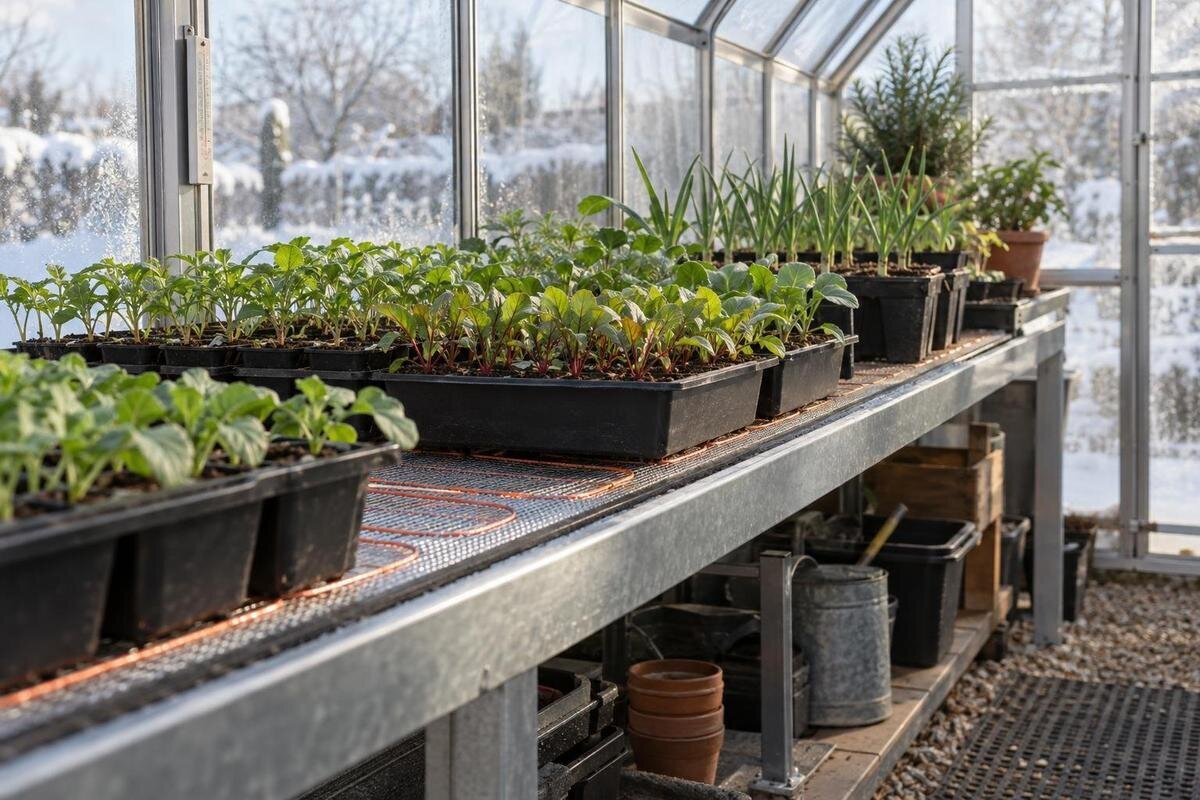
Greenhouse heating
Should you heat the seedling bench or the whole greenhouse? The answer depends on which part of the plant needs controlled conditions, how many trays are in propagation and what conditions other plants need. Root-zone heating concentrates warmth around trays or growing media; space heating raises air temperature across a much larger area. The two methods can also be used together. Neither guarantees a particular temperature or lower running costs: equipment, enclosure heat loss, weather and control settings all matter.

Root-zone warmth and greenhouse air are different targets
Root-zone heating puts heat under or around seed trays so it reaches the growing medium and young roots through contact. A seedling heat mat or heated bench may be designed for this purpose, but equipment differs: check the maker’s stated greenhouse use, dimensions, control method and operating limits. The temperature in a cell depends on the tray, medium, contact and surrounding conditions; a control setting is not automatically the temperature experienced by every seed. A shallow tray and a deeper pot can respond differently, so check representative growing media rather than assuming one surface reading describes them all. Reassess if the tray or mix changes.
Space heating takes a different route: it warms greenhouse air, which then exchanges heat with foliage, benches, pots and the structure. It can address conditions around plants beyond a single heated patch, but air may be warmer in some places than others, and warm air does not mean every root ball has reached its required temperature. Conversely, a warm patch of media is not evidence that the rest of the greenhouse—or even the tops of its seedlings—is warm enough. Think of root-zone and air temperatures as related but separate measurements; one control setting cannot automatically manage both targets.
When heated benches suit propagation
Bench heating makes sense where propagation is confined to a defined group of trays and the crop’s germination or early root growth calls for a warmer medium than the general greenhouse air. That could be one planned sowing batch or cuttings on a section of bench, rather than every plant in the structure. Check seed packets, propagation instructions or a reliable horticultural supplier for the needs of each crop and stage; there is no single setting for every seedling. Check whether the advice describes medium temperature or air temperature, as the two can differ. If a batch contains several crops, sort them by their stated requirements rather than averaging.
A narrow heated zone is less useful if the entire crop area needs warm air or seedlings will move straight into conditions that are too cool for them. Decide how many trays will be sown at once, how long each batch needs the zone and where it will go next. Consider whether keeping an empty area warm between sowings is necessary; switching unused zones off may make the plan more focused, if the equipment instructions and crop requirements allow it. Bench heat supports propagation, but cannot replace suitable light, moisture, air movement or space. Cold periods overnight matter too, so assess conditions when plants are most vulnerable, not only on a sunny afternoon.
Size the heated bench around your trays
Measure the trays you genuinely plan to heat, then sketch them on the bench with room to water, inspect and lift them without disturbing neighbouring seedlings. Include the largest routine batch and any overlap between sowing and growing on, rather than sizing for a single idealised tray. Mark positions that will hold unheated pots or tools as well as the heated footprint. Check that the planned trays, bench support and arrangement fall within the equipment’s documented dimensions and use instructions. Allow access for routine inspection and for the controls, as directed by the maker. This helps avoid choosing a mat that does not cover the working layout or heating more bench than a typical propagation run needs.
The catalogue lists Aluminium Greenhouses in sizes from 3.77 m² to 28.08 m²; those floor-area figures show a range of greenhouse sizes, not bench dimensions or heating performance. Use the exact configuration you are considering to plan bench length, aisle clearance and where unheated plants will sit. A floor plan helps identify whether one controlled zone is enough or whether separate batches need different arrangements. It also shows how much of the greenhouse remains outside the propagation zone, which matters when deciding whether air heating has a separate role.
When the whole greenhouse needs heating
Whole-greenhouse heating is relevant when the target applies to the air around more than propagation trays: foliage that is sensitive to cool air, established plants kept in the same space, or a working area that needs a chosen air range for its intended use. It is also the method to assess when you need protection across the canopy, not just at the base of a few plants. Separate a minimum protection aim from active growing conditions, because they can require different targets and schedules. Include only the plants and activities that genuinely need that air condition. Define when it is needed too, since daytime and overnight requirements may differ.
Heating air means heating a much larger volume and the surfaces it contacts, while warmth escapes through the greenhouse covering, joints and openings. Floor area alone cannot size the demand: height, exposed surface, leakage, outside conditions and documented insulation all matter. For example, Limited Edition Aluminium Greenhouses are listed from 3.77 m² to 28.08 m², but that is floor-area information, not a volume or heat-loss rating. Base a whole-space estimate on the exact structure and verified specifications, not the product family’s name or broad size range. If the information needed to assess the structure is missing, ask a qualified heating professional to review it.

Using warm benches in a cooler greenhouse
Using both methods can make sense when propagation media need warmth while other plants or the working area have a separate air requirement. A bench zone can help distinguish those tasks, but it does not create two fully controlled climates on its own: warm media transfer some heat to nearby air, and door opening or ventilation can change conditions. The greenhouse heater may still need to operate to meet its air target. If you use a separate propagation enclosure, check that its equipment is suitable and that the arrangement still allows required airflow and access. Do not assume a warm corner will keep every crop at the conditions it needs.
The T-Model Orangery Greenhouse range is listed from 16.52 m² to 30 m². On the layout for your selected size, mark the heated bench and the positions of plants that need controlled air temperatures. Check the media and surrounding air during representative cool conditions. If seedlings meet their medium requirements while their foliage or other plants do not meet their air requirements, a mat-only plan is incomplete. Ask the equipment maker whether the controls support the arrangement you intend to use.
Compare operating costs from real use
Do not judge running cost from the word ‘mat’ or from a heater’s rated input alone. For electric equipment, compare documented consumption in kilowatt-hours where available, or use appropriate consumption records alongside actual operating time; then apply the current tariff for the hours the equipment runs. A thermostat-controlled unit may cycle, so its use depends on weather, control settings, greenhouse heat loss and the heating schedule. If a suitable meter is needed, use it in line with its instructions or ask a qualified professional. For other energy sources, use documented consumption and the relevant current fuel rate rather than guessing from the equipment label.
Compare the two approaches against the same propagation requirements over comparable cold periods. A lower rated input does not prove lower energy use if a unit runs for longer. Account for any additional plants served by a space heater, too: its broader air-heating role may make the two setups different in scope. If you are considering a Pyramid Greenhouse, listed from 5.53 m² to 18.9 m², use the selected configuration and documented heater data for the comparison. Avoid claiming a saving before consumption and local energy tariffs are known, and do not compare an unusually mild week with a cold spell.
Match the heat to the crop and its growth stage
Make a crop list before choosing a heating method. For each sowing or cutting batch, record whether its propagation guidance describes a medium-temperature need, an air-temperature need or both, and whether that changes after emergence. This avoids warming every plant because one tray needs a warmer start, and avoids assuming warm media alone suits species with different requirements. Keep the guidance with each batch so the target follows the crop rather than the equipment label. When instructions are unclear, ask the seed supplier or a horticultural adviser instead of applying a universal setting. Note the relevant growth stage, since the same crop can have different needs as it develops.
Sort plants by shared requirements and location. Trays with a common need may share a bench zone; plants needing different air conditions may be better managed in separate areas or at different times, if the layout permits. The Limited Edition Aluminium Greenhouses with Storage listing identifies a model family with built-in storage, but storage is not automatically propagation space: check whether it is separated from the growing area and which parts of the enclosure share air. Count the trays you intend to heat when selecting bench equipment, not every shelf or storage space in the greenhouse. This distinction matters when estimating how much space needs warm air.
Plan for the move from germination to growing on
After emergence, warmth is only one part of growing on. Seedlings need crop-appropriate light, moisture, air movement and space, and their preferred conditions can differ from those needed to germinate. Review propagation guidance before leaving a mat at its sowing setting for the next stage; a control that suited a tray of seeds may not suit young plants once they are established. If shoots become crowded or growth changes, reassess staging and conditions rather than automatically increasing the heated footprint. The mat does not supply light or resolve poor spacing. Plan any transition according to crop guidance rather than following a fixed timetable.
Plan where a batch will grow after germination and how it will be protected during changeable weather. A mat cannot protect leaves, stems or pots once seedlings move to an unheated surface, and warm roots do not indicate that the surrounding air is suitable. The Bloomcabin Prestige Greenhouse is listed in areas from 3.77 m² to 28.08 m². Plan both the propagation bench and the growing-on area on the layout for your selected size, allowing space for seedlings to grow rather than just for their initial trays. Check conditions in the receiving area before moving a batch out of the heated zone.

The greenhouse enclosure still affects both methods
Greenhouse ventilation and the enclosure influence both heating methods. Air leaks and frequent door opening can lower air temperature; ventilation used to manage temperature or humidity can release warmth as well. Root heating may help the trays, but it does not remove the need to ventilate appropriately or keep the surrounding air within the crop’s requirements. Any insulation or covering should be compatible with the structure and must not obstruct access, vents, drainage or light. Confirm instructions for the greenhouse and any accessory instead of assuming a generic material or fitting will suit it. Do not close openings that the plants or structure need simply to hold heat.
Use documented information for the exact model: construction details, ventilation arrangements and any insulation option the supplier confirms. The Spacious Greenhouse range is listed from 47 to 70 m²; planning whole-space heating requires the actual volume and enclosure details as well as floor area. If specifications are unclear, ask the greenhouse supplier for the relevant details and have a heating professional assess the site conditions. Check that the information applies to the configuration you are considering.
Test the setup against the conditions plants need
Choose by testing the crop’s required conditions, not by assuming one method wins. For a bench-only trial, select a representative batch and record the medium temperature as well as the air around the seedlings at the times that matter to them. For space heating, record air at representative plant locations and note outside conditions, door use and ventilation. Follow the maker’s directions for controls and probes, and use a suitable independent thermometer or logger to check results rather than relying only on a heater display. A short record over comparable conditions is more useful than a single reading; keep day and overnight observations separate if both affect the crop.
Record the crop and stage, source of its temperature guidance, equipment model, documented input, operating pattern and tariff used for each comparison. Change one factor at a time where practical and keep a plan for colder-than-expected periods if the plants need protection beyond the bench. If you are considering a Wall Greenhouse, the listed area range is 3.69 m² to 14.34 m². Assess the selected model’s specifications and exposure alongside your temperature records when deciding whether bench heating alone meets the crop’s needs or whether whole-space heating is also required.
Frequently asked questions
Can a heated seedling bench replace a greenhouse heater?
Not if the greenhouse air or plants beyond the heated trays need controlled conditions. Bench heating focuses warmth around a local growing zone; it does not provide reliable cold protection for leaves, stems or unheated pots. If those also need protection, assess space heating or another suitable arrangement.
Will seedling bench heating always use less energy?
No. It may avoid heating unused space when only a few trays need warmth, but consumption depends on the equipment, operating time, control settings, greenhouse heat loss, weather and the applicable energy tariff. Compare recorded or measured use over comparable periods; the method alone does not establish a saving.
What temperature should I set a seedling heat mat to?
Follow crop- and stage-specific propagation guidance, and check whether it refers to the growing medium or the air. Seed types and growth stages differ, so there is no universal setting. Check the medium with a suitable thermometer or logger and follow the equipment maker’s instructions.
Will a heat mat warm the greenhouse air?
Some heat can transfer from the tray and growing medium to nearby air, but a bench heater is not a reliable way to set the temperature of the whole greenhouse. The effect depends on the equipment and conditions. Check the air around plants separately if their growth depends on it.
Can seedlings stay on a heated bench after germination?
They can if crop-specific guidance and the equipment instructions support it, but germination conditions may not suit growing on. Reassess light, moisture, airflow and temperature as seedlings develop, and plan where they will go before they leave the heated area.
Bench heating is the more focused option when a defined group of seedlings needs warm media and the remaining greenhouse can stay within the crop’s air requirements. Whole-space heating is relevant when the wider canopy, other plants or the working area need warmer air, while some propagation setups may need both. Base the choice on crop guidance, actual bench use, the greenhouse’s documented details and measured conditions. Comparing energy use under similar conditions keeps the decision tied to the plants and the season, rather than to a heater’s nameplate alone.
