
Why Tomatoes Split in a Greenhouse: A Diagnosis Guide
Greenhouse crop problems
A split fruit is often the visible result of a mismatch: the inside expands faster than the skin can stretch. In a greenhouse, uneven root-zone moisture is a common trigger, but the crack alone cannot prove what happened. Compare its direction and age with fruit maturity, recent watering, hot conditions and the pattern across plants before changing the routine.

Recognise the split before tracing its cause
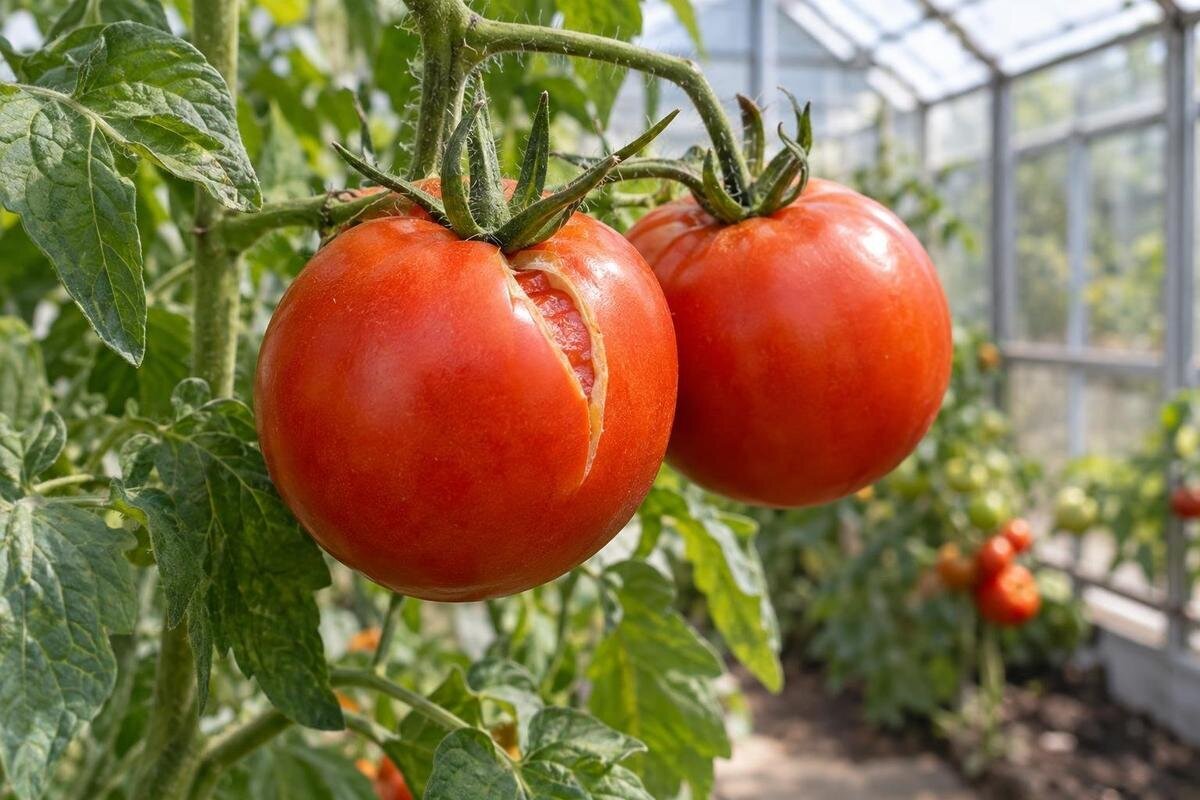
A true split is a break through the skin, often with wet flesh visible in a fresh opening. It may begin near the stem scar and run down the side, or curve around the shoulders; some cracks are hairline, while others gape as the fruit swells. Note whether the edges are fresh and clean or have dried into a corky scar. A healed mark records earlier damage, whereas a widening, wet opening is still vulnerable to decay. Also note how many fruit are affected and whether they are at a similar stage. One ripe tomato and a cluster of small fruit are different patterns to investigate, although neither identifies the cause by itself.
Photograph an affected tomato close enough to show the crack, then take a wider view showing its position on the plant. Include the stem and blossom ends if possible, and photograph sound fruit at a similar stage for comparison. Record the date, cultivar, fruit colour and recent watering or heat changes beside the images. Take any later photo from the same angle and distance to see whether the crack has widened. If several fruit are affected, photograph a fresh and an older split separately, as weathering can obscure the original shape. Images help preserve evidence, but cannot show root-zone moisture or prove what triggered the damage.
Radial and concentric cracks
Radial cracks run from the stem end down towards the blossom end; concentric cracks form curved rings around the shoulders near the stem. A fruit can show both, and either pattern may be shallow or deep. These terms describe direction, not a unique cause. Both commonly occur when fruit expands faster than its skin can stretch, and a rapid increase in water uptake is a frequent trigger. Shape alone cannot tell whether irrigation, heat-related drying, maturity or cultivar susceptibility mattered most. Record where the crack starts, how far it runs and whether it is fresh instead of treating a picture as a verdict.
Check the blossom end as well. A dry, sunken dark patch there is more consistent with blossom-end rot than with a skin split; a misshapen fruit with deep scars around the blossom end may point to another issue such as catfacing. Holes, ragged missing tissue or a separate expanding lesion are not typical cracking. A bruise or tear from handling can also look different from a split that developed on the plant. These distinctions help choose what to investigate, but more than one problem can affect a fruit at once. If tissue is soft, wet or mouldy, note that separately: decay after a split may be secondary and does not reveal the original trigger.
Reconstruct the recent watering pattern
Begin with a short timeline, not a guess based only on the latest watering. In the days before noticing the split, note hot weather, a missed watering, a timer adjustment, a reservoir running low, a blocked emitter being cleared, or a large refill after the bed or potting mix had dried. When water becomes available again, roots can take it up and the fruit can expand quickly; the crack may be noticed after the trigger. Rain is usually less relevant in a covered greenhouse, although water entering through an open side or roof can still change conditions. In a bed, note whether the whole row received the same watering; for a container, record its own refill. A heavy watering alone is not proof: look for a dry-to-wet change that fits the timing and affected plants.
Compare the interval as well as the total amount. A similar weekly total can still leave roots dry for longer if water arrives in a few large doses. Record any change to a timer, supply, irrigation line or hand-watering routine. Avoid changing several factors at once, or it becomes hard to tell whether later fruit improved. Awkward access to watering points is also worth noting. If you are comparing layouts using the Limited Edition Aluminium Greenhouses range, check the selected configuration’s dimensions against your bed positions and watering route. Keep that layout assessment separate from the record of moisture changes affecting the current crop.
Check moisture where the roots are
Check dampness where active roots are, not just at the surface. The top of a bed or potting mix can look dry while lower layers remain moist, or the reverse in a narrow container. Use the same simple method at several points, such as a finger or narrow probe at a consistent depth, or a moisture meter used for comparison rather than treated as an absolute reading. For pots and grow bags, comparing their weight as they dry can also help, provided you use the same method each time. A point beside the stem may not represent the far end of a bed or a separate container. The useful question is whether the root zone swings sharply between dry and very wet, not whether the surface looks tidy.
Treat pots, grow bags and border soil separately: they retain water differently and may dry at different rates, especially in warm conditions. Containers can vary from one another too, even when watered together. Check whether water reaches the whole line or bed; a dry strip beside a wet one can make a single watering time misleading. Persistent sogginess points towards drainage or overwatering, not a reason to add still more water. When assessing a layout for the T-Model Orangery Greenhouse, use the particular configuration’s dimensions to plan access to each planted area. Allow for checking individual containers and different parts of a bed, rather than relying on a reading from the easiest spot to reach.

Account for greenhouse heat and exposure
Heat can intensify the water problem without being a standalone explanation for every split. On bright days a greenhouse may warm quickly; plants lose more water through their leaves and exposed growing media can dry sooner. A plant that seems adequately watered at one check may therefore face higher demand later, depending on the setup and weather. If you have a thermometer, note temperatures near the crop as well as any overall greenhouse reading; conditions at the roof are not necessarily what fruit and foliage experience. A hot spell followed by a large refill is a more useful clue than warmth alone.
Map where cracks occur: one end of a bed, a sunny edge, near a door, or mainly in containers? Such clusters can point towards exposure or uneven water delivery, but position is a clue rather than proof. Ventilation may reduce accumulated heat, yet opening vents cannot correct a dry root zone by itself; check air conditions and growing-medium moisture separately. Condensation on glazing or humid air does not show whether roots are wet. If the Pyramid Greenhouse is among the structures you are comparing, review its stated ventilation details alongside the intended crop positions and site exposure. Greenhouse shape alone does not explain the temperature experienced by the fruit.
Compare fruit stage, variety and position
Fruit maturity changes the likelihood of cracking. Splits are often noticed as tomatoes approach colour change or full ripeness, when fruit growth and the skin’s ability to stretch may no longer stay in step. A mature fruit left on the plant can be exposed to another influx of water after a dry period, although cracks can happen earlier too. Compare cracked and sound fruit at similar stages rather than assuming every fruit on a truss is equally vulnerable. Picking sound ripe fruit regularly can reduce the time it remains on the plant, but it will not correct fluctuating root moisture or guarantee that later fruit stays intact.
Variety matters as well: some cultivars are more prone to cracking than others, so one variety splitting while another beside it remains sound is a useful clue, not proof. Record the cultivar and compare fruit at a similar stage and position; differences in fruit size and growth also make unrelated plants a poor direct comparison. Access matters when making these comparisons, particularly if ripe fruit is hidden or difficult to reach. If you are considering Limited Edition Aluminium Greenhouses with Storage, examine the chosen configuration’s planting footprint and access to each row. Use those details to assess your proposed inspection route, without assuming how much growing space the product name represents.
Keep water supply steady without waterlogging
Work towards an even supply at the roots, not permanent saturation. Avoid letting plants become markedly dry and then compensating with a very large dose; use root-zone checks to decide when watering is needed and apply it consistently. There is no reliable single volume or calendar rule for every greenhouse: bed soil, potting mix, container size, weather, plant size and drainage all change demand. If hot days shorten the interval, check more often rather than assuming a fixed weekly schedule is still suitable. Keep water directed to the root area, and treat mulch or irrigation aids as support for monitoring, not a substitute.
Inspect delivery as well as routine. Check that emitters are clear, connections are not leaking, containers receive water evenly, and a timer is operating as intended; a programmed schedule cannot confirm moisture at each root ball. Adjust one factor at a time, then watch new fruit over subsequent picking rounds, because cracks already formed will not close. The aim is to reduce extremes, not force every bed to the same reading when the growing media differ. For a proposed layout using the Bloomcabin Prestige Greenhouse, compare the chosen dimensions with the positions of your containers, irrigation lines and water supply. Identify where you would check delivery along the line, including its far end.
Harvest split fruit and inspect nearby plants
Pick split fruit promptly, especially if it is ripe or the crack is open. A shallow, clean split does not automatically mean the whole tomato has spoiled, but it makes the fruit less suitable for storage. If it is firm and otherwise sound, wash it under running water, cut away the damaged area with a clean knife and use it promptly. Discard it if there is mould, soft breakdown, an unpleasant smell or contamination you cannot confidently remove. A deep opening can collect moisture and decay; leaving it on the plant until it collapses also makes it harder to spot nearby new damage.
Inspect neighbouring fruit and note their maturity before removing them. If tomatoes are repeatedly hidden behind foliage or hard to reach, note which rows or positions are being missed. That distinguishes an inspection difficulty from a pattern in which cracking genuinely affects only one area. For anyone comparing a larger growing space, the Spacious Greenhouse listing gives an area range from 47 to 70 m². Use the actual configuration and proposed bed positions to assess whether fruit would be within reach and how watering zones would be arranged. Floor area alone does not establish either point, and a larger structure does not itself prevent cracking.

Track cracking across picking rounds
Keep a brief record across several picking rounds. Note the date, crack direction and depth, how mature each fruit was, which bed or container it came from, recent watering adjustments, root-zone observations and any hot spell. Keep the notes alongside your photographs so that the timing and location remain clear. Compare entries for the same cultivar and fruit stage before looking for a broader pattern across the greenhouse. This helps distinguish a one-off split from repeated damage linked to one irrigation line, cultivar or corner. Specific notes are more useful than a description such as ‘watered heavily’: record what changed and when, including whether the growing medium had been dry beforehand.
After changing one factor, assess new fruit rather than waiting for damaged skin to repair. Less cracking in later fruit supports your working explanation but does not prove it; cultivar, maturity and weather may have shifted too. If you are also considering the Aluminium Greenhouses range, keep a separate layout plan showing the selected size, specified openings and intended crop positions. Your crop record can identify places needing closer observation, while the plan helps you assess access to those places. Neither an improvement in later fruit nor a product’s floor area establishes that replacing the structure would solve the problem.
Know when to review the setup or ask for help
If splitting is the only symptom and it follows a clear dry-to-wet history, correct that pattern and observe the next fruit. Ask a local horticultural adviser or plant diagnostic service for help if cracks occur with widespread wilting, stem or root damage, unusual spreading lesions, or continuing deterioration despite steadier moisture. A lesion that is wet, discoloured or mouldy may involve a secondary problem. Keep images of both fruit ends and the whole plant, note the cultivar and watering record, and describe when the damage first appeared. Cracking alone is not evidence of a nutrient shortage, so adding fertiliser without checking the wider crop is unlikely to clarify the diagnosis.
If damage repeatedly clusters near a wall, door or one end, compare exposure, temperature, drainage and water delivery at affected and unaffected plants. A wall or enclosed shape does not guarantee stable conditions, and a photo cannot show the greenhouse’s day-to-day microclimate. If you are considering a Wall Greenhouse, assess the intended position’s shade and air movement alongside the listing’s ventilation details and your proposed watering access. Use the location-based observations to identify what needs attention in that plan. A persistent pattern is worth investigating, while one split alone rarely justifies redesigning the growing space.
Frequently asked questions
Can tomatoes split in a greenhouse without rain?
Yes. Irrigation or hand-watering can cause a sharp change in root-zone moisture, and hot conditions may dry a bed, pot or grow bag before the next watering. Rain is not required: check what changed before the split rather than assuming a covered greenhouse stays evenly moist.
Do radial and concentric cracks have different causes?
They describe the crack’s direction: radial lines run from the stem end, while concentric cracks curve around the shoulders. Either can follow rapid fruit expansion, often after increased water uptake. Their shape is a clue, not a reliable way to assign one separate cause to each type.
Should I water less after a tomato splits?
Not automatically. A sharp reduction can create another dry period and further fluctuation. Check moisture around the roots, restore a consistent supply without waterlogging, and inspect how evenly water is delivered. Judge the change using new fruit; existing cracks will not close.
Will picking tomatoes earlier stop cracking?
Picking sound fruit at an appropriate mature stage can reduce the time it remains exposed to further growth and changing conditions, but it will not correct uneven watering or remove a cultivar’s susceptibility. Follow the cultivar’s normal harvest stage; earlier picking is not a guaranteed fix.
Can I eat a cracked tomato?
A firm tomato with a small, clean crack may be usable promptly after washing and cutting away the damaged area. Discard fruit with mould, soft decay, an unpleasant smell or extensive contamination. Deep, open cracks can deteriorate quickly; when in doubt, discard the fruit.
Tomato splitting is best diagnosed by combining several clues: how the skin has broken, whether the fruit was ripening, what happened to root-zone moisture, and whether damage follows a particular plant or part of the greenhouse. Correct one likely source of fluctuation, keep observations of new fruit, and treat an uncertain pattern as a reason to gather more evidence—not to make several drastic changes at once.
