
Late Frost in an Unheated Greenhouse: What Can You Protect?
Greenhouse growing guide
An unheated greenhouse is a buffer from wind and rain, not a guaranteed frost-free room. After a mild spell, seedlings and soft new growth can be particularly exposed when conditions turn. The useful response is to triage: check the local forecast and temperatures inside, identify the plants least able to cope, move the pots you can and cover plants that cannot be moved with a suitable material. This guide explains what those measures can and cannot do, and how to assess damage afterwards.

An unheated greenhouse can still reach frost temperatures
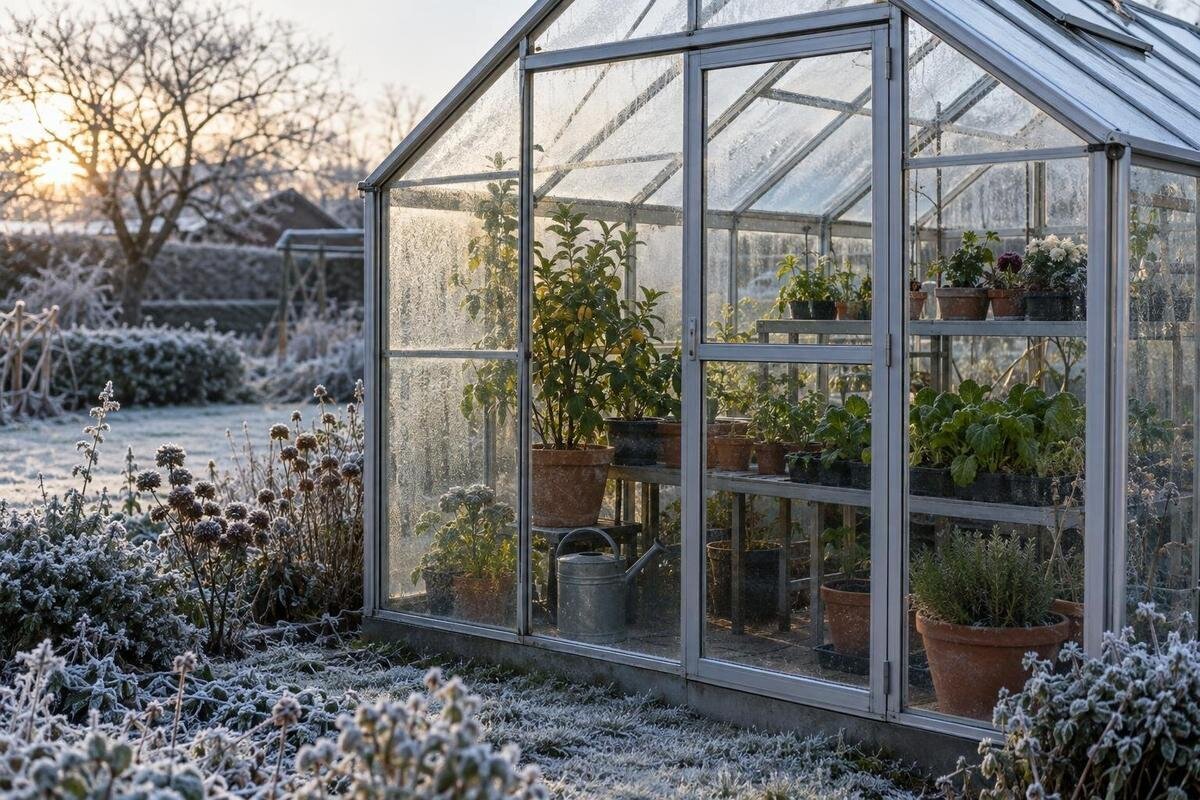
A greenhouse without a heater cannot hold a set minimum temperature. It may shelter plants from wind and retain some warmth gathered during the day, but that warmth gradually escapes as the structure and its contents cool. The rate depends on the building, its openings, the ground and the weather. On a clear night, surfaces can lose heat quickly; an enclosed space may still approach outdoor temperatures, and frost can form inside. Treat the greenhouse as a buffer, not as a room that will stay above freezing simply because the door is shut.
A warm afternoon reading does not tell you what the temperature will be before dawn. Leaves and small pots can experience different conditions from a thermometer mounted near the roof or doorway. Cold air may collect close to the floor or in an exposed corner, while a sensor beside glazing may show a colder spot than the rest of the growing area. Surface temperatures can also differ from the air reading. Pay attention to the conditions around the plants you want to protect, rather than relying on one comfortable reading elsewhere in the greenhouse.
Use the forecast and inside readings together
Use the local forecast as an early warning, not as an exact prediction for every plant. Check the expected minimum and any frost or freeze alert, then consider the conditions at your site. Clear skies and light winds can favour rapid cooling of surfaces; sheltered low-lying areas may also behave differently from nearby, more exposed ground. A forecast point some distance away will not necessarily reflect the coldest corner of your garden or the temperature inside your greenhouse. Check the forecast early enough to organise protection, then look for updates before evening. If several cold nights are forecast, plan for the whole period rather than treating the first night as an isolated event. Decide where relocated pots will stay and when you will be available to manage covers. This makes the forecast useful for organising the work, even when it cannot predict the exact temperature beside a particular plant.
A minimum–maximum thermometer or data logger placed near the crop canopy gives a more useful picture than a reading at the door. Follow the instrument instructions, keep it out of direct sun and away from glazing, and do not let it touch a cold surface. If you have one sensor, put it near the most vulnerable plants; on a later cold night, you can compare another area. Record the overnight minimum and, if available, humidity as context. Humidity alone cannot tell you that plants are safe from frost.
Prioritise plants by vulnerability and value
Give first attention to plants with tender tissue or active new growth: newly emerged seedlings, recent transplants, warm-season vegetables and herbs that are not frost-hardy, and plants carrying open flowers or developing fruit. Tomatoes, capsicums, cucumbers and basil can be useful examples to check, but tolerance varies with variety, growth stage and the length and severity of the cold. Use reliable crop-specific guidance rather than treating any one list as a universal ranking. Separate the question of vulnerability from the question of value. You may choose to prioritise a small batch of seedlings needed for your planting plan, a plant that would be difficult to replace, or a crop whose flowers you particularly want to preserve. Make that choice before you run out of sheltered space. The aim is to allocate the protection you have deliberately, rather than simply protecting whichever pots are nearest the door.
Pots may deserve extra attention because their roots are more exposed to cold than roots in the ground, particularly in small containers or on raised benches. Also check plants beside outer panels, doors and floor-level cold spots. Make a short list with three groups: plants to move, plants to cover in place, and plants you are prepared to leave without extra protection. Mark where each group is located so that a tray at the back of a bench is not overlooked. For mixed trays, check whether the plants need the same treatment rather than assuming the whole tray has one level of tolerance. If you are planning space for crops with different needs, the Limited Edition Aluminium Greenhouses listing gives area options from 3.77 to 28.08 m². Compare room for the plant groups, cover supports and access, not just the area occupied by pots.
Moving pots is often the safest first option
Move portable, high-priority plants before the temperature falls, while they are easy to handle and their foliage is not frozen. Choose an indoor or enclosed place known to stay above the plants’ individual cold tolerance; a garage, shed or porch is not automatically frost-free. If no suitable sheltered place is available, a protected area with a reliably higher minimum may still be preferable to leaving valuable pots exposed, but check its conditions rather than guessing. Work out how many pots the destination can actually accommodate before carrying the first load. Identify which plants will go there and which will need covers in the greenhouse instead. If the forecast changes while you are moving them, this order of priority lets you use the available space for the plants you most want to preserve. Keep plant labels with the pots so that temporary relocation does not leave mixed seedlings difficult to identify.
Plan the route and destination before evening. A trolley or tray can make several pots easier to move, and grouping them can make it simpler to cover them together, though grouping does not create dependable warmth. Leave enough space to reach each plant and avoid crushing foliage or blocking access. When comparing layouts, the T-Model Orangery Greenhouse listing gives area options from 16.52 to 30 m²; use the specific plan to assess usable access, rather than relying on the range alone.

How to place temporary frost covers
For plants that cannot be moved, horticultural frost cloth or fleece can provide an extra buffer. Support it over the foliage with suitable hoops or stakes where practical, and bring the edges down around the group to limit gaps. Secure the material without crushing stems or flowers. Check the fit in daylight: a piece that covers the tops of a group may not be large enough to reach around its sides once supports are in place. Allow for the tallest plant rather than pulling the cloth tight across uneven foliage. Make sure you can lift or open it without catching stems, and decide how you will secure it again if another cold night follows. A cover can slow heat loss, but it does not produce heat and cannot guarantee protection if the temperature falls well below what the crop can tolerate.
Avoid pulling a loose plastic sheet directly onto leaves, and do not use material so heavy or wet that it bends the plants. Keep the cover clear of greenhouse openings and fittings, and use supports that are stable in the space. If you are planning a future layout with covered beds or pots, the Pyramid Greenhouse listing gives area options from 5.53 to 18.9 m²; compare the chosen arrangement with the space needed for supports and a clear route.
Manage doors and vents through the cold period
Before the evening cools, close doors and any openings that can be safely closed, following the greenhouse and vent instructions. This may reduce draughts and help retain some warmth collected during the day, but it cannot set a minimum temperature. Do not force an automatic mechanism, block an opening or alter a fitting to make it stay shut. Different models and vent arrangements work differently, so rely on the instructions for the structure you have.
Check conditions again in the morning. Once the frost risk has passed and the space begins to warm, remove or open plant covers and ventilate as conditions require. Sunshine can heat a closed greenhouse quickly, and plants left under covers need daylight. If another cold night is forecast, replace the covers later rather than leaving them on through a warm day. For a model you are considering, including the Bloomcabin Prestige Greenhouse, verify the chosen version’s door and vent operation in its documentation before building a cold-night routine around it.
When temporary protection is not enough
Base the decision to move or cover a plant on its known tolerance and the readings you have, not on whether the greenhouse feels warmer than outside. If the forecast minimum is likely to fall below the crop’s limit, or you cannot establish that limit for a plant you especially want to preserve, relocation is the safer choice where possible. Decide on a fallback while there is still time to use it: identify which pots could be moved if the forecast worsens and which plants must remain in beds. If there is no suitable destination, recognise that some damage may be unavoidable rather than treating an extra sheet as a dependable solution. This is a limit of the available protection, not necessarily a failure to fit the cover properly. Several layers do not turn an unheated greenhouse into a reliably frost-free space.
If sensitive plants must remain in place through recurring cold, consider whether a purpose-designed heating system is appropriate for the structure and the crop. Follow its manufacturer’s instructions and seek qualified help for any electrical work; do not improvise with flames or unsuitable household heaters. The Spacious Greenhouse listing gives area options from 47 to 70 m², but the stated area is useful for capacity planning only: it does not establish the temperature the greenhouse will maintain overnight.
Shade cloth, watering and cover storage
Shade cloth and greenhouse shade screens are for managing bright light, not a substitute for frost cloth. Do not assume that a screen intended to reduce sun will insulate plants. Keep openings clear and use each material for its stated purpose. Likewise, avoid overhead watering as a general emergency response. Irrigation used for frost protection depends on a specific method and reliable operation; if you do not have guidance for the crop and system, do not improvise it.
Keep frost cloth and its supports together so that you can find the right materials before the next cold night. Once the cloth is dry, check it for tears and note which bed or group of pots each piece fits. Store the fastenings with it rather than leaving them scattered around the greenhouse. If several pieces look alike, a simple label can save another round of measuring and rearranging when time is short. Keep the storage location accessible when pots are in their usual positions, not only when the greenhouse is empty. The Limited Edition Aluminium Greenhouses with Storage listing identifies a built-in-storage version and gives area options from 5.52 to 28.08 m²; check the selected model’s storage dimensions and access before assuming your materials will fit.

Assess frost damage after plants thaw
Wait until plants have thawed before touching or moving damaged foliage. Injured leaves can look water-soaked, translucent, limp or darkened, but the full extent may not be obvious immediately. Flowers and buds can be lost even when a stem survives. Check more than one part of the plant and consider where it was positioned overnight; similar symptoms can have other causes, so the timing and location are useful clues rather than proof on their own.
Do not prune every discoloured leaf at dawn. Wait until the boundary between damaged and living tissue is clearer, and watch for signs of recovery before making major cuts. Resume normal care rather than trying to force growth with extra fertiliser or heavy watering. Keep notes on individual plants instead of judging the whole crop from the worst-looking specimen. Record which parts appear damaged and revisit those observations as recovery becomes clearer. Also note whether crowding made it difficult to inspect the plants without disturbing neighbouring foliage. That is a useful layout issue to address separately from the immediate damage. If you are comparing layouts, the Aluminium Greenhouses listing gives area options from 3.77 to 28.08 m²; use a measured planting and access plan to assess working space rather than assuming that a larger stated area alone will solve the problem.
What to record after a frost
After the event, write down the date, forecast minimum, lowest inside reading, sensor position, crop and growth stage, and which plants were covered or moved. Note whether doors and vents were closed, when covers went on and when they came off, and any humidity reading available. A photograph of the affected area can help you remember where plants stood and whether a cover slipped or left a gap. Keep measurements separate from observations: record the temperature shown by the instrument, then describe the plant symptoms without treating them as a temperature reading. Include plants that showed no obvious damage as well as those that suffered. That makes the record more useful than a collection of photographs of the worst leaves. If you compare nights later, note any change in sensor position or protection so that you can see what was different.
Use those notes to decide what to move first next time, where to place the thermometer and whether your covers are ready to use. A single night does not describe every future frost, but repeated readings can reveal patterns that an outside forecast misses. If you are considering a wall-adjacent format, the Wall Greenhouse listing gives area options from 3.69 to 14.34 m²; measure conditions at the intended plant positions rather than assuming proximity to a wall will keep them frost-free.
Frequently asked questions
Will an unheated greenhouse stop frost?
It can reduce wind exposure and buffer conditions, but it has no guaranteed minimum temperature. It may cool close to outdoor conditions overnight. Use readings from inside and check the tolerance of each crop; move the most vulnerable plants if a cover is not enough.
Should I cover plants inside a greenhouse?
For vulnerable plants that cannot be moved, a supported layer of horticultural frost cloth can provide extra protection. Keep it off delicate foliage where practical, secure it, and remove or open it once the frost risk has passed and the space begins to warm.
Can plastic go directly over plants overnight?
Avoid letting plastic rest on leaves. Contact may transfer cold to the foliage, and moisture can collect underneath. If using a waterproof outer sheet, support it clear of plants, secure it properly and remove it during the day. Frost cloth is generally easier to use as a temporary plant cover.
Should I water plants before a frost?
Keep soil at its usual appropriate moisture, but do not drench plants as a last-minute fix. Irrigation used for frost protection requires a specific method and reliable operation, so do not improvise it. Relocation and supported covers are more practical options for most home growers.
What should I do with frost-damaged leaves?
Let the plant thaw before handling it, then give it time to show which tissue is still alive. Leaves may collapse while stems or buds survive. Avoid pruning everything immediately; remove clearly dead growth once the extent of the damage is easier to judge.
A late-frost plan works best when it is selective and measured. Keep the least tolerant plants mobile, have covers ready for the rest, and use actual minimum readings to test how much shelter the greenhouse provides at your site. After the event, notes on crop stage, cover and location can turn an uncertain night into a better-informed planting plan. No unheated structure or temporary cover can promise frost-free conditions; match each crop to a level of protection you have reason to trust.
