
Do Water Barrels Keep Greenhouses Warmer at Night?
Greenhouse heating and thermal storage
Water barrels can absorb some daytime warmth and release it as a greenhouse cools, but they do not create heat. Their overnight contribution depends on how much heat the water absorbs, how far its temperature falls and how quickly heat escapes from the structure. A simple heat-capacity calculation sets a limit on the stored energy; temperature records show whether that energy makes a useful difference at plant level.

Before choosing a greenhouse 1
How water barrels affect overnight temperature
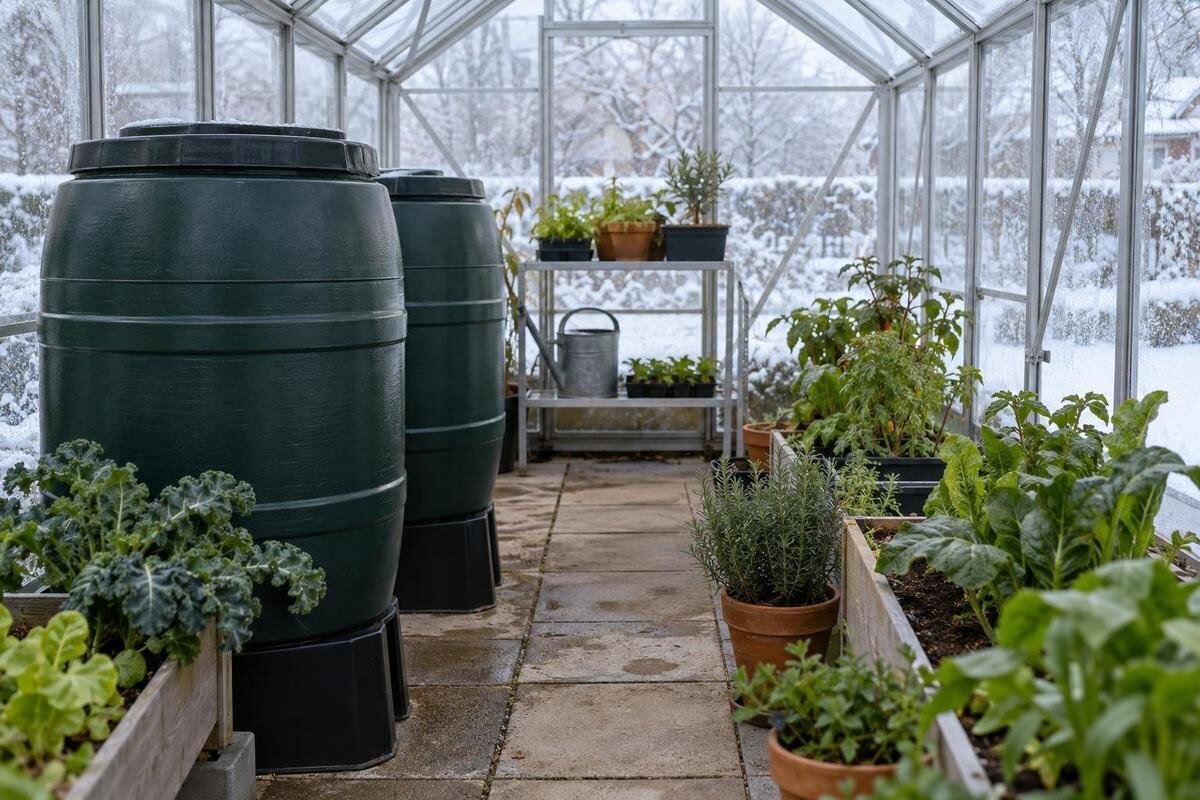
Water barrels provide thermal mass; they do not generate heat. During the day, sunlight reaching a vessel and warm greenhouse air can raise the water's temperature. After the air cools below the water, heat transfers back into the surrounding space. That exchange may slow the fall in air temperature after sunset and soften the difference between daytime and night-time readings. It cannot set or hold a chosen temperature, because the barrel has only a finite store and the greenhouse continues to lose heat. In other words, a barrel shifts some stored daytime warmth into the evening; it is not a continuous heat source.
The useful effect depends on how much warmer the water is than the surrounding air, the barrel's exposed surface and the rate of heat loss. As water cools towards the greenhouse temperature, heat transfer slows. Heat released near a barrel may also escape through the covering, gaps or open vents instead of warming the whole crop zone evenly. Air at plant height may not track the water temperature, particularly if the barrel is in another corner. A barrel can moderate a brief or mild dip yet still leave plants too cold on a longer or colder night. Treat it as a possible buffer, not guaranteed frost protection.
Calculate how much heat the water stores
Estimate stored heat with this formula: energy (kWh) ≈ water mass (kg) × 4.18 kJ/(kg·°C) × temperature fall (°C) ÷ 3,600 kJ/kWh. The 4.18 is water's approximate specific heat; dividing by 3,600 converts kilojoules to kilowatt-hours. One litre of water has a mass close to one kilogram. For example, 200 L that cools from 20°C to 10°C has a 10°C fall, giving 200 × 4.18 × 10 ÷ 3,600, or about 2.32 kWh of heat released. This assumes all the water changes temperature evenly; it is an illustrative calculation, not a prediction that a barrel will reach those temperatures.
If the same 200 L falls only 5°C, the estimate halves to about 1.16 kWh; each 1°C fall across that volume is about 0.23 kWh. A larger volume increases the theoretical total in proportion, provided it warms and cools by the same amount. The calculated amount does not say how quickly heat reaches plants or how much escapes before dawn. Record the water temperature near sunset and before dawn, using the same point and method. If only the barrel surface feels warm, don't assume the whole volume has the same temperature or has released the full amount in your calculation.
Before choosing a greenhouse 2
Compare stored heat with greenhouse heat loss
Heat loss sets the other side of the question. A greenhouse loses energy through its covering and any gaps, while ventilation exchanges warm air with outside. Wind, cloud, the indoor–outdoor temperature difference, enclosure size and shape, exposed covering area and vent settings can all change the overnight fall. The same barrels may have a noticeable effect during one mild, calm night and a small effect during a colder or windier one. There is no reliable universal number of 'hours of warmth' for a given barrel size without specifying the greenhouse and conditions. A temperature record is more useful than a general rule.
For scale, Limited Edition Aluminium Greenhouses with Storage is listed in sizes from 5.52 m² to 28.08 m². That area range identifies available scale; it is not a heat-loss rating and cannot tell you how many barrels are needed. For a transparent comparison, record the selected model and configuration, water volume and temperature change, inside and outside readings, ventilation state and night conditions. If a heater is involved, note its documented output and logged operation rather than inserting an assumed demand. Without a documented heat-loss figure, don't subtract an invented value from the barrel's theoretical store; treat it as a capacity limit and compare it with recorded conditions.
How much warmth reaches the barrels in daylight
Barrels can release only heat they first absorb. Their daytime 'charge' depends on how much sunlight reaches them, how warm the greenhouse air becomes and how long those conditions last. Shade from trees or buildings, season, cloud and orientation all matter; a vessel in a shaded corner may stay close to the greenhouse's average air temperature and have little extra heat to give back. Sun on the roof does not prove the full water volume has warmed. Compare water readings at a consistent depth in the afternoon, at sunset and again before dawn. A larger barrel may also warm more slowly if its exposed surface is small relative to its volume.
A Wall Greenhouse listing covers 3.69 m² to 14.34 m², but the category name does not establish the sun path or thermal contribution of the wall at a particular site. Check the proposed position for shade during the hours when the greenhouse receives useful sun, and note whether the adjacent wall blocks or reflects it; don't count a wall as stored heat without measurements. Place water where it can gain warmth without shading plants, blocking a door or interfering with normal airflow. Keep ventilation appropriate for the crop rather than closing vents solely to warm the barrel, and record any change to the set-up.

Before choosing a greenhouse 3
Barrel size and available growing space
There is no universal litres-of-water-per-square-metre rule. Use the heat-capacity calculation and observed water-temperature change, then weigh that result against the floor space the vessel occupies. More water increases theoretical storage per degree, but it cannot store heat that never reaches it. Several barrels may shade beds, narrow access paths, obstruct watering or pruning, and make it harder to ventilate or inspect the structure. Decide which plants and tasks need priority, then sketch the barrel footprint alongside benches and beds. A small, measured trial can help you judge whether the overnight benefit justifies using that space for water rather than plants.
The Bloomcabin Prestige Greenhouse listing spans 3.77 m² to 28.08 m². That range shows why a general floor-area rule is unlikely to fit every layout, but it does not describe the usable floor space in a chosen version. Check the exact plan and dimensions, then mark out beds, benches, doors and each proposed barrel at its actual size. Include room around the vessel for filling, temperature checks and plant care, rather than counting only the area beneath it. The plan should also show whether the barrel would obstruct access to a vent or shade a bed.
Check the weight before filling a barrel
Account for water weight before filling a vessel in place. One litre weighs about one kilogram, so 200 L adds roughly 200 kg before the barrel itself; a larger volume adds proportionally more. The load sits over a limited footprint, so the base and any staging matter. Use a level, stable location and confirm that the specified base or support can carry the full loaded vessel. Don't set it on a bench, shelf or raised platform unless its capacity for that load is documented. Check that it is unlikely to be bumped during routine work; moving a full barrel later may be difficult.
For Limited Edition Aluminium Greenhouses, the catalogue range is 3.77 m² to 28.08 m²; the area figure says nothing about base load capacity. Ask for support information for the exact greenhouse and installation, and consult a qualified installer if the proposed position is uncertain. The same check applies to paths, floor coverings or any platform below the vessel. Don't assume that a larger greenhouse or a product name implies a stronger base. Leave space to inspect for leaks as well as to reach the barrel safely; moisture around a support can create a separate maintenance problem.
Before choosing a greenhouse 4
Greenhouse size changes the heat balance
Equal barrel volumes can perform differently in enclosures with different internal volumes, shapes, covering areas, gaps and ventilation. Floor area is useful context, but the amount of greenhouse air and exposed surface also affects how quickly conditions change. Avoid scaling barrel capacity simply in proportion to floor area: a larger footprint can bring a different roof and wall area, as well as changes to the plant layout or sun path. When comparing models, use the selected unit's dimensions and construction information rather than its category name alone. A calculation based on one structure is a starting point for another, not a temperature prediction.
The Spacious Greenhouse range is listed from 47 m² to 70 m². That figure provides a scale comparison, not the enclosed volume, insulation performance or heater requirement of a selected model. For this larger footprint, consider both where barrels could stand and which growing areas their warmth would need to reach. Use the exact model dimensions and documented covering, ventilation and optional insulation details when comparing it with a smaller structure. A successful barrel trial in a small greenhouse cannot establish the result in a much larger one: changing models can alter both the heat available and the heat lost.
Check the greenhouse's documented specifications
Thermal mass slows temperature change; the greenhouse envelope affects how quickly heat leaves. Before buying, compare the exact glazing or cladding specification, joints and seals, available ventilation and any stated insulation options. Establish which features are included in the selected configuration and which are optional. A feature matters only if it is actually supplied and suitable for that model. For a fair barrel test, keep ventilation and other settings stable; changing vents or adding insulation at the same time makes it harder to identify what the water contributed. If you consider insulation, check compatibility and ventilation requirements rather than assuming any covering can be fitted.
For a model in the Aluminium Greenhouses range, turn the specification into a comparison of what is included, what is optional and what remains unspecified. The category name alone does not establish insulation, air leakage or the vents supplied. Confirm those details and the compatibility of optional equipment with the supplier before including them in an estimate. Where a heat-loss value is unavailable, use monitored temperatures rather than a convenient assumption. Keep a record of any changes to the enclosure during a barrel trial so that improvements from seals, insulation or vent settings are not attributed to the water.

Before choosing a greenhouse 5
Measure water and plant-zone temperatures
Temperature logging turns the calculation into a site test. Put the main air sensor near the plants you want to protect, around their height, shaded from direct sun and not touching glazing, a barrel or a heater. A second sensor near the barrel can show whether its effect is local; a shaded outdoor sensor helps explain cold or mild readings. Measure water temperature at the same depth and position each time. A data logger is useful for the overnight curve, while a maximum/minimum thermometer can show the extremes. Check the device placement and batteries before trusting a short run of readings. Avoid putting your only sensor immediately beside warm water.
Record afternoon and sunset readings, overnight lows and dawn values, together with cloud, wind, vent position and heater run time. Repeat over several nights: a cloudy, still night and a clear, windy one are not a controlled comparison. The T-Model Orangery Greenhouse range is listed from 16.52 m² to 30 m², but its stated area cannot identify a cold spot; place sensors in the actual crop area of the selected layout. If comparing with and without a barrel, do so only when plant protection remains adequate, and keep other settings as consistent as possible. Compare minimum temperatures, not just the evening peak.
Compare the measured benefit with heater use and cost
To assess whether stored heat reduces purchased heating, collect local energy data rather than relying on a generic cost claim. For an electric heater, a suitable meter can record electricity use; also note its documented heat output and operating time. For another fuel, use the equipment's stated consumption and the local unit price. A simple energy cost estimate is metered kWh multiplied by the applicable usage tariff; use a time-based rate where relevant and keep fixed charges separate. A barrel's calculated heat is not automatically the same as electricity saved, because release timing, heat losses and heater controls affect the result. Compare like nights, and don't treat a heater's nominal rating as continuous operation if it cycles.
The Pyramid Greenhouse range is listed from 5.53 m² to 18.9 m². When assessing a selected model, consider the measured plant-zone minimum, any change in heater energy use and the growing space occupied by barrels together; floor area alone cannot establish demand or savings. A useful result must also meet the minimum temperature you have set for the crop. If the barrels slow cooling but that minimum is still missed, their role remains supplementary. The records can help you decide whether the space they occupy is worthwhile, without treating stored heat as a promise of lower running costs.
Frequently asked questions
Will water barrels stop frost in a greenhouse?
Not reliably. A barrel can release heat after sunset if the water warmed during the day, but its store is finite and some heat may escape before it reaches the plants. Compare logged minimum temperatures at plant height with the minimum you need. If that temperature must be maintained, don't rely on barrels alone.
How much water do I need?
There is no standard amount for every greenhouse. Use the heat-capacity calculation, then measure how much the water actually warms and cools overnight. More water raises the theoretical store only if it receives enough heat, and it also needs floor space and a support suitable for its full weight.
Does water stay warm all night?
Not necessarily. Water releases heat while it is warmer than the surrounding air; the rate slows as their temperatures get closer. A barrel may still be warm at dawn or cool much earlier, depending on the site and weather. Record both water and greenhouse temperatures to see what happens.
Where should I place a water barrel?
Choose a stable, level position where the barrel can gain daytime warmth without shading plants or blocking access and airflow. Check the support for the full weight of the water and container. Measure temperatures at the barrel and in the plant zone, since a warm spot beside the vessel may not represent the whole greenhouse.
Can barrels replace a greenhouse heater?
They should not be treated as a guaranteed replacement when you need to maintain a minimum temperature. Compare repeated plant-zone readings with the minimum required for your crop. If you are assessing a reduction in heater use, compare energy records under similar overnight conditions as well. The stored heat calculation gives a finite energy estimate, not a promised temperature or saving.
Water barrels can make a greenhouse cool more slowly, but their contribution is finite and depends on the heat the water absorbs and the enclosure loses. Use the heat-capacity calculation as an upper limit, then judge the result from water and plant-zone readings on representative nights. That gives you a sound basis for deciding whether a barrel is a useful buffer or whether additional heating is needed.
