
Buying a Greenhouse for a Windy Garden: Site and Specs
Greenhouse buying guide
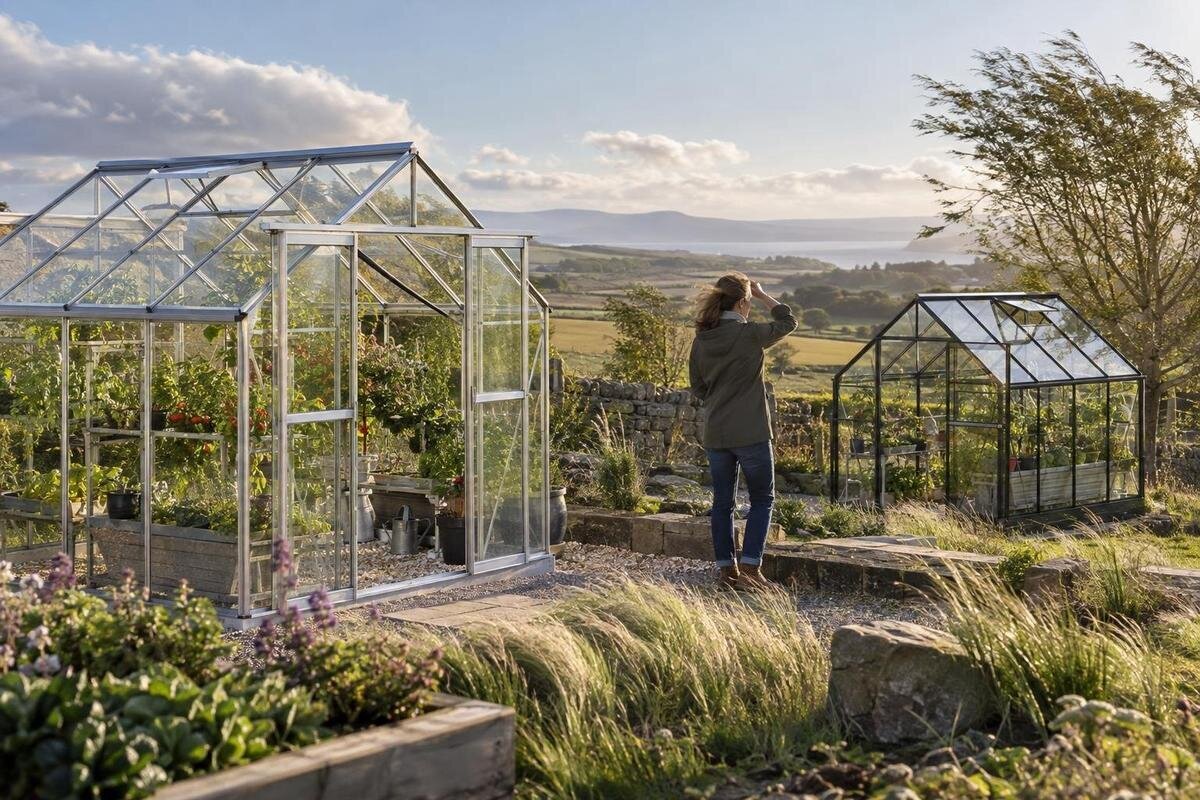
Buying a greenhouse for a windy garden starts with the plot, not a material label. Wind exposure can vary across a single garden, while a greenhouse’s performance depends on the exact frame, glazing, connections, base and installation conditions. Map where gusts reach, compare candidate positions, and then match product documentation to the prepared ground. The aim is not to guess which shape looks strongest; it is to find out whether the specified greenhouse and its fixing requirements suit the site. The checks below help you separate visible site issues from questions that need a supplier or qualified professional to answer.

Map wind exposure across the garden
Start by observing the actual greenhouse footprint, not just the garden as a whole. Wind can arrive across an open boundary, pass through a gap between buildings or be redirected by a slope, fence or line of trees. The sheltered feeling beside the house may not describe conditions at the far end of the plot. On several windy days, note the direction, where gusts strengthen or ease, and whether branches or lightweight garden items move differently at candidate positions. A forecast can help you record broad conditions, but it cannot show every local effect. Treat one calm visit as a poor basis for choosing a permanent site.
Draw a simple site plan and mark open boundaries, buildings, fences, tree lines, changes of level and possible greenhouse positions. Check it against more than one wind direction: the same fence may shelter one position in one condition and offer little protection in another. Note narrow gaps between structures, where airflow may be concentrated, and trees that could change the screening they provide as they grow or lose leaves. Record the intended entrance as well as the footprint, so you assess the place you will actually use. If the site is particularly exposed, request model-specific wind information and consider site-specific advice from a suitably qualified professional rather than relying on a broad phrase such as “storm-proof”. Take photographs from each proposed position after noting the wind direction, including the boundaries and gaps that influence it. They provide a useful record when you compare dimensions and installation clearances later, or when you need to explain the setting to a supplier or installer. Distinguish between a site that is generally breezy and one that receives abrupt gusts from a particular direction; this may be especially relevant to doors, vents and exposed corners. Revisit the plan after a substantial garden change, such as removing a hedge or building a new fence, because airflow around the proposed structure may change.
Assess shelter from walls, fences and trees
Nearby walls, fences and hedges can reduce direct exposure, but their effect depends on height, gaps, distance and wind direction. A position tight behind an obstacle is not automatically the calmest: air may be redirected around an end or corner, and a gap between structures can channel it. A hedge that looks dense at one time of year may offer different screening later. Treat shelter as a condition to assess, not as a feature that replaces the greenhouse’s own documented performance. Compare each possible footprint where the frame will stand, rather than judging it from the path or a sheltered spot elsewhere in the garden.
Balance any shelter with safe clearance and practical access. Avoid a position where an unstable tree or overhanging branch could fall onto the structure, and check whether nearby buildings or fences leave room to assemble, inspect and maintain it. Consider where rainwater, leaves or other garden debris may collect, and whether you can reach the greenhouse without squeezing through a narrow passage. A location that is easy to approach may be preferable to one that appears more sheltered but is awkward to use or maintain. If two positions seem similar, compare their exposure and access on your site plan instead of choosing by appearance alone.
Check ground conditions and base requirements
Before settling on a footprint, check whether the ground can provide the firm, level support required by the particular greenhouse. Soft, uneven or waterlogged ground may call for preparation, and drainage can vary across a garden even over a short distance. Look for places where water regularly sits, changes in level, or existing paving that may not match the product’s installation requirements. Measure the space available for the full external footprint and allow for access around it; interior growing space is not the same as the area needed to position and support the structure. Check for buried services, drains or irrigation runs before choosing a position, as these may affect where site preparation is practical. Also consider whether water run-off from nearby roofs or hard surfaces crosses the proposed footprint. These observations do not determine a foundation design, but they help you identify questions to resolve before committing to a location.
Read the base and foundation instructions for the exact model before ordering materials or arranging site work. Find out whether a base is included, optional or required, and whether it has to be attached to a particular type of support. A name such as Prestige greenhouse with metal base is not enough to tell you whether the base replaces a foundation, how it is fixed or what wind conditions apply. Check those details in the product documentation, and ask the supplier or a qualified installer about any mismatch between the instructions and your ground. Do not assume that a base label alone establishes suitability for a windy site.
Compare frame construction and wind information
A frame material is only one part of a greenhouse’s construction. Compare the details supplied for the exact model: frame profiles, joints, connection points, bracing and the fasteners used to assemble it. These details help you understand what the specification actually covers; photographs or a general material description cannot establish how the complete frame performs in wind. Look for model-specific wind-resistance information and check whether it describes the full assembled structure or only a component. If no clear information is published, ask the supplier what evidence is available before deciding.
The label on a product such as the Aluminium Classic greenhouse identifies a model, but the word “aluminium” alone does not tell you the frame dimensions, joint design or wind performance. Avoid comparing candidates by the apparent thickness of a frame in an image. Instead, set their published construction details side by side and ask what installation conditions the wind information assumes. If a rating or other performance statement is provided, check which model and configuration it applies to, and whether it assumes particular fixing or site conditions. Do not assume that a figure for one greenhouse transfers to another in the same material.

Check glazing and panel retention
The glazing specification matters alongside the frame. Find out what type of glazing the exact model uses, and how its panels are held in place: the listing or supporting documents may describe clips, channels, seals or other retention details. Wind acts on the whole greenhouse, including panel edges and their connections to the frame, so a glazing description by itself does not confirm how securely a panel is retained. If the product information gives a wind figure, check whether it applies with the specified glazing fitted and secured as instructed. Ask whether the supplied information distinguishes between standard glazing, optional glazing and any alternative panel system. A comparison is meaningful only when the models are configured alike. Keep copies of the relevant documents, including any revisions, so that a later query about parts or installation refers to the version you selected.
Ask how damaged glazing or retaining parts can be identified and replaced, and whether the manufacturer provides guidance for operating the greenhouse in windy conditions. A panel’s material or thickness alone is not a complete comparison; the fixing method and the tested or stated configuration also matter. For a candidate such as Classic Plus 385, consult the details for that exact model rather than reading performance into the number in its name. If the glazing type, retention method or wind assumptions are not clear, make those unanswered points part of your buying decision rather than filling them in from another model’s description.
Confirm how the greenhouse is anchored
Check how the frame is intended to connect to its base and how that base is intended to be supported. The documentation should identify the relevant fixing points and explain what components are included or need to be supplied separately. Do not assume that one anchoring approach will suit paving, concrete, compacted ground and softer soil alike. The ground, base and frame have to be considered together; a well-described frame does not answer questions about its connection to the site. If the instructions do not match the surface you have, ask the supplier or a suitably qualified installer for advice before ordering.
A name such as pyramid greenhouse for masonry bases should prompt you to check the exact model’s installation requirements, not to assume that any existing wall, plinth or paved area is suitable. Confirm what support the product documentation calls for, how the greenhouse is fixed to it and whether those details depend on the condition of the underlying ground. Ask which parts are included and which are not, so there is no gap between the structure you buy and the installation you plan. If the site needs a base or foundation designed for its particular conditions, leave that decision to a competent professional rather than improvising from a product name.
Compare freestanding and wall-adjacent positions
A freestanding greenhouse is exposed around its perimeter, while a wall-adjacent or lean-to position has a nearby surface that may alter the airflow. Neither arrangement is automatically safer. A wall can reduce direct exposure from one direction, but wind may also be redirected around its corners or through gaps nearby. Assess the proposed position and the relevant wind directions instead of treating a wall as a shield in every condition. Also check whether the position leaves enough room for access, assembly and maintenance without putting the structure in a narrow passage.
A product name such as aluminium lean-to greenhouse identifies a format, not a guarantee of wind protection or compatibility with your wall. Read the installation information to establish what the model requires at the wall and roof junction, and whether the proposed supporting surface and fixing arrangement are addressed. If there is any doubt about the wall’s suitability or the connection, ask a qualified professional to assess it. Compare a lean-to with a freestanding option on the same basis: site exposure, complete product specification, support requirements and the space you will need to use it.
Plan access, doors and ventilation
Check how you will enter, move around and tend the greenhouse in the position you have chosen. The product information should make clear which doors and vents are included, where they are located and how they operate. In an exposed position, an open door or vent can be affected by gusts, so ask what the manufacturer advises about operation and securing openings in windy weather. Do not assume that a greenhouse’s general description tells you how its openings are arranged or what clearance they need.
Allow space for the entrance to be used without obstruction and for you to reach components that need routine attention. A model name such as wall-based T-model greenhouse orangery does not establish its exact opening layout; check the individual listing and any installation or operating documents. Consider how the proposed position affects access from the garden and whether nearby walls, fences or stored items would restrict it. A site that works for the frame but makes the entrance difficult to use can become inconvenient in everyday conditions. Include this practical check alongside wind exposure, not as an afterthought. Think about the route for carrying plants, compost and tools to the door, particularly when the surrounding ground is wet or gusty. A clear route also makes it easier to inspect the exterior without leaning on the greenhouse or moving stored items each time.

Check maintenance and replacement information
Exposure to wind makes it sensible to understand what maintenance the manufacturer recommends and how to obtain the instructions for your exact model. Ask what the documentation says about checking visible connections, glazing retention and other components, and follow its guidance rather than adjusting structural parts without advice. Find out whether replacement glazing, seals or fixings can be identified by model or part reference. Keeping the product information and installation instructions together will help you refer to the correct configuration later, especially if the range includes similar-looking options.
Apply the same questions to every candidate, including a listing such as the limited-edition aluminium greenhouse. The wording of a product name does not tell you how long any replacement part will be available, which items can be replaced individually or what maintenance is required. Check the product information and ask the supplier about any details that matter to your plans. This is particularly useful if you expect the greenhouse to remain in use for years: ongoing upkeep and the ability to identify the correct components are part of a considered purchase, not separate from it.
Compare the full specification before ordering
Create a shortlist that records the site conditions beside each exact model’s published details. Include the intended position, exposure, available footprint and ground type, then compare frame construction, glazing retention, wind information, base requirements and anchoring. Mark what is confirmed and what still needs an answer. This makes it easier to compare like with like and prevents a broad category name from standing in for a technical detail. If you receive an answer from a supplier, note which model and configuration it refers to; specifications for a different greenhouse may not apply. Include the date and source of each document, since a product range or its installation guidance may be revised. This record also avoids confusion where a page presents options whose requirements differ.
A product page such as the Orangerie greenhouse can be considered alongside other candidates, but the name alone does not establish its size, performance or suitability for your site. Before placing an order, confirm the exact model and configuration, what components are included, and which base or fixings need separate arrangements. Check that the proposed installation can be completed in the space available and that the site-specific questions have clear answers. If an important point about wind performance or anchoring remains unresolved, pause rather than relying on appearance or assumption.
Frequently asked questions
Can a hedge make a greenhouse safe in a windy garden?
A hedge may reduce direct exposure, but its effect depends on its height, gaps, distance and the wind direction. Air can still be redirected around its ends. Treat planting as one part of the site assessment, not a substitute for checking the greenhouse’s specifications.
Is an aluminium greenhouse automatically better in strong winds?
No. A material name alone does not describe frame profiles, connections, bracing, glazing retention or anchoring. Compare the complete, model-specific construction details and any documented wind information, rather than using the frame material as a shortcut.
What wind rating should I look for?
Ask the supplier for wind-resistance information for the exact model and the conditions it assumes, including installation and glazing details. If the information is unclear or your site is unusually exposed, request further guidance before ordering; do not rely on a broad marketing phrase.
Can a metal base be used as the foundation?
Not necessarily. A base may be one part of an installation, but its name does not establish that it replaces a foundation or provides suitable anchoring for your ground. Check the model’s instructions and confirm what support and fixings are required.
Is a lean-to greenhouse safer than a freestanding one?
There is no universal answer. A wall may reduce direct exposure in one position, while its corners or nearby gaps may redirect airflow. The wall and connection also need to suit the installation. Compare the actual site and model documentation.
There is no single greenhouse shape or frame material that is automatically right for every windy garden. A considered choice brings the site assessment together with model-specific information on the complete frame, glazing, base and anchoring. When those requirements make sense for the proposed position and ground, you can compare candidates on evidence rather than appearance. Where an important specification or installation condition is unclear, get that point resolved before you order.
