
Buying a Greenhouse for Snowy Winters: Questions About Structural Loads
Greenhouse buying advice
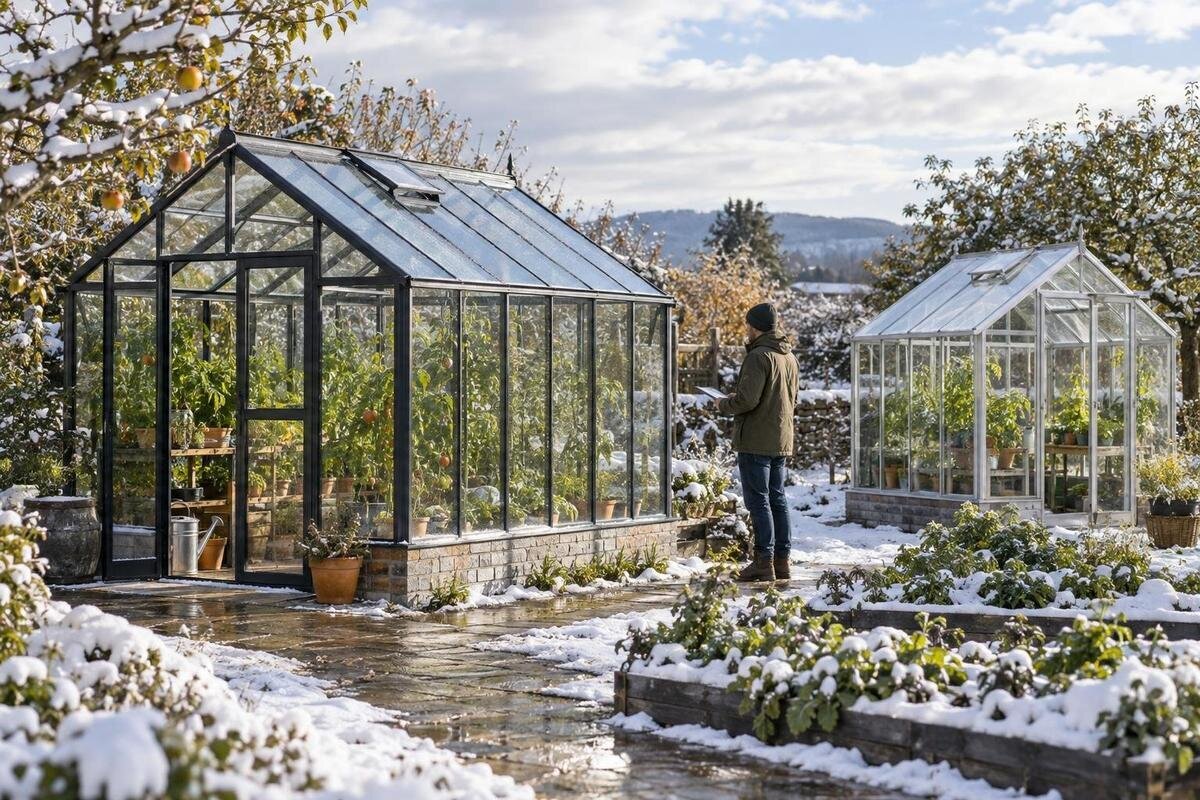
Buying a greenhouse for snowy winters means putting structural loads on the checklist before choosing a model. Ask for snow-load information in writing, then find out which parts, configuration and conditions it covers. A figure is useful only when it can be compared on a like-for-like basis and related to the intended site. The questions below help you separate documented capacity from a general winter claim and show when a qualified professional should review the details.

Before you buy 1
What a snow-load rating needs to specify
A snow-load rating is meaningful only when it identifies the assembly and loading condition it covers. Ask for the exact greenhouse model and size, the part or complete structure being rated, the units, and whether the figure describes a roof load or another value. A description such as winter-ready, robust or designed for year-round use does not explain how much snow the greenhouse can support. Nor can you compare two figures if one lacks a unit or scope. Ask whether optional parts, glazing variants or base choices change the rated assembly, and request written technical information rather than relying on a brief marketing phrase.
Find out whether the figure is a design value, a test result or indicative guidance, which conditions it assumes, and which document revision it refers to. Similar terms can describe different measures, so a number needs context before it supports a purchase decision. If a brochure describes a whole product family, ask which size and version it covers; do not assume every item shares the same rating. You are not being asked to interpret engineering calculations yourself. A clear document lets a qualified professional consider whether its assumptions match your intended installation. Keep the document’s date and revision with your notes, and ask whether it applies to the item you plan to order.
Ask what the rating includes
Snow load has a route through the structure. It reaches the roof panels or glazing and supporting members, passes through joints and fixings, then goes into the frame, base and supporting ground or structure. A rating for one component cannot automatically describe the assembled greenhouse, and a roof capacity does not confirm that the support beneath it is suitable. The weakest or excluded part may set the limit, so ask whether the figure covers the complete supplied structure in its installed form or named components only. Request a clear list of included and excluded parts, with support, foundation and anchoring assumptions.
If Bloomcabin Prestige greenhouse with metal base is on your shortlist, its name identifies the model but does not establish a snow rating. Ask for any structural information tied to the exact version and whether its scope includes the base named in the listing, the frame-to-base connections and the support beneath them. If the base or foundation is outside the assessment, resolve that separately before ordering. Ask who provides any excluded component and who confirms its suitability. Apply the same questions to every candidate; otherwise, a figure for a bare frame could be compared with one for a complete assembly. Record each rating’s boundaries beside the model.
Before you buy 2
Understand the units and load conditions
Figures are not always expressed in the same way. A value per unit of area describes something different from a total load, and neither can be interpreted without knowing where that load acts and how it is distributed. Even two figures using the same unit may refer to different arrangements, such as a load spread across a roof or concentrated in another way. Ask for the unit in full, the surface to which it applies and whether it is a roof rating or a ground snow value. Ask whether the area means the roof surface or another defined area; do not compare numerals or convert the rating into a guessed snow depth.
Ask how the rating addresses uneven accumulation and drifting, what snow conditions it assumes, and whether the figure is a design limit, a test outcome or guidance for a particular setup. Snow weight changes with moisture and compaction, so a generic depth chart cannot make unlike ratings equivalent. The Bloomcabin Orangerie can be identified by name in your notes, but its label alone says nothing about the meaning or scope of a load figure. Keep the supporting document beside the product entry and compare only after its conditions and coverage are clear. If the seller cannot explain a measure, ask for a written explanation rather than filling the gap yourself.
Allow for how snow can collect around the roof
Snow may collect unevenly rather than forming an even blanket across the roof. Roof shape and slope can influence whether it stays or slides; wind and nearby walls or taller structures can create local drifting. A roof that sheds snow may leave it piled against a wall, below a roof edge or beside a doorway, so shedding alone does not prove that the greenhouse can carry the load. A nearby roof edge can also change where a drift settles. On a site plan, note adjoining buildings, roof edges and places where snow might accumulate. Ask whether a stated rating assumes an even load and whether relevant uneven accumulation is addressed, rather than judging capacity from appearance.
The Classic Plus 385 is a product identity you can include in a comparison, but its name does not reveal roof geometry or snow performance. Request drawings and technical information for the exact configuration instead of inferring a rating from photographs. If a greenhouse would sit close to another structure, ask a qualified professional whether the surrounding layout changes the assumptions behind a general rating. Also consider where snow that leaves the roof would land, particularly if it could affect a path, entrance, lower roof or neighbouring structure. This is a site-planning question as well as a load question.

Before you buy 3
Match published figures to the intended site
Published figures need context because a greenhouse’s position can differ from a broad regional snow assumption. Elevation, exposure, topography, nearby buildings and a wall or roof that shelters one side may affect how snow accumulates. Shelter is not proof of lower loading; it can also change where snow drifts. Before comparing models, note the proposed position, what is above or alongside it, and whether the ground or building support is unusual. A simple site sketch can help you describe those surroundings. Use that information when asking whether a stated rating is relevant, rather than assuming one general figure fits every garden.
If you are considering the wall-mounted T-model greenhouse, ask whether any published snow information applies to the wall-adjacent arrangement you intend to buy. Clarify whether the rating concerns an open setting or takes account of the roof-to-wall junction, surrounding structure and specified support. The product name alone cannot answer that, and a rating for a different layout should not be transferred without confirmation. A qualified local structural professional can review conditions that are hard to represent in a product document, such as a likely drift or unusual exposure, before you commit to a model.
Include the base and anchoring in the load path
The base and anchoring belong in the structural discussion, even if they appear as separate purchase items. Loads travel through the greenhouse supports into a base and then into the ground or supporting structure. Ask what levelness, support spacing, fixings and foundation the supplier assumes; find out which items are included in the rating and which must be assessed separately. A substantial-looking base cannot correct a mismatch in the support beneath it, while a frame rating alone does not confirm the complete installed arrangement. Do not design or alter a foundation from a product photograph; refer that question to a qualified professional.
The name pyramid greenhouse for masonry bases identifies a listing, but it does not say what the masonry base must be or whether that base is part of any structural assessment. Ask whether a published rating assumes a particular base and connection, and who confirms the existing support is suitable. If you plan a new base or an adaptation, share the product documents and site details with a qualified professional before ordering. Do not assume masonry increases roof-load capacity; the relevant question is how the complete load path is supported. Confirm whether requirements change with the selected size or configuration.
Before you buy 4
Check the frame and glazing configuration
Structural performance can depend on the exact frame, joints, glazing bars and roof panels specified for a model. A change in size, panel type, bracing or optional component may create an assembly different from the one covered by the rating. Ask for a document that identifies both the model and the version you are buying, and whether accessories or later replacement parts affect the stated scope. Do not infer snow capacity from a material name, the appearance of a panel or the fact that another size has a published figure. The evidence needs to match the chosen configuration.
For example, the Aluminium Classic greenhouse label tells you which listing you are viewing, not how its frame or glazing is rated. Compare written load information and the included-parts details, rather than treating a material name as a shortcut for strength. If a technical sheet refers to a frame but does not say whether roof panels, joints and fixings are covered, ask what remains outside its scope. Keep the selected variant and document together; if a response refers to another configuration, ask the seller to confirm whether it applies to the version on your order.
Confirm the rating before ordering
Before ordering, have the seller identify the precise item, selected size, glazing and accessories covered by the load information. Product families can include different configurations; even similar names do not make their ratings interchangeable. Ask for the relevant technical or assembly document, any limits on modifications, and which components or site preparations are outside the supply. Save the response with your purchase notes so you can refer to the same assumptions during installation planning or when a professional reviews the site. If the order changes after the confirmation, ask whether the information still applies.
If you are considering the Aluminium lean-to greenhouse, request information for the exact wall-adjacent arrangement you plan to buy, rather than assuming a value for another format applies. Clarify what the rating assumes about the building beside it, the connection and the support; the product name does not answer these points. If no model-specific document is available, ask the seller to state in writing what they can confirm and what remains unassessed. A clear response can be compared with other candidates; a general reassurance cannot establish the rating’s scope.
Before you buy 5
Separate snow capacity from other winter claims
A snow-load figure is one part of a winter purchase decision, not a complete statement about durability or safe use. It does not automatically cover wind, impact, drainage or every other structural condition. Ask which issues are addressed separately and whether snow affects the use of vents, doors or other movable parts. Do not treat snow clearing as a replacement for a suitable, documented rating. If the supplier expects snow management to be part of care, request clear instructions on when and how it should be done, including limitations; do not improvise work on a roof or put yourself at risk.
The Limited Edition aluminium greenhouse is a name, not evidence of winter capacity. Ask for model-specific snow information and a clear account of what it excludes, then read that beside any maintenance or snow-removal guidance. If a seller says a greenhouse is intended for year-round use but provides no snow-load basis, treat those as separate statements; one does not substantiate the other. Where likely accumulation is heavy, uneven or difficult to assess, ask a qualified structural professional to review the site before choosing rather than assuming the document covers it.
Use clear answers to compare your shortlist
Use the same comparison columns for every candidate: exact model and configuration; stated load and units; roof or assembly covered; distribution and conditions assumed; document source and revision; base and anchoring assumptions; and exclusions. Mark missing details as not supplied instead of filling them from the model title or another greenhouse’s sheet. Ask each seller the same questions in the same order. That makes gaps visible and prevents a whole-structure rating being set beside a component-only figure. A higher number is not automatically the better choice when scope or conditions differ.
Then compare each documented assumption with the intended site. A clear, applicable rating gives a more useful basis for selection, but it does not replace a site-specific assessment where exposure, drifting, elevation or uncertain support raises questions. If the seller cannot confirm a rating, decide whether to seek independent advice rather than treating missing information as either high or low capacity. The purchase decision is about the fit between evidence, configuration and site, not the boldest number or the most substantial-looking greenhouse. Leave unresolved assumptions visible before you commit.
Frequently asked questions
Is a snow-load rating the same as a maximum snow depth?
Not by itself. A snow-load rating states a load under defined conditions; depth alone does not show the weight of snow on a roof. Moisture and compaction affect snow, while roof shape and accumulation patterns affect how it reaches the structure. Ask for the rating’s units and assumptions, and do not use a generic depth chart to decide whether a particular model is suitable.
Can I compare two ratings if they use the same units?
Only after checking their scope and assumptions. One figure may cover a component while another describes an assembled greenhouse; the models, load distribution or design basis may differ too. Matching units are useful, but not enough. Ask which exact configuration each figure applies to and compare documents that describe the same kind of load.
Does a sloping roof remove the need for a snow rating?
No. Snow may remain on a roof or slide off and collect elsewhere. Slope alone does not establish structural capacity or show where drifting will occur. Ask whether the rating applies to the particular roof design, and include nearby walls, buildings and roof edges in a site review by a qualified professional.
Does a rating include the greenhouse base and foundation?
Only if the documentation says so. A rating might cover the greenhouse assembly but leave its base, anchoring or supporting foundation outside the assessment. Ask what the supplier assumes about each part and who confirms the site support. Do not treat a base’s product name or appearance as evidence that the complete installed structure is covered.
Can I rely on clearing snow instead of checking the rating?
No. Snow-management instructions may form part of care, but they are not a substitute for knowing what the structure is rated to carry. Ask whether clearing is expected, what method and timing are specified, and what limitations apply. Do not improvise a procedure or put yourself at risk; seek safe instructions for the actual model.
Buying for winter is less about finding the largest headline number than knowing exactly what has been rated and under which conditions. Put the model-specific document beside the site details, note any assumptions about the base and surrounding structures, and leave unsupported claims out of the comparison. When those assumptions cannot be matched confidently, a qualified professional can help assess them before the order is placed. That is a firmer basis for choosing a greenhouse than its name, appearance or a promise of general winter use.
