
Buying a Small Greenhouse for a Compact Garden
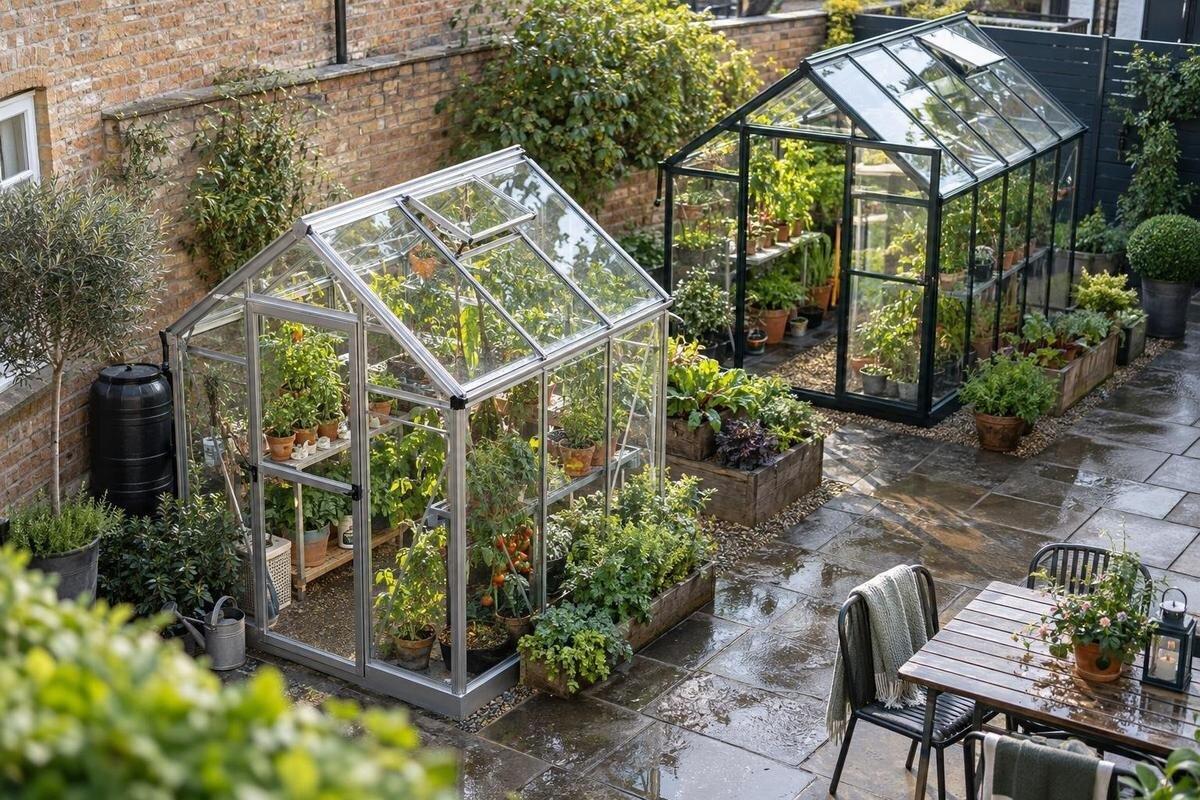
Greenhouse buying guide
Buying a small greenhouse for a compact garden is a balancing exercise: the structure must fit without making the rest of the garden awkward to use, while still providing the growing room you want. “Small” is not a reliable measurement, so begin with the space you can give up and the plants or tasks you want it to support. Map the site, include access around the door, then compare actual dimensions, internal layout, base requirements and delivery route. A product name or photograph cannot confirm that a greenhouse will fit your plot.

Decide how much garden the greenhouse can use
Begin by defining what “compact” means on your own plot. A small garden may still have a sunny corner, or it may have little spare ground after paths, seating, bins and established beds are accounted for. Mark the area you are genuinely willing to allocate to a greenhouse instead of treating every bare patch as available. Note fixed features such as walls, fences, steps, drains and trees, along with anything you need to reach or keep clear. Include the positions of gates and any existing route through the garden. This gives you a usable site boundary and stops an appealing catalogue footprint from quietly taking over another part of the space.
Then decide what the greenhouse is for. A few seed trays, tender plants, seasonal crops and a collection of larger pots each place different demands on floor area and height. Write down the plants or tasks that matter most, how many containers you expect to use, and whether you want room to work inside or only to reach in from the doorway. Note whether you need to move plants in and out as the seasons change. If the site cannot serve every wish, rank them. That priority list helps you judge whether a smaller interior would still be worthwhile, rather than choosing by the word “small” alone.
Check the full outside footprint
Treat the greenhouse footprint as the complete shape it occupies, not merely the number quoted for its floor. Check whether the published width and length refer to the outside frame, a base, or some other measuring points; if unclear, ask for a dimensioned drawing before ordering. Measure the narrowest part of the proposed site if fences or walls are not parallel, rather than relying on an average. Allow for any projections shown in the specification and for the practical space needed to approach and maintain it. A model whose stated length fits exactly between a fence and path may still leave no workable route to the door. Sketch the outline to scale, including nearby boundaries, before you shortlist.
Check dimensions for each named version, not for a similar photograph or an item with a related title. Classic Plus 385 can be included as a candidate in your comparison, but the number in a model name is not proof of its length, width or growing area. Record the stated height as well as the base dimensions; where both eaves and ridge heights are given, note which matters for your intended plants and surroundings. A low roof can limit what you grow or how you move inside, while overall height may matter under branches or an overhang. Keep the product-page dimensions beside your site measurements rather than relying on memory.
Plan the growing layout inside
An outside footprint does not tell you how much planting space remains once you are inside. Draw an interior plan with the plants, pots, trays or shelves you expect to use. Decide whether you need a central path, one working edge or access from the doorway only; each choice affects how much growing area you can actually use. A crowded plan can make watering, tying in plants and lifting containers awkward. Give the tasks you do regularly enough room to happen without shifting everything else, and avoid counting narrow leftover gaps as useful capacity. If you expect to bring in a chair or storage box, sketch that too rather than adding it after you choose.
Consider plant height and the shape of the growing area, not just the number of pots it might hold. Tall plants may need clear space above them; trays and low containers use a different portion of the floor. Leave room to reach leaves and check plants from more than one side where your layout requires it. Put each candidate beside the plan: Bloomcabin Orangerie can be added to the same comparison, but its name alone does not state its internal dimensions or usable layout. Use the product details to assess whether your planned rows, shelves and walking space can coexist, then redraw the plan if a feature changes the balance.
Make room for the entrance and everyday access
In a compact garden, the approach can matter almost as much as the greenhouse itself. Check where the entrance sits and how it opens, then mark the full area needed to use it. A hinged door may need room to swing; any alternative opening still needs a clear route and a place to stand while carrying a tray or pot. Confirm the stated opening and threshold details instead of assuming them from a photograph. Make sure the entrance will not clash with a fence, wall, raised bed or the route you use to move around the garden. If the door opens onto a narrow path, test whether you can still pass when it is in use.
Think beyond the first step through the door. You may need to carry compost, watering cans, tools or harvested plants in and out, and you may want to kneel or turn without blocking the route. If there is a narrower gate or passage between the delivery point and the site, check whether all parts can be moved along it; the greenhouse dimensions alone do not answer that. A listing such as the wall-based T-model greenhouse should still be assessed against its published access details and a measured path. The title is not a dimensioned plan showing where an entrance or clearances fall. When comparing two shapes, check whether their opening position leaves the same clear working area.

Choose a position that supports light and practical use
Record the light at the proposed position at different points of the day, and think about how it changes as nearby trees grow or lose leaves. Buildings, fences and hedges can cast shade that is not obvious from a quick look at midday. Match the likely light to the crops you actually want to grow, rather than assuming any open patch will work equally well. A short site sketch showing the direction of shade and the nearby obstructions can help you compare two possible positions without making a permanent commitment. If there are two plausible spots, observe them separately rather than using the brighter one as a proxy for both.
Consider wind exposure, surface water and access for cleaning or repairs as part of the same placement decision. A sheltered corner may be convenient but darker or harder to reach; an open patch may give better light yet require the manufacturer’s specified fixing arrangements to be checked. Also look at how rainwater moves across the ground, without assuming that a greenhouse or a nearby wall will change it in a predictable way. Do not infer that a wall provides enough warmth or that a fence makes a site adequately protected. Where the support, fixing or exposure requirements are unclear, get advice from the manufacturer or a suitably qualified installer before committing to the position.
Compare freestanding and wall-adjacent layouts
A wall-adjacent greenhouse can be worth comparing when open ground is limited, but it does not make the footprint disappear. It still needs its own ground area, a usable entrance and enough access for the tasks you plan to do. Check whether the proposed wall reduces light at the times that matter, and whether rooflines, windows, pipes or existing fittings affect the position. The wall also has to meet the product’s stated requirements; do not assume that any convenient boundary is suitable simply because a greenhouse is described as leaning against a building. Note which sides would remain accessible for maintenance and plant care before you decide.
Compare the actual outline and access needs of this format with a freestanding design on the same garden sketch. aluminium lean-to greenhouse is one named option to review, but “lean-to” in a title does not establish the dimensions, how it must be supported or what the wall needs to provide. Check the manufacturer’s written installation information and consider whether you can reach the outside, clean the panels and tend plants without squeezing through an unusable gap. A wall-adjacent format may solve one space problem while creating another, so judge the complete arrangement rather than its label. Compare the amount of unobstructed growing room as well as the external width.
Confirm the base and ground requirements
Before selecting a model, find out what it needs to stand on and which parts are part of the order. A greenhouse base, a supporting surface and a foundation are not interchangeable terms: the product information should define what is supplied and what must already be prepared. Check the required dimensions and surface conditions against the manufacturer’s instructions, not from a photograph or an assumed standard. If the site needs building work or the requirements are unclear, ask a qualified installer to assess it. This is especially important where a small, uneven or sloping area leaves little margin for adjustment. A mismatch may also affect how the entrance lines up with the route you have planned.
Read the item description carefully if the model name refers to a base. For example, Prestige greenhouse with metal base should prompt you to confirm the exact package contents, compatibility and preparation requirements; the name alone does not establish whether the base is included in the option you are ordering. Check whether relevant parts are selected separately, and whether their dimensions correspond to the version you plan to buy. Reserve enough of the garden plan for the prepared base as well as for access around the greenhouse. Sorting this out before purchase helps avoid choosing a structure that fits the sketch but not the surface it is meant to stand on.
Check what the product listing actually specifies
Once a candidate fits the site, compare the details that affect how you will use it. Look for the stated glazing or panel type, frame material, ventilation arrangements, door details and included fittings, where these are specified in the product information. Do not assume that two models with similar names or photographs share the same construction or accessories. Note which details are explicit and which remain unanswered; if a feature matters to your growing plan, confirm it for the exact model and selected configuration. This is a practical way to separate useful specifications from broad wording in a product title. Check whether options shown in images are included or separately listed.
Base descriptions deserve particular care. A listing titled pyramid greenhouse for masonry bases identifies a model by name, but it is not a plan for the masonry, a statement of dimensions or confirmation of what comes with the order. Check the exact base interface and preparation details in the written product information, and seek competent professional advice where site work is involved. For any greenhouse, compare stated dimensions, included components and options on the same version of the page. Keep a note of any unanswered point so the choice rests on confirmed details, not an assumption prompted by a product label.

Plan delivery and assembly before ordering
A greenhouse that fits the garden may still be difficult to bring to its final position. Measure the route from the delivery point to the site, including gates, turns and any narrow passage, and compare those clearances with the product’s stated package or component details when available. Check what delivery arrangements the seller lists and whether unloading or movement to the garden is included; do not assume that delivery to an address means delivery to the prepared site. If a route or handling requirement is unclear, ask before placing the order. Also make sure there is somewhere practical to put packages without blocking an entrance or path.
Allow space to assemble the greenhouse and to store parts safely while work is under way. Review the assembly information for the exact model and identify whether you plan to do the work yourself or arrange help from a competent installer; do not assume every item has identical assembly demands. Confirm the exact model and options in your order, including any base or accessories selected separately. A name such as limited-edition aluminium greenhouse does not tell you which version, package or parts you will receive, so use the details on the actual listing and order confirmation. Planning the route and assembly area in advance can prevent the garden layout from becoming the last-minute obstacle.
Choose the model that fits the whole plan
Make a shortlist of two or three candidates and compare them against the same questions: do the stated outside dimensions fit, can you use the entrance, does the internal layout serve your planting priorities, and are the base and site requirements clear? Add only facts from the relevant product page or written confirmation. Separate fixed requirements from preferences, such as an extra shelf or a particular appearance, so that a feature you like does not outweigh a problem with access or usable room. A simple side-by-side note is more reliable than trying to remember differences between pages. If one candidate fails an essential requirement, remove it rather than giving its attractive points extra weight.
Check that the price you are comparing covers the same things, including any separately listed base, accessories, delivery or assembly costs that apply to your chosen option. This is not a reason to choose a cheaper package automatically: an omitted component can change the practical cost, while paying for an unused feature can waste a limited budget. A listing such as aluminium classic greenhouse belongs in the same comparison only on its stated details; do not infer finish, panel type or upkeep from the product name. Recheck the exact configuration before ordering if a change to it would affect your site plan. Keep the final comparison grounded in the version you would actually buy.
Frequently asked questions
What counts as a small greenhouse for a compact garden?
There is no single size that suits every compact garden. Work from the outside space you can spare, then check the interior layout against the plants and tasks you have in mind. A model only counts as a good fit if you can use its entrance and still move around the rest of the garden.
How much clearance do I need around a greenhouse door?
There is no universal clearance figure; it depends on the door arrangement and your route. Use the stated opening dimensions, allow the full swing if it opens outwards, and leave enough room to approach carrying items. Follow the product information for any access or maintenance clearance.
Is a lean-to greenhouse best for a small garden?
Not automatically. A wall-adjacent layout still occupies ground space and needs suitable light, access and support. Compare its complete footprint and use requirements with a freestanding option, and confirm that the wall and installation arrangement meet the manufacturer’s instructions.
Does a greenhouse include its base?
That varies by model and selected package. Read the exact listing for included components, base compatibility and the surface or preparation required; do not rely on a title or image to settle it. Ask the retailer for clarification and get professional advice if site work is needed.
What should I confirm before ordering a small greenhouse?
Confirm the dimensions of the exact version, door access, internal layout, stated panel and frame details, base requirements and included parts. Then check the route to the site, the seller’s delivery terms and any assembly arrangements that apply. Keep the written product details with your garden sketch.
A compact garden does not call for the smallest greenhouse available; it calls for one whose footprint, access and internal arrangement make sense together. Measure the site, plan the crops and movement you need, and use the published specifications to test the base, light, delivery route and included parts. If none of the candidates fits without blocking a path or sacrificing essential growing room, revise the layout or planting plan before buying. Space left for access is more useful than a greenhouse that fits only on paper.
