
Small Greenhouse Guide UK: Size, Layout, Placement & What to Grow | Bloomcabin
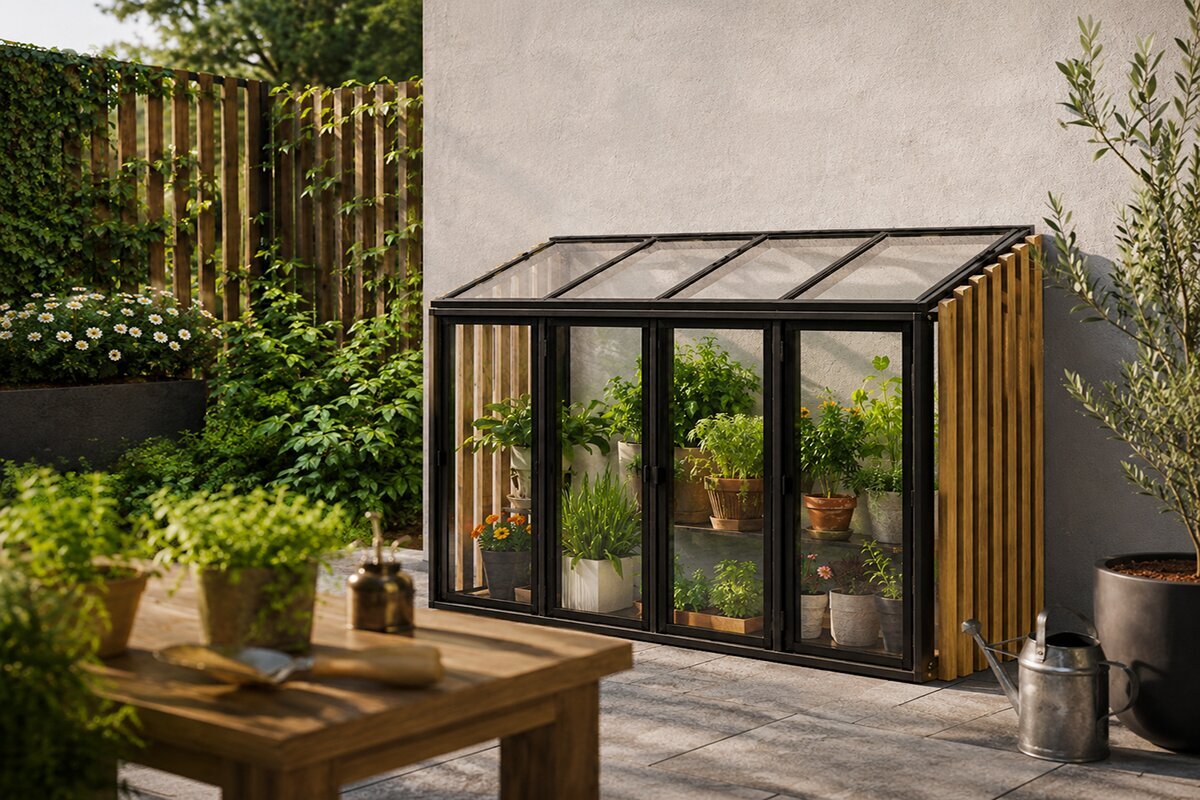
Why small can work brilliantly
The best small greenhouse makes an awkward part of the garden genuinely useful.
A narrow strip beside the house, a paved area near the kitchen or a sunny boundary wall can all support a compact greenhouse. On many British plots, these edge spaces are more realistic than giving up the centre of the lawn to a large freestanding structure.
Small greenhouse is a broad term. A mini wall greenhouse may be used mainly for propagation, herbs and compact containers. A lean-to greenhouse provides a real walk-in interior while staying close to a wall. A small freestanding greenhouse needs more clearance but offers the classic greenhouse experience and access from more than one direction.
Before comparing square metres, decide what the greenhouse must do. Raising seedlings in spring requires different shelving from growing full-height tomatoes and cucumbers all summer. A permanent potting bench, a chair or a collection of overwintered pots changes the internal plan again.
Convenience matters more in a small greenhouse than people expect. If the structure is close to the kitchen, water source and main garden route, short daily jobs become easy. A greenhouse at the far end of a wet lawn may be technically larger but less useful in ordinary life.
Three compact greenhouse types
Mini wall, lean-to or freestanding? Start with the shape of the available garden space.
01 / Smallest footprint
Mini wall greenhouse
A strong option for patios, side returns and tiny gardens where vertical shelving matters more than walk-in floor area.
02 / Compact walk-in space
Lean-to greenhouse
Uses the line of a building or substantial wall and creates a proper working interior without occupying the middle of the garden.
03 / Independent garden feature
Small freestanding greenhouse
Works best where there is enough clearance around the structure and you want access, light and visual presence from several sides.
What counts as small?
The right size is the smallest greenhouse that still works when the plants are mature.
Empty floor area can be misleading. A door, aisle, staging and mature plants each claim space. Two greenhouses with similar outside dimensions may therefore feel completely different once they are in full summer use.
In a mini greenhouse, height is often more valuable than floor space. Multiple shelves can hold seed trays and herbs while larger containers remain lower down. This makes the same footprint work on several levels.
A walk-in greenhouse needs a route that remains usable with a watering can or tray in your hands. An aisle that is technically passable but constantly brushes leaves becomes frustrating very quickly.
Marking the footprint with string or masking tape is useful. Add the door line, shelving depth and likely plant positions, then physically walk through it. This is a much better test than looking at dimensions on a screen.
Plan around the mature crop, not the young plant bought in April. A single tomato or cucumber can occupy far more width by midsummer than expected.
Placement in a UK garden
Light matters, but so do drainage, wind, daily access and the relationship with the house.
Observe the proposed site at different times of day. Fences, sheds, extensions and neighbouring buildings can create long shadows that are not obvious at midday. Low spring and autumn sun can behave very differently from July.
A location near the house is often convenient for herbs and regularly harvested vegetables. Water, tools and kitchen access are close, making quick greenhouse visits more likely.
For a wall-mounted greenhouse, check downpipes, outside taps, lights, windows, vents and door openings. The structure should not block a building service or make future maintenance difficult.
British gardens can be wet for long periods. Do not place the greenhouse at the lowest point of a patio where runoff naturally collects. Roof water and surface water need an obvious route away.
Wind exposure varies dramatically between a sheltered urban garden, a coastal plot and a new-build estate on open ground. A less exposed position may be worth more than a marginal increase in sunlight.
Leave enough maintenance clearance to clean glazing, inspect gutters and reach the rear of the structure. A hedge or fence that sits too close can make a compact greenhouse awkward to maintain.
Design the inside first
A small greenhouse should change with the season instead of being filled permanently with furniture.
Spring propagation, summer tomatoes and autumn salads do not need the same layout. Removable staging and movable pots make the interior much more useful than fixed furniture on every wall.
The aim is to create one clear route and several growing zones that can expand or contract as crops mature.
Layout rule 01 Keep the main route obvious You should be able to carry a tray from the door to the back without moving pots first.
Layout rule 02 Use height deliberately Narrow shelving, hanging supports and trained crops can share the same footprint at different levels.
Layout rule 03 Keep one adaptable zone A removable shelf or open corner makes it easy to switch from propagation to taller summer crops.
Layout rule 04 Protect the ventilation path Plants and furniture should never block roof vents, doors or designed airflow openings.
What to grow
Choose crops by height, harvest value and how efficiently they use protected space.
Tomatoes suit small walk-in greenhouses because they can be trained vertically. Fewer well-spaced plants are usually more productive and easier to manage than an overcrowded row.
Cucumbers also use height efficiently, although their large leaves can shade smaller crops. Give them a defined trellis zone where growth can be controlled.
Herbs are ideal for mini wall greenhouses. Basil, parsley, coriander and other kitchen herbs use small containers and can be harvested frequently.
Lettuce, spinach and other leafy crops can use the cooler edges of the season before heat-loving plants dominate the greenhouse.
Peppers and aubergines can benefit from the protected environment in sunnier positions, especially in regions where outdoor summer warmth is less reliable.
Seedling production may be the highest-value use of a tiny greenhouse. Several shelf levels can hold many trays in spring, then the same shelves can be removed or repurposed later.
Tender container plants can gain protection through the shoulder seasons. Their true winter suitability depends on the temperatures the particular greenhouse experiences.
Seasonal rotation is more productive than trying to keep every space permanently occupied. One shelf can serve three completely different purposes between March and October.
Ventilation
Small greenhouses warm quickly because there is less air inside to buffer sudden sunshine.
A compact greenhouse can move from cool to hot surprisingly quickly on a bright day. That is useful in spring but can become a problem in June or July.
Roof vents, doors and any designed openings should remain clear even when plants are fully grown. A large tomato leaf can reduce airflow more than expected.
In a walk-in greenhouse, the door can be a major part of warm-weather ventilation. Keep the area around it free so it can open fully.
Automatic vent openers can make daily temperature management easier if they suit the greenhouse model and are installed correctly.
The aim is not maximum heat. Healthy conditions come from balancing warmth, air exchange, humidity and, where necessary, seasonal shading.
Glass or polycarbonate?
On a small UK plot, glazing affects both plant conditions and how the greenhouse looks from the house.
Clear glass keeps strong visual links with the garden and can make a compact greenhouse feel lighter beside a patio or kitchen window.
Polycarbonate behaves differently in appearance and light distribution. The best choice depends on the model, site, weather exposure and gardening priorities.
Because a small greenhouse is often close to living areas, aesthetics may matter more than they would for a purely functional structure hidden at the bottom of a large garden.
Glazing should be considered together with ventilation, frame, orientation, foundation and planting. No single material choice works independently from the rest of the design.
Small greenhouses around the UK
A coastal garden, London courtyard and northern exposed plot need different priorities.
South-west & coastal gardens Wind and driving rain make anchoring, sheltered placement and drainage especially important.
South-east & London Warm summer spells can heat a compact greenhouse quickly; ventilation and shading deserve high priority.
Midlands Mixed weather favours flexible layouts and good all-season access.
Northern England Cooler spring and autumn conditions can increase the value of protected growing, while wind and frost remain important.
Wales & western uplands Rainfall and exposure make foundation drainage and site choice particularly relevant.
Scotland Shorter seasons, wind and winter weather mean robust placement and realistic crop timing are essential.
Foundation & floor
A compact glass greenhouse still needs a serious, accurate base.
Small does not mean temporary. A glazed aluminium greenhouse performs best on a level, stable support that suits local soil, drainage, wind and frost conditions.
Existing paving is not automatically the structural foundation. The construction beneath the visible slabs matters.
On decking, the supporting frame below the boards must be considered. A wall greenhouse also needs a sensible relationship between its base, the house wall and rainwater flow.
The interior floor can be hard-surfaced, planted or arranged with containers. Each option changes maintenance and flexibility.
Whatever the floor choice, excess watering needs somewhere to go. Damp corners become inconvenient quickly in a small greenhouse.
Shelving without crowding
Vertical space is valuable until the shelves start stealing light and air from each other.
Deep staging around every wall can make a compact greenhouse darker and less flexible. Different shelf depths usually work better.
A narrow upper shelf can hold small pots while leaving usable space below for larger containers.
Removable shelving is especially useful during spring propagation and can disappear once tall summer crops need the height.
Do not block a vent with a storage box or permanent bench. In a small volume, one obstructed opening can noticeably affect airflow.
Keep enough access to clean glazing and the floor. Maximum storage is not the same as maximum usefulness.
Watering
Small greenhouses make hand watering easy — but also make overwatering easy to miss until the floor is wet.
Because every pot is nearby, hand watering can be very precise. Check soil moisture rather than watering everything automatically.
Upper shelves may dry faster than large pots on the floor. Sun-facing containers behave differently from shaded ones.
If drip irrigation is installed, route lines neatly around the edges rather than across the only walkway.
The advantage of a compact greenhouse is visibility: a wilted plant, leaking emitter or waterlogged pot can be noticed quickly.
Common mistakes
Most small-greenhouse problems start with trying to fit too many functions into one footprint.
1. Buying by outside size alone
Internal routes, door position and mature crops determine real usability.
2. Choosing the easiest but shadiest corner
A spare space is not automatically a good greenhouse location.
3. Filling every wall with staging
Too much fixed furniture reduces light and flexibility.
4. Underestimating mature plants
Summer growth can completely change the available aisle.
5. Treating the base as an afterthought
Glazing and doors rely on a stable, level foundation.
When should you choose a bigger greenhouse?
Size up when the aisle, plants and work surface can no longer coexist comfortably.
Several tomatoes, cucumbers and propagation shelves can quickly consume the smallest walk-in greenhouse.
If two people regularly garden together, extra aisle width is more useful than it first appears.
A permanent chair or potting bench changes the interior considerably because it also needs space around it.
A bigger greenhouse is worthwhile when it creates a cleaner layout, better airflow or more sensible plant spacing.
Compare mini wall, lean-to and compact freestanding models before deciding that the smallest footprint is automatically best.
Design & visibility
A small greenhouse often sits close to the house, so it becomes part of the everyday garden architecture.
Frame colour, glazing and base detail are visible from kitchen windows, patios and main garden routes.
Matching the greenhouse frame with doors, windows, railings or other metalwork can make the structure feel intentional.
A clean foundation edge or paving line improves the final appearance dramatically on a compact site.
A well-designed small greenhouse does not have to be hidden. It can become one of the elements that gives a modest garden structure and identity.
If mini becomes too small
The next step does not have to be a large freestanding greenhouse in the middle of the lawn.
A walk-in lean-to greenhouse is often the natural upgrade because it keeps using the edge of the property efficiently.
A longer wall or solid garden boundary can support more growing space without sacrificing the centre of the garden.
A small freestanding classic greenhouse works where there is enough clearance and an independent position is preferred.
The best progression is not simply small, medium, large; it is choosing the geometry that continues to suit the property.
Quick decision framework
Choose the greenhouse around the limitation in the garden that cannot be changed.
Almost no ground space? Prioritise a mini wall greenhouse and use vertical shelving.
A sunny wall is available? Compare lean-to and other wall greenhouse formats.
You want access from several sides? A compact freestanding greenhouse is more natural.
Mostly seedlings and herbs? Shelf capacity may be more valuable than walk-in floor space.
Tall crops and a potting bench? Choose enough width to keep a real aisle.
Greenhouse beside the patio? Treat colour, glazing and foundation as part of the garden design.
Bloomcabin United Kingdom / Compare models
From mini wall designs to compact walk-in greenhouses, the right size depends on the way your garden actually works.
These Bloomcabin UK pages help compare greenhouse types, layouts and larger alternatives.
Compact View greenhouse →
Wall-mounted Explore model →
Classic Compare aluminium greenhouse →
More space Open product details →
Design See another option →
Collection View greenhouse collection →
Alternative Check suitable model →
FAQ
Small greenhouse questions
What is a good size for a small greenhouse?
The smallest size that still allows mature plants, a practical route and adequate ventilation without constant rearranging.
Is a mini greenhouse worth it?
Yes, especially for seedlings, herbs and small-space gardening where a larger structure is unnecessary.
What can I grow in a small greenhouse?
Herbs, salads, seedlings, peppers and carefully managed vertical crops such as tomatoes and cucumbers.
Is a lean-to greenhouse good for a small garden?
Often yes, because it uses a boundary edge while creating a genuine walk-in growing space.
Do small greenhouses overheat quickly?
They can, because the air volume is limited. Ventilation and seasonal shading are important.
Should I add shelves?
Yes, but keep them flexible and clear of vents.
Where should a small greenhouse be placed?
In a bright, accessible and well-drained location with enough clearance for maintenance.
When should I choose a larger one?
When mature plants, work space and the main aisle cannot all function at the same time.
Small footprint / serious greenhouse
A small greenhouse works best when every square foot has a clear purpose.
Choose the site first, the gardening routine second and the greenhouse size third. That order creates a compact structure that feels deliberate rather than cramped.
View compact greenhouse Explore all greenhousesUnited Kingdom: General planning guidance only. Foundation, anchoring, wind, snow, setbacks, planning permission and local requirements vary by site and greenhouse model.
