
Disinfecting a Greenhouse After a Serious Plant Disease Outbreak
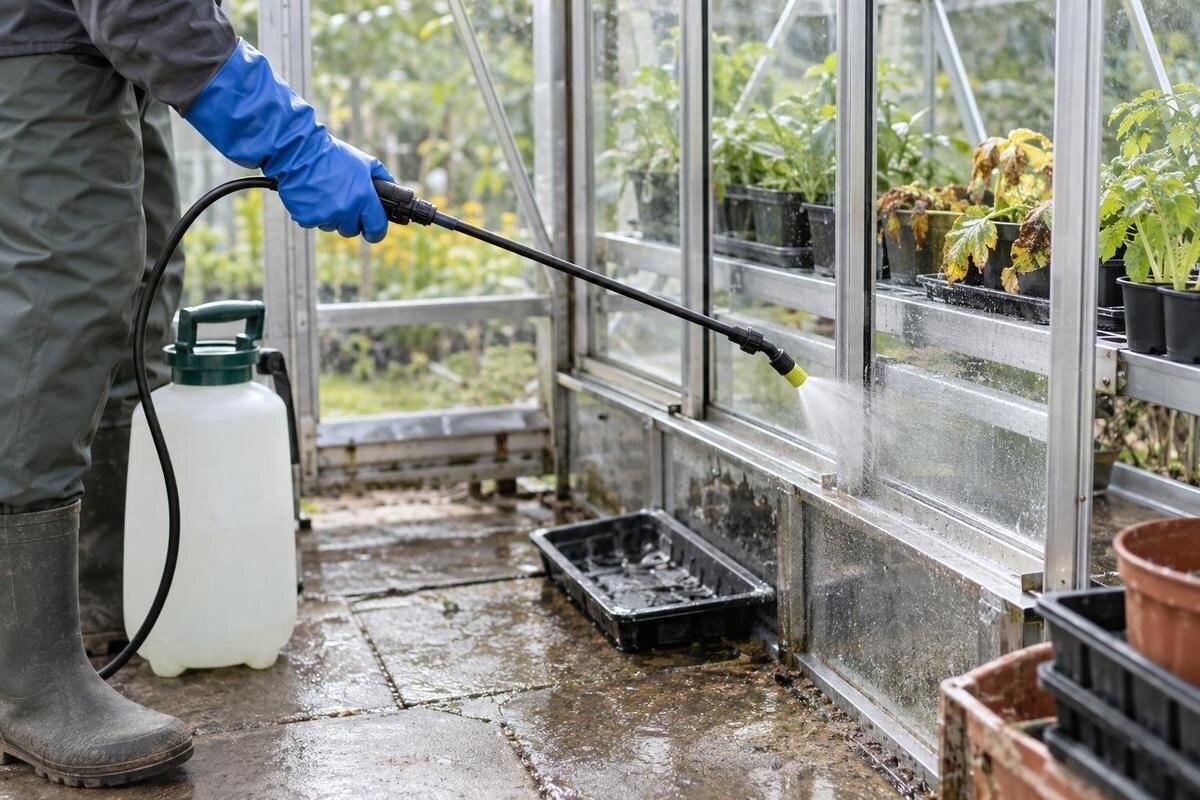
Greenhouse sanitation
A serious plant disease outbreak calls for more than washing down the greenhouse. The right cleanup depends on what caused the symptoms, where it persists, how it spreads, and which surfaces or equipment can be treated without damage. Visible cleanliness is not proof that a pathogen has been controlled. A sound recovery plan identifies the likely cause, limits movement, removes contaminated plant material, cleans away organic debris, and then uses only a compatible method supported for the target problem. The steps below explain how to make those decisions without relying on a one-size-fits-all chemical recipe.

01
Get a reliable diagnosis before disinfecting
Symptoms such as wilting, spotting, stunting, stem lesions, and root decline can result from a pathogen or from water, temperature, nutrient, or chemical stress. Different disease groups can also persist in different places and respond differently to treatments. A fungal problem, bacterial disease, virus, oomycete, or soil-associated organism should not be assigned the same cleanup protocol just because the symptoms look severe. Contact a state Cooperative Extension office, university plant diagnostic lab, or qualified crop diagnostician when an outbreak is spreading or its cause is uncertain. Submit samples as the diagnostic service directs, and avoid carrying uncovered symptomatic plants through healthy growing areas.
Ask for practical direction, not just a disease name: where the organism may persist, whether spread is associated with debris, tools, water, soil, or insects, which crop material to remove, and which greenhouse surfaces need treatment. Ask whether follow-up sampling or monitoring is useful before replanting. Distinguish a confirmed laboratory diagnosis from a provisional assessment, and record any questions still awaiting an answer. Keep dates, crop names, symptom photos, recent plant movements, and products already used with the case notes. Maintain a separate equipment record with the greenhouse model, purchase information, and manuals. For an identified model such as the Limited Edition aluminum greenhouse, request the corresponding care documentation when checking treatment compatibility. Photos of the affected surfaces and the proposed product label will help the manufacturer answer a specific question rather than give general cleaning advice.
Contain movement and map the affected areas
Begin containment while arranging diagnosis. Stop moving trays, carts, cuttings, pots, tools, and irrigation fittings from the affected area to healthy crops. Limit entry to people doing the work and mark a clear boundary between affected and unaffected zones. On a simple sketch, note crop rows, benches, potting space, shared water lines or tanks, drains, doors, and staff routes. If healthy crops must be tended first, do that before entering the affected area; afterward, change or clean clothing, footwear, and tools as advised for the organism.
Keep clean supplies and incoming plants outside the affected zone, and use separately identified tools or containers where possible. Avoid shaking plants, sweeping dry material into the air, or carrying wet debris across a clean aisle. Mark containers and equipment clearly enough that another person can tell which items are awaiting treatment and which are ready for use. Include temporary debris storage and the route out of the greenhouse on your sketch. Mapping helps keep the response proportional: a crop-specific problem does not automatically mean the frame must be discarded, while shared benches or water routes may extend the work beyond the first visible plants. If rebuilding later becomes necessary, compare the proposed layout with this map. When reviewing the Garden View T-Greenhouse, request a layout drawing so you can assess clean-supply storage, crop access, and waste removal before making a purchase decision.
02
Remove infected plants and contaminated growing media
After a diagnostician identifies what should be removed, take diseased plants, fallen leaves, roots, weeds, volunteer seedlings, spilled growing medium, and contaminated disposable ties or labels out of the production area. Keep debris from brushing healthy leaves or trailing over benches. Contain it in suitable bags or covered containers and carry it along a route that avoids clean crops and supplies. Do not shake roots or knock dried residue from foliage; dry material can scatter. Look under benches, around pot rims, and behind equipment as well as at the visible canopy, because fragments left in concealed spots can recontaminate cleaned areas.
Do not automatically compost diseased debris or spread used potting mix around the garden. Some pathogens persist in infected plant fragments or growing media, and a home compost pile may not provide a validated treatment. Follow the diagnostic service's disposal advice; ask Cooperative Extension or your local waste provider when the route is unclear. Set reusable pots, trays, stakes, and clips aside until you know whether they can be cleaned and disinfected for this pathogen. Keep a brief inventory of what was removed in case you need to explain the cleanout or investigate a recurrence. A clean appearance alone is not a reason to return an item to use.
Clean surfaces before applying a disinfectant
Physical cleaning is a distinct stage, not a cosmetic finish. Dirt, sap, growing medium, algae, and plant residue can obstruct a disinfectant's contact with a surface or make its directions inapplicable. Remove loose debris first, then wash compatible hard surfaces using a cleaner and method approved for those materials. Use dedicated brushes or cloths, keep them from moving back into a finished zone, and follow instructions on whether and how to rinse before applying another product. Avoid forceful spraying that pushes residue into joints, spreads droplets, or carries contaminated material toward drains.
Work methodically over benches, pot rims, shelves, door hardware, frame edges, glazing joints, and floor-wall junctions. Check underneath and behind equipment, around fasteners, and beside drains; the center of a bench can look clean while residue remains at its supports. Keep a zone-by-zone record so a cleaned surface is not touched again by a dirty tool. Note cracks, peeling finishes, swollen wood, or inaccessible cavities while they are visible. Empty storage areas included in the affected zone before cleaning them, and separate their contents by treatment status rather than putting everything back together. For an identified Limited Edition greenhouse with built-in storage, request care instructions for both the growing area and storage components. Document any enclosed space you cannot reach through normal access, and ask about approved access or servicing rather than removing fixed panels.

03
Match the treatment to the pathogen and label
Select a disinfectant only after establishing the likely pathogen and the surfaces being treated. Read the product label for the permitted site and use, target organism or efficacy claim, dilution, application method, contact time, temperature limits, required protective equipment, ventilation, rinsing, and re-entry directions. Maintain any labeled wet contact time; a quick spray-and-wipe is not automatically equivalent. Follow the label as written. Do not invent a concentration, combine chemicals, or assume that an everyday household cleaner is a greenhouse disinfectant.
There is no universal treatment for every outbreak. A method appropriate for a cleaned, nonporous bench may not be approved for glazing seals, metal, irrigation components, pots, or wood; some products also require a rinse or restrict what can be used on a surface afterward. Make a treatment list that pairs each surface with the applicable product directions and the manufacturer's care instructions. Resolve conflicts before application: a disinfectant's efficacy claim does not establish that a greenhouse coating will tolerate it. Owners of a Bloomcabin Prestige greenhouse should request guidance for their exact components when the manual does not answer that question. If the label does not clearly cover the intended application, pause and ask the diagnostic service or product manufacturer rather than increasing the strength or repeating applications.
Check greenhouse materials and equipment
One greenhouse can contain coated or bare metal, glass or plastic glazing, wood, painted surfaces, sealants, rubber, and equipment housings. Do not assume they tolerate the same cleaner because they are part of one structure, or infer a finish from how it looks. Check the exact greenhouse manual and ask the maker about a particular panel, coating, seal, or accessory if documentation is missing. Share the disinfectant label and photos when asking. Avoid abrasive tools or high-pressure methods unless the manufacturer permits them; scratches and damaged coatings can hold residue or create new maintenance problems.
Protect fans, motors, sensors, heaters, outlets, and control boxes from wash water and chemical spray unless their documentation gives a suitable cleaning method. Do not dismantle live equipment or improvise covers; leave internal electrical work and damaged components to a qualified service professional. Include equipment model numbers in your records, since a greenhouse manual may not cover accessories installed later. Ask the service provider how accessible exterior surfaces can be cleaned and which areas require professional attention. If damage eventually warrants a new structure, include cleaning access in the purchasing discussion. The published floor-area range for the Bloomcabin Orangerie is 506 to 753 square feet; for a project of that size, map equipment positions and service access before ordering. Floor area alone does not tell you whether every component will be reachable for cleaning.
04
Include tools and irrigation systems
Tools and movable equipment deserve their own pass because they can carry plant sap, soil, or fragments between host plants. Include pruning shears, knives, pots, trays, stakes, carts, hose ends, and reusable labels in the inventory. First remove visible soil or plant residue using a compatible cleaning method; only then apply a product whose directions cover that tool or surface. Follow its contact-time and any rinse or drying directions. Separate equipment for affected and healthy zones where possible, and keep cleaned tools in a protected place rather than returning them to a contaminated bench. If the advice calls for treatment between plants, follow that specific procedure rather than relying on end-of-day cleaning alone.
Shared water systems need pathogen-specific advice, especially where water is recirculated or passes through tanks, filters, hoses, emitters, or drainage channels. Tell the diagnostician where the water originates, whether it is reused, and which crops share the system. Ask whether samples are needed before treatment, since sampling and cleanup should be coordinated. A surface spray may not reach internal deposits, and adding disinfectant can damage parts or expose plants unless the product and equipment directions explicitly support that use. Ask the diagnostician and irrigation-system maker which sections need attention and whether components should be removed, replaced, or professionally serviced. Keep irrigation part numbers separate from greenhouse frame identifiers. When requesting support for an Aluminum Classic greenhouse, specify whether the affected item belongs to the structure or to a separately installed watering system so the question reaches the appropriate supplier.
Assess porous and hard-to-reach materials
Porous or damaged surfaces need extra scrutiny. Unsealed wood, fabric, foam, soil, roots, cracked trays, and residue-filled joints may retain contamination in places a surface treatment cannot reach. There is no reliable universal recipe for sanitizing every porous material. Ask whether the pathogen-specific protocol supports reuse, removal, or replacement; the answer may differ for a pot, a bench top, and a structural part. Do not assume a material is safe because it has dried, been exposed to sunlight, or received a brief rinse. A surface treatment should not be treated as a way to disinfect infected growing media unless its directions and expert guidance support that use.
Where a method cannot be validated, removing a small porous accessory may be more practical than trying to treat it. Get advice before dismantling fixed benches, glazing, or structural members. Take photographs and exact part details, then ask the maker or an installer about approved repair options; do not improvise structural changes or handle damaged glass without qualified help. Explain whether the concern is visible damage, trapped residue, or a material the proposed disinfectant cannot treat. Those are different problems and may call for different responses. For an identified Aluminum Lean-To greenhouse, include the affected component's location and its connection to adjacent surfaces in the support request. Ask who should assess any adjoining material outside the greenhouse manufacturer's scope, and keep that area on the cleanup plan until its treatment or repair is resolved.

05
Choose between repair, replacement parts, and a new greenhouse
After contaminated crops and loose material are removed and compatible cleaning is complete, assess what can be restored. Separate consumable supplies, replaceable fittings, panels, bench surfaces, and the main frame instead of treating the greenhouse as one all-or-nothing item. Use the manual, exact spare-part identifiers, photographs, and measurements to ask the manufacturer whether a component is available and approved for your model. If glazing is cracked or difficult to remove, contact a qualified installer; do not attempt unsafe glass work or alter the structure without documented approval. Record which items are damaged or inaccessible and how they relate to the affected area.
Consider full replacement only after diagnosis, material compatibility, repairability, and the scope of contamination are understood. A plant disease does not by itself prove the frame is permanently contaminated, and repeated use of stronger chemicals is not a substitute for evidence. Compare approved component replacement with a new structure in light of the growing plan and practical cleanup needs. Ask the greenhouse maker, installer, and plant diagnostician where their advice overlaps. If reviewing the Bloomcabin Oasis pyramid greenhouse as a replacement option, request the documentation needed to assess access to joints, replaceable components, and permitted cleaning methods. Apply the same questions to every candidate rather than choosing by appearance. A new structure also requires a plan for contaminated soil, water, or retained equipment; otherwise, replacing the frame may leave the original source of recurrence unaddressed.
Verify the cleanout before restarting
Bring crops and supplies back only after the disinfectant label's contact, rinse, drying, and re-entry directions have been met and the diagnostic advice supports reuse. There is no single waiting period for every pathogen and product. Start with clean containers, tools, and growing media; do not return saved items until their treatment or replacement has been decided. Keep incoming plants separate from the cleaned growing area when practical, inspect them before introduction, and avoid sharing runoff, trays, or tools during the initial recovery. If the specialist recommends a follow-up test or inspection, complete it before treating the cleanout as finished.
Record the working diagnosis, affected zones, removed materials, products and labeled directions used, surfaces treated, dates, and any follow-up inspection. Keep the record with greenhouse manuals and parts information; it can help explain a recurrence and make later maintenance more targeted. Monitor the first crop closely and isolate new symptoms for diagnosis instead of repeating the same chemical treatment by habit. Build ongoing sanitation around crop turnover, tools, water, and incoming plants using advice for the identified disease, rather than a calendar of unnecessary broad-spectrum treatments.
Frequently asked questions
Does a serious outbreak mean I need to disinfect the entire greenhouse?
Not automatically. The pathogen, affected plants, shared tools or water, and the surfaces involved determine how broad the cleanup needs to be. Ask a plant diagnostic service which areas and materials need treatment rather than spraying every surface by default.
Can I use household bleach to disinfect my greenhouse?
There is no universal bleach mixture that is appropriate for every pathogen, surface, or product formulation. Follow the disinfectant label and check material compatibility with the greenhouse manufacturer. Never mix bleach with other cleaners or chemicals, and do not improvise a concentration.
Can I reuse pots, trays, and growing media?
It depends on the pathogen and whether a supported cleaning and disinfection method exists for that item. Keep suspect materials separate until you have guidance. Do not assume used growing media is safe because it looks clean or put outbreak debris in a compost pile without pathogen-specific advice.
How long should I wait before planting again?
There is no single waiting period for every disinfectant and disease. Follow the product label for contact, rinsing, drying, and re-entry directions, then use the diagnostic service's advice about when the treated area is ready for crops.
Does a plant disease outbreak mean I should replace my greenhouse?
Usually, an outbreak alone does not establish that the structure must be replaced. First confirm the disease, identify where it may persist, and check whether affected components can be cleaned or replaced. Ask the greenhouse manufacturer or a qualified installer about structural repairs.
A thorough greenhouse recovery is not measured by how much disinfectant was used or how spotless the structure looks. It depends on identifying the disease, removing the material that can carry it, cleaning reachable surfaces, and treating only what the label and material guidance support. Keep the diagnostic advice and cleanup record together, then restart with clean supplies and a plan for monitoring the first crop. That makes the next response more precise if symptoms return.
