
Adding Greenhouse Shelves or Hanging Baskets Safely
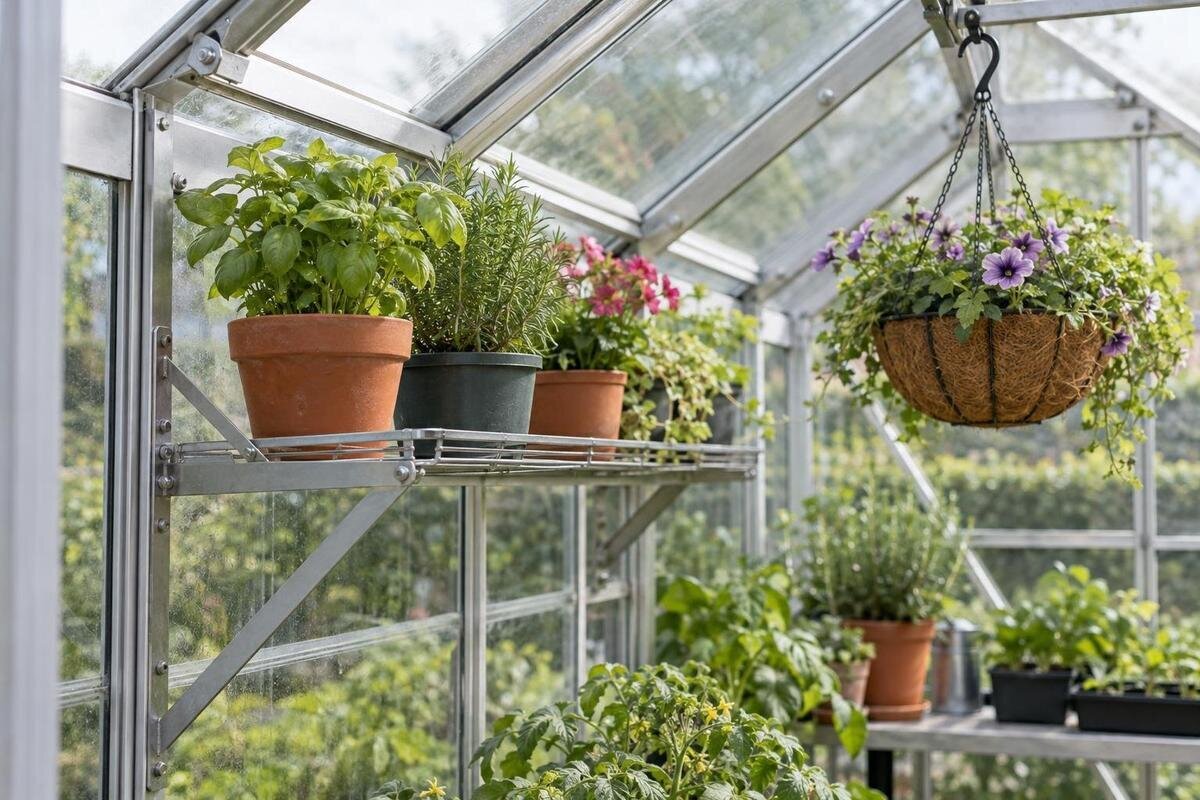
Greenhouse accessory safety
Greenhouse shelves and hanging baskets can free up growing space, but an accessory is safe only when its attachment point and load are approved for the exact greenhouse. A roof member that looks sturdy is not proof that it can carry a suspended planter; glazing, vents and their fittings must not be treated as supports. Before buying or installing anything, find the model-specific instructions and learn what the stated load covers. If the manufacturer does not document the proposed point and use, leave the load off until the manufacturer or a qualified greenhouse installer confirms a suitable option.

Before you buy 1
Decide what the shelf or basket needs to hold
Begin with the job you want the accessory to do. Seed trays, hand tools, small pots and an overhead basket are different loads and may need different support. Write down the accessory type, number of items and proposed location, along with whether items will be concentrated near one edge or spread across a shelf. Note whether plants will grow, containers hold water, or anything will hang and move. This inventory is not a way to calculate greenhouse-frame capacity; it lets you compare your plan with the instructions or explain it to an installer. Plan for the heaviest normal arrangement, not an empty shelf or dry pot on installation day.
Ask whether overhead storage is necessary at all. A shelf attached to a specified rail, a freestanding bench and an approved basket hanger serve different purposes; none is suitable just because it fits the available space. Preserve room for watering and harvesting, and consider reach, door and vent movement before settling on a spot. Don’t place a shelf where its corners or plant pots could press against glazing. Sketch a rough position to catch clearance conflicts before ordering, but remember that a layout sketch says nothing about load approval. If you are considering a Lean-To Greenhouse, include your intended shelf or basket layout in the purchase inquiry and request the documents identifying compatible accessories and their mounting positions.
Find documentation for the exact greenhouse
Use the greenhouse identification label, original order records or assembly paperwork to establish the manufacturer, exact model, size and version, plus a serial or product number if available. A familiar silhouette or similar model name is not enough: a different frame revision can use different channels, brackets or accessory parts. The limited-edition aluminum greenhouse page is a product-family reference, not a substitute for the identifier on your own documents. Record codes exactly as printed, including suffixes, and keep the matching manual and parts list together. Don’t use a diagram from a neighboring model only because its frame looks similar. If you cannot find a label, ask the manufacturer whether records or clear, non-invasive photos can help identify the greenhouse.
Look for the assembly manual, an accessory sheet, a technical drawing or written manufacturer guidance that shows the relevant part, its position and the specified hardware. A general assembly guide may explain how the greenhouse is built without stating accessory loads; an illustration of a shelf or hook does not automatically set a safe maximum. Check for a rating, what it applies to, position limits and any restrictions on accessory count. If the relevant pages are missing or ambiguous, ask for the correct document or a written answer tied to the model before buying or mounting a part. Note the document version and date so later advice can be matched to the same design.
Before you buy 2
Use only specified fixing points
An approved fixing point is one the manufacturer identifies for the specific accessory in its instructions or a drawing, installed in the stated location with the specified hardware. It may be a named accessory channel or another designated feature, but don’t assume every metal profile is intended to hold equipment. Greenhouse frames contain members with different purposes; a roof bar, crosspiece or upright can look substantial without having a published accessory rating. A rating for another part of the greenhouse is not automatically a shelf rating. The fixing point, bracket and frame member all need to match the documented arrangement. Never treat the roof as a hanging rail unless the exact instructions expressly approve that use and give applicable limits.
Use the shown orientation and fasteners; don’t substitute a screw, clamp, wire, cable tie or homemade bracket because it appears to fit. Avoid drilling or attaching to glazing bars, clips, panes, gutters, ridge members, vent operators or door frames unless the exact accessory instructions designate that point. A T-Model Greenhouse Orangery needs its own model-specific guidance; transferring a bracket position from another greenhouse is not a compatibility check. The accessory instructions may not cover how it connects to the greenhouse, so check both sets of documentation. If fitting would alter a frame member, require glass removal or conflict with the instructions, pause and ask a qualified greenhouse installer to review the arrangement.
Check what the load limit actually covers
Read a load figure with its full label and context. It may refer to the payload on a shelf, the complete accessory, one bracket, a pair of supports, a rail span or a whole system; these limits are not interchangeable. Check the units, permitted position and whether items must be distributed over the surface or arranged as shown. A rating for the shelf itself does not prove that the greenhouse connection can carry it, and a connection rating does not necessarily include the shelf’s own weight. Don’t add separate component values to invent an approved total, or treat an unused part of a rail as spare capacity unless the instructions say to. If the rating basis is missing, ask the manufacturer to clarify it.
Ask whether the stated figure applies to one shelf, several shelves on the same rail, or a shelf-and-basket combination, and whether the manual allows the proposed position. Follow the published configuration; don’t extend a rating to a longer span, an extra bracket or a different fixing point. When considering a pyramid-type greenhouse, request a drawing that identifies the approved accessory positions, rather than choosing a location from an exterior photograph. The documentation must cover the exact frame connection and use. If only the shelf’s limit is known, while its attachment to the greenhouse is not, the load question is still unresolved. Keep the applicable rating and drawing together so the installation position can be checked against both.

Before you buy 3
Include pots, water and accessories in the load
Assess the complete setup in its normal, fullest condition, not just the empty accessory. It can include the shelf or hanger, brackets, pots, trays, saucers, growing medium, mature plants and any water retained after irrigation. A reservoir, self-watering pot or wet growing mix may weigh more in use than a dry, newly planted container. If drainage collects in a tray, include the tray and retained water in the information you give the manufacturer. Ask whether the published capacity means the weight of the items, the complete accessory or both; the word “capacity” alone may not settle that distinction.
Record the container types and number, whether the load may collect near one edge, and the fullest expected watering condition. Use that inventory to compare your plan with a documented limit, not to decide what an undocumented frame can carry. When considering a greenhouse listed with built-in storage, separate your storage needs from your growing needs: ask which feature is intended to hold each group of items and request the applicable instructions. If the finished load is uncertain, describe the pots, growing medium, trays, water system and expected plant size to the manufacturer or installer. Update the inventory when you change containers or add a reservoir; the original arrangement may no longer describe what the support will carry.
Treat hanging baskets as a distinct overhead load
A hanging basket is a distinct overhead load: its weight reaches the structure at an attachment point, and its contents may move. Watering, pruning, a bump or air movement can make it swing; opening a nearby window or vent may change where it moves. Include the basket, chain or hanger, pot, growing medium, plant and retained water when describing its full load. Don’t assume a static accessory rating covers movement, off-center placement or several hangers on one rail. Check whether instructions name the basket or hook, fixing point, spacing and allowable load. A general shelf rating or a roof member’s appearance is not permission to suspend a planter.
If hanging baskets are part of your plan for a Prestige greenhouse, ask specifically for the approved hanger, its mounting position and the applicable load guidance before ordering. Plan how you will reach the basket for watering, pruning and removal without pulling on the hanger or leaning on the greenhouse frame. A container that is easy to lift when empty may be difficult to handle once watered and planted. Keep an approved basket away from glass and the full travel of doors or windows, allowing for its movement during ordinary use. If no overhead point is documented, consider an appropriately rated ground-supported option that keeps the plant within comfortable reach.
Before you buy 4
Plan clearances and combined accessory positions
Sketch positions before ordering or installing. Check that shelves and baskets leave the full travel of roof vents, side windows, doors and screens clear, and do not narrow the route you use to reach plants. An approved mounting point can still be a poor location: shelves may shade plants, crowd mature foliage or restrict air movement, while a basket may strike glazing as a door moves. Plan for the plants at their expected size, not only as seedlings. Keep accessories from touching glass and don’t put a shelf where its contents can be knocked against a pane. These layout checks are separate from load approval.
Treat load information as applying only to the configuration it describes. Adding shelves at separate locations does not automatically make their combined use safe, and an unused bracket doesn’t transfer its rating to another point. Ask whether the documentation permits several accessories on the same rail or greenhouse bay, especially if it gives a limit for the complete system. When planning a large backyard greenhouse, mark every proposed shelf and basket on one layout rather than submitting separate accessory requests that omit the rest of the arrangement. Keep the approved layout with the load information, and note any position or spacing restrictions so later additions can be reviewed against the complete setup.
Check the existing frame and accessory fit
Before loading a greenhouse that is already in use, look from a safe position for obvious problems around the proposed point: a bent member, a loose connection, missing hardware, unusual movement or damaged glazing. A visual check cannot certify the frame, but visible damage is a reason not to add a load. Don’t tighten or dismantle structural joints, remove panels or load a suspect area to see what happens. If the structure has shifted, been repaired or has a loose connection, ask the manufacturer or a qualified installer whether that specific frame and fixing point remain suitable. Don’t assume that a greenhouse is sound at an accessory location simply because it is standing.
Match accessories to the exact model and version, and check the part number and fitting instructions before purchase. Similar-looking brackets can differ; a piece that slides into a channel is not proof that it is approved for that channel or load. If a component is missing, bent or unidentified, locate the original parts list and give the manufacturer its exact spare-part identifier, along with clear photos taken without removing glazing. Don’t enlarge holes, substitute fasteners or add pieces to make an accessory fit. If the fit is uncertain, a greenhouse installer can review it rather than modifying the frame.

Before you buy 5
Use a support method that avoids unapproved frame loads
If an overhead fixing point is not documented, a floor-supported shelf, plant stand or bench may be an alternative only if its own instructions give a suitable load limit and the greenhouse base or floor is appropriate for its placement. It avoids transferring weight to a roof member, but is not automatically safe: check stability, footprint and access. Keep it clear of doors, vents and paths. Don’t place a bench so that it rests on a frame member or pane; despite its name, that arrangement still transfers force to the greenhouse structure.
For a manufacturer-approved accessory, plan installation with the specified hardware and instructions available, and keep pots and tools out of the work area. Consider how the accessory will be handled and positioned without contacting the glazing; loading should wait until installation is complete and any required checks have been made. If the work involves frame alterations, glass removal or a method absent from the manual, have a qualified greenhouse installer review it rather than attempting an improvised installation. Agree on the exact accessory, location and intended contents beforehand. Ask the installer to identify any mismatch between the supplied parts, the instructions and the existing greenhouse before work proceeds.
When accessory approval is missing
If you can’t find a clear rating and attachment diagram, do not attach the shelf or basket. Send the manufacturer or original supplier a single request with the information needed to assess the arrangement: the greenhouse model, product label or serial number if available, manual revision, accessory part number and proposed mounting location. Include the number of accessories and describe their fullest watered contents. Clear photos and an annotated layout can help distinguish the intended point from nearby frame members without removing glazing. Ask for a written answer identifying the approved hardware, position and load basis, including any restrictions on combined use. If frame condition or a past alteration is in question, include that information and request an installer’s review.
If storage needs are driving a replacement decision, a page for an aluminum Classic greenhouse can help identify a model family to ask about; request its exact assembly and accessory documents before purchase. Make shelf and basket support a specific buying question rather than relying on product name, overall area or appearance. If no one can confirm the intended arrangement, don’t suspend or mount it on the greenhouse. Consider a separately rated option placed on a suitable base, or choose a model and accessory combination for which the manufacturer provides the necessary instructions.
Frequently asked questions
Can I hang a basket from a greenhouse roof bar?
Only if the instructions for your exact greenhouse and accessory explicitly approve that bar, hanger and load. A roof member that looks sturdy is not proof that it is rated for hanging baskets. If the manual does not identify the point, do not attach the basket; ask the manufacturer or a qualified greenhouse installer for model-specific guidance.
How do I know whether a fixing point is approved?
Look for that specific point in the manufacturer’s accessory instructions or technical drawing, along with the required hardware and installation position. A general assembly diagram or a similar-looking frame member is not enough. If the instructions are missing or unclear, ask for model-specific guidance before attaching anything.
Should I include water and plant growth when checking a load?
Yes. Describe the fullest normal setup, including the pot, growing medium, mature plant, tray and water that may remain after irrigation. Ask whether the published limit covers the accessory, its contents, the mounting hardware or the complete assembly. Do not use a dry, empty-pot weight as the basis for a loaded shelf or basket.
Can I use a shelf or bracket made for another greenhouse model?
Use it only if the manufacturer confirms it is compatible with your exact model and version. A bracket that fits into a channel may still be unapproved for that location or load. Do not force it, alter the frame or substitute fasteners to make it fit.
What information should I provide when I ask about an accessory?
Share the greenhouse model and product or serial number if available, the manual version, the accessory part number, the proposed fixing point and the number of shelves or baskets. Describe the fullest watered arrangement and include clear photos taken without removing glazing. Ask which points are approved and what the load limit covers.
Safe greenhouse storage depends on a documented connection, the correct accessory and a load limit that covers the way you plan to use it. Take particular care with hanging baskets: a roof member is not an accessory rail by default. If the manual does not identify the fixing point, rating or permitted combination, leave the load off and seek model-specific guidance. A ground-supported alternative may work, but it still needs its own capacity and a suitable place in the greenhouse.
