
Growing Alpine Plants in a Greenhouse
Alpine greenhouse guide
An alpine greenhouse is usually a rain shelter and a way to manage exposure—not a warm house for mountain plants. Success depends on matching light, airflow, root conditions, and winter care to each species. Because alpine plants come from habitats ranging from sunny scree to cool, shaded crevices, one temperature or watering rule will not fit a whole collection.

Before choosing a greenhouse 1
The role of a greenhouse in alpine plant care
Alpine describes plants adapted to mountain environments; it does not prescribe one greenhouse temperature or watering schedule. Elevation, aspect, snow cover, rock type, wind, and growing season vary, so an exposed-ridge cushion plant and a primrose rooted in a cool crevice can respond differently under glass. Many need bright conditions and cool roots, while others tolerate filtered light or require more even moisture. A greenhouse changes that balance: it can exclude rain yet trap solar heat and still air. Treat the structure as a way to manage a specific weather problem, not as a miniature mountain.
Decide whether your collection needs a greenhouse. Species suited to local outdoor conditions may thrive in a rock garden where air moves freely and seasonal weather remains natural. Glass is most useful when prolonged rain, repeated storms, or the need to keep delicate pots dry is the main concern. Count the plants that need cover, then reserve space for access and staging rather than filling every corner. The Limited Edition aluminum greenhouse listing spans 40.6 to 302 sq ft; that is a range of footprints, not an estimate of plant capacity or ventilation. Also consider whether the proposed site provides suitable light and shelter.
Identify each species’ habitat and growing needs
Before arranging plants, sort them by origin and growing habit: exposed scree, alpine meadow, snowbed, limestone crevice, and woodland edge do not offer the same light, moisture, or root conditions. A nursery label, specialist reference, or trusted grower’s notes should tell you whether a species prefers direct sun, bright filtered light, winter moisture, or a drier dormant period. Some need a cool rest, while others vary in cold tolerance. “Hardy” does not mean a plant will tolerate warm, stagnant air or saturated potting mix. Check the requirements for the named plant and, where available, its cultivar or provenance.
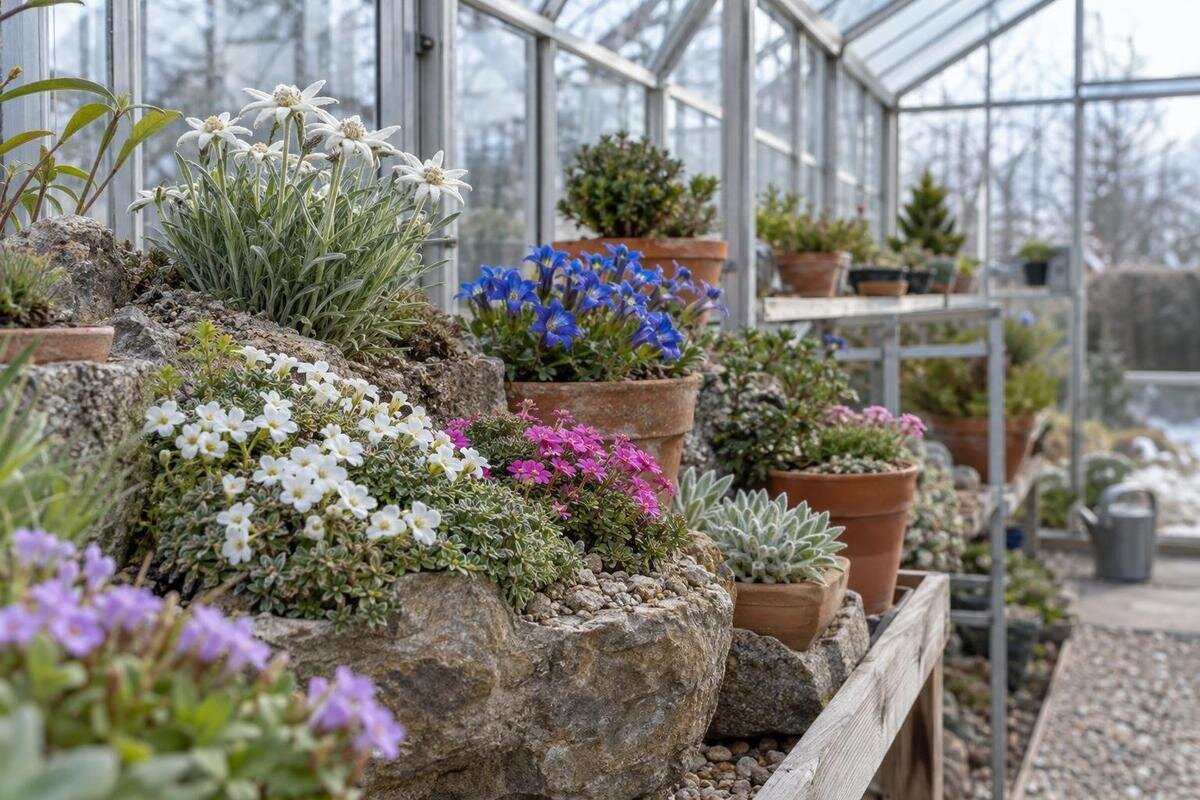
Named plants show why grouping by need matters. Edelweiss (Leontopodium alpinum) generally suits an open, sunny position, cool conditions, and fast drainage. Allioni’s primrose (Primula allionii) favors bright, cooler light and a more consistently moist but freely draining root zone. Common houseleek (Sempervivum tectorum) usually handles a wider temperature range and prefers strong light with sharp drainage. These are starting points, not substitutes for species-level guidance; even a familiar genus can include plants from different habitats. Keep labels with the pots and record their position, growth, and flowering so you can adjust care based on a plant’s response.
Before choosing a greenhouse 2
Match light exposure to the species
Match light exposure to each plant rather than treating the greenhouse as a whole. Open-site alpines often benefit from strong light, but a plant from a shaded crevice or sheltered slope may need bright shade. Glazing and the greenhouse’s orientation alter exposure through the day and across seasons. A bench near a wall, roof edge, or taller pot can receive a different pattern from the center. Notice whether foliage remains compact or stretches toward a brighter side, and whether leaves show signs of excess light or heat. These observations are more useful than assuming every alpine should sit in direct midday sun.
Map the sun before settling on permanent bench positions. Check the intended growing area in the morning, around midday, and later in the day; one visit will not show the full pattern. On a simple layout sketch, mark areas that receive direct sun and those shaded by the structure or nearby objects. Note the time of each observation so you can distinguish a briefly shaded spot from one shaded for much of the day. Keep some pots movable so you can adjust their positions as light shifts through spring and summer. The T-Model greenhouse orangery listing ranges from 178 to 323 sq ft. Floor area helps compare layout options, but does not reveal how a particular bench is lit. Once you know the site’s exposure, place shade-preferring plants separately. Recheck those positions when taller plants or additional staging change the arrangement.
Ventilation and plant-level monitoring
Ventilation helps prevent bright weather from turning a cool-growing collection into a hot, stagnant one. Open adjustable vents before the air has become uncomfortably warm, especially after a cool night followed by sun. Aim for air exchange around the benches, not just an open door at one end; a useful airflow path depends on the position and operation of the openings. Still air can also leave foliage and pot surfaces wet longer after watering or condensation. Do not assume that a large greenhouse footprint automatically provides enough ventilation for the plants inside.
Compare the chosen configuration’s vent locations, opening area, and ease of adjustment, and consider whether air can move through the plant zone. The Pyramid greenhouse listing includes sizes from 60 to 203 sq ft, but its area range says nothing about ventilation capacity. Check the details for the size you are considering, including whether you can reach and operate the openings with benches and pots in place. Plan the layout around that access instead of leaving vent operation as an afterthought. A min/max thermometer placed at plant height helps reveal daytime peaks and overnight lows; readings beside glazing can differ from conditions among the pots. Note its location when recording readings so comparisons remain meaningful. Use the readings alongside plant observations rather than treating one measurement as a universal target.

Before choosing a greenhouse 3
Manage rain, humidity, and watering separately
Rain exclusion can help where roots and crowns remain wet for days, but it does not mean keeping every alpine dry. Potted plants rely on you to replace rainfall, and growth stage, pot size, potting mix, wind, and sun all affect how quickly roots use water. Water the root zone according to the species and the condition of the medium. Avoid routinely wetting compact crowns or letting pots sit in runoff. A dry surface does not prove that the full root zone needs water. When checking a group, assess individual pots rather than watering the entire tray because one plant looks dry. Keep plants with similar moisture needs together, but leave their labels visible so exceptions are easy to recognize. A brief note about which pots needed water can help you identify differences in drying without turning that observation into a fixed watering schedule.
Manage dampness by spacing foliage and pots so air can move between them, clearing fallen leaves, and checking for condensation after cool nights. A greenhouse can have dry leaves one day and humid, still air the next; rain protection alone controls neither. When vents might admit driving rain, keep sensitive pots out of the rain’s path while still releasing trapped heat and moisture. The Classic aluminum greenhouse listing spans 40.6 to 302.3 sq ft. Use its stated range to compare sizes, then check the selected configuration’s covering and openings in relation to your site.
Choose a well-drained medium for each plant
Most container-grown alpines need a potting mix that drains promptly while retaining enough moisture for their roots; a coarse appearance alone does not guarantee that balance. Start with the species’ soil preferences. A limestone-crevice plant may call for a calcareous medium, while another taxon may be adapted to acidic rock or humus-rich turf. Use a clean, open-textured mix suited to that plant and a pot with unobstructed drainage. Avoid one recipe for the whole collection, and do not assume a gravel layer can correct a fine, compact mix throughout the pot.
A suitable grit top dressing can keep crowns away from wet organic debris and make small pots easier to handle, but it cannot compensate for blocked drainage or overwatering. Check moisture in the root zone rather than judging it only by the surface, and note how quickly each pot dries in its final position. Record the potting mix alongside the plant’s label or collection notes; otherwise, differences between similar-looking pots can be difficult to interpret later. If you adjust a mix, record what changed rather than relying on memory. The lean-to greenhouse listing spans 40 to 154 sq ft; that footprint range may help you compare room for pot groups, but usable bench and aisle space depends on the selected layout. Keep sensitive plants in separate, labeled groups so you can adjust their potting mix and watering without disturbing the rest of the collection.
Before choosing a greenhouse 4
Arrange pots for airflow and access
Arrange the collection in zones that reflect care needs: full-sun pots together, bright-shade plants apart, and species with different winter or moisture routines clearly labeled. Leave gaps between pots for air and inspection; close-packed foliage can hide pests, damp crowns, and differences in drying. Keep staging easy to reach so you can move plants during a heat spell without rearranging the whole greenhouse. A clear working aisle is useful growing space in its own way: it lets you water selectively and inspect the backs of benches rather than overlooking them.
Plan usable area from bench footprints, pot diameters, aisle width, and room to carry trays, not from greenhouse floor area alone. If supplies need a separate place, the greenhouse with built-in storage listing offers sizes from 59.4 to 302 sq ft. Compare the exact storage arrangement with your bench plan rather than assuming the full stated area is available for plants. Check interior and bench height for comfortable access, especially if you handle many small pots. For a low-growing collection, practical working room matters more than extra height for plant growth.
Manage summer heat and seasonal changes
Plan for summer heat as well as day-to-day ventilation. A greenhouse can warm quickly even when the outdoor morning feels mild, and roots in small pots respond differently from plants in a broad garden bed. Ventilate early when sun reaches the structure, and check conditions among the pots rather than relying on a forecast or a thermometer far from the collection. If a species still shows stress after airflow improves, consider whether its bench receives too much direct sun. Suitable temporary shade for that group may be better than reducing light across the entire greenhouse.
Track conditions across spring, summer, and fall, since a fixed opening routine may not suit every day. A min/max record beside representative plants helps distinguish a brief daytime peak from an overnight chill and shows whether a move or shading adjustment helped. Pair each entry with the weather, vent position, and any shade in use so the record explains what was happening, not just the temperature. Focus on changes you can manage consistently: a routine that depends on frequent manual adjustments needs someone available to make them. If another person cares for the collection while you are away, identify the groups with different light needs and explain the usual adjustments. Make changes gradually for plants that have been in deep shade or a sheltered position. Shade can reduce excessive direct sun, but it will not solve poor airflow or overly warm roots on its own. There is no single greenhouse temperature that suits all alpine species; use species guidance and observed growth rather than a warm-crop setting.

Before choosing a greenhouse 5
Plan winter care around each species’ cold tolerance
Winter care starts with each plant’s natural cycle, not the assumption that every alpine wants the coldest possible shelter. Some species need a cool dormant period; others have less tolerance for severe freezing, especially in pots where roots are more exposed than in the ground. Rain cover can prevent persistent winter saturation but also removes rainfall and snowfall, so moisture still needs attention. Confirm each species’ cold requirements and decide whether it should remain in the greenhouse, be moved outdoors, or receive other suitable protection for your local conditions. An unheated structure does not maintain one stable temperature.
During dormancy, growth and water use often slow, but a blanket no-water rule can dry roots while constantly wet potting mix increases risk. Check pots less frequently but deliberately, adjusting water to the plant, potting mix, and actual conditions. Keep a winter grouping plan that identifies which plants remain under cover and which may need to move. Labels should stay readable after rearrangement, and any plant moved to a different position should remain accessible for moisture checks. Leave room to make those moves without crowding neighboring pots or blocking the aisle. The Prestige greenhouse listing spans 40.6 to 302 sq ft; that range helps compare available footprints, not winter temperatures or frost protection. Confirm what the selected structure does and does not provide, and do not treat an unheated greenhouse as a guaranteed frost-free space.
Compare greenhouse space and ventilation options
Choose a greenhouse by working back from the collection: list the plants, note their light and seasonal requirements, identify how much rain shelter each needs, and estimate the number of pots and work surfaces. Then compare usable floor space, access, interior height, and adjustable ventilation in the actual model and size. A low-growing collection may need more bench area and easier viewing than a tall canopy; room to separate species is more valuable than filling every square foot. Draw the proposed benches and aisles within each option’s dimensions, then mark where the different plant groups would go. Include space for temporary moves and routine care, not just the pots you own today. Separate essential requirements from preferences in your comparison: accessible vents and room for distinct care groups should not be overlooked because another option offers more total floor area. This makes the final choice specific to your collection rather than simply a choice between larger and smaller structures.
Floor-area ranges help narrow options, but they are not substitutes for specifications. A large house can still overheat if its ventilation is poorly matched to the site, and a smaller one can be hard to work in if benches block the aisle. The large backyard greenhouse listing spans 506 to 753 sq ft; that is a substantial range of floor areas, not an alpine-growing recommendation. For each option, verify measurements, vent type and placement, covering details, and how you will manage summer light and heat. Choose a layout you can maintain through changing seasons.
Frequently asked questions
Can alpine plants grow in an unheated greenhouse?
Many can, but an unheated greenhouse does not guarantee the right winter conditions. Check each species’ cold requirements and remember that roots in pots may be more exposed to freezing than roots in the ground.
Do all alpine plants need full sun?
No. Edelweiss usually suits a sunny position, while Allioni’s primrose generally prefers bright, cooler light. Match exposure to the named species and its growing conditions.
Does rain protection mean I should water less?
Not automatically. A greenhouse roof excludes rainfall, so potted plants still need water when their species and potting mix require it. Check moisture in the root zone rather than following one schedule for every pot.
How should I ventilate an alpine greenhouse in summer?
Use adjustable openings before the house heats up, and check conditions among the plants. The right routine depends on the greenhouse, its site, and the species; there is no single temperature target for an entire collection.
Can I use standard potting mix for alpine plants?
A single mix may not suit every species. Check whether each plant needs a mineral, calcareous, acidic, or more moisture-retentive medium, and make sure its pot drains freely.
Successful alpine greenhouse growing is about preserving the conditions each plant is adapted to: suitable light, moving air, a well-drained root zone, and protection from prolonged rain without unnecessary warmth. Group plants by their actual habitat and winter needs, monitor conditions at bench level, and adjust one factor at a time. That approach makes the greenhouse a useful shelter without turning a varied mountain collection into one uniform crop.
