
Scratched Powder Coating on a Greenhouse: Repair Options
Greenhouse repair guide
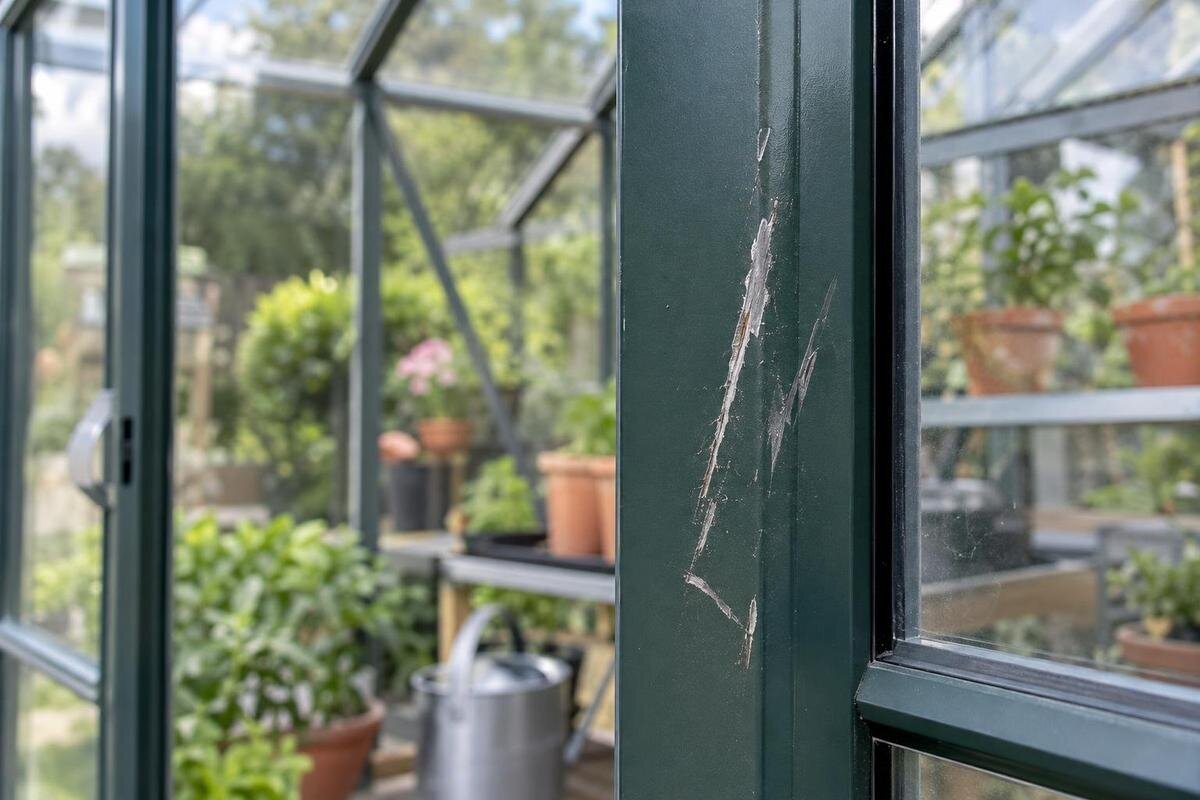
A scratch on a powder-coated greenhouse frame may be a removable rub mark, a change in the finish, or a break through the coating. Those are different problems, and color alone cannot reliably distinguish them. Inspect without scraping, check whether the coating still appears continuous, and note any separate signs such as a bent member, loose joint, or displaced glazing. A superficial scuff may need no repair; a coating breach calls for manufacturer-approved guidance. If the frame itself or an exact replacement part is in question, ask the manufacturer or a qualified installer before dismantling anything.

What a powder-coating scratch can mean
Powder coating is a factory-applied finish that forms a film over the frame material. A scuff may change the film’s sheen or leave transferred material on top without exposing the substrate; a deeper scratch can break through it. The original coating is made and cured for its intended use, so a touch-up is not automatically the same finish simply because the color looks close. Marks may appear pale, dark, shiny, or dull depending on light, soil, and the surrounding surface. The exact coating and underlying material depend on the greenhouse model. Treat the visible mark as something to assess, not proof that the metal beneath it is damaged or that a particular paint will match.
Keep two questions separate: is the finish damaged, and is the frame member in good condition? A small nick does not answer the second. Look for a bent profile, a loose connection, movement where members meet, or glazing that appears displaced, but do not press on panels, loosen fasteners, or flex the frame to test it. Damage close to a joint or glazing support deserves more caution than an isolated cosmetic mark. Frame geometry and the role of a member are not always obvious from ground level. If the structure looks distorted or a member seems compromised, stop at visual inspection and ask the manufacturer or a qualified installer to assess it.
How to distinguish a scuff from coating loss
Inspect the frame when it is dry and in even daylight; light from the side can reveal an edge or texture change, but it can also exaggerate a shallow scuff. Start with a wide view that locates the mark, then look closely without poking it. If dirt or a deposit may be sitting on the finish, clean only by the method and cleaner permitted in the greenhouse manual. A soft cloth or damp wipe may be appropriate only if the instructions allow it. Avoid testing an unapproved cleaner on the visible area; it could alter the finish and make the original mark harder to judge. Do not use a blade, fingernail, abrasive pad, or polishing compound to see whether the mark catches.
A transfer mark or grime may change or lift under permitted gentle cleaning while the coating remains continuous. A scratch through the film may show a line of differently colored substrate or a clearly missing edge. Visible chips or lifted flakes indicate coating damage; blistering, pitting, or suspected corrosion also warrant manufacturer review. Color differences alone are less reliable because reflections, dust, shadows, and an aged finish can mislead. Even a mark with no obvious bare metal may have damaged the film in a tiny area. If you cannot tell whether the coating is intact, take a close photo and ask for manufacturer guidance rather than widening the mark to inspect it.
Inspect the affected frame area without worsening it
Map the scope before choosing a response. Note the member affected—such as a frame bar, corner, door surround, or base profile—its position, approximate length and width, and whether other marks are nearby. Record the direction of the scratch and any nearby point of contact as observations, not proven causes. Take one photo showing where the mark sits on the greenhouse and a closer image in natural light; place a ruler beside it if scale is useful, without dragging it across the finish. Include adjacent connections in an overview only if they can be seen safely. These records help a manufacturer distinguish one abrasion from repeated contact or broader coating loss.
Check for separate signs without dismantling anything: a visibly bowed member, a connection that has shifted, a door or vent no longer meeting its frame, or displaced glazing changes the question from finish repair to a broader assessment. Do not remove glass or panels to reach a scratch, and do not try to straighten a profile. Separate the photos of finish damage from those showing alignment concerns so each issue can be reviewed clearly. If that review leads to considering a new greenhouse, the Prestige greenhouse range provides a 40.6–302 sq ft starting point for comparing sizes. Record your existing footprint separately; a catalog size range cannot establish which replacement would fit.
Record the greenhouse and finish before requesting help
Find the exact greenhouse model before asking for a touch-up product or spare part. Check the original manual, order confirmation, invoice, frame label, and any parts diagram; note the model name, serial or order number, approximate purchase date, and finish or color code if documented. Identify the damaged member by its position rather than guessing a part name. A description such as dark green or silver may help but is not a reliable identifier. Frame shapes, colors, and coating formulations can change between model generations. Do not order a part because its photo looks similar or assume a current product uses the same profile.
Send a concise request with overall and close-up photos, the dimensions you have, and identifiers from the paperwork. Ask which touch-up material and preparation method are approved for that exact finish, whether an exact part is available, and whether a warranty or service review should happen before repair. Do not assume DIY work automatically affects coverage—or that it leaves coverage unchanged. Use a current page such as the Classic aluminum greenhouse listing to clarify which catalog model you mean, but attach your original order details as well. Ask the service team to confirm the model generation before discussing a part or finish. This avoids confusing a present-day product name with the identity of an older greenhouse.

When a scuff can be left alone
If permitted gentle cleaning removes a transfer and the coating still looks continuous, with no exposed substrate, loose flakes, or nearby frame concern, treatment may not be necessary. Record the mark and watch for change during routine visual care rather than repeatedly polishing or adding paint. A small difference in sheen can remain visible even when the layer is intact; trying to erase that variation may remove more finish than the original rub. Do not perform a fingernail test or use a marker to blend the color. A photo taken before cleaning gives you a useful record if the appearance changes later.
Decide what would trigger another review rather than repeatedly trying to improve a stable blemish. Useful changes to record include a larger affected area, newly lifting edges, or additional marks elsewhere. Keep later photos at a similar angle and distance so differences in lighting do not look like deterioration. The extent of the problem also matters when considering replacement: one stable scuff is a different purchasing question from finish loss across many members. If you are already considering a substantially larger unit, the large backyard greenhouse range lists 506–753 sq ft. That comparison concerns a change in growing space, not a remedy for a minor mark; assess whether you actually want the larger footprint before pursuing it.
When manufacturer-approved touch-up may be appropriate
A spot touch-up may be an option when the manufacturer confirms that the damage is limited, the frame itself is sound, and an approved product and procedure exist for the exact model and finish. Request the product’s precise identifier and written instructions rather than relying on a generic color name. Ask whether the manufacturer considers a field touch-up appropriate for that location and size of damage. Instructions should establish how to clean and prepare the area, which applicator or product to use, whether more than one application is needed, where it may be applied, and the required working conditions and cure time. Do not fill gaps or cover hardware as though they were coating scratches.
Follow those model-specific instructions exactly; do not substitute a similar-looking paint, borrow a procedure from another brand, or assume an old video applies to a current coating. Clarify anything the instructions leave uncertain before starting, including when the repaired area can be cleaned or handled again. If an applicator cannot reach the mark without contacting a seal or panel, ask whether professional access is needed. For an existing lean-to, identify the affected member and its position relative to the building in the service request. The Lean-To Greenhouse model page can help distinguish the current catalog model, but the original records must establish which version you own. A model name alone does not identify the approved touch-up.
Why generic paint and aggressive preparation can backfire
A close color is not a reliable match for a powder-coated frame. Two coatings that look alike in a small swatch may differ in gloss, texture, and how a repaired spot sits against an aged surface. A touch-up sold for cars, appliances, outdoor furniture, or general metalwork is not automatically compatible with a greenhouse finish; the frame material, factory coating, and nearby plastics or seals may differ. Without manufacturer approval, a label alone cannot tell you whether the product is intended for that surface or repair size. Avoid buying a product based only on a color chart or a photo taken in different light.
Sanding, scraping, wire brushing, strong solvents, rust converters, and abrasive pads can remove sound coating or affect adjacent components. Some maker-approved procedures may specify particular preparation, but that is not permission to improvise or extend it. Do not coat moving channels, drainage paths, glazing channels, seals, fasteners, or mating faces unless the manufacturer expressly includes them. If you have already used an unapproved product, document its name and any preparation performed; ask for guidance before adding another layer or trying to strip it. When requesting help for a model identified with the Limited Edition greenhouse collection, include the actual finish code rather than relying on the collection name. Product identity and coating identity are separate details in a repair request.
When to request a replacement part or installer assessment
When coating loss extends into a joint, hardware interface, or glazing support, or when a frame member is visibly damaged, ask whether an exact replacement component is appropriate and whether installation requires a qualified professional. Match by model, part identifier, dimensions, profile, and generation—not appearance alone. If a member is bent, a connection is loose, or the enclosure has shifted, touch-up will not address that separate condition. Do not loosen fasteners, remove glazing, or substitute a generic bar while investigating. Before anyone dismantles a glazed section, ask who should do the work and whether the manufacturer or installer needs to inspect it first.
A useful component request identifies both the member and its location within the assembly. Include a part number from the manual or diagram, if available, and describe which neighboring members connect to it. For a greenhouse associated with the T-Model greenhouse listing, specify which portion of your actual structure contains the damage rather than sending only a close-up with no location reference. Ask whether a quoted replacement includes the necessary associated hardware and whether any adjacent components also need review. Have the service team confirm the part identifier in writing before ordering. If the exact component is unavailable, an installer assessment is preferable to assuming that a similarly shaped current part can be substituted.

When to compare a complete greenhouse replacement
A full greenhouse comparison becomes more relevant when finish damage is repeated across multiple members, several parts need replacement, the frame has separate condition concerns, or no approved repair or exact component is available. It is not automatic: a visible finish defect alone does not establish that replacing the structure is necessary. Ask for the repair scope and part availability first, then compare that with complete replacement and any installer assessment. Keep the finish issue separate from structural concerns when reviewing estimates; a touch-up quote and a frame repair are not the same job. Asking for each option to be described separately makes the comparison clearer. Do not base the decision on a coating photograph alone.
When considering a new unit, compare documented footprint, intended location, access, configuration, and glazing or door layout, not just a product photo. For example, the Pyramid-type greenhouse size range is 60–203 sq ft, which provides an initial area comparison but does not describe how that footprint would work on your site. Ask for the dimensions of the specific version under consideration and have an installer assess the existing base where needed. Include removal, installation, and any site work as separate items in the comparison. Also consider the disruption to plants and stored equipment during the changeover. These practical costs help distinguish a worthwhile replacement from an unnecessarily large response to a finish defect.
Keep repair records and limit repeat abrasion
After a maker-approved repair or component replacement, keep the instructions, product or part code, date, and before-and-after photos with the greenhouse paperwork. Follow the manual’s cleaning advice; abrasive pads or unsuitable cleaners can create new marks or hide changes. During normal visual care, notice whether the same spot is repeatedly rubbed by a moving part, tool, or stored item. Record the contact rather than adjusting a door, vent, or frame without guidance. If abrasion recurs, ask for its cause to be assessed rather than layering another patch over the same place. Do not assume the finish needs periodic reapplication unless the maker says so.
Keep chemicals, tools, and frequently moved equipment from rubbing against the frame during everyday use. Pay particular attention to where a tool is leaned or an item is carried through the doorway; changing a storage habit may prevent another mark without altering the greenhouse. If lack of storage is also influencing a future replacement decision, the greenhouse model with built-in storage is a separate configuration to investigate. Ask about its actual storage arrangement and usable space rather than inferring them from the title. Meanwhile, preserve the existing greenhouse’s repair record even if you plan to replace it. It documents what was treated and helps distinguish an old repaired spot from new damage.
Frequently asked questions
Can I use automotive touch-up paint on a greenhouse frame?
Only if the greenhouse manufacturer approves that exact product and procedure for your model and finish. A similar color does not guarantee a compatible coating, sheen, or preparation method. Ask for the approved product identifier before applying anything.
How can I tell if a scratch goes through the coating?
A clearly missing edge or a line of differently colored substrate can indicate a breach, but light, dirt, and reflections can mislead. Do not scrape or probe the mark. If you cannot tell whether the coating is intact, photograph it and ask the manufacturer.
Does a scratch mean the greenhouse frame is unsafe?
A finish mark alone cannot establish the condition of the frame. Look separately for a bent member, loose connection, shifted frame, or displaced glazing. If you see one of those signs, arrange an assessment by the manufacturer or a qualified installer.
Should I sand a scratch before touching it up?
Do not sand unless the manufacturer’s instructions for your exact finish specifically require it and explain how. Improvised sanding can remove sound coating around the mark and make the damaged area larger.
What information should I send when asking about a repair?
Include the model and any serial, order, or part numbers you have, plus the scratch’s location and approximate size. Send an overview photo and a close-up in natural light, and note any nearby damage or frame movement.
The right response depends on what the mark actually shows. A removable transfer or shallow scuff may call for no more than manufacturer-approved cleaning and observation. Missing or lifting coating deserves an exact, model-specific repair recommendation, while frame distortion or a damaged connection calls for a separate assessment. Photograph the area, use the greenhouse’s original records, and avoid guessed paint or improvised preparation. That keeps a small finish issue from becoming a larger, harder-to-identify repair.
