
Can an Aluminium Greenhouse Be Lengthened in Future?
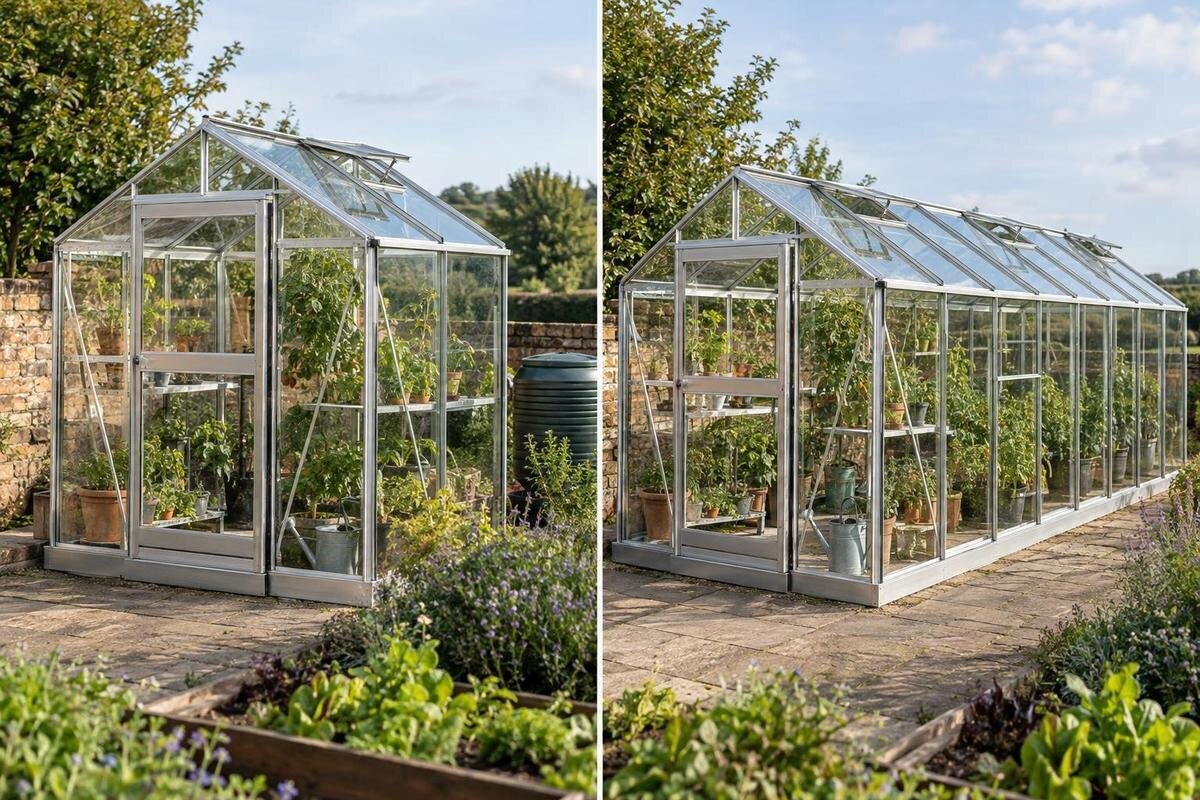
Greenhouse buying guide
If you may need more growing space later, choose a greenhouse based on evidence of its extension system, not the metal named in its frame. An aluminium greenhouse can be lengthened only if the exact model and configuration support a compatible addition, matching parts can be obtained, and the base and site can accommodate the revised layout. A catalogue offering several sizes does not, by itself, show that an installed unit can be extended.

Aluminium does not automatically mean modular
Aluminium describes the frame material; it does not tell you whether the frame is modular. Some systems are designed around repeatable bays, while others are supplied in set configurations whose end frame is not intended to be moved. Both may use aluminium profiles. Only the documentation for the exact model and selected configuration can distinguish them. The Classic greenhouse listing shows listed areas from 3.77 to 28.08 m². That range can help you compare the sizes offered, but it does not show that an installed smaller version can be lengthened. The largest listed option might be a separate configuration rather than the result of adding a kit to the smallest one.
Be precise about what you mean by an extension. Adding length to the original frame is different from changing its width, buying a larger version at the outset, or placing another greenhouse beside it. A manufacturer-designed extension should identify where it joins, how much length it adds, the finished size and whether the end wall changes position. Catalogue sizes within one family may be separate configurations with different components. Ask for a drawing that connects the specific size you select now to the proposed future configuration. If the answer names neither, treat the current footprint as fixed.
What a genuine length extension involves
An approved length addition may mean inserting one or more frame bays, extending rails along the roof and sides, and rebuilding the end wall at the new end. Depending on the model, it may also need extra glazing, seals, connectors, fasteners, bracing or base components. Existing end panels may not fit the new end, and some parts may need to be replaced rather than reused. This is a description of possible scope, not a universal parts list: the manufacturer's drawings and instructions must define the correct components and sequence. Loose aluminium profiles or generic connectors are not a substitute for a model-specific extension system.
The Spacious Greenhouse listing shows listed areas from 47 to 70 m²; those figures identify sizes on a product page, not a method for converting one installed size into another. For any model, request a drawing of both the current and proposed configuration. It should identify the added sections, the finished external dimensions, the end wall's new position and which components are reused or replaced. It should also show where doors, vents and gutters finish. If you are shown only a picture of a larger greenhouse, ask how the specific unit you plan to buy would be changed to reach that layout.
What a model-specific extension confirmation should state
For a new purchase, give the retailer or manufacturer the exact product name and selected configuration. If you already own the greenhouse, include its order reference, purchase date, identification label if present, and details of parts that have been replaced or altered. Photos can add context, but they do not replace a model or parts reference. When enquiring about the Limited Edition aluminium greenhouse, specify the size and options you are considering rather than referring only to the product family. If you have quotes for several configurations, identify which one your extension enquiry concerns. Keep the original size and proposed finished size clearly labelled in the correspondence. This avoids an answer about a larger greenhouse available to buy now being mistaken for confirmation that your selected greenhouse can be lengthened later.
Ask for a direct written answer about your exact model and size. It should name the extension kit or configuration, identify the compatible part numbers, state the permitted addition and explain any limits or conditions. Ask whether the answer applies to the product version and glazing configuration you have selected, and whether an inspection is needed before work begins. For a new greenhouse, raise the question before completing your purchase. Save the response with the order documents; a general assurance that the range is modular does not tell you what can be added or how.
Parts must match the model and its version
Frame sections, connectors, end caps, seals, glazing retainers and fasteners can be specific to a model. A similar-looking profile or the same nominal length does not establish a fit: joint shapes, fixing points and product revisions can differ. Even two greenhouse pages that use the word aluminium do not thereby share a parts specification. When discussing the Lean-to greenhouse model, use its exact model and version as the reference for every proposed component. Ask the supplier to distinguish parts that remain in place, parts that move and parts that must be newly supplied. If a replacement is offered under a different part number, ask whether it is compatible with the existing components around it. A clear parts schedule is more useful than a collection of photographs of apparently matching sections, especially when the greenhouse has already had repairs.
Parts availability is a separate question from whether an extension is technically possible. Ask which components can be ordered for the proposed change, whether they are supplied separately or as a complete kit, and whether approved replacement parts exist for older versions. A part that can be sourced for a new greenhouse today is not proof that the same part will be available years later. Ask what can be confirmed about supply and how you would identify the correct parts in future. Keep the original product details, parts list and drawings so that a later enquiry can be specific.

Confirm that the design covers the longer configuration
Adding length changes the overall geometry of a greenhouse, so the original design information should not simply be assumed to apply to the extended version. The frame, connections, bracing and support requirements need to be confirmed for the finished configuration by the manufacturer. When considering the T-Model Orangery Greenhouse, identify exactly which part of the proposed layout would be lengthened. Ask for the original and extended layouts to be labelled consistently so that you can compare them without confusing width, length and overall area. The proposal should make clear which dimensions change and which remain the same. If the drawing differs from the configuration in your quote, resolve that difference before comparing costs. The assessment needs to concern the greenhouse you intend to install, not merely another size bearing the same model name.
The condition and installation of an existing greenhouse also matter. Bent or corroded members, loose connections, previous alterations or an uncertain anchoring arrangement are reasons to seek an assessment before planning work. Tell the manufacturer about any changes and ask what must be inspected. Where the proposed work affects structural members or support, use a suitably qualified professional to review the specific greenhouse and site. Do not cut, drill or remove parts on the strength of a general claim that a model can be extended.
The existing foundation may need to change
An extension takes up additional ground, and its support needs to cover the finished layout rather than only the existing greenhouse. Check the length and position of the current base, the available space at the proposed end, and any nearby boundaries, paths, services or drainage routes. A paved area beside a greenhouse, or a new section of concrete, is not automatically a suitable continuation of its foundation. The connection between old and new support work may also need to be specified for the proposed configuration.
The Prestige greenhouse with metal base listing names a particular base configuration; the wording alone does not say whether an existing base can be extended or joined to new foundation work. Ask for the support and foundation requirements for the full proposed length, not just the additional section. If changes are needed, have a qualified professional assess the site and the existing support before work is planned. Also ask whether the greenhouse must be partly dismantled or moved to make those changes, as that can affect the scope of the project.
Glazing, doors and drainage in the extended layout
An extension affects more than the frame. The glazing panels, their retaining parts and the end wall need to match the manufacturer's design for the finished greenhouse. A panel that fitted the original end may not fit the new position, and the new section may require glazing in a specified size or configuration. Use only parts the manufacturer confirms as compatible; do not assume that panels or retainers from another model will work because they look similar. Ask which existing panels, if any, are intended to be reused.
Check the revised layout for openings and water flow as well. Ask whether doors or vents stay in their current positions, move to another end or need replacement, and confirm that access remains practical around them. For a model such as the Oasis Pyramid Greenhouse, request a drawing that shows the complete proposed arrangement rather than considering the additional floor area alone. Trace your route from the garden entrance to the greenhouse door, then through the planned growing and working areas. Would moving the end wall also mean moving the path that serves it? Would benches obstruct an opening in its revised position? Ask for gutters and discharge points to be marked on the same plan, so you can see whether the existing drainage route is retained or needs to change. Resolve these layout questions alongside the frame proposal, rather than leaving them until the extra section has been ordered.
Compare a larger starting size with a future extension
Before choosing a smaller greenhouse on the assumption that it can grow, consider what extra space you will actually need. Longer rows of plants may call for more length, while room for benches, access or equipment can depend on the layout as well as the overall area. Square metres alone do not show where doors, storage or work space sit. Sketch the planting and working areas you need now, then mark the additions you expect to make later. Distinguish space for more plants from space needed to reach and tend them; otherwise, the proposed extra length may not solve the problem you have identified. Compare drawings of the current option and intended future layout, using the same furniture and equipment dimensions in both. Check that the longer footprint fits the available site without blocking access or drainage. This gives you a practical reason for choosing a particular size rather than simply selecting the largest area.
The Limited Edition greenhouse with built-in storage is a useful example of why the selected configuration matters as much as its area. Record the storage arrangement and other features you are considering when asking about an extension. Ask how those spaces would relate to the added growing area, which features would remain in place and whether any would need to move. Do not count the same floor space as both storage and planting space in your comparison. If a larger configuration is available now, compare its complete layout with the proposed extended version, rather than assuming the two would be identical. Consider whether each option would meet your needs if no further alterations were made. The choice is between a usable greenhouse bought now and a smaller one with a confirmed alteration route, not simply between two headline floor areas.

Budget for the whole alteration, not just the extra bay
Ask for a quote that covers the complete approved change. Depending on the proposal, the scope may include an extension kit, additional glazing, structural review, foundation work, labour, installation, removal of existing parts and access to the site. A figure for frame components alone may leave out other work needed to reach the finished configuration. Ask what is included, what is excluded and whether a site assessment is needed before the full scope can be priced. Where separate suppliers are involved, clarify which quote covers each part of the work, so that an item is neither omitted nor counted twice. Distinguish work required for the extension from optional changes you would like to make at the same time. Use those same boundaries when comparing the proposal with a larger greenhouse bought at the outset; otherwise, the two totals may describe substantially different projects.
Consider the disruption as well as the work itself. Ask whether plants, benches or equipment need to be moved, whether any existing parts must be removed, and what access is required for the work. The answers depend on the greenhouse and the proposed method, so do not assume a fixed duration or installation sequence. If you cannot confirm an extension route, compare a larger complete greenhouse with a separately sited structure that has its own confirmed design and foundation. A separate greenhouse adds space, but it is not an extension and should not be joined to the first without approval.
When to treat the greenhouse as fixed-size
A credible yes should be supported by a drawing for the exact model, a compatible parts list, confirmation of the finished configuration and a workable foundation plan. You should also understand who will assess the existing structure and carry out the work, and what is included in the quote. If the only answer is that the greenhouse is aluminium, that several sizes are sold, or that an extension might be possible, key information is missing. For your buying decision, treat the selected size as fixed until those points are confirmed.
Keep the product name, selected size, order details, drawings, instructions and written extension response together. A parts list for a proposal records what is specified now; it is not automatically a promise of indefinite future supply. If expansion is essential to your plans, make the documented extension route part of your decision before buying. If it cannot be confirmed, choose a size that meets your needs as supplied or plan for a separate greenhouse rather than relying on an unverified alteration.
Frequently asked questions
Can every aluminium greenhouse be extended?
No. Aluminium describes the frame material, not whether the greenhouse is modular. Extendability depends on the exact model, its approved configuration, compatible parts and the foundation. Ask the manufacturer for a drawing and written confirmation that applies to the greenhouse you plan to buy or already own.
Does a range of available sizes prove that a greenhouse can be lengthened?
No. A range may show separate sizes available to order; it does not explain how one installed size could be converted into another. Ask whether there is a specific extension kit for your selected model and size, and request a drawing of the proposed change.
What should I send when asking about an extension?
Provide the exact model and selected size or configuration, along with the order reference and purchase date if you already own it. Photos, identification labels and details of any replaced or altered parts can help. Ask for the compatible kit, drawings and any conditions that apply.
Can I use parts from a similar greenhouse or the same brand?
Not unless the manufacturer confirms that the specific parts fit your model and version. Similar-looking profiles, shared brand names or the word aluminium do not establish compatibility. Check the part numbers and approved configuration rather than relying on appearance.
What if a future extension is not confirmed?
Treat the size you buy as fixed. Compare it with a larger configuration available now, or consider a separately sited greenhouse with its own confirmed design and foundation. Do not assume that two greenhouses can safely be joined just because they are the same brand.
The useful answer is not that aluminium greenhouses can or cannot be extended in general. It is whether the exact model can become a specified longer configuration with compatible parts and a suitable foundation. If the manufacturer can document that route, you can assess it alongside the full scope and cost. Without that evidence, buy on the assumption that the greenhouse's current footprint is permanent.
