
Greenhouse Polycarbonate Panels: Signs They Need Replacing
Greenhouse repair
Clouding, fading or light surface marks on a greenhouse polycarbonate panel can look worrying, but appearance alone does not tell you whether replacement is due. Cracks, holes, a shifted sheet, failing edges and water entering around a panel deserve closer attention. The useful distinction is between a change in appearance and a change in fit or function. This guide explains what to inspect, what may point to another component and what information to gather before requesting an approved spare.

There is no universal replacement age
Polycarbonate does not have one replacement date that applies to every greenhouse. Its appearance and performance depend on the panel specification, installation, care and conditions over time. A gradual change in colour or clarity may be ageing, but it is not by itself proof that the sheet has failed. Conversely, a panel can still look reasonably clear while a crack, open edge or loose fit lets water or wind through. Treat age as background information, not a pass-or-fail test. The maker’s manual or original paperwork is the best place to find guidance for that particular greenhouse.
Make a simple baseline: note each panel’s position and take a close photograph as well as a wider view. Clean only by the method recommended in the manual, then compare panels in similar light; reflections and viewing angles can make one sheet seem cloudier than another. Record whether the change is isolated or appears across several panels, and whether it remains after cleaning. These details help a supplier assess the condition against the panel specification. They are more useful than relying on the greenhouse’s age or a general replacement interval.
Physical damage is a stronger warning sign
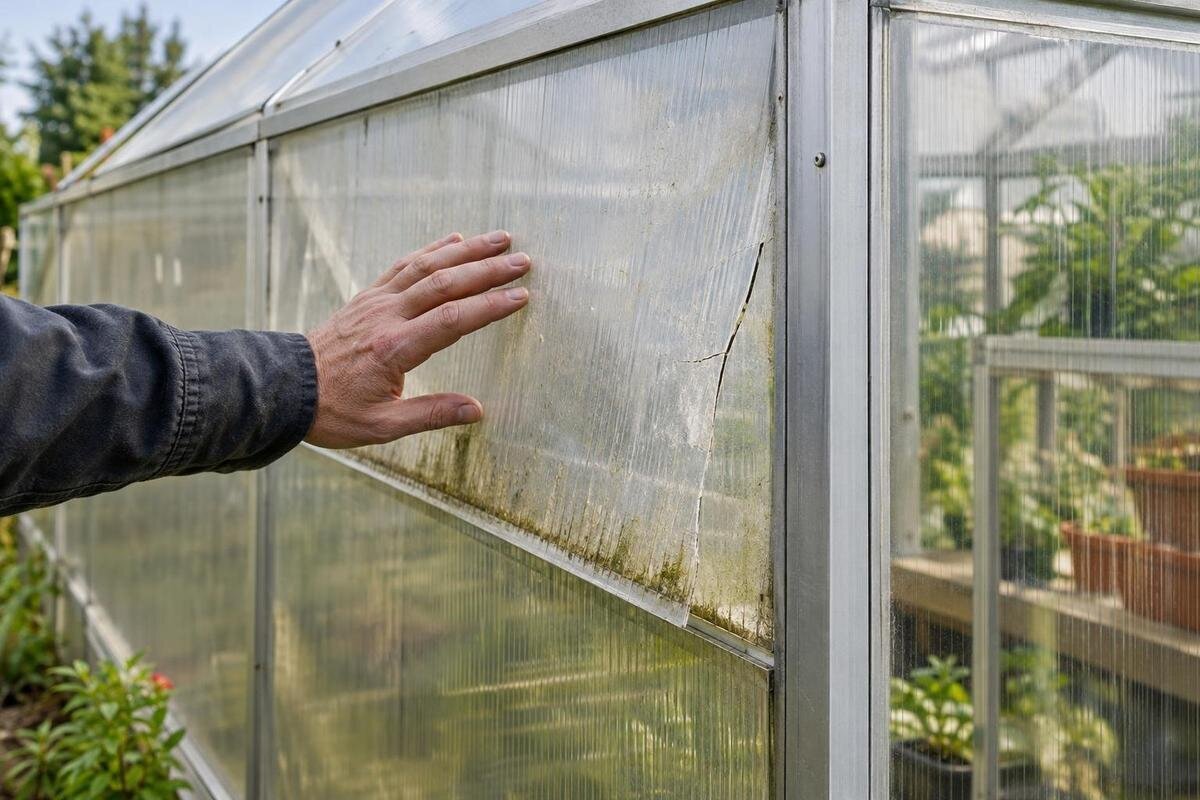
A hole, a split, a crack that runs through the sheet or a broken edge is more significant than a colour change. Pay particular attention to damage that reaches a panel edge or fixing area, because it may affect how the sheet sits in its frame. A deep gouge can also deserve closer inspection if it has altered the surface or created a visible fracture line. Do not assume a mark is harmless just because it is small: note its location, length and whether it appears to pass through the panel.
Damage that leaves an opening or a loose section can affect the greenhouse’s protection from weather and may allow the panel to move further. Avoid pulling at it, climbing to reach a roof sheet or trying an unapproved patch. If a panel is loose overhead, or pieces are unstable, keep people clear and arrange an assessment by a qualified installer. A photograph taken from a safe position, along with notes about when the damage appeared, can help the supplier decide what needs to be inspected.
Movement and gaps point to a fit problem
A panel that has shifted, rattles in ordinary conditions, bows away from neighbouring sheets or leaves a new gap may not be seated as intended. Look for a lifted corner, an edge that has moved out of its visible channel or a gap that was not present before. These signs merit attention even if the sheet itself has no obvious crack. Do not push or lever the panel back into place: doing so could worsen damage or obscure the reason it moved.
From a safe position, photograph the panel and its surrounding frame, and note which wall or roof section it occupies. Describe the movement separately from any visible damage: a sheet that rattles but looks intact presents a different problem from one with a broken corner. A poor fit can involve a retaining component or the frame as well as the sheet. When contacting the supplier, give the exact model name from your paperwork; if yours is a T-Model Orangery Greenhouse, identify it by that name and describe the panel’s location. Say whether the gap is new, whether it stays visible and whether a previous adjustment has already been made. These observations help explain the fitting problem without assuming that the panel itself is the cause. The model name identifies the greenhouse, but the supplier still needs to confirm the correct spare.
Clouding and colour change need context
A faded, hazy or marked surface can look like a failure when it is mainly a cleaning issue or a cosmetic change. Check whether the mark is on the accessible surface, whether it changes after manufacturer-approved cleaning and whether nearby panels show the same appearance. Fine surface marks and deposits do not automatically mean the sheet has lost its function. If clarity remains noticeably different, describe what you see rather than diagnosing the cause from appearance alone.
Some polycarbonate panels have internal channels or layers. If your panel does, moisture or haze that appears to be inside it is different from dirt on the outside and may not be removable by wiping. Describe whether the affected area is a small patch, a band near an edge or a change across most of the sheet. Also distinguish a persistent mark from moisture that is visible only at certain times; record what you observe without assigning a cause. Do not drill into the sheet, open its layers or apply chemicals to investigate. If your paperwork identifies a Pyramid Greenhouse, include that exact name in the enquiry alongside the condition notes. Ask whether the appearance warrants further assessment for your installed panel type, rather than assuming either that all haze is harmless or that every cloudy sheet needs replacing.

Water at a panel may start elsewhere
Water below a panel does not prove that the polycarbonate sheet itself has failed. It may be entering at a joint, an edge or another part of the greenhouse, then running to a different point before dripping. A draught near a panel can also come from a gap in the frame or a retaining component. A crack or hole is a clearer sign of sheet damage, but the location of a damp patch on its own is not enough to identify the cause.
Record when the water appears, where it first becomes visible and whether the panel is wet on its surface or seems to hold moisture inside. Separate the first visible wet point from the place where water eventually drips onto a bench or the floor. If you cannot see where it starts, say so rather than naming the nearest sheet as the faulty one. Take photographs rather than removing trim to investigate, and note any visible crack or gap separately from the water trail. This keeps the enquiry focused on finding the affected component before ordering a panel. If you are also considering a new model, such as one from the Limited Edition Aluminium Greenhouses with Storage range, make that a separate enquiry. A request for help with water entry should clearly identify the existing greenhouse, not the model you might buy instead.
Inspect panel edges and the supporting frame
The panel edge and the parts that retain it can help explain a poor fit. From a safe position, look for a visible gap, a displaced retainer or a panel edge that no longer sits evenly alongside its neighbours. Do not remove a strip or seal simply to see what is underneath. A damaged or displaced component can make a sound panel appear to need replacement, so ask the supplier or installer to assess the interface before ordering a new sheet.
Also look for visible changes in the frame around the affected panel, such as a section that appears out of line or a support that no longer meets the sheet as it did before. Describe where the change occurs: at one corner, along an edge or across several neighbouring panels. If an earlier photograph shows the same area, include it to illustrate the difference rather than trying to judge alignment from memory. Repeated damage in the same position is a reason to ask for the frame and retention system to be reviewed, not to add screws, sealant or improvised support. For a Bloomcabin Prestige Greenhouse, give that model name when reporting the concern. Make clear whether you are reporting a visibly damaged sheet, a displaced retaining part or a possible frame issue, so the assessment is not limited to replacing the panel alone.
Repair, reseating or replacement?
The right response depends on what has failed. Cleaning may be enough for dirt on an intact surface; a retaining component may need attention if the sheet has shifted; a cracked or punctured panel may need an approved replacement. Follow the greenhouse manual and the maker’s advice rather than applying a generic adhesive, tape or sealant. If the manual describes a repair procedure, check that it applies to your exact panel and model before proceeding.
Compare the scope of a local repair with the work needed across the rest of the greenhouse. If one panel is damaged and the frame is sound, a compatible spare may be the relevant enquiry. If several components are affected, ask an installer to assess the whole structure before deciding. Request a clear description of what each proposed option addresses: the sheet alone, its retaining parts or additional frame work. A panel-only quote and a broader repair quote are not the same scope of work. If you also want to compare a complete replacement, a listing such as the Spacious Greenhouse belongs in that separate comparison. Consider what you need from the greenhouse as a whole, while keeping the immediate repair decision tied to its condition. Do not treat a new model’s listing as evidence that its glazing can be used in the existing frame.
How to identify the correct spare panel
Do not order by appearance alone. Find the greenhouse model and any serial, part or order number on the original paperwork, manual or product label. Note whether the damaged sheet is in the roof or a wall, its position and which way it faces. If the panel type or construction is visible without dismantling anything, photograph it; do not remove a damaged sheet just to measure it. Use documented measurements where available and ask the manufacturer to confirm what else is needed.
When requesting a spare, send clear photographs of the whole greenhouse, the affected panel and its frame, plus the information from your paperwork. Label each photograph with the panel’s location so the supplier can connect the close-up to the wider view. If several sheets need attention, give each one a simple reference and keep that reference consistent throughout the enquiry. Ask the supplier to confirm the part identifier and compatibility before ordering, including any relevant panel construction, profile or orientation. The Aluminium Classic Greenhouse page can help identify the complete model you are referring to, but it is not a spare-panel cross-reference. If the original part number is unavailable, state which details you do have and which remain uncertain. Let the supplier or installer establish the match rather than filling those gaps with measurements or specifications taken from a similar-looking sheet.

When several panels are affected
Damage across several sheets can change the assessment, but it does not automatically mean that every panel needs replacing. Note how many are affected and whether the pattern is consistent: isolated impact damage differs from widespread clouding, repeated movement or cracks in the same part of the frame. Compare the panels only after suitable cleaning and in similar light. This record helps an installer distinguish a group of ageing sheets from a local event or a problem with the way panels are retained.
Ask for an assessment that covers the affected sheets and any related frame or retaining components, rather than a quote for panels alone. Keep the findings for each panel separate: one may be cracked, another may have shifted and a third may only look cloudy. This avoids turning a mixed set of observations into a blanket request to replace all the glazing. Ask which sheets need attention and why, and distinguish necessary work from a preference for a more uniform appearance. If parts are unavailable or the condition extends beyond the glazing, compare repair with complete replacement. A Lean-to Greenhouse is one named model you may wish to enquire about separately, but neither its name nor its appearance establishes suitability for your site. Keep the condition assessment of the existing greenhouse distinct from the requirements for any new one.
Plan the work and keep the records
Panel replacement can involve awkward or elevated work, particularly on a roof. Do not stand or lean on polycarbonate, climb onto the greenhouse or handle a loose overhead panel as if it were secure. If access is difficult, the sheet is unstable or the frame appears damaged, leave the assessment and work to a qualified installer. Use the instructions for the exact greenhouse and panel; do not make structural changes or substitute a different glazing material without approval from the manufacturer and an installer.
When the work is complete, keep the part number, supplier confirmation, date and photographs with the greenhouse paperwork. Note which panel was replaced and retain any instructions for its care or later inspection. Record whether retaining parts or other components were also changed, so a future enquiry does not depend on remembering the details. A photograph of the completed work provides a useful comparison with the earlier damage record. Keep records of separate repairs under their own dates rather than treating the whole greenhouse as newly glazed after one sheet is replaced. If the original model is no longer supported and you choose a complete replacement, such as a model from the Limited Edition Aluminium Greenhouses range, start a separate set of records for it. Retain its confirmed glazing details rather than carrying over the old greenhouse’s panel information.
Frequently asked questions
Does yellowing mean a polycarbonate panel must be replaced?
Not by itself. Yellowing or clouding can be an appearance change, and dirt or deposits may contribute. Clean the panel only as its manufacturer recommends, then check for cracks, holes, a loose fit or other damage. If the change remains and affects how the greenhouse works for you, ask the manufacturer or an installer whether it matters for that panel specification.
Can I patch a cracked panel with tape or sealant?
Do not assume that a household tape, adhesive or sealant is compatible with the panel or its frame. A surface mark is different from a crack through the sheet, a hole or a split edge. Check the greenhouse manual for an approved repair method; if none is specified, ask the supplier or a qualified installer whether the panel should be replaced.
Can I use any polycarbonate sheet with the same measurements?
No. Similar-looking sheets may differ in construction, thickness, profile, edge details or the way they are retained. Those differences can affect whether a panel fits and is suitable for that greenhouse. Use the exact spare-part identifier where available, and have the manufacturer or installer confirm compatibility before ordering. Do not assume that cutting a different sheet to size will make it a suitable substitute.
How can I tell whether moisture is on the panel or inside it?
Check whether the moisture is on an accessible surface or appears to sit between the panel’s layers or in its internal channels, if it has them. You may be able to wipe an accessible surface without dismantling anything; moisture inside the panel needs a different assessment. Photograph the location and ask the manufacturer or installer what it indicates. Do not drill into the panel or try to open its layers.
Do I need to replace every panel at the same time?
There is no universal rule. One damaged panel may call for a local replacement, while damage across several panels or a wider frame problem may need a broader assessment. Consider the condition of each sheet, whether exact spares are available and whether matching panels can be confirmed. An installer can help define the work; a uniform appearance alone is not a reason to replace sound panels.
A replacement decision is strongest when it is tied to a visible fault: a crack, hole, damaged edge, persistent movement or a panel that no longer protects the greenhouse as intended. Clouding and colour change deserve attention, but do not settle the question on their own. Record what you see, check the model paperwork and have the manufacturer or a qualified installer confirm whether the sheet, its retaining parts or the wider frame needs attention. That gives you a clearer basis for choosing a compatible repair or replacement.
