
Before You Order a Freestanding Greenhouse, Choose Its Position
Greenhouse buying guide
Buying a freestanding greenhouse is easier when you know where it will stand before comparing models. The garden sets the practical limits: sunlight, wind exposure, ground conditions, clearances and access can all change whether a particular product fits. Walk the property, identify one or two possible positions and note what needs checking. Then compare those notes with the product information and ask about unresolved installation requirements before ordering. The site is the first part of the purchase decision, not an afterthought.

Site checks before you order 1
Choose the site before comparing greenhouse models
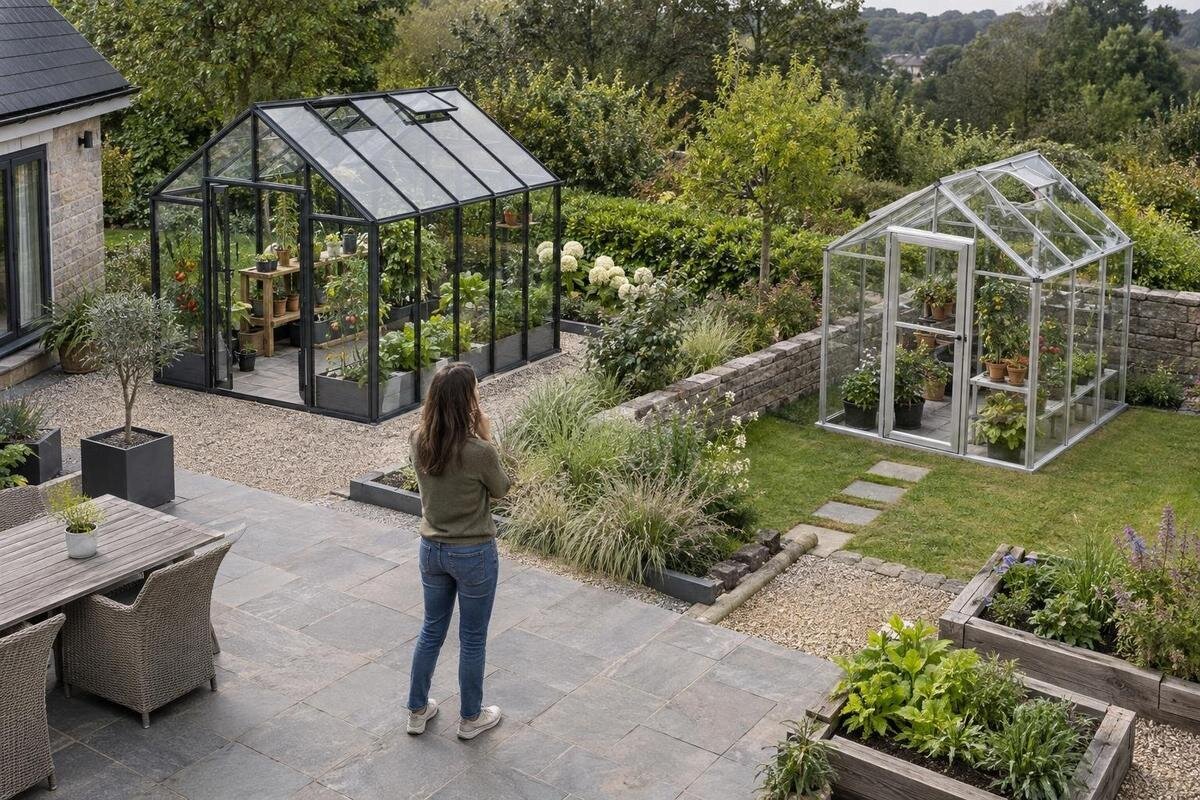
A freestanding greenhouse has to fit the garden as it exists, not the open rectangle suggested by a product photo. Choose one or two likely positions and mark each on the ground before browsing. Note nearby paths, beds, paved areas, gates, boundaries and buildings, as well as where people normally walk or work. If two locations are possible, keep both in play rather than settling on the first clear patch. One site may be easier to reach; another may offer more room around the structure. Recording both gives you a practical comparison and helps rule out a poor fit before you spend time on model details. A photograph can help you remember each layout, but tape measurements should set the limits.
Keep model choice provisional until those site notes exist. A product image cannot show whether an opening will face a fence, whether the footprint leaves room to move, or what base arrangements are required. A listing such as the Limited Edition Aluminium Greenhouse is a model to compare, not proof that it suits a particular position. Check its published dimensions and installation information, then ask the seller about anything not stated. Save the exact product details you use, so any follow-up question relates to the right model. Choosing the site first stops you from treating an attractive product as fixed and trying to make the garden accommodate it afterwards.
Check sunlight at different times of year
Observe each candidate spot at different times of day rather than judging it from one visit. A house wall, tree canopy, neighbouring building or fence can cast a long shadow in the morning or later afternoon even if the ground is bright at midday. Note direct sun and shade separately, and repeat the check in another season if tree cover or the sun’s path changes noticeably. Record approximate times or conditions instead of writing only sunny or shaded; that makes two possible sites easier to compare. A sketch or a few dated photographs can help, but assess the precise position where the greenhouse would stand, not just the view from the house.
The right balance depends on what you plan to grow and on the greenhouse’s stated requirements, so there is no universal position rule that fits every garden. Write down whether your intended plants need a particularly bright area, some shade, or a mix, and compare that plan with your observations. When considering Bloomcabin Orangerie, or any other model page, check its actual dimensions and placement instructions; the name does not tell you how light falls in your garden. If a site is bright for only part of the day, treat that as a deliberate trade-off, not something to discover after delivery. Do not choose an orientation from a generic rule without checking the site.
Site checks before you order 2
Assess wind and available shelter
Compare how open each candidate site is and which boundaries might provide some shelter. A hedge, fence or building can reduce direct exposure from one side but leave the site open elsewhere; gaps between structures may also channel gusts. Conditions can differ between two corners of the same garden, so do not judge from the property as a whole. Note nearby trees and branches too, since they can affect the position in more than one way. If you cannot assess the exposure yourself, ask someone familiar with the site rather than assuming a fence will shield it. There is no simple shelter label that replaces a model-specific wind check.
Ask the retailer or an appropriately qualified installer what wind exposure and securing arrangements the selected greenhouse requires, and whether the proposed position is compatible. The Glass Greenhouse Plus 385 listing is one product page to examine, not evidence of a wind rating or a particular installation method. Do not infer how a model will perform from its name, image or apparent weight. If a spot is strongly exposed or the required guidance is unavailable, pause before ordering and get the relevant advice. Moving the proposed location may be simpler than trying to resolve an unanswered site question after purchase. Keep the question tied to your exact property and chosen model.
Inspect the ground and establish the base requirements
Inspect the exact patch and how water moves across it. A lawn that looks level may slope slightly, and ground that seems firm in dry weather may become soft or hold water after rain. Note depressions, uneven areas, existing paving, nearby drains and runoff from roofs. If possible, check the site after rainfall as well as when it is dry; record where water collects and how long the patch remains wet. These observations identify questions about support and drainage, but do not establish that a surface is suitable for a particular structure. For uneven ground, persistent pooling or a substantial slope, get advice before choosing a base or preparing the site.
Check the exact base and ground-preparation requirements for the model you are considering. The listing name Bloomcabin Prestige Greenhouse Metal Base contains a base reference, but that is not confirmation that it matches your ground or that no other preparation is needed. Ask what is included, what support the greenhouse needs, whether additional work is required and who can advise if the surface is uneven. Do not assume a product-name reference to a base makes every patch ready for installation. Where preparation involves levelling or structural work beyond routine garden tasks, consult a qualified professional rather than improvising technical details from a photograph.
Site checks before you order 3
Measure the footprint and space around it
Measure the outside area the chosen model would occupy, not just the space you hope to use for plants. Use dimensions in the product information to mark the footprint with tape or string. Then check how much room is needed around it for access, cleaning and routine maintenance, using any clearances the supplier specifies. Include the direction a door or other opening must operate, where relevant, and make sure it will not be blocked by a fence, path or stored items. A greenhouse can fit on paper but remain awkward to use if the approach or working space is left out. Keep growing capacity separate from the footprint check.
Compare those measurements with a specific product page, such as Aluminium Classic Greenhouse, rather than relying on the model name or the apparent scale of a gallery image. Check its stated outer dimensions and height, then confirm any opening direction or additional space the instructions call for. If the measurements or clearances are not published, ask the seller; do not estimate them from a photograph or a number in the model name. Mark the outline on the ground and walk the planned access route; check whether the remaining space suits the way you expect to use and maintain it.
Account for trees, walls and fixed obstructions
Look above and around the plot, not just at the ground. A tree canopy can change the light pattern and bring seasonal leaves or branches into the area; eaves, gutters, downpipes, fences and stored garden items can restrict clearance or send roof water towards the site. Check whether the greenhouse would sit under overhanging growth, beside a service point, or where routine pruning and cleaning would be awkward. Before digging or other ground disturbance, identify buried services and ask an appropriate professional if their location is uncertain. Note any maintenance access that must remain clear; guessing a universal offset is not a substitute for the model’s instructions.
If the candidate position is close to a building, verify that the chosen product is designed for the arrangement you have in mind. Wording in a listing such as the T-model greenhouse orangery for a wall base is a reason to check its exact fitting and clearance requirements, not permission to assume it can stand freely beside any wall. A roof edge or drainpipe may also affect water flow and access. Use the product instructions and seller’s advice to establish the required relationship; if the setup remains unclear, do not treat a nearby wall as part of the greenhouse’s support.
Site checks before you order 4
Plan the delivery route and everyday access
Check the route from the street or driveway to the proposed position, not only the plot itself. Measure narrow gates, turns, steps and paths, and note low branches or other obstacles that could affect moving items through. The greenhouse may fit the site while the route to it is awkward, so compare access with the seller’s delivery and handling information. If access depends on moving garden furniture, lifting something over a boundary or temporarily blocking a path, decide whether that is realistic before ordering. This is a purchase consideration as much as a garden-layout detail.
Ask the seller what delivery includes, where the order will be left, and what access or handling limits apply; do not assume that delivery means the components will be taken to the final position. If assembly is planned on site, consider where parts can be set down and whether there is room to work without blocking the household’s usual route. Also consider everyday access after installation: taking tools to the greenhouse, carrying plants or supplies, and reaching the area for maintenance should not depend on squeezing past a permanent obstruction. These checks help distinguish a feasible position from one that is merely large enough on a plan.
Confirm that the position suits a freestanding model
Be precise about what you mean by freestanding. A greenhouse intended to stand independently may have different site requirements from one whose position or base is tied to a wall. Do not use a blank wall or solid-looking boundary as assumed support, and do not assume that a standalone-looking product image proves that the model can be installed without an adjoining structure. Check how the manufacturer classifies the chosen greenhouse and what base, support and clearance it specifies. This matters especially when the only convenient position is tight against a house or outbuilding; appearance alone does not settle the installation type.
A page titled Aluminium Wall Greenhouse can be useful when comparing product categories, but its name is not a complete installation specification. For a freestanding purchase, confirm on the chosen product page that the model is designated for that arrangement, then check its base and clearances. If the description or images suggest a wall connection but do not explain it, ask the seller rather than guessing. The aim is to buy the type of greenhouse your selected position can accommodate, not to change the site plan to fit an unclear label.

Site checks before you order 5
Match your site notes to each product listing
Once a candidate position has passed the basic checks, compare each product page with your notes line by line. Verify the stated outer dimensions and height, the required support or base, specified clearances, the direction of doors or openings where relevant, and any assembly or securing information. Check delivery terms as a separate issue. Do not use a model number, photo scale or product name to estimate dimensions or installation needs. Keep a record of what is confirmed and what still needs a seller’s answer; a product can look suitable while a key requirement remains unknown.
If Pyramid Greenhouse for Masonry Bases is on your shortlist, confirm from the product information which base arrangement applies and whether it matches your intended position. Its name alone does not establish that existing paving, a garden wall or another base will do. Ask the seller to clarify compatibility and preparation, and whether these details are included in the order or need separate planning. This is not a technical calculation; it is a way to avoid choosing a model whose stated installation requirements do not match the site. Update your notes if the answer changes what the position needs.
Keep the order open until key questions are answered
Compare possible positions in a written record. For each one, note what you have confirmed about sunlight, wind, ground, drainage, clearances, obstacles and access, then list unanswered questions beside it. Use a separate mark for unknown rather than counting an unverified detail as a yes. If a site works only on the assumption that a door can open or water can drain away, check that point again. This gives you a fair comparison between locations and makes it easier to assess a product against observable conditions and information supplied for that exact model.
If neither position works, pause rather than buying and hoping to adapt the garden after delivery. You may be able to choose another site or a different greenhouse, but compare that change against the available space and the model’s stated requirements again. For uncertain ground or structural questions, consult a qualified professional; for unclear product details, ask the seller. When the chosen model and position match on the details you can verify, you have a sounder basis for ordering a freestanding greenhouse. An unresolved limitation is a reason to revisit the choice, not to guess.
Frequently asked questions
How much sunlight should a greenhouse position get?
There is no single amount that suits every greenhouse and growing plan. Observe the candidate position at different times of day and, if possible, in different seasons. Note where shade falls, then compare that pattern with the needs of the plants you intend to grow and the selected model’s instructions.
Is a sheltered corner always the best choice?
No. A hedge, fence or wall may reduce exposure from one direction but still leave the site open elsewhere, or affect sunlight and water flow. Check the exact position and compare its exposure with the requirements for the greenhouse you are considering.
Can I put a freestanding greenhouse on sloping ground?
Do not assume that a sloping site will suit a particular model. Check the product’s base and ground-preparation requirements, and ask the seller about anything unclear. For substantial unevenness or structural work, get advice from a qualified professional rather than estimating what is needed.
What should I measure before ordering?
Measure the available area and compare it with the greenhouse’s stated outside dimensions. Allow for any specified clearances and the space needed for doors or other openings. Also check the route through gates and along paths, and confirm that the planned position leaves practical access for use and maintenance.
Should I choose the greenhouse before choosing its position?
Identify and measure one or more possible positions first, but keep the model choice provisional until you have checked its exact requirements. If the product details do not make clear whether a site will work, ask the seller before ordering or reassess the position.
The best position is the one that suits your growing plans and meets the selected greenhouse’s stated requirements. Record the light, exposure, ground, clearances and access, then check the exact product information against those notes. If a key requirement is uncertain, resolve it before checkout. Choosing the site first gives you a clearer basis for buying a freestanding greenhouse.
