
How to Calculate Rainwater Tank Size for a Greenhouse
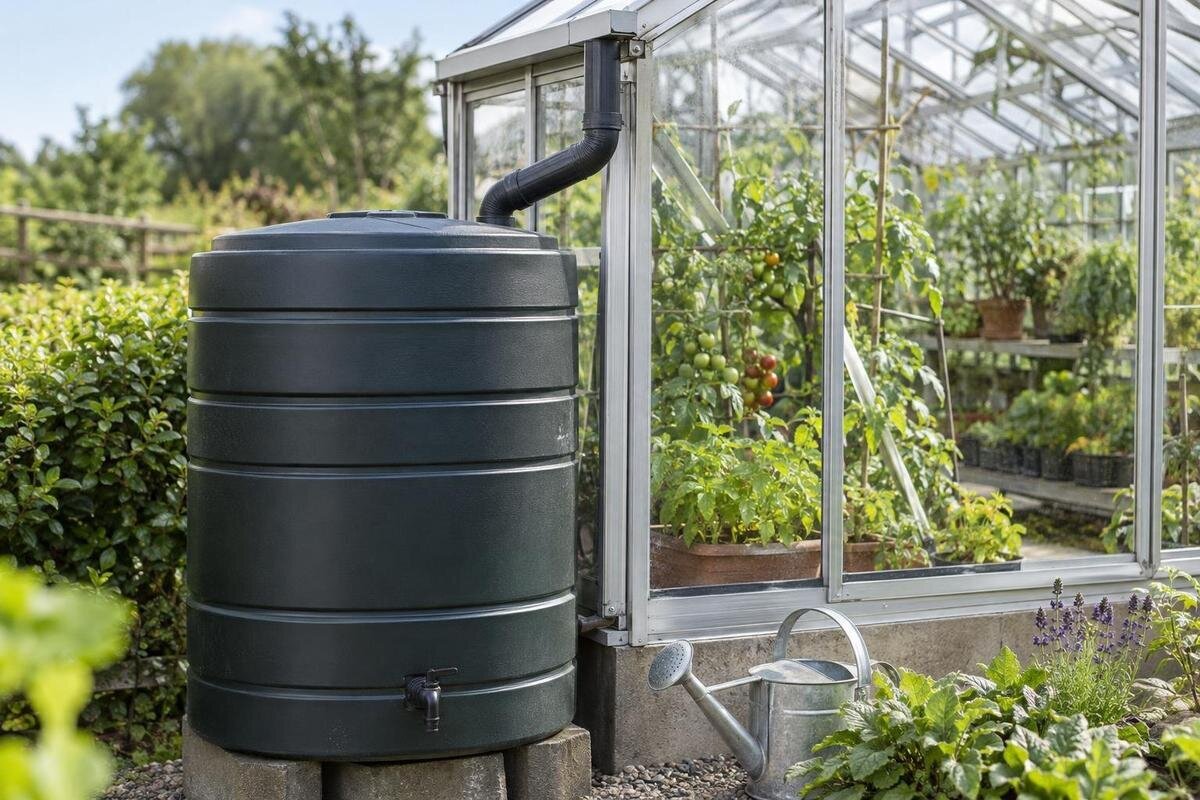
Greenhouse water planning
To size a rainwater tank for a greenhouse, compare what the roof can collect with how much water the plants use and how long you want stored water to last. Roof area and local rainfall determine potential supply; watering records and the gap between useful rain events determine demand. There is no standard number of litres per square metre that suits every greenhouse. A tank can carry surplus from a wet spell into a drier one, but it cannot correct a long-term shortfall. Calculate both sides, allow for collection losses, and plan where excess water will go when the tank is full.

What to check before choosing tank capacity 1
Choose the dry spell the tank must cover
Think of the tank as a buffer between two uneven flows: water enters when it rains and leaves whenever you water. First decide what the buffer is for. It might cover a short gap between showers, or hold some surplus from wetter months for a drier part of the growing season. Those goals can lead to very different volumes. A tank size based only on greenhouse floor area, or on what a nearby gardener owns, ignores both local rainfall and the crops being watered. Write down the period you want to cover and whether rainwater is a supplement or the only planned source.
Then check whether that goal is possible from the roof. Estimate net collection for the relevant rainfall period, and estimate the water required over the same period. Keep the units consistent: compare litres collected over ten days with litres needed over ten days, not annual supply with daily demand. If demand is consistently greater than collected supply, a larger tank cannot create the missing water; it can only retain a surplus that actually arrives. If collection exceeds demand but the tank empties before rain returns, storage capacity may be the issue. Separating those cases helps avoid choosing a volume that is either too small or rarely filled.
Measure the roof catchment that actually drains to the tank
Rainfall depth is measured against horizontal ground area, so calculate the roof’s horizontal projection rather than adding the sloping surface areas. For a straightforward rectangular greenhouse, use plan length multiplied by plan width as a starting point. For several roof planes, add the horizontal projected areas of the portions that drain to the tank; do not count a single vertical rainfall depth once for each sloping face. Include an overhang only if it feeds the gutter. Do not count a nearby house roof, wall or other surface unless its runoff is deliberately connected to the collection system.
When comparing the Limited Edition Aluminium Greenhouses, use the dimensions for the exact greenhouse you intend to install, then mark which eaves or outlets will feed the tank. A catalogue area figure may help you compare scale, but it does not confirm the roof projection or which edges have gutters. If the available drawing shows only the greenhouse area, ask which roof sections drain to the proposed outlet. A section that cannot deliver water to the tank should not be included in its catchment calculation.
What to check before choosing tank capacity 2
Use rainfall data for your site, not an annual average
Look up rainfall for the greenhouse site, rather than relying on a broad regional or national average. A nearby gauge or representative weather station is a better starting point; where possible, compare monthly totals across several years and keep daily data for dry intervals. Check that the units and period match your calculation: millimetres per month are not millimetres per day. The monthly pattern matters because a wet-season surplus can be separated from watering demand by a long dry spell. One annual total hides when the water arrives, and one unusually wet year may make a small tank appear adequate.
Use the record to ask two questions: how much rain might fall on the catchment during the months you want to collect, and how long can pass without rain that meaningfully refills the tank? Daily records show gaps that monthly totals smooth over. If records are limited, treat the estimate as uncertain and choose a cautious planning period rather than relying on the largest recorded storm. A simple rain gauge at the site can improve future estimates, but it measures rainfall depth, not litres captured. Roof losses and the connections to the tank still need to be allowed for.
Convert roof area and rainfall into collected litres
Potential collection in litres equals projected catchment area in square metres multiplied by rainfall in millimetres. The conversion is direct: 1 mm of rain on 1 m² represents 1 L before losses. For example, a 12 m² horizontal catchment under a 20 mm event has a gross potential of 240 L. That is not a promise that 240 L will reach the tank. Water can be missed at the roof edge, retained on a surface, spilled from gutters or diverted before it reaches storage. For several rain events, calculate each event and add the amounts for the period you are modelling.
To estimate usable inflow, multiply gross yield by a collection factor between zero and one, chosen to reflect the actual roof and gutter setup. Do not assume one universal factor: use measured results where available or a cautious estimate supported by the system design. The T-Model Orangery Greenhouse range is listed from 16.52 m² to 30 m², but that range is not a single roof measurement; calculate from the chosen configuration. Decide whether your factor includes first-flush diversion and other losses. If it does, do not subtract them a second time; if it does not, deduct them separately.

What to check before choosing tank capacity 3
Measure the greenhouse’s irrigation demand
Plant demand is often the least certain input, so measure it rather than borrowing a figure for a different greenhouse. Over representative weeks, record the litres used for greenhouse watering and the days on which they are used. A calibrated watering can can help with a small setup; a meter can help if the supply is shared, provided you separate greenhouse use from the rest of the garden. Include the period when watering is busiest, not only a cool or quiet month. A weekly average is useful for planning, while daily notes reveal unusually high-use days.
Demand changes with the crop mix, number and size of pots, bed area, planting stage, ventilation and weather. Greenhouses with similar footprints can need different amounts of water if one is packed with containers and another has fewer plants. The Pyramid Greenhouse range is listed from 5.53 m² to 18.9 m², but that size range cannot tell you how much water a particular planting will use. Base the estimate on the crops and containers you intend to maintain, then note how use shifts through the year. Recheck it after a major change in planting, and keep non-greenhouse watering out of the total.
Calculate storage for dry periods
Choose a storage period that corresponds to a real dry gap in the rainfall record. As a simple estimate, multiply typical daily greenhouse use by the number of days you want to bridge, then add a stated allowance for variation in demand or water that cannot be drawn from the tank. If daily use varies, adding the logged amounts for the target interval is more accurate than multiplying by a yearly average. Do not count rain during that interval unless the local record suggests it is dependable and the tank can capture it. Choose any reserve to reflect the uncertainty in your own estimates rather than copying a fixed percentage.
If the aim is to carry surplus between seasons, model the sequence as a water balance: opening tank volume plus net rainwater collected, minus greenhouse demand. A result above usable capacity indicates overflow; a result below zero indicates unmet demand. Carry the remaining stored volume into the next calculation, keeping it between zero and the tank’s usable capacity. Run the calculation through a wet and dry period using local records. When comparing sizes in the Spacious Greenhouse range, listed from 47 to 70 m², calculate plant demand and connected roof catchment separately rather than using greenhouse area alone. Daily figures are better than monthly ones for identifying short dry intervals.
What to check before choosing tank capacity 4
Compare usable capacity with nominal tank volume
Tank labels can show total or nominal capacity, but the volume available for watering may be lower. The outlet may sit above the bottom, some space may be reserved at the top, and sediment or maintenance can make a portion impractical to draw. Ask the tank supplier for usable capacity at the intended outlet and compare that figure with the required reserve. If the capacity includes water you cannot withdraw, it cannot all serve the planned dry gap. Do not count water in pipes or other containers unless it is genuinely available to the same supply.
Keep square metres and litres separate when comparing products. The Limited Edition Aluminium Greenhouses with Storage range is listed from 5.52 m² to 28.08 m²; that is a greenhouse size range, not a rainwater tank capacity in litres. A title containing the word storage is not a substitute for a separate tank specification. For linked tanks, confirm how much volume is usable across the set and whether the connection keeps that water available as intended. A simple comparison table with roof area, estimated inflow, required usable litres and nominal tank volume helps keep the different figures distinct.
Allow for first-flush diversion and plan the overflow
A first-flush device diverts some initial roof runoff before it reaches storage. The amount depends on the chosen setup, so use that allowance in the collection calculation rather than applying a made-up standard volume. Also plan access to screens and gutters for maintenance: if debris blocks the route, rainfall recorded in a weather chart will not become stored water. Your estimated inflow should reflect the collection system as it will actually be maintained, rather than assuming an ideal, unobstructed route from every roof edge to the tank.
Plan what happens once the tank is full. Overflow is a normal part of rainwater collection, especially when rain arrives faster than water is used, so identify a suitable route away from the greenhouse base, paths and neighbouring property. Do not rely on the tank to absorb every storm, or direct overflow to a place where it can cause erosion or collect against a structure. When considering the Bloomcabin Prestige Greenhouse, check the collection system separately: the listing does not by itself confirm a gutter, first-flush unit or tank connection. Ask a qualified drainage professional if the outlet route or site levels are uncertain.

What to check before choosing tank capacity 5
Check the tank position and the route from roof to tank
Tank position affects whether the planned capacity can be filled and used conveniently. On a site sketch, mark the connected downpipe, tank footprint, inlet and overflow routes, and the space needed to inspect the lid, screen and outlet. Leave access for cleaning and drawing water. A tank that fits only by blocking a working path or placing the overflow beside the greenhouse may be a poor choice even if its litre rating looks right. Consider how the tank can be delivered to its position too, especially where fences, doors or narrow paths limit access.
If you are considering a lean-to greenhouse, check the actual roof edge and site arrangement when drawing the collection route. Do not assume a nearby wall or house roof contributes unless its runoff is deliberately connected. Distance and levels affect the route, so have the proposed layout checked rather than guessing from a product name. A full tank places substantial weight on its support; ask the tank supplier or a qualified professional to confirm that the chosen base and location are suitable, particularly for an elevated tank. The tank’s litre rating alone does not confirm that its support is suitable.
Use a worked example, then test the estimate
Here is an illustrative calculation, not a product specification. Suppose the selected roof has a measured horizontal projection of 12 m² and the rainfall record gives a 20 mm event: 12 × 20 = 240 L gross. If, purely for this example, a collection factor of 0.8 represents all losses, estimated net inflow is 192 L. Suppose a watering log shows 12 L per day and you want to cover ten rainless days: that interval needs 120 L of usable water. The Aluminium Greenhouses range is listed from 3.77 m² to 28.08 m², so this 12 m² catchment is not a default for every greenhouse; use the chosen model’s actual roof projection.
Those results answer different questions. At least 120 L of usable water at the start of the dry interval would meet the example demand, before any chosen reserve. To retain the entire 192 L event in an empty tank, you would need at least 192 L of usable space; a partly full tank has less room available and will overflow sooner. After rain, compare the tank-level change with your estimate and keep a watering log. If the tank empties early or repeatedly overflows before a dry spell, check the rainfall, demand and collection assumptions before changing capacity.
Frequently asked questions
How do I calculate litres collected from a greenhouse roof?
Multiply the roof’s horizontal projected catchment area in square metres by rainfall in millimetres. The result is the gross potential in litres: 1 mm over 1 m² equals 1 L. Reduce it by a collection factor or separate allowance for losses before treating it as usable inflow.
Should I use the sloping roof area or the greenhouse footprint?
Use the roof’s horizontal projection: rainfall depth is measured vertically against a horizontal area. For a straightforward rectangular roof, plan dimensions can help establish that projection. Include only roof sections that drain into the collection system, and check the actual plan rather than assuming the greenhouse’s stated area is the catchment.
Can I size the tank using annual rainfall?
Annual rainfall can help estimate total potential supply, but it does not show when rain arrives or how long the tank must bridge a dry spell. Use local monthly figures for broad seasonal planning and daily records where available to check the gaps between useful rain events.
How much extra tank capacity should I allow for first flush and overflow?
There is no single extra volume that suits every setup. Account for first-flush diversion as a collection loss, either in your collection factor or as a separate deduction, not both. Overflow is water the tank cannot hold once full, so plan a suitable route for it rather than counting it as extra capacity.
What if plant demand is greater than the roof can collect?
A larger tank cannot store water that never reaches it. Recheck the demand estimate and collection losses, decide how much of that demand rainwater is meant to supply, and consider another water source or a properly connected catchment area. More storage helps only when surplus water is available to retain.
A useful tank size follows from two separate estimates: the usable water needed through a chosen dry gap, and the surplus your connected roof can realistically deliver. Compare those figures with the tank’s usable capacity and the site’s overflow route. A local rainfall record and a short watering log make the estimate easier to refine; the result should reflect your greenhouse and planting, not a generic rule.
