
Growing Cape Gooseberries in a South African Greenhouse
CAPE GOOSEBERRIES UNDER COVER
Cape gooseberries can crop well under cover, but they are not a quick project for every greenhouse. They need a long, warm growing window, bright light and room for a branching plant; an unheated structure may extend the season without protecting against every cold night. Heat can also build quickly on sunny days. Before planting, judge your local frost risk and summer conditions, plan the plant’s mature spread and support, and learn to recognise ripe berries by colour and husk condition rather than size alone.

Is a greenhouse suitable for Cape gooseberries?
Cape gooseberry (Physalis peruviana) is a frost-sensitive perennial suited to warm growing conditions, but in colder areas it is often grown as an annual. It needs a long growing season: the plant must establish, flower and set fruit, with enough warmth left for the berries to ripen. A greenhouse can shelter young growth and add useful warmth on sunny days, but those gains depend on the weather and the structure. An unheated greenhouse does not maintain summer conditions through a cold night. A late start may produce flowers without leaving enough time for mature fruit, so think about the whole crop cycle rather than the first bloom alone.
South African conditions vary with location, altitude and exposure, so there is no single best planting month. Begin with local frost risk and estimate how much warm weather will remain after transplanting. In a warm, frost-free garden, growing under cover may add little; in a cooler site, a greenhouse may extend the useful season only if light and night-time conditions remain suitable. If the crop would need ongoing heating to survive or finish ripening, weigh that demand against the likely harvest. An unheated greenhouse should not be treated as winter protection without checking temperatures at plant height.
Light, heat and ventilation
Choose the brightest suitable growing position. Persistent shade can produce weak growth and limit flowering, while a mature plant may shade neighbouring crops as its branches spread. A greenhouse is not automatically sunny: trees, fences and nearby buildings can cast shade, and the sun’s path changes through the year. Observe the proposed bed at several times of day and, if possible, in more than one season. Do not put the plant in a dark corner simply because it is vacant. Good light supports stronger growth and makes flowers, developing husks and pests easier to inspect. Leave room for other crops that need their own light as the canopy expands.
Heat management matters just as much. A closed greenhouse can warm quickly in strong sun, so make sure available doors or vents can be used and check conditions near the foliage rather than guessing from outside. A minimum–maximum thermometer helps reveal hot afternoons as well as cold nights; either extreme can slow growth or interfere with flowering. Take readings on sunny days and after cool nights, since one comfortable afternoon is not a season-long picture. The Bloomcabin Prestige Greenhouse with Metal Base is listed in footprint options from 3.77 to 28.08 m². Use the chosen size to sketch a bright bed, access path and eventual canopy; the area range alone does not tell you how many plants will fit.
Plan for the plant’s mature spread
Plan for a branching shrub, not a compact crop or a climbing vine. A Cape gooseberry transplant can look small, then send out side shoots that lean into paths and neighbouring plants. Give the canopy room to widen and leave an accessible side for watering, pruning and picking. Keep doors, vents and routes through the greenhouse clear. If you are considering several plants, start with fewer than your maximum estimate and observe how they spread in your conditions. Crowding makes it harder to inspect flowers, spot pests and collect fallen fruit, and can leave interior growth poorly ventilated.
Draw the layout using the plant’s expected mature spread, not its nursery-pot size. Include a stake or cage, any container, walkways and enough access to retrieve fruit that drops beneath the branches. The Spacious Greenhouse is listed from 47 to 70 m², a footprint range to compare for a larger mixed-crop plan, not a recommendation that one Cape gooseberry needs a large house. A smaller space may be workable for one plant if the arrangement leaves room; a large greenhouse can still feel crowded once beds, shelves and paths are in place. Sketching the plan helps you judge usable growing space rather than relying on total floor area alone.
Sow and transplant around local frost risk
Start from seed or a healthy young plant, and follow the seed supplier’s germination guidance if sowing. Seedlings need warmth to germinate and strong light once they emerge; warmth without enough light tends to produce thin, stretched growth. Use a clean tray or small pots, keep the growing medium moist but not saturated, and pot on carefully as roots fill the starting space. If seedlings are raised indoors, acclimatise them gradually before moving them to their final position so the change in sun and temperature is not abrupt. Avoid starting so early that they sit crowded in small containers while you wait for safe transplant conditions.
Set transplant timing by local frost risk and the warm weather still available, not by the first sunny afternoon. In an unheated greenhouse, take readings near the planned bed or pot at night; a warm day does not show what a young plant will experience after sunset. The Aluminium Classic Greenhouse is listed in areas from 3.77 to 28.08 m². If you are comparing growing and propagation space, map where trays will sit temporarily and where the mature plant will stand for the rest of the season. This stops seedling equipment from taking the brightest permanent position and helps avoid planting into space already committed to other crops.

Soil, containers and watering
Use fertile, freely draining soil in a bed. Cape gooseberries need a steady supply of water as they establish and carry fruit, but roots that remain saturated can suffer. Add well-rotted compost if the bed lacks organic matter, and avoid trying to force growth with heavy nitrogen feeding: excessive leafy growth can come at the expense of flowers and fruit. Because the roof diverts rainfall, a greenhouse bed may be dry even when nearby outdoor ground is wet. Check moisture in the root zone rather than judging by the surface, then water evenly; repeated shallow watering may leave deeper roots dry.
Containers are an option where there is no suitable bed, but a small root volume dries quickly and gives the plant less room to grow. Choose a stable container with drainage and enough capacity for a mature plant; a decorative seedling pot is only a temporary home. Check containers more frequently in hot weather, and consider mulch to slow moisture loss without piling it against the stem. The Lean-to Greenhouse is listed from 3.69 to 14.34 m². When comparing a compact floor plan, include the container, support and an accessible route rather than counting only the pot’s position.
Support stems without training them like a vine
Give the plant a stake, cage or other suitable support early, before its stems spread. Cape gooseberries do not climb by tendrils, so guide the main stems with loose ties rather than expecting them to wind around greenhouse framing. Use ties with room for stems to thicken, and add them at more than one point so a long branch is not forced into a bend. As fruit develops, check for sagging stems, branches resting on the floor and ties that are becoming tight. Keep the support clear of doors and vents, and use only a fixing confirmed as suitable for the greenhouse if you intend to attach it to the structure.
Pruning is most useful for removing damaged, dead or badly tangled growth and restoring access, not for turning the plant into a narrow column. Cutting heavily to fit an overcrowded space can remove flowering shoots and delay the crop. Keep healthy flowering branches where possible, and make small adjustments before stems become a dense knot. The Limited Edition Aluminium Greenhouse is listed in areas from 3.77 to 28.08 m²; compare the selected floor area with the room needed to position a support and reach the plant from a path. Spare access makes tying and picking easier than pruning around obstructions.
Pollination under cover
Cape gooseberry flowers are generally self-fertile, so you do not need to grow two plants solely to obtain fruit. Pollination still has to happen, though, and an enclosed greenhouse may have fewer visiting insects and less movement around the flowers. Ventilate when weather permits and allow pollinating insects access if practical, while protecting plants from unsuitable cold or heat. Watch what happens after flowering: a berry should begin to swell inside the husk. If flowers fall without fruit forming, consider heat, light, inconsistent moisture and how well the plant is established as well as pollination; adding more plants alone may not fix the cause.
If the plant is flowering but fruit set is poor, gently tap a flower-bearing stem or give its support a light shake while flowers are open, then observe whether more berries develop. Avoid vigorous handling, which can break shoots, and do not treat shaking as a remedy for high heat or water stress. The T-Model Orangery Greenhouse is listed from 16.52 to 30 m². Its footprint range cannot indicate how much air movement a specific layout provides, so check the openings and the planned plant position when assessing a protected growing space.
Recognise ripe fruit by its colour and husk
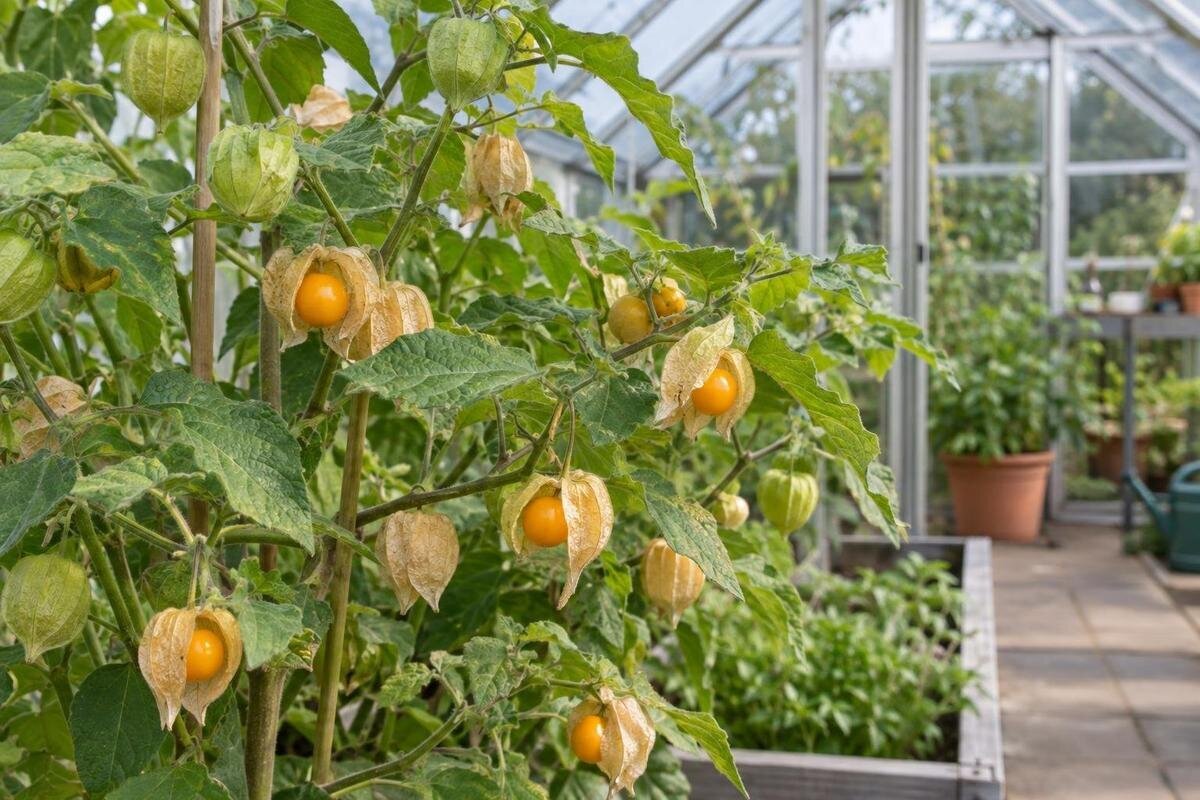
The husk is a useful sign, but check the berry inside before harvesting. As the fruit matures, the papery covering changes from green to dry, pale tan or brown; the berry becomes golden yellow to orange. A green berry beneath a green, fresh-looking husk is not ready, even if the covering looks full. Colour is a better guide than size, since a large fruit can still be immature. Leave doubtful fruit on the plant and recheck it rather than picking everything at once. When ripe, the flavour should be noticeably sweeter and more balanced than the sharp taste of an unripe berry.
Ripe fruit often drops naturally or comes away easily, so check beneath the plant and around lower leaves regularly. Collect fallen berries before they sit in damp debris, and handle them gently to avoid splitting the skin. The husk can stay on while you gather the fruit and helps keep the berry clean; remove it when preparing fruit for use. The Pyramid Greenhouse is listed from 5.53 to 18.9 m². When comparing a layout, allow room to reach beneath the canopy and pick up fallen fruit, not only space to stand beside the entrance. Access matters more once branches spread.

Manage the crop through a long season
Do not expect one large flush all at once: flowering and ripening can overlap, so pick in stages as berries reach full colour. Keep watering reasonably consistent while fruit develops, check supports as branches gain weight and clear dropped fruit from the bed. Late in the season, look at the weather and the condition of the remaining berries rather than extending the crop automatically. Warm afternoons under glass do not guarantee mild nights, and a cold spell may slow ripening or damage a tender plant. The date of the first ripe berry gives a more useful measure of season length than the first flower alone.
In frost-free conditions the plant may persist for more than one season; where frost is likely, plan for it to be lost or replaced rather than assuming an unheated greenhouse will overwinter it. The Limited Edition Aluminium Greenhouse with Storage is listed from 5.52 to 28.08 m²; when comparing a layout with built-in storage, account for that space separately from the area intended for beds, support and paths.
Troubleshoot before expanding the planting
When growth is vigorous but flowers or fruit are scarce, review the conditions rather than adding fertiliser at once. Check the light reaching the canopy, daytime heat, night-time cold, soil moisture, crowding and movement around the flowers. A plant can look healthy and still have too little season left for fruit to ripen. If blossoms drop, note whether the bed dried out or the greenhouse became especially hot, then adjust one factor and watch the next flowers. Inspect new growth and the undersides of leaves for aphids, whitefly or other pests; early checks are easier than trying to manage a dense, tangled plant later.
At the end of a trial, judge success by ripe fruit, not by the number of blossoms or full-looking husks. Record sowing or transplanting, first flower, first golden berry, temperature extremes, watering interruptions and support problems. That history can show whether the limiting factor was season length, pollination, heat or layout. If the first ripe berries arrive just as cold weather returns, an earlier start may help only when seedlings can receive enough light and suitable night conditions; otherwise, the site may not offer a worthwhile unheated crop. Try one well-managed plant before filling the greenhouse with several.
Frequently asked questions
Can I grow Cape gooseberries in an unheated greenhouse?
Yes, if your local season is warm and long enough for the berries to ripen. An unheated greenhouse can add warmth on sunny days, but it may still become cold overnight and should not be assumed to protect a frost-sensitive plant. Check temperatures near the plant before transplanting.
Do I need more than one plant for pollination?
Usually not. Cape gooseberry flowers are generally self-fertile, so one plant can set fruit. Under cover, fewer insects or still air may affect pollen movement. If flowers open but little fruit forms, first review heat, light and watering; gentle movement of flowering stems may help.
Do Cape gooseberries climb a trellis on their own?
No. It is a branching plant, not a tendril climber. Use a stake, cage or another suitable support to hold stems as they spread and carry fruit. Tie stems loosely, and keep the support clear of doors, vents and paths.
How do I know when a Cape gooseberry is ripe?
The husk dries to a papery tan or brown, and the berry inside turns golden yellow to orange. Ripe fruit often drops or comes away easily. A green berry beneath a green, fresh-looking husk needs more time, even if the husk looks full.
How much greenhouse space does one plant need?
There is no single footprint that suits every plant or layout. Allow for the mature canopy, support, a route for watering and picking, and room to collect fruit that drops. A young plant may look compact, so plan around its later spread rather than its nursery-pot size.
Cape gooseberries suit a greenhouse when the structure and local climate work together. Give the plant bright light, a long enough warm season, steady moisture, room to branch and a simple support. Keep the air moving and watch whether flowers develop into fruit; poor fruit set calls for a review of growing conditions as well as pollination. A dry, papery husk and a fully golden-yellow to orange berry are the clearest signs of ripeness. If nights stay too cold or summer heat is hard to manage, treat an unheated greenhouse as a modest season extension, not a substitute for a suitable growing climate.
