
Large or Smaller Glass Panes for a Greenhouse?
Greenhouse glazing guide
Choosing between a greenhouse with a few broad glass panes and one divided into smaller panes affects more than its appearance. Pane size changes the frame pattern, the effort of moving the glass and the scope of a possible replacement. The useful comparison is the actual glazing layout for the exact model and configuration, rather than a product photograph or a general claim that bigger or smaller is better.

What counts as a large pane?
On a greenhouse, a pane is one piece of glazing held within the frame. Large and small are relative descriptions, not standard sizes: a pane that spans a broad bay in one model may be modest in another. It does not necessarily mean a single sheet across an entire wall or roof. Roof slopes, end walls, doors and vents can use different shapes and divisions, so one overall pane count can conceal several layouts. Treat the glazing pattern as part of the design for that model; it is not automatically a swap-in choice once the frame has been specified. When suppliers use terms such as bay, section or panel, ask what each term measures.
Request an elevation or glazing schedule for the exact configuration. It should show each side and roof plane, the number of panes and their dimensions, including shaped panels at gables or corners. Check whether a figure refers to the glass or to the frame opening, and whether doors or vents are counted separately. A named product such as Pyramid Greenhouse helps identify the model, but its name alone does not establish pane dimensions. Compare the drawing for the footprint and options you plan to order, not a photograph of another size or a generic product-family image. Where drawings show only overall frame dimensions, request the glazing detail rather than estimating individual panes from the outer measurements.
How pane size changes the greenhouse’s appearance
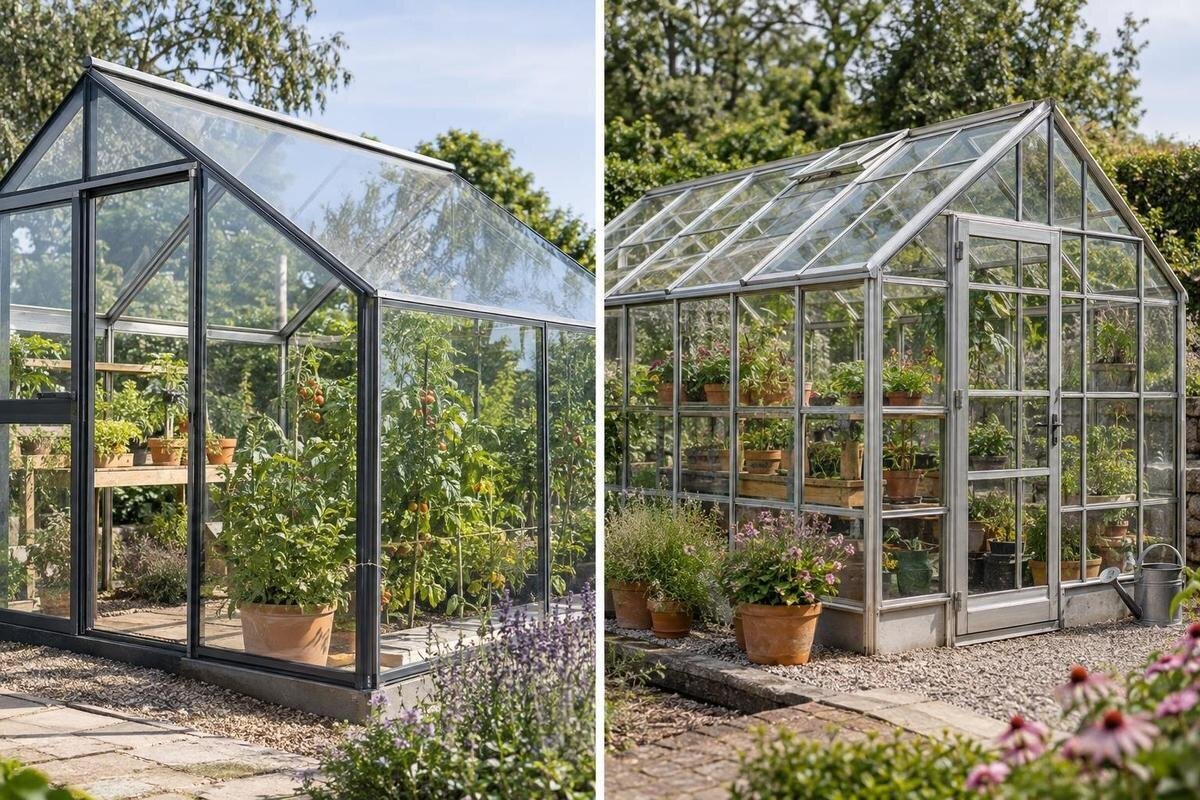
With fewer, broader panes, there are fewer visible frame divisions across a given glazed area. The result can feel more open and give a clearer view through the wall or roof, although perimeter frames and structural members remain. Smaller panes create a more frequent grid, which some people prefer for a traditional, finely divided appearance or a strong sense of rhythm. Neither style is inherently more attractive: greenhouse proportions, bar width, frame finish and the garden around it all affect the result. The same number of panes can also read differently on a tall side wall and a steep roof.
Look at a dimensioned elevation at a useful viewing scale, then consider the greenhouse from the positions you will actually use: the path, house, main doorway and inside the growing area. A close-up photograph can make frame bars seem heavier or lighter than they will appear at full size, while wide-angle images can distort spacing. Compare the pattern across the whole structure, including end panels and door framing; an attractive front elevation may have a different rhythm at the sides. Also check whether a broad bay is visually interrupted by a door, opening vent or intermediate frame member. If the view matters, judge the selected configuration rather than relying on a family name.
Pane divisions, sightlines and daylight
A pane layout changes where the frame crosses your view. If you plan to look through the greenhouse towards a garden view, fewer vertical divisions may make that view feel less interrupted. Inside, the position of bars may affect how open the space feels when you stand at a bench or look along a path. These are visual effects rather than measures of usable floor area: a wider pane does not create more growing space, and frame members still occupy their designed positions. Consider several viewpoints, not only the straight-on view shown in a catalogue.
Pane count alone is not a reliable way to predict daylight. The total glazed area, frame profile, glass specification and any surface treatment all influence what you see and how much light passes through; the roof and wall layout matter too. More divisions can mean a different amount of frame across a face, but the difference depends on the actual system. If daylight is a priority, compare the same greenhouse size and glass specification, and ask for the stated glazing arrangement rather than assuming that a single broad pane always admits more useful light. Do not infer tint or performance from a photograph; assess the pane layout separately from the glass type.
Moving and fitting larger glass panes
Glass is awkward to move because it is rigid, has exposed edges and must be protected from impact. For the same glass specification, a larger pane contains more glass and will generally weigh more as a single unit; exact weight depends on its dimensions and the specified glass. A broad piece can also be harder to manoeuvre through a gate, along a narrow path or around a corner, and its large surface can be difficult to control outdoors. These are practical handling issues, not proof that large panes are unsuitable. Have the supplier or installer assess the actual panel sizes and access route before delivery and fitting.
Smaller panes may be easier to move as individual units, but that does not make the job automatically simple: there are more separate pieces to identify, protect and position, and the total task includes every panel. Ask what the installation service covers, who is responsible for unloading and whether the delivery route has been checked. For a named range such as Limited Edition Aluminium Greenhouses with Storage, use the selected model’s glazing details—not the range title—to discuss handling. Do not base lifting plans on an image or an assumed standard pane size, and follow appropriate professional guidance for moving and fitting glass.

What happens when a pane breaks?
If a pane is damaged, the immediate question is whether it is a separately replaceable unit in that frame system. With smaller modules, a repair may involve ordering one pane rather than a broad section, provided the manufacturer supplies it individually and the frame allows that work. A large pane may mean a larger replacement piece and more difficult access, but it does not follow that damage will affect the whole greenhouse. The frame design determines how the glass is retained and whether adjacent parts must be removed; do not assume either way from the pane count.
Pane dimensions are only one part of a replacement specification. The correct item may need to match the model, position, glass type, thickness, shape and any finish or safety designation specified for the system. A roof panel and a side panel may look similar but have different dimensions. Ask the manufacturer or supplier to confirm compatibility before ordering; a glass sheet of similar size is not automatically suitable. When comparing a model such as the Bloomcabin Prestige Greenhouse, establish which details identify a replacement panel and whether the supplier uses a part reference for each position.
Planning for replacement glass
Replacement planning is easiest before you need a pane. Ask whether individual replacement panes can be ordered for the selected greenhouse, how the correct position is identified and what details the supplier requires to match the part. Confirm whether replacements are supplied as bare glazing or as another assembly, and ask for a written quotation for the item and any fitting service if available. Availability, cost and supply times are model- and supplier-specific; do not assume that a common-looking pane is held in stock or can be sourced locally at short notice. The point is to understand the process, not to predict a future repair.
Keep the final drawing, order confirmation, model and configuration details, plus a simple note of which pane is where—for example, roof plane, end wall or door. If a replacement is ever needed, those records can help the supplier identify the right part without relying on a guess. If you choose the Spacious Greenhouse, keep the details for your exact version together so that a future enquiry can refer to the original order. If glass is cracked or broken, leave assessment and removal to an appropriately qualified professional and keep people away from the damaged area. Do not handle shards or use a broken piece as a measuring template.
What to compare on greenhouse glazing drawings
A fair comparison needs drawings for the same overall greenhouse size and the same selected glazing type. Ask to see elevations of all sides and the roof, with the number and dimensions of panes, positions of glazing bars, and the locations of doors, vents and fixed panels. Confirm whether dimensions are actual glass sizes or frame openings; the difference matters if you are comparing a proposed replacement. Check both sides and the roof: a front view alone may conceal smaller gable pieces or panels around openings. If one quote lists only an overall footprint or a broad product description, it does not answer how many panes are used.
Keep the variables consistent. If the purpose is to judge the visual pattern or handling, compare the pane layout without changing the greenhouse size or glass specification at the same time. Then check the named glass type, thickness and any specified treatment separately, along with what is included in the chosen configuration. A range such as Aluminium Greenhouses should be assessed by its particular model and options; the category name cannot tell you the number or size of panes. If you compare two versions, note changes in the bars as well as the clear glass dimensions. Ask the supplier to confirm that the drawing matches the quotation before placing the order.
Delivery access and future care
Consider the route from the delivery point to the greenhouse site, not only the finished frame. Gates, tight turns, steps, narrow passages and the space available to set down packages can affect whether particular pane sizes can be moved safely. Ask for packed dimensions as well as glass dimensions; packaging can alter the space required. The delivery or installation provider should confirm the route and unloading arrangements for the actual order. Smaller panes do not remove the need for a clear path, and a large pane that fits its opening may still be difficult to bring to that opening.
More individual panes may mean more pieces to label and keep protected during delivery; fewer, larger panes mean fewer units but larger ones to manoeuvre. That is a planning difference rather than a guarantee about cost or time. Agree a suitable set-down area with the delivery or installation provider, and ask whether packages are identified by wall or roof section. For a Lean-to Greenhouse, include the approach to the intended wall position when discussing access for delivery and later maintenance. Once the greenhouse is in use, follow the manufacturer’s advice for cleaning and inspecting the glazing and its frame.

Choosing between fewer and more frame divisions
Choose the layout around the priorities that matter most. If uninterrupted views and a less divided frame are high on your list, a verified arrangement with broader panes may suit the look you want, provided its handling and replacement requirements are acceptable. If a finer frame pattern matters more, smaller panes may be preferable visually. Where you want an individual panel to be replaceable, confirm that the manufacturer treats it as a separate service part rather than assuming the grid makes this possible. These preferences need not all point to the same answer.
Think through the greenhouse in day-to-day use: where you will stand, which walls face the main garden view, and how access for a future repair might work. Do not use pane size as a shortcut for judging strength, safety or light transmission; those questions depend on the specified glass and frame. When considering Limited Edition Aluminium Greenhouses alongside other options, record your visual preference separately from these technical requirements. If you are still undecided, compare two same-scale elevations and note how the bar positions affect the views or work areas you care about.
What to confirm before ordering
Ask for a written specification that identifies the model, exact size and selected configuration, then check the pane count and dimensions for each face and roof plane. For end walls, roof slopes and door or vent panels, ask for the dimensions individually; a single panel count does not tell you their shape or placement. Confirm the named glass type and thickness, any treatment or safety designation, and whether the layout includes the openings shown in the drawing. Make sure you understand what is included and which details are optional. The quotation and drawing should refer to the same version.
Also ask how the glass will be delivered and handled, what the installer needs to know about access, and whether individual replacement panes can be ordered later. Ask how to identify a damaged pane and what information the supplier would need. Keep the confirmed drawing and part references with your greenhouse documents. If the T-Model Orangery Greenhouse is on your shortlist, include its selected glazing layout in this final comparison. For any model, have the manufacturer confirm that a requested alternative arrangement is approved for the frame; do not substitute glass or alter the glazing layout without that confirmation.
Frequently asked questions
Do larger panes let more light into a greenhouse?
Not necessarily. Fewer bars may change how much of a glazed area is occupied by the frame, but pane count does not tell you how much light passes through. Compare the selected glass, any treatment, frame profile and roof layout. Do not infer light transmission from a photograph.
Are smaller greenhouse panes easier to replace?
They may be easier to move as individual units, but only if the design allows one pane to be replaced separately and the correct replacement is available. More panes also mean more pieces to identify. Check the model’s replacement information before treating a smaller grid as an advantage.
Does pane size determine how safe greenhouse glass is?
No. Pane dimensions alone do not tell you the glass type, thickness, support or fit. Ask for the specified glazing for the exact model and configuration, and use a qualified professional for assessment or replacement. A picture of a pane pattern is not a safety specification.
Can I change a greenhouse from smaller panes to one large pane?
Only where the manufacturer has designed and approved that layout for the frame. A larger pane may require different dimensions and a different method of securing it, so do not remove bars, enlarge an opening or substitute glass without confirmation. Ask the supplier or a qualified installer about an approved configuration for your exact model.
What details do I need to order replacement glass?
Give the supplier the model and configuration, pane location, dimensions from the documentation and specified glass details. Include the order confirmation or glazing schedule so they can identify the matching part. If a panel is broken, do not handle fragments to measure it; have a professional confirm the replacement.
The practical choice is the pane layout you can live with and service, not simply the one with the fewest bars. Use a same-scale drawing to judge the frame pattern, then weigh the actual pane dimensions against your delivery route and replacement plan. Once the selected glass and frame configuration are written down, the visual preference becomes a grounded comparison rather than a guess.
