
Adding Compost to Greenhouse Beds Without Overfeeding Crops
Greenhouse growing guide
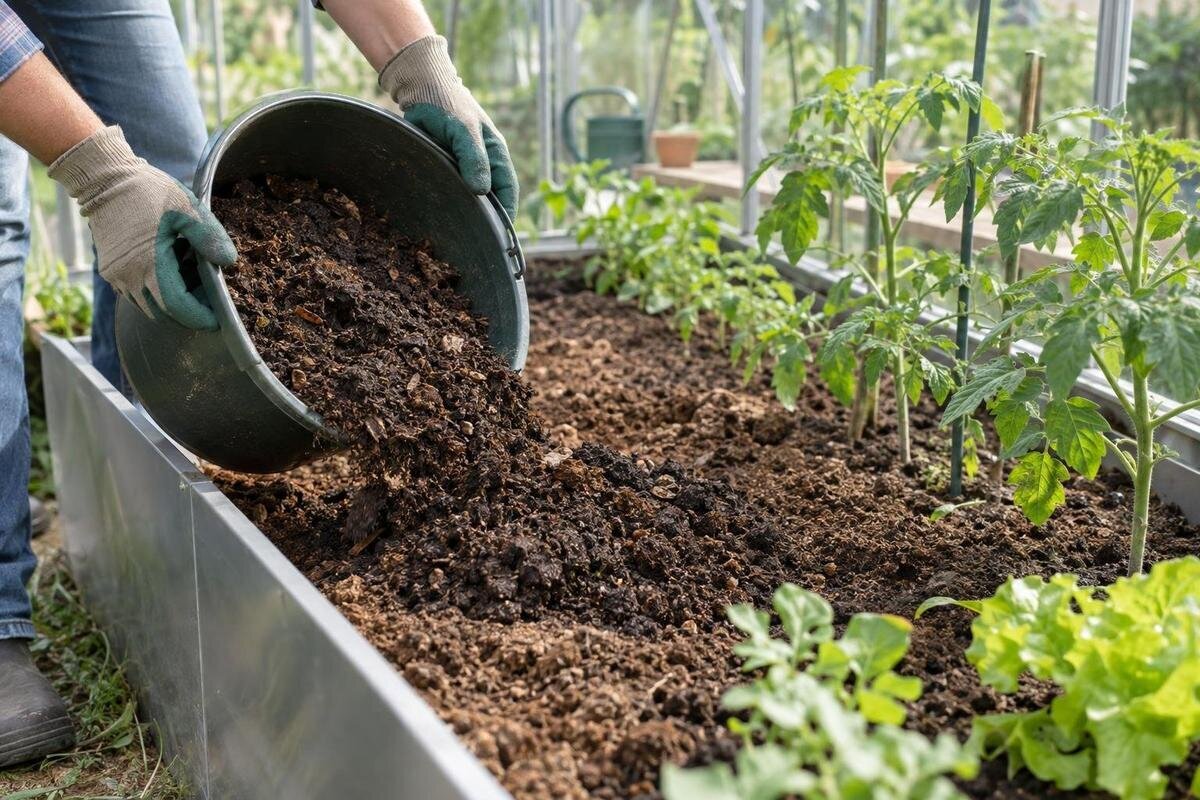
Greenhouse beds can grow well without receiving a fresh compost layer at every planting. Compost adds organic matter, but it also brings nutrients, and a covered bed may receive little rainfall to carry soluble nutrients away. The sound way to avoid overfeeding is to match mature compost to the crop and the current soil test results, then calculate any quantity from the area being treated. This guide focuses on that decision rather than on a general fertiliser schedule.

Compost adds nutrients as well as organic matter
Compost is often chosen to add organic matter, but it is not a nutrient-free conditioner. Even when fully decomposed, it carries nutrients from its feedstock. Some remain in organic forms and become available gradually as microorganisms continue breaking them down; others may be available sooner. Its nitrogen, phosphorus, potassium, pH and soluble-salt levels vary with ingredients, processing and batch. Two mature composts can therefore behave differently in the same greenhouse bed. A dark, crumbly texture does not indicate nutrient content, and compost should be counted as an input to the bed’s fertility plan rather than assumed to have no effect on nutrient levels.
The greenhouse roof also affects nutrient movement. Rain is largely kept off the beds, so there is less natural through-flow than in an exposed garden; irrigation, drainage, crop uptake and leaching still matter. If compost is added at every planting without checking previous applications, nutrients that crops have not taken up may accumulate over time. A generous layer can also raise soluble salts or supply more of a nutrient than the crop needs. The aim is not to avoid compost, but to use it for a reason and include its contribution alongside other amendments and feeds.
Identify each crop bed and its past inputs
Write down what each bed is intended to grow and what has already gone into it. Crops do not all have the same nutrient demand, and a seedling bed, a leafy crop and a long-season fruiting crop may call for different plans. Record compost, manure, fertiliser, lime, wood ash and liquid feeds, including when and where each was used. Note relevant changes in irrigation or drainage too. Without that history, a new compost addition can overlap an earlier one even when the previous application is no longer visible on the surface. Where past quantities are unknown, record that uncertainty rather than treating the bed as if it has received nothing.
Keep in-ground soil separate from raised-bed fill, pots and grow bags: these are different root zones and may use different media or feeding plans. Do not combine a container mix with a soil sample from a permanent bed, or calculate a bed application from the whole greenhouse area. The Bloomcabin Prestige Greenhouse range is listed from 3.77 to 28.08 m², which can help compare overall greenhouse size. The measured dimensions of the intended beds—not that area range—are what you need to work out the soil area for compost.
Sample greenhouse beds by growing zone
Take soil samples before adding compost, not from a patch that has just been treated. Follow the laboratory’s instructions for sampling depth and the number of subsamples. The aim is to represent the root-zone soil in a reasonably uniform bed or zone, rather than taking a handful from one convenient point. Keep areas separate if they differ in crop, previous additions, texture, irrigation or visible condition. If one patch has a distinct problem, label it for separate investigation instead of mixing it into a larger sample and diluting the result.
Tell the laboratory what you plan to grow and what compost or fertilisers have been used, and ask for an interpretation suited to that crop and greenhouse soil. When planning beds for a Spacious Greenhouse, use the layout to identify sampling zones rather than assuming the whole growing area needs one combined sample. Give each zone a clear name and use it on both the sample label and your plan. That makes it possible to apply the resulting advice to the right bed without relying on memory. If you use grow bags or imported media, ask how those should be tested; a result from one bed should not be treated as a prescription for every growing surface.
Interpret the soil test before adding compost
Read the test as a set of results, not as a single instruction to add organic matter. pH affects how readily some nutrients are available, while electrical conductivity (EC) is an indicator of soluble salts; the method used matters when interpreting either result. Nutrient levels and organic matter can help explain what the bed already contains. Ask the laboratory to relate its findings to the crop and to the sample type, especially if the report uses unfamiliar units or reference ranges. Keep the reported result separate from the application recommendation: one describes the sample, while the other advises what to do. When comparing reports from different dates, check the methods and units before interpreting a numerical change as an improvement or a problem.
If the results show that nutrients are already adequate or elevated, another compost layer may not be needed for fertility. If a nutrient appears low, that alone does not prove that compost is the right response: the compost’s own nutrient content, the crop and other soil conditions matter. Do not use compost as a catch-all correction for pH, salinity or drainage. If results are unclear or seem inconsistent with the crop, ask the laboratory or a horticultural adviser to interpret them before making a change.

Check compost maturity, source and analysis
A mature compost has generally cooled and stabilised, and often has an earthy smell and a crumbly texture. These are useful clues, not a guarantee: appearance or smell alone cannot confirm that a batch is suitable for growing crops. Material that is still heating, smells strongly of ammonia or has a sour odour may need more time to mature. Compost that is not fully decomposed can continue changing in the bed and may affect nutrient availability or sensitive roots. Keep maturity and nutrient content as separate questions. A batch can look ready to use without being appropriate for a bed that already has ample nutrients. If you are unsure, ask the supplier about the batch and its intended use rather than relying on colour alone or assuming that a longer composting period makes it a low-nutrient material.
Ask what went into the compost, how it was processed and whether there is a batch analysis. Useful details can include nutrient content, moisture, pH and EC, as well as whether figures are reported on a dry-matter or as-supplied basis. Check that the analysis describes the batch you intend to buy, rather than treating a general product description as a batch result. Before using a nutrient figure to calculate an application, establish which reporting basis it uses; do not compare unlike figures as though they mean the same thing. If feedstock history is unclear, ask about persistent herbicide residues, as some can survive composting and harm susceptible plants. For beds planned within the Limited Edition Aluminium Greenhouses range, use these details to compare compost batches before ordering, rather than choosing solely by bag size or appearance.
Calculate quantity from bed dimensions
For an even top layer, measure the soil surface of the bed and multiply its area in square metres by the intended depth in millimetres to get a volume in litres. For example, a bed measuring 3 m by 0.8 m has an area of 2.4 m²; a hypothetical 10 mm layer across it would be 24 litres. That example shows the arithmetic only, not a recommended depth. The application depth must come from the crop, soil results and compost analysis, not from a convenient round number.
Measure each bed rather than using the greenhouse’s total area. The Aluminium Greenhouses range is listed from 3.77 to 28.08 m², but those overall size figures are not a volume of soil to amend. For several beds, calculate each separately and add the results only if the same rate genuinely applies to all of them. For an irregular shape, divide the bed into simpler measured sections and record the dimensions used. Keep the application rate beside the calculation so you can see why that quantity was chosen. If the recommendation is expressed by weight rather than volume, ask how to measure it for the particular compost instead of assuming that a bag’s litre figure supplies the conversion.
Separate beds from paths and other growing media
A greenhouse’s usable area includes more than soil beds. Paths, work surfaces, benches and container-growing areas should not be included in a compost calculation for an in-ground bed. For a raised bed, distinguish between a surface application and replacing or topping up the fill: the first depends on the bed’s surface area, while the second also depends on its internal depth and how much medium is already present. A gap below the bed edge is therefore a measurement of available space, not evidence that the whole gap should be filled with compost. Keep pots and grow bags separate, since their growing media and nutrient plans may differ from the surrounding soil.
Sketch the intended bed edges and walking routes before estimating quantities. When comparing the Lean-to Greenhouse range, mark any planned benches, pots and storage on the same drawing so each growing system has a clear boundary. Label which areas contain existing soil and which will need a growing medium brought in. This separates the question of how much fill a new bed needs from whether an established bed needs more compost. It also gives you a practical way to check an order: each quantity should correspond to a named bed and a defined purpose, rather than to every unoccupied part of the greenhouse.
Choose a rate for the crop and tested soil
Use the soil result and compost analysis together to decide whether an application is justified and what amount is appropriate. If the bed already has enough of the nutrients the compost would add, withholding it is a sensible option. If a crop-specific recommendation gives a target, check whether it refers to a particular nutrient, compost volume or growing medium; these are not interchangeable. Include other recent inputs in the calculation, and ask for help interpreting the recommendation if the units or the compost test do not match. Be clear about the reason for using compost: wanting more organic matter does not remove the need to account for its nutrients. Likewise, identifying one low nutrient does not establish that the full mixture supplied by a particular compost is suitable. The chosen amount should address the bed’s needs without ignoring what is already adequate.
Keep separate plans for beds with different crops or histories rather than spreading one rate everywhere for convenience. If you are considering a T-Model Orangery Greenhouse, include the intended crops on the bed layout as well as the dimensions. Beside each bed, record whether compost is needed, the basis for that decision and any other amendment supplying the same nutrient. A blank entry should mean that a decision is still needed, not that the bed automatically receives the standard amount. If there is no test-based or crop-specific basis for an application, avoid inventing a rate simply because the next planting is due.

Apply evenly and avoid automatic repeat doses
When the evidence supports an application, measure it for the bed and distribute it evenly instead of leaving concentrated piles. Follow advice for the particular crop and growing system on whether to leave the material on the surface or mix it into the soil. Avoid burying stems or crowns, and take care not to disturb established roots. Applying between crops can make it easier to work accurately, but timing and placement still depend on the compost, the soil result and the next crop.
Do not add a second layer just because the first has disappeared from view; compost breaks down and blends into soil, but that does not mean its nutrients have all been used. Watch how the crop grows, yet treat plant symptoms as clues rather than proof of excess or deficiency: water stress, pH, pests and other issues can look similar. Record where and when a change appeared before deciding what it means. If a problem develops, investigate the bed and retest where appropriate before adding more. When planning beds for a Pyramid Greenhouse, allow access to each growing area so you can distribute a measured application evenly and inspect the crop afterwards. Assess any later changes against that bed’s treatment history rather than assuming all beds need the same response.
Keep records for the next growing cycle
A brief record makes repeat applications easier to judge. Note the crop and bed, the compost source and batch, any analysis, the date and the actual volume or weight used. Include the bed area and other inputs such as manure or fertiliser. If you have several zones, mark them on a simple plan so test results and applications can be matched to the right place. Keeping the compost label or supplier analysis with those notes is useful when the next soil test needs interpreting.
Compare records with later test results and crop performance before deciding whether to repeat an application. Look for what changed between crops: a different compost batch, another fertiliser, a new crop or an altered bed area may make last season’s quantity inappropriate. Keep the reason for withholding compost as well as the details of applications; otherwise, a useful decision to add nothing can disappear from the record. If you are considering the Limited Edition Aluminium Greenhouses with Storage range, plan where to keep unused compost and retain its label so you can identify the batch when you use it later. At the next review, you should be able to trace an application from the material supplied to the bed treated, then assess whether the same choice is still justified.
Frequently asked questions
How often should I add compost to a greenhouse bed?
There is no reliable calendar interval for every bed. Check the crop, the bed’s nutrient history and the soil test before adding more. If nutrients are already adequate, an annual compost top-up may be unnecessary; follow crop-specific advice where results show a need.
Does mature compost have low nutrient levels?
Not necessarily. Maturity describes how far the material has decomposed, not how much nitrogen, phosphorus, potassium or soluble salts it contains. Compost can be fully mature and still supply more nutrients than a particular bed requires, so check its analysis as well as its condition.
How do I calculate the volume of compost for a bed?
For an even top layer, multiply the bed’s area in square metres by the intended layer depth in millimetres to get litres. For example, 2.4 m² at a hypothetical 10 mm depth is 24 litres. This is a volume calculation, not a recommended application rate.
Can I add compost while crops are growing?
That depends on the test results, the compost and the crop’s stage. Avoid digging around established roots or piling material against stems and crowns. If an application is justified, follow crop-specific advice on placement; otherwise, it may be simpler to assess the bed between crops.
Can I use the same compost rate in every greenhouse bed?
Not automatically. Beds may have different crops, soil histories, irrigation, nutrient levels or growing media. Keep in-ground beds, raised-bed fill and container mixes distinct, and apply any recommendation to the area and crop it was intended for.
Avoiding overfeeding is less about choosing a small amount on a fixed calendar and more about knowing what is already in each bed. A soil test sets the starting point; the compost’s maturity and analysis show what the material may add; measured bed dimensions turn an appropriate recommendation into a quantity. Add compost only where it is useful, keep different crops and growing media distinct, and let the records guide the next decision. In a covered greenhouse, that measured approach helps prevent repeated, unexamined additions from becoming the default.
