
Growing Pak Choi in a Greenhouse
Greenhouse crop guide
Pak choi is best treated as a quick cool-season crop, not as a plant that benefits from extra greenhouse heat. Under cover, warm afternoons and lengthening days can trigger premature flowering, while uneven moisture and root disturbance add stress. A practical plan uses small sowings, a thermometer at crop height, good ventilation and prompt harvests. Because local conditions vary, schedule by the weather inside your structure rather than copying a fixed month-by-month calendar.

Cool-season conditions for greenhouse pak choi
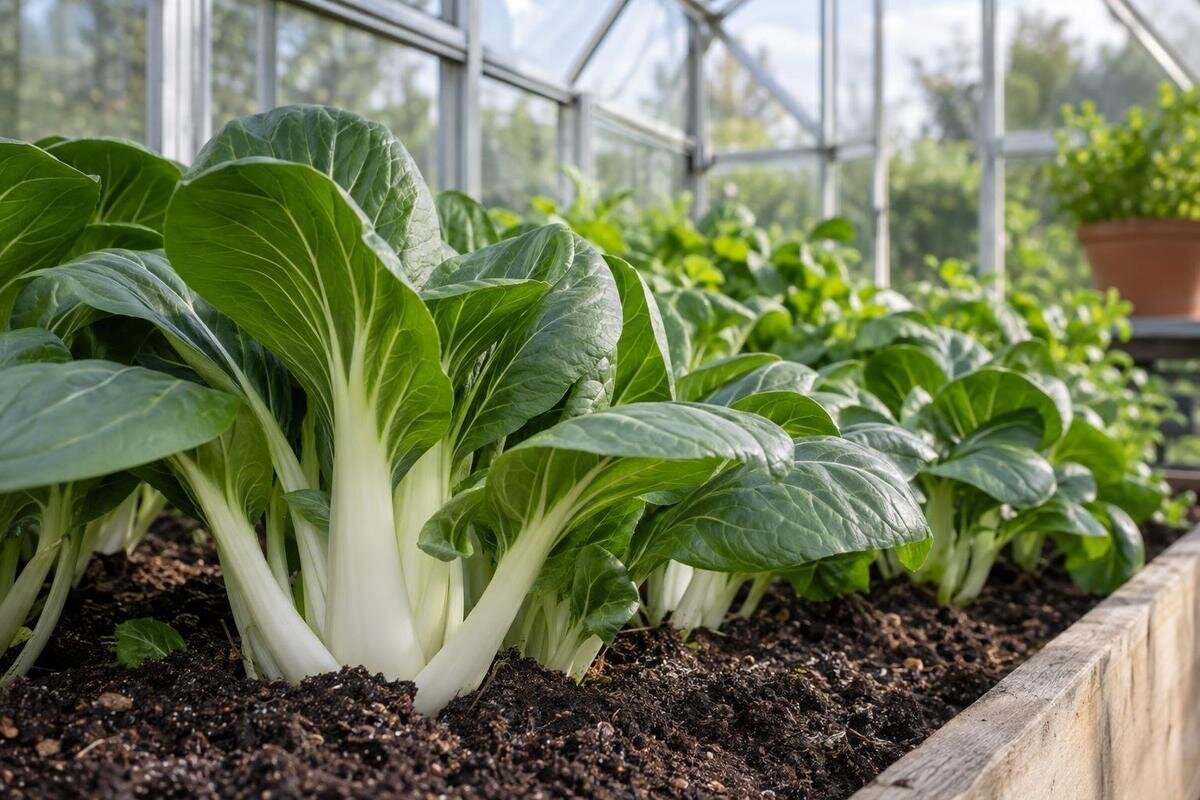
Pak choi, also called bok choy, is a quick-growing leafy brassica harvested for its broad leaves and crisp stalks. It fits a short greenhouse rotation, but being under cover does not make it a warm-weather crop. Hot afternoons and lengthening days can push susceptible plants into flowering before they form the compact rosette you want; a prolonged cold spell can also interrupt establishment. Aim for steady leaf growth in a cool, mild window rather than trying to maximise heat. Cultivars differ in size, maturity and tendency to bolt, so check the seed packet before deciding on spacing or whether to grow baby leaves or full-size plants.
A greenhouse can shelter seedlings from wind and heavy rain and extend a suitable growing window at either end of the year, depending on the site. It does not cool a hot spell, and an unheated structure cannot guarantee a stable night temperature; bright sun can make the air inside warmer than outdoors. Use local weather and readings inside the greenhouse rather than assuming one month works everywhere. When comparing growing space, Limited Edition Aluminium Greenhouses are listed in footprints from 3.77 to 28.08 m². Treat that as total floor area, then allow for paths, access and other non-crop space before estimating how much pak choi you can plant.
Choosing sowing dates for local conditions
Check conditions where the plants will grow, not just outside the door: air near the roof can differ from the level of small seedlings. A simple min–max thermometer placed beside the crop helps you see the daytime peak and overnight low. Note readings for several days and compare them with the seed supplier’s guidance for that cultivar. One mild morning does not reveal whether the structure will overheat by mid-afternoon. If repeated peaks are too warm, wait to sow or reduce the hottest sun with temporary shade, while still giving seedlings enough light to grow steadily. Record the pattern rather than relying on a single reading.
Use months only as a rough prompt. In a hot-summer garden, an autumn sowing after daytime heat eases is often a sensible first trial; another window may open in late winter or early spring, before warm weather builds. Where cold spells are prolonged, time sowing so young plants can establish without sitting in a chill. Local exposure, altitude, nearby walls and the year’s weather all change the result, so a national date table is a poor substitute for observation. Start with a short row, record emergence and leaf growth, and move the next sowing by a week or two if the crop is too slow or begins to flower early.
Stagger small sowings while conditions stay favourable
Pak choi develops quickly enough that succession sowing is usually more dependable than one large batch. Begin with a short row or a limited number of modules, then sow another small batch about every 10 to 14 days while temperatures and daylight remain suitable. Keep the interval flexible: warmth can speed growth and make batches overlap, while a cool spell may slow the first one. Inspect the earlier planting before sowing again. If it is still far from harvest, extend the gap; if it is nearly ready, bring the next batch forward. Staggered sowing gives a steadier supply and spreads the risk of a sudden hot spell.
Use the packet’s days-to-maturity as an estimate, checking whether it counts from sowing or transplanting. A baby-leaf harvest may be possible in about four weeks for a fast cultivar; a full rosette often takes closer to six to eight weeks, but temperature, light and variety can shift the timing. Harvesting young leaves also changes how long each plant occupies the bed. If several crops share the greenhouse, mark out where each successive batch will go and when that space should become available. The T-Model Orangery Greenhouse page lists area options from 16.52 to 30 m²; use a bed plan to work out how successive sowings could fit alongside longer-term crops.
Choose between direct sowing and raising seedlings
Direct sowing in the final bed is often the simplest way to avoid root disturbance. Prepare a fine, moist seedbed, sow at the depth stated on the packet and water gently so the seed is not washed into a clump. Keep the surface evenly damp while seedlings emerge, but do not leave it saturated. Once the rows are established, thin gradually to the spacing required for the chosen harvest size. Clean thinnings can be used as tender leaves; removing them also prevents the remaining plants from competing for light and moisture. Label each short row with its cultivar and sowing date, especially if two varieties are growing side by side.
Modules are useful when another crop occupies the bed or when you want to replace a harvested row without disturbing neighbouring plants. Sow a few seeds per cell, then retain the strongest seedling; transplant while it is young and its root ball holds together. Avoid keeping plants crowded in small cells until roots circle the plug, because a delayed, stressed transplant can take longer to establish and may be more prone to bolting. Water it in and protect it from a sharp change in heat while it recovers. If trays, work space and beds share one floor plan, the Pyramid Greenhouse range is listed at 5.53 to 18.9 m²; check the actual dimensions before assigning room to each.

Keep the bed fertile and evenly moist
Pak choi makes leafy growth quickly, so prepare a fertile bed with a loose structure and good drainage before sowing. Add mature compost where the soil needs organic matter, and loosen compacted ground so roots can reach evenly through the bed. Avoid working very wet soil, which can compact as it is handled. A greenhouse roof does not prevent a bed from becoming waterlogged, and a container still needs drainage and enough depth for the variety. Follow the packet for container spacing and final plant size. Extra fertiliser is not a fix for poor structure; aim for balanced fertility rather than forcing soft, overly lush growth.
Check moisture in the root zone, not just on the surface. Under cover, leaves may stay dry while the soil dries quickly on a sunny day, so inspect the bed regularly and water thoroughly when needed. Let excess water drain and avoid the cycle of wilting followed by a heavy soak; uneven supply slows growth and adds avoidable stress. Water at the base where practical, particularly in a crowded bed, and remove dead leaves so they do not sit against moist soil. A light mulch after seedlings establish can slow surface drying, but keep it clear of the crowns. When comparing the Limited Edition Aluminium Greenhouses with Storage models, listed from 5.52 to 28.08 m², account separately for growing beds, access and the storage space you need.
Ventilate to control daytime heat
Heat can build quickly under a cover, even when outside air still feels comfortable. Open the vents or doors provided for the structure before the greenhouse becomes hot, following its instructions and keeping plants protected from strong gusts. Air exchange helps reduce trapped heat and moisture, but it cannot make a hot season suitable for pak choi. A min–max thermometer at leaf height shows whether your routine is working; readings in direct sun or close to the roof are less useful. If the crop repeatedly overheats, change the sowing date or use temporary shade during the harshest sun rather than relying on extra water to cool it. Check again in the afternoon, when temperatures often peak.
An unheated greenhouse can moderate exposure but cannot be relied on to maintain a chosen temperature overnight. Nor should a structure be shut tightly to hold warmth through a cool evening without considering the following day’s forecast. Check conditions as weather changes and use openings as intended; do not assume every model has the same ventilation arrangement. Before choosing a structure for a warm site, compare the Bloomcabin Prestige Greenhouse options, listed from 3.77 to 28.08 m², and verify the particular model’s opening and ventilation details. The listed area is not evidence of airflow or temperature control, so consider those features separately from footprint.
What causes pak choi to bolt
Bolting is the development of a central flowering stem instead of continued compact leaf growth. Watch for the centre lifting above the leaves, a stretched stem, smaller new leaves or visible buds. The trigger is not always one event: hot conditions, lengthening days, a cold spell when plants are young, uneven watering and root disturbance can combine, and cultivars differ in their response. Warmth and day length often increase together as seasons change, which makes pak choi difficult to schedule by temperature alone. A greenhouse changes the temperature around the crop but not the length of the day, so cover alone cannot prevent flowering. A plant that is only slow-growing is not necessarily bolting; look for a rising central stem.
Lower avoidable risks by choosing a slower-bolting cultivar if available, sowing in the cool window, keeping moisture even and transplanting seedlings before they become root-bound. Treat a resistance claim as reduced risk, not a promise that plants will never flower. If a stem appears, harvest usable leaves promptly; cutting off the stem will not turn an advanced plant back into a compact rosette. Small batches also mean fewer plants are lost at once. The Spacious Greenhouse range is listed at 47 to 70 m²; even in a large footprint, sow pak choi in manageable sections rather than filling every bed on one date. This is especially useful when the next cool window is uncertain.
Spacing for baby leaves and full-size plants
Set spacing according to the harvest you want. Baby-leaf crops can be sown more closely and cut while plants are small; full-size pak choi needs the packet’s wider spacing so each rosette can broaden. A crowded full-size planting may produce undersized, uneven plants and make it difficult to inspect leaves or water the soil. It also restricts air movement within the crop. Thin seedlings early rather than waiting until their roots are interwoven, and avoid pulling one plant out so roughly that its neighbour is dislodged. If you want both harvest types, give them separate short rows so the sowing density and cutting date are clear.
Draw the growing area before planting and include paths, row ends, door access and room to reach the back of a bed. Use the mature width on the cultivar label, not seedling size, when estimating how many plants fit. Shelves and benches may change what can be grown on the floor; usable bed area depends on the model and the layout you choose. The Aluminium Greenhouses listings cover 3.77 to 28.08 m², but a total floor-area figure cannot show the final row arrangement. Check the product dimensions and plan against the space you can actually tend, then leave room for other crops and routine harvesting. A layout you can reach is more useful than one that is difficult to water.

Check regularly for pests and leaf damage
Inspect pak choi every few days, particularly at the seedling stage and on the undersides of mature leaves. Aphids often gather on soft new growth; small pinholes can indicate flea beetle feeding, while ragged edges or slime trails point to other chewing pests. Brassica crops can attract sap-feeding and leaf-chewing insects, and greenhouse cover does not make plants pest-free. Remove visible pests by hand where practical, and take away heavily damaged or yellowing leaves. Check nearby volunteer brassicas and clear old crop debris so it does not shelter pests between sowings. Identify the problem before choosing a control, because not every spot or hole has the same cause.
If using insect mesh, make sure it does not obstruct necessary airflow, then check beneath it because pests can still be present. Look across the row as well as at individual damaged plants to see whether feeding damage is isolated or widespread. Any crop-protection product must be labelled for the plant and intended edible use; follow product directions and local guidance rather than treating the whole bed by guesswork. Continue inspecting the crop after taking action so you can see whether fresh damage is appearing. Remove diseased material rather than leaving it beside healthy plants.
Harvest promptly and plan the next sowing
Harvest young leaves once they reach the size you want, or wait for a full rosette as described for the cultivar. You can take outer leaves from a healthy plant for a lighter repeated harvest, or cut the whole plant at the base for a single harvest. Keep harvests prompt as temperatures rise: a centre that begins to stretch is a warning to use the plant before flowering makes the leaves less suitable. Harvest in manageable amounts, handle leaves carefully and use them soon; tender leaves can wilt after picking. Where plants remain compact, you can harvest individual plants as needed rather than clearing the whole row at once.
After the final cut, remove roots and leftover leaves, especially if a plant was diseased. Pak choi belongs to the brassica family, so where space allows, avoid following it immediately with another brassica; rotating crop families can help limit the carry-over of shared pests and diseases. Record the cultivar, sowing date, first harvest and any early bolting, then adjust the next sowing to match what your own thermometer and plants showed. The Lean-to Greenhouse listings span 3.69 to 14.34 m²; compare the usable bed and access area when deciding whether successive rows can fit alongside other crops.
Frequently asked questions
When is the best time to sow pak choi in a greenhouse in South Africa?
Use the coolest reliably mild part of your local growing year rather than a fixed month. In a hot-summer garden, try sowing after daytime heat eases, then consider another small batch before warm weather returns. Check the temperature inside the greenhouse, as conditions vary with the site.
Can I grow pak choi in an unheated greenhouse?
Yes, if the season is cool enough for the plants to establish and grow steadily. An unheated greenhouse can shelter a crop, but it may become hot on sunny days and cannot guarantee a stable night temperature. Monitor conditions at plant height rather than relying on the cover alone.
How can I reduce the risk of pak choi bolting?
Sow in a cool window, keep moisture even, avoid root-bound seedlings and choose a slower-bolting cultivar if one is available. These steps reduce avoidable stress, but cannot guarantee that plants will not flower; temperature, day length and variety also matter. Harvest promptly if a stem starts to rise.
How often should I sow pak choi for a steady harvest?
While conditions remain suitable, sow a small batch about every 10 to 14 days, then adjust after watching the first row. Slow growth, a hot spell or an approaching harvest may call for a longer or shorter interval. Stop sowing when the season is no longer favourable.
Is it better to direct sow pak choi or transplant it?
Direct sowing avoids transplant disturbance and works well in a prepared bed. Modules are useful when another crop occupies the space, but transplant seedlings while they are young and keep the root ball intact. With either method, follow packet spacing and maintain even moisture.
With pak choi, a greenhouse is useful only when its microclimate stays within a cool, steady growing window. A modest first sowing, close temperature checks and a record of when plants begin to bolt will show whether autumn, late winter or another local period suits your site. Repeat the crop while it stays leafy, then clear the bed for something better suited when heat or long days make bolting more likely.
