
Curling Tomato Leaves in a Greenhouse: Stress Pattern or Disease Warning?
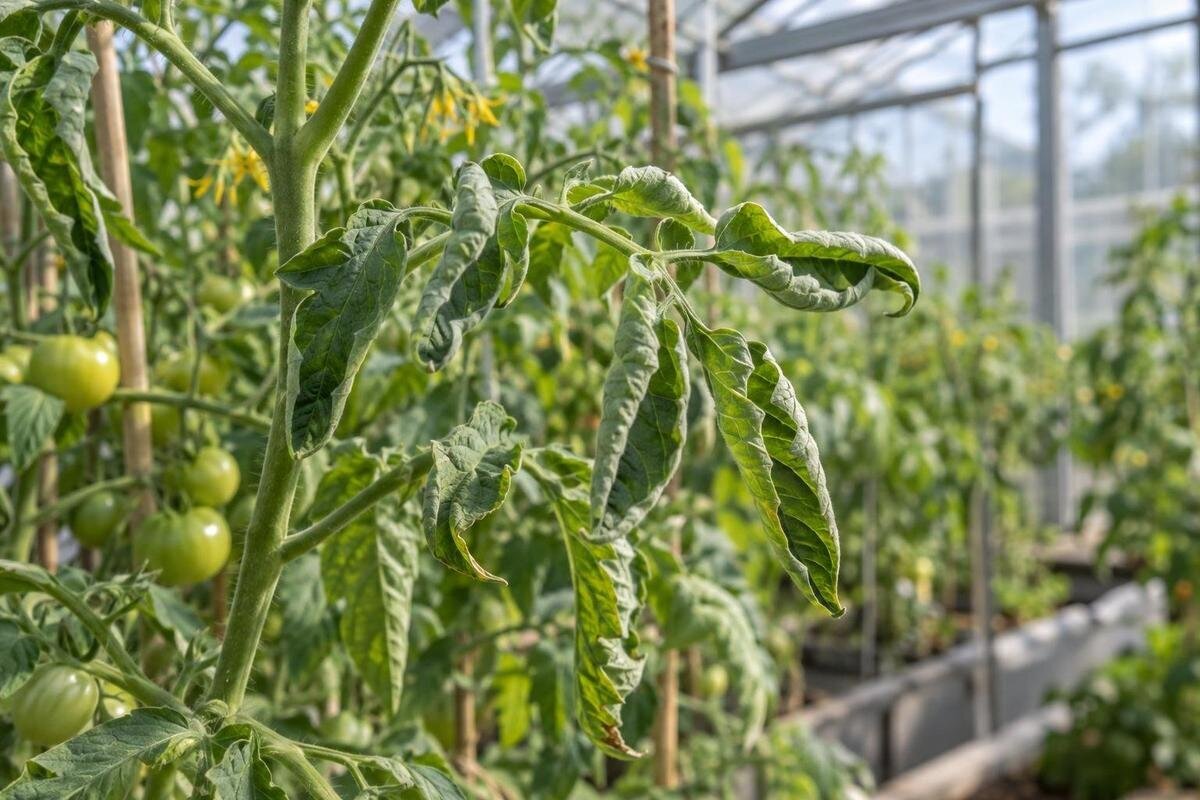
Tomato growing in a greenhouse
Curled tomato leaves inside a greenhouse can look like a warning, but their shape alone cannot tell you whether the plant is reacting to growing conditions or facing a pest or disease. Green, rolled older leaves after heat or uneven moisture often fit physiological stress; distorted new growth, mottling, yellowing, stunting or spreading symptoms deserve closer investigation. Compare several plants and note timing, leaf age, colour and greenhouse conditions before changing watering, feeding or spraying. A pattern narrows the possibilities, but a specialist or diagnostic laboratory may be needed to confirm the cause.

Leaf curling is a symptom, not a diagnosis
Leaf curl describes a change in shape, not a diagnosis. With physiological leaf roll, the edges of leaflets often turn upwards or roll lengthways, commonly on older, lower foliage. The leaves may look firmer or thicker but remain mostly green, while the growing tip continues to produce normally shaped leaves. This response is not contagious, although several plants may show it at once if they share heat, moisture or root stress. “Physiological” means the leaf is responding to growing conditions or plant growth rather than a named pathogen. Tomato varieties also differ in leaf form, so compare like with like; curl direction alone does not identify the cause.
Other problems can produce a similar silhouette. Virus infection, sap-feeding pests, root damage, nutrient imbalance and herbicide exposure can all distort foliage, and two stresses may overlap. A photograph of one curled leaflet rarely separates them. Check colour, texture, spots, insects, the age of affected leaves and whether new growth is changing; compare with a healthy plant of the same variety. The useful question is not simply “Are the leaves curling?” but “Which leaves changed, what else changed, and what happened just before?” Also note whether the stem, flowers or overall growth look different.
Check which leaves and plants are affected
Inspect the plant from the growing tip down rather than looking only at the most conspicuous leaf. Physiological leaf roll is often clearest on mature leaves lower on the plant, while the newest leaves continue to expand in their usual shape. Persistent distortion at the top, smaller leaflets, unusual yellowing or a cramped growing tip needs closer attention. These are tendencies, not rules: severe water or heat stress can affect many leaves, and some diseases begin subtly. Check whether one leaflet or one side of the plant is affected, and note whether the curl appeared suddenly or developed gradually. The age of the leaf at first change is more informative than a later snapshot of the whole plant.
Mark affected plants on a simple row or bed plan. Note whether curl follows one sunny edge, a dry section of irrigation line, a doorway or a cluster of neighbouring plants; compare with unaffected plants of the same age and variety. A shared location points towards a shared exposure, not a confirmed cause, while unrelated plants may still share a seedling source or care history. A dated hand sketch is enough. If you are also planning a future greenhouse, the Bloomcabin Prestige Greenhouse listing covers 3.77–28.08 m². Use the selected size as the outline for your plan, then mark the actual beds, rows and plant positions.
Heat and strong sun can trigger leaf rolling
Heat and strong sun can make a tomato roll its leaflets, reducing exposed surface when water loss outpaces root uptake. In a greenhouse, the canopy can warm rapidly under direct sun, and the warmest part of the day may bring more curling than the morning. A leaf that relaxes later may support a stress pattern, but a change in timing does not rule out infection or root problems. High demand may also expose an irrigation weakness that was not obvious in milder conditions. Watch the plant at comparable times on several days rather than judging from one hot afternoon.
Check conditions near the leaves rather than assuming the roof, doorway or outdoor reading tells the whole story. Record the time, sun and air movement, and use a thermometer at canopy height if available. Note whether affected plants share a hot corner or an area with little air movement. Differences within the growing space also matter when comparing larger structures such as the Spacious Greenhouse, listed at 47–70 m²: total area alone does not describe conditions around each plant. Review the existing vents, doors and shading together, and change one factor at a time. Avoid adding heavy shade or extra water as a reflex; first check whether heat exposure and root moisture match the symptoms.
Uneven watering and root stress can look similar
Uneven moisture can produce curling even when you have been watering regularly. A root zone that repeatedly dries out may not supply leaves during hot periods; soil kept saturated can deprive roots of oxygen and reduce uptake. Damaged, cramped or diseased roots may also make the canopy look water-stressed when the surface appears damp. Pots, raised beds and in-ground soil dry and drain differently, so one schedule is not reliable across every container or corner. Recent transplanting or root disturbance can also affect how well a plant takes up water. Curling alone cannot tell you whether the root zone needs more or less.
Check moisture around the roots in several affected and unaffected spots, not just at the surface. Look for blocked emitters, uneven delivery, pooling, slow drainage or a recent change in frequency; compare plants under similar sun before adjusting. Avoid alternating a long dry spell with heavy soaking, and do not add water to soil that is already persistently wet. For a new layout, options such as the Aluminium Classic Greenhouse, listed at 3.77–28.08 m², provide a starting footprint; mark the beds and water points separately so you can compare delivery across the growing area. Where a bed stays wet while leaves curl, check drainage and roots before increasing the supply.

Nutrient problems and herbicide injury
Excess fertiliser salts or a strong feed can stress roots, while nutrient shortages usually need other clues—such as colour changes, altered growth or a soil test—rather than curl alone. Too much nitrogen can be associated with vigorous, soft growth and leaf rolling, but appearance cannot confirm it. Adding fertiliser, calcium or micronutrients without evidence can worsen an imbalance or add to salt stress. Record what was applied, in what amount and when; repeated unexplained symptoms are a reason to test the growing medium rather than guess. Recent changes to compost, manure or liquid feed are worth noting too, especially if affected plants share a feeding area.
Chemical injury is another possibility when the newest leaves are twisted, narrow, cupped or otherwise misshapen, especially after a nearby herbicide application or use of a suspect input. If plants nearest an exposed side show similar fresh damage, record that pattern, but do not treat it as proof. Ask about products used around the site and note the timing and wind direction. Consider surrounding activity when reviewing a greenhouse position, too. The Lean-to Greenhouse listing covers 3.69–14.34 m², but its dimensions cannot establish protection from drift. The relevant clues are the exposure at your site and whether the onset of damage coincides with nearby spraying.
Pests leave signs on leaf undersides and new growth
Look beneath leaves and around growing points with a hand lens if available. Aphids may gather on tender shoots and leave cast skins or sticky honeydew; whiteflies may be seen on leaf undersides or rise when foliage is disturbed. Spider mites can cause fine pale stippling or bronzing and, in heavier infestations, webbing; thrips may leave silvery scarring and distort young leaves. These signs help direct inspection, but they vary by pest and stage, and one cursory glance does not rule out small populations. Pay particular attention to new leaves, where feeding and distortion may first become noticeable.
Inspect several affected and apparently healthy plants, including both leaf surfaces and the newest growth. Look for repeated feeding damage that lines up with the distortion, rather than blaming any insect found nearby; an incidental insect may not be responsible. Note what you see before choosing a control, since spraying on the basis of curl alone may miss the cause and affect beneficial insects. When comparing layouts in the Limited Edition Aluminium Greenhouses range of 3.77–28.08 m², include access to the crop rows in your plan. Your inspection needs to cover leaf undersides and growing tips throughout the crop, not only the foliage visible from the doorway.
Mottling, yellowing and stunting need closer attention
New growth that stays curled, cupped or unusually small, especially alongside yellowing, a mosaic of pale and dark green areas, vein discolouration or shortened growth, is more concerning than green rolling confined to old leaves. A virus such as tomato yellow leaf curl virus can cause curling of young leaves, yellowing and reduced leaf size, often with stunted growth. Other infections, pests, herbicide injury and root disorders can overlap. Flowers or fruit may also be affected in some cases, but their condition does not identify a virus by itself. A mosaic pattern or a deformed growing tip is a clue to investigate, not a diagnosis.
Concern rises if symptoms progress through successive new leaves or appear on more plants over time, particularly if whiteflies are present: some tomato viruses are transmitted by whiteflies. Their presence alone is not proof of infection, and plants can share a non-infectious stress. Keep the structure's identity separate from the crop history in your notes. A model reference such as the T-Model Orangery Greenhouse, listed at 16.52–30 m², describes the growing space, not the cause of symptoms. Record whether affected plants share a supplier, transplant date or irrigation area, and take that history to a plant-health specialist or laboratory for confirmation.
Track changes before adjusting plant care
Before changing the routine, keep a short record: the date first noticed; leaf age and position; number and location of affected plants; recent hot or bright periods; watering, feeding, pruning or transplanting; and any spray use. Photograph an affected plant alongside a healthy comparator of the same variety. Use row labels or markers to track whether the same leaves are changing or symptoms are appearing on new growth. Record any improvement or new signs at each check. A written history prevents one memorable hot afternoon or watering mistake from becoming a diagnosis.
If observations support heat or moisture stress, make a modest, targeted correction—such as adjusting the existing ventilation routine or evening out water delivery—and then watch new leaves. Old curled leaflets may not straighten after conditions improve, so judge the response by later growth and the plant as a whole. Avoid heavy watering, extra feed, pruning and spraying all at once; multiple changes make cause and effect difficult to judge. Keep the same approach when considering a different structure. The Pyramid Greenhouse listing spans 5.53–18.9 m², but changing the greenhouse is not a diagnosis or a substitute for understanding the conditions associated with the curling.

Photographs that help a plant-health diagnosis
Take one image of the whole plant, one of the growing tip, and close photographs of an affected leaflet from above and below. Include a healthy leaf from the same plant or a nearby plant of the same variety. Use steady, natural light, keep the leaf in focus and avoid filters or strong colour adjustments; yellowing and mottling are evidence, so altered colour can mislead. If practical, include a ruler beside distorted growth for scale without covering the symptom. Photograph any spots, webbing or insects you find as well as the curl.
Add the date, plant or row number, variety if known, and a short note on recent heat, watering, fertilising and spray history. Repeat photographs from the same angle as the pattern develops; a sequence can show whether damage is old, spreading or limited to one flush of growth. Include the wider greenhouse layout only as context, not as a substitute for leaf detail. If identifying the structure, give the selected size as well as its model: the Limited Edition Aluminium Greenhouses with Storage listing, for example, ranges from 5.52–28.08 m². Keep the original files if you share them, so colour and timing are not lost.
When to seek an expert diagnosis
Ask a local horticultural adviser, extension service or plant diagnostic laboratory for help if symptoms are spreading, new growth remains distorted, several plants become stunted, or curling appears with mosaic, strong yellowing, lesions or visible pests. Early advice is useful when a transmissible disease or unfamiliar pest is possible, because a photograph alone may not reveal the agent. Ask what sample, if any, they need before cutting or sending plant material. Share your symptom map, photographs, variety and recent treatment history to make the assessment more useful.
If only a few older leaves roll after a hot spell and new growth stays normal, with no colour changes, pests or decline, careful monitoring may be reasonable while you check heat and moisture patterns. Do not assume the cause is harmless if symptoms persist or broaden; seek advice if the crop deteriorates quickly. Avoid taking cuttings from plants with unexplained distortion, and do not apply a pesticide, fungicide or fertiliser as a diagnostic experiment. A qualified person can advise whether inspection, testing or targeted action is appropriate.
Frequently asked questions
Can greenhouse heat alone curl tomato leaves?
Heat and strong sun can contribute to physiological leaf rolling, particularly when water loss exceeds what the roots can replace. Check conditions near the canopy and note whether the pattern is worse at the warmest time of day. That timing supports a stress explanation but does not rule out pests or disease.
Do curled leaves mean my tomato needs more water?
Not necessarily. Dry soil can stress a plant, but persistently wet soil or damaged roots can also interfere with water uptake. Check moisture around the roots in affected and unaffected areas before changing your watering routine; leaf shape alone cannot tell you whether to add water.
How can I tell physiological leaf roll from a virus?
Physiological rolling often affects older, green leaves while new growth remains normal. Concern increases when young leaves are persistently distorted or smaller, or when curling comes with yellowing, mosaic patterns or stunting. These are clues rather than proof; a specialist or laboratory may be needed to identify a virus.
Should I remove curled tomato leaves?
Not automatically. Removing leaves will not correct heat, watering or root stress, and unnecessary pruning adds another disturbance. If you suspect a disease or pest, ask a plant-health adviser whether removal is appropriate before cutting or moving affected material.
Should I spray as soon as leaves curl?
No. Curling alone does not identify a pest or disease to treat. Inspect both sides of the leaves and the growing tips for insects, feeding marks, spots or colour changes. Seek local advice if symptoms are spreading or unclear rather than using a pesticide as a diagnostic test.
Treat curling as a pattern to investigate, not a cue for automatic watering, feeding or spraying. Green, older leaves that roll after heat or uneven moisture, with normal new growth, often fit physiological stress. Distortion in young leaves, colour changes, stunting, visible pests or symptoms spreading through the crop call for closer diagnosis. Note where the change appears, inspect both sides of the leaves and compare plants of the same variety. If the pattern is progressing or remains unclear, seek local plant-health advice before taking decisive action.
