
When to Direct Sow or Raise Greenhouse Seedlings
Greenhouse growing guide
Deciding whether to direct-sow or raise greenhouse seedlings is not a choice between two systems with one universal winner. A seed sown in its final bed avoids a move; a tray-raised plant can be timed and placed once that bed is ready. The best route depends on the crop’s roots, its tolerance of transplanting, the time it needs before planting out, germination conditions and the space available for both nursery trays and mature plants. Use the methods crop by crop, even within one greenhouse.

What direct sowing and transplanting change
Direct sowing means placing seed where the crop will stay until harvest, whether that is a greenhouse bed or its final container. Germination and early growth happen in that same position, so there is no tray-to-bed move or disturbance from lifting a plug. This keeps handling to a minimum, but it commits the growing area from sowing onwards. If emergence is patchy, gaps remain in the row until they can be resown or filled; if seedlings emerge too close together, thinning is still needed. The final position must be ready and suited to the crop when the seed goes in, not merely available later. Use clear row labels, particularly when several varieties share a bed, as young seedlings can be difficult to tell apart.
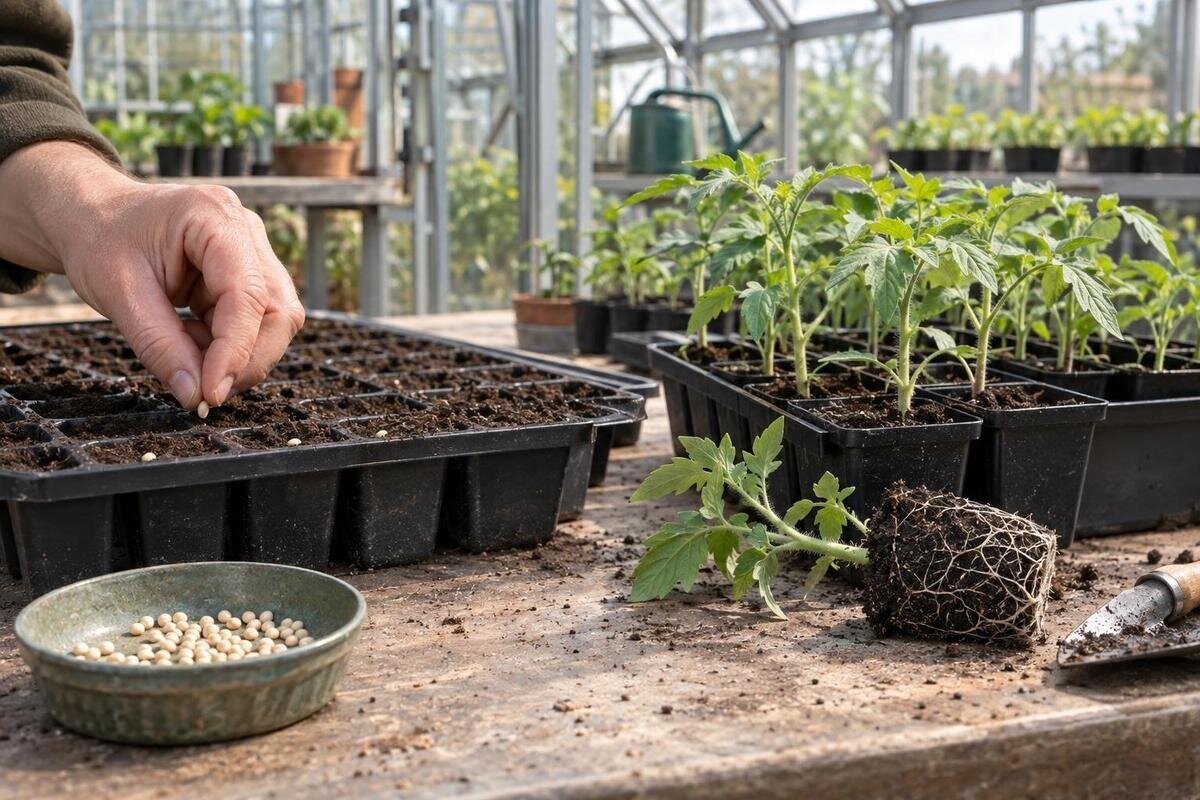
Raising transplants separates germination from the final growing position. Seeds start in cells or pots, and young plants move into the greenhouse bed or containers later. That makes it easier to label small batches, monitor emergence and keep the main bed available while seedlings develop. It also creates another stage to manage: trays need room, each batch needs attention, and planting out disturbs roots to some degree. A transplant start does not automatically shorten the crop’s total growing time, just as direct sowing is not automatically simpler if a seedbed is difficult to maintain. Compare the full route from sowing to final position, rather than judging by the first few weeks alone.
Crop traits that guide the choice
Choose by crop rather than by the greenhouse alone. Ask whether the crop has roots that are easily disturbed, how well young plants tolerate moving, how long they need before reaching a planting-ready size, and what conditions the seed needs to germinate. Those answers usually point more clearly than a general preference for trays or rows. Read the seed packet for sowing depth, spacing, temperature or light requirements and any advice on transplanting. If it recommends direct sowing, treat that as a useful starting point; a greenhouse does not remove the crop’s growing requirements.
Then match the method to the layout. Direct sowing uses the final bed earlier; raising seedlings shifts some of the work to bench space and may leave the bed available for another crop in the meantime. If you are comparing structures, the Limited Edition Aluminium Greenhouses listing shows area options from 3.77 m² to 28.08 m². Use the stated area as a broad footprint comparison, not as a bench-capacity figure. Include access, established crops and final planting positions on your sketch before deciding how many trays your working space can take.
Root crops, peas and beans: common direct-sown choices
Carrots and parsnips are strong examples of crops normally direct-sown. Their edible roots develop below the surface, and lifting young plants can disturb the taproot; sowing in the final bed avoids that extra handling. Radishes are commonly sown where they will mature because they develop quickly and are easy to space in a row. Beetroot is often direct-sown too, although some growers successfully move very young seedlings. For any root crop, follow its own instructions and prepare the growing medium to suit the crop. Do not assume that a tray-raised plant will form the same root as one left undisturbed.
Peas and beans are also frequently sown into their final position when conditions suit them, rather than kept in a nursery for long. Modules can still help if a protected start is useful or the greenhouse bed is not yet ready; use separate cells and move plants while young to reduce the need to separate tangled roots. Direct-sown lines still need attention: label rows, use the recommended sowing depth and thin seedlings where necessary. Removing extras can seem wasteful, but a crowded row leaves plants competing for room, water and light. Treat packet guidance as the baseline rather than applying one practice to every legume.
Tomatoes, peppers and brinjals as transplants
Tomatoes, sweet peppers, chillies and brinjals are commonly raised as transplants. Their seedlings can be started in trays or pots and moved into their final greenhouse positions once established. A nursery start is useful when you want several varieties kept separate, when the bed is occupied, or when you want to plant a batch at a planned time. These crops generally tolerate transplanting better than taproot crops, but seedlings can still be set back if handled roughly or held too long. Use the seed packet and variety guidance to decide when to sow and when to plant out.
Think about when the final bed will be free as well as the sowing date. A tray full of healthy plants is not an advantage if the planting positions are still occupied or the seedlings have outgrown their cells. For a structure such as the T-Model Orangery Greenhouse, listed in sizes from 16.52 m² to 30 m², sketch the mature plant positions before allocating space to seedlings. Include access to those established plants throughout their growing period. You can then see whether the nursery batch will fit alongside them and whether its final planting positions will be available when needed.

When either route can work: leafy crops and cucurbits
Lettuce can be sown directly into a bed or raised in trays and planted out. Direct sowing avoids handling and suits planned rows or successive sowings; transplants can be easier to place at regular intervals or use to fill a gap after another crop is removed. Spinach is commonly direct-sown, though young transplants are another option in some systems. Small seeds can be difficult to distribute evenly, so clearly marked rows and thinning can make the crop easier to manage. Choose based on crop guidance, spacing and how consistently you can keep the seedbed suitable for germination.
Cucumbers and baby marrows may also be direct-sown when the final bed is ready and conditions suit, or raised briefly in individual cells. A tray can help with timing, but their quick growth makes it important not to leave seedlings waiting long; move them with the root plug intact rather than separating the roots. When considering the Pyramid Greenhouse, available in listed areas from 5.53 m² to 18.9 m², plan where these crops will grow after the nursery stage. The useful comparison is whether your proposed layout accommodates both their final positions and the working space needed to move and tend them.
What seed trays add to the process
Trays make small plants easier to group, label, count and move as a batch. Individual cells can avoid a later step of separating roots from a shared seed tray, while a shared tray can be useful when seedlings will be pricked out at a suitable stage. The trade-off is more handling and closer monitoring. Cell volume, growing medium and the time a seedling will spend in the nursery affect how much attention it needs; a crop expected to stay longer may need more room than one planted out soon after germination. Follow crop-specific instructions rather than choosing a tray simply because it fits the bench.
Plan a tray area that is easy to reach and keep in order, with labels that remain readable and space to lift a tray without disturbing its neighbours. Work out whether any seedlings may need potting on before the final bed is free; that creates another demand on nursery space. If you are considering the Limited Edition Aluminium Greenhouses with Storage, the listed area range is 5.52 m² to 28.08 m². For your chosen size, draw in the proposed benches and allow room to handle both trays and individual pots. Base the batch size on that working layout, including any extra room needed after potting on.
Balance nursery space with final growing space
Direct sowing and raising transplants place demands on different parts of a greenhouse. A direct-sown crop takes up its final bed from the beginning, even while seedlings are small; a tray-raised crop occupies a bench and then requires its final growing positions. If an established crop remains in place while new trays are started, those demands can overlap. Make a simple calendar showing when each bed will be occupied and when each batch is expected to move. This avoids choosing a method solely because the bench or bed happens to look free on sowing day.
Count usable growing positions rather than assuming the whole floor is available. Leave room for access, watering and routine work, and account for pots or crops that cannot easily be shifted. To compare sizes in the Bloomcabin Prestige Greenhouse range, listed from 3.77 m² to 28.08 m², mark these occupied positions on each proposed layout. Then check where a new batch would go while the current crop is still growing. The practical balance is enough nursery room to raise that batch and enough final growing space to plant it out without relocating established crops or crowding plants together.
Use local conditions to set sowing time
Use a sowing calendar as a guide, then check the conditions where the seed will germinate. Growing seasons vary across South Africa, and a greenhouse may be warmer or more changeable than the nearby garden, depending on location and weather. Do not assume that placing a seed under cover guarantees the right temperature or light: conditions can shift through the day and across the season. Read the packet for the crop’s requirements and observe the actual growing space. A month on a calendar is not proof that a seedbed has reached the conditions the crop needs.
Time sowing from when the final position is expected to be free, not just from a preferred harvest date. For transplants, allow for the germination and seedling period given in crop guidance, then avoid sowing so early that plants have to wait in cells. For direct-sown crops, the bed must be ready and conditions suitable at the same time. The Spacious Greenhouse has listed area options from 47 m² to 70 m², but additional space does not remove the need to coordinate overlapping batches. Record when each batch is sown, emerges and moves into its final position. Those dates help you judge future sowings against your own greenhouse conditions rather than a copied calendar.

When and how to move seedlings
Plant seedlings out when they are sturdy enough to handle and the crop has reached an appropriate stage, not simply because a certain number of days has passed. Many crops are moved after their first true leaves develop, but timing differs, so use species-specific advice. A root plug that holds together is easier to move than loose medium, while roots filling the cell or circling at the edge can signal that a seedling has waited too long. Avoid pulling by the stem or separating tangled roots. If a batch is uneven, move only the plants that are ready and keep the others under observation.
Prepare the final position first, then move each seedling with as much of its root plug intact as practical. Water dry trays before lifting, handle the plug rather than squeezing the stem, and follow crop guidance on planting depth. A plant moved from a protected greenhouse to a less protected site also needs to adjust to that change; this is different from a short move between similar conditions inside the greenhouse. When planning a nursery area in the Aluminium Greenhouses range, listed from 3.77 m² to 28.08 m², check the route from bench to bed. The chosen configuration should leave room to carry trays and reach planting positions without disturbing established crops.
Make a decision for each crop
Before sowing, make a short decision record for each crop. Note whether its guidance favours direct sowing or transplanting, how well it tolerates root disturbance, when the final position should be free and what conditions germination requires. Then compare space: direct sowing uses the bed immediately, whereas a transplant start needs nursery room before it needs the bed. If both methods are suitable, try a small batch of each rather than changing the whole planting at once. Keep the variety and timing similar so the comparison tells you something useful.
Use the record to refine the greenhouse layout as well as the sowing choice. If you are considering the Lean-to Greenhouse, with listed areas from 3.69 m² to 14.34 m², compare the selected model’s full dimensions with the nursery and final planting positions in your plan. Include access to both, rather than judging the layout only by how many trays fit. After planting, note emergence, losses, handling time and whether the next crop was delayed by a full bed or bench. Review these observations crop by crop: they can show whether the method itself worked well or whether its timing and space allocation need adjusting.
Frequently asked questions
Which greenhouse crops are usually direct-sown?
Carrots and parsnips are usually direct-sown because moving young plants can disturb their developing taproots. Radishes, peas and beans are also commonly sown where they will grow when conditions suit them. Follow the crop’s packet or local growing guidance, especially if it recommends a particular method.
Can I raise lettuce in trays and transplant it?
Yes. Lettuce can be sown directly into its final bed or started in trays and planted out. Direct sowing avoids handling; transplants can be easier to space individually or use to fill a gap. Choose according to the variety’s guidance, your preferred layout and whether the bed will be ready when the seedlings are.
Should I raise tomatoes in trays?
Tomatoes are commonly raised as seedlings and transplanted once established. This can help you keep varieties labelled and plan when they move into the final bed. Direct sowing may also be possible, but the best choice depends on the crop guidance, local conditions and whether the greenhouse bed is available at the right time.
How can I tell when a seedling is ready to transplant?
Look for a sturdy plant at a suitable stage for its crop, rather than relying on a set number of days. Many seedlings are moved after their first true leaves develop, but timing varies. A root plug that holds together is easier to handle; roots filling the cell can mean the plant has waited too long.
Can I use both methods in the same greenhouse?
Yes. Direct-sow crops that establish well in their final position and raise transplants where a separate start solves a real timing or handling problem. Plan for both the nursery space and the final growing positions, then keep notes on how each crop performs so you can refine the choice next time.
There is no need to use one sowing method for every greenhouse crop. Direct-sow crops such as carrots and parsnips where root disturbance is a concern, raise transplant-friendly crops such as tomatoes in trays when a planned start helps, and choose between the two for flexible crops according to conditions and space. Comparing each crop from germination to its final position will show which approach works best in your greenhouse.
