
How to Identify Parts for a Discontinued Greenhouse
GREENHOUSE REPAIRS
An out-of-production greenhouse can still be identified, but a photograph of a damaged bar or pane is rarely enough to select the correct spare. A useful enquiry brings together clues that agree: the manufacturer and model, any revision or serial marking, the part’s position, its profile and measured dimensions, and the original manual or parts drawing. Keep the evidence together before asking about availability. If the item is part of the glazing or frame, do not remove it just to obtain a sample; a manufacturer or installer can confirm what needs to be measured and how.

Describe the fault before naming the spare
First describe what has happened without deciding what the replacement is called. Note what is missing, cracked, bent, loose, leaking or no longer moving as it should, and whether one item or several are affected. Mark the position on a simple sketch. Left and right depend on your viewpoint, so state where you were standing and which direction you were looking. Identify the front, rear, door and relevant roof slope. Record whether the item appears to be a frame member, panel, seal, fastener, door or vent fitting, or an accessory. The manufacturer may use different terminology; your description can still be precise without guessing the part name.
Photograph the whole greenhouse before focusing on the fault, then note the affected bay or opening and any adjacent pieces that still look intact. If a loose fragment is already on the ground, keep it with its fasteners and do not reshape, drill or force it into place. Avoid dismantling a frame or removing glazing to make identification easier. If a damaged component affects stability, a roof panel is loose, or glass may break, leave the area alone and arrange an assessment by an installer or suitable glazing professional. A clear account of the location and condition is more useful than an unsafe sample.
Find the manufacturer, model and revision
Search for a maker’s plate, product label, serial number, model name or batch mark on the greenhouse and in its original paperwork. Useful records may include the invoice, order confirmation, installation handover, delivery documents, packaging or a manual kept with garden records. Transcribe every character, including hyphens, spaces and suffixes, and photograph the label straight-on so the wording is readable. Note what you know about the purchase or installation date, but mark estimates as estimates. If a label is on a part that would need to be moved to read it, do not take that part apart; look for paperwork or ask the installer.
Write down the product name exactly as recorded, rather than shortening it to a description such as aluminium greenhouse. A model name may have several sizes or production revisions, and parts may change during a product’s life. A T-Model Orangery Greenhouse catalogue entry can help confirm the spelling of that listed model name, but it does not establish that an older T-model shares its revision or spare parts. Treat a familiar name as one clue, then check it against the label, measurements and drawings before ordering. If no serial number survives, say so instead of trying to reconstruct one.
Photograph the part in context
Build a small photo set rather than relying on one close-up. Start with a full view from outside, then take a medium view showing the damaged area in relation to a door, corner, roof ridge or wall bay, followed by a close-up of the part and its connections. Use even daylight where possible, keep the camera square to the profile, and include a ruler or tape only if it can be held safely without covering the detail. Add another angle to show depth, ends and orientation. These views help distinguish a part’s shape from the way it sits in the assembled greenhouse.
Take a separate image of any surviving identical part, label, stamped mark, bracket or fastener, and include both ends if they are visible without moving anything. Make a quick sketch showing the location and direction, then use that reference in each photo caption, such as front-left roof bay, viewed from outside. Keep catalogue images separate from photographs of your own greenhouse. For example, the Pyramid Greenhouse listing identifies a current product, but its overall silhouette cannot establish the roof profile or spare-part code of another structure. Your own photographs need to show those details. Avoid climbing or leaning over glazing for a closer view; ask a professional to take images that require unsafe access.
Measure the structure and component separately
Measure the greenhouse separately from the component. Note its outside length and width, and record a height only if it can be measured safely from the ground or taken from a reliable drawing. State where each measurement was taken, whether it is internal or external, and the unit. Do not assume the current footprint equals a model’s advertised area; the greenhouse may have been altered or measured from inside. When looking for original documents, check for a drawing or order description that states the configuration rather than estimating from a photograph. Overall figures can help narrow a model family, but cannot identify an extrusion, pane or connector on their own.
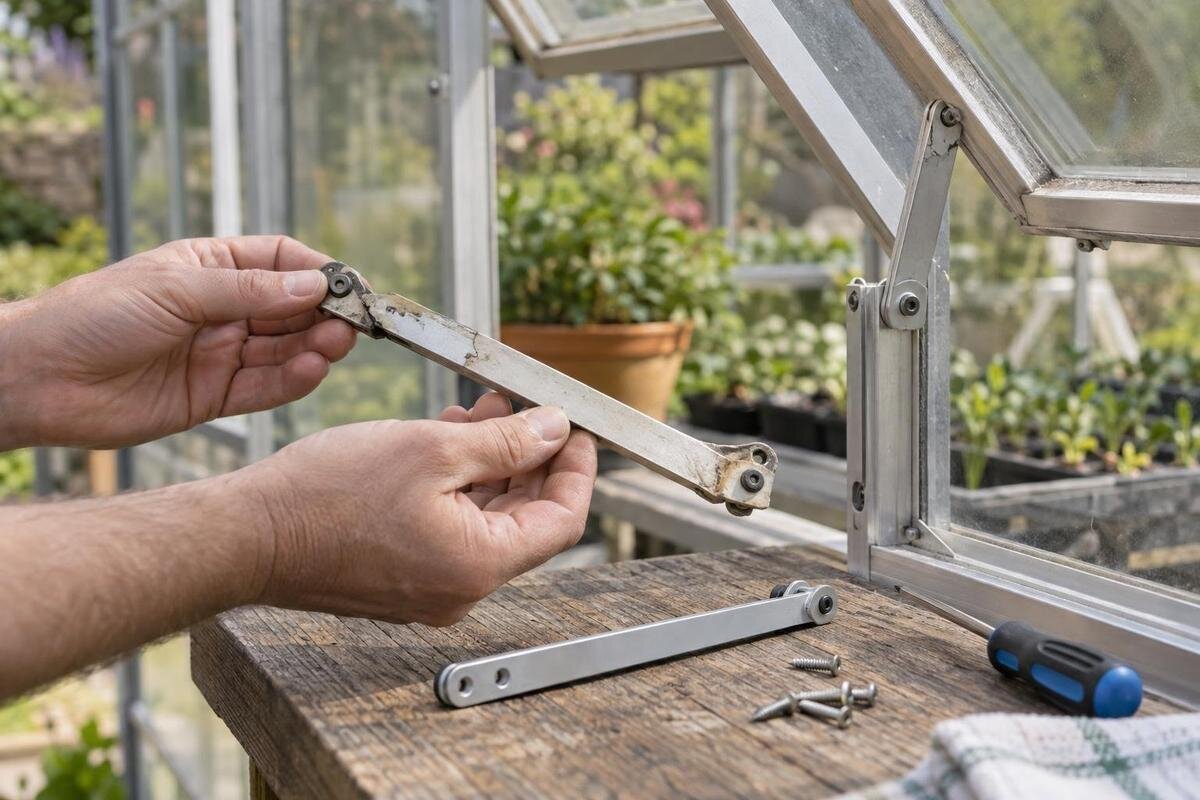
For a loose, non-fragile part that can be measured without dismantling anything, note its full length and relevant width and depth. For an installed part, photograph it with a scale only where it is safely accessible. Mark whether a dimension is approximate and state exactly which edges were measured. If you are comparing a complete replacement, use the stated details on its product page rather than treating the new structure as an interchangeable assembly. For example, the Spacious Greenhouse listing gives a 47–70 m² range; that describes the listed range, not the footprint or part dimensions of your discontinued greenhouse.

Record the profile and its connections
For a profile such as a bar, rail or channel, record its cross-section as well as its length. Photograph the end of an already detached sample only if it is safe to handle; otherwise, take clear views of an exposed end or drawing and ask an installer to measure it. Note grooves, lips, flanges, hollow sections and the direction each faces. A rough description such as square tube or curved strip can help start the conversation, but it is not a specification. Do not pry off a cover strip or panel to reveal a hidden profile; the connection may be supporting another component.
Identify what joins the part to the rest: a hole or slot pattern, bracket, clip, bolt, screw, cap or seal, and the position of each. Record the count and any stamped number, as well as which end faces upwards or towards the door. A fastener that looks similar may have a different thread, length or intended connection, so do not substitute by appearance. Keep configuration wording in your records too. In the title Bloomcabin Prestige Greenhouse with Metal Base, for example, “with Metal Base” is a qualifier worth recording rather than omitting. Check the wording in your own order or manual when describing base connections. Ask for the manufacturer’s part identifier or confirmation for your exact model.
Identify glazing and seals separately
Treat a broken or missing pane as a glazing-identification question, not just a size. Record where it sits—roof, wall or door—its orientation, visible edge type, and any wording in the manual or label about glazing. Do not infer thickness, composition or suitability from colour, apparent weight or a photograph. Do not lift, cut or remove glass to obtain a measurement, and keep people away from loose or cracked material. A qualified glazing professional or the greenhouse manufacturer can confirm which specification and measurements are needed for that position and model.
Seals, glazing beads and retaining strips can be as model-specific as the pane. Note where the seal runs, whether a loose piece has a distinctive cross-section, and whether the original part number appears on a drawing. Photograph a safe sample beside a ruler rather than stretching it to estimate its length. Keep these items separate in the enquiry so a request for glass does not omit retaining parts, or vice versa. If your search leads to a broad listing such as Aluminium Greenhouses, distinguish the catalogue category from the glazing details in your own records. The enquiry still needs the exact model, panel position and relevant seal or retaining-strip reference.
Check manuals, drawings and purchase records
Gather documents that can be matched to the actual build: the assembly manual, technical drawing, component list, original quotation and any installer notes. Check the cover or footer for a model, version or publication date, then identify the page and callout that appears relevant. A manual for a similarly named greenhouse may show a familiar shape but describe a different production run or option. Compare the drawing with your label and measurements; do not treat an illustration as proof that a component fits. If a document is missing, ask the manufacturer or original supplier whether they can locate records using the model details and purchase information.
Where a drawing uses a numbered part, quote that reference along with the document title and page, but also describe the real item and send its photos. A number copied from an unrelated version may lead to the wrong component. Keep compound model names complete: Limited Edition Aluminium Greenhouses with Storage includes a configuration detail that would be lost if shortened to Limited Edition. Compare the complete name in your paperwork with the title on any document you find, rather than relying on the shared words alone. Save the reply and any replacement number with the manual, so a later repair does not have to repeat the search.
Send a clear replacement-parts enquiry
Make one request per identifiable component, or group items only when you know they share the same model and version. Put the maker, full model name, label or serial details, approximate age, overall dimensions, part location, quantity and observed condition near the top. Attach a full view, contextual photo, close-up, label image and any relevant drawing page. Give each file a useful name, such as door track, right side, close-up. State the units and distinguish a measured dimension from an estimate. If you are unsure what the part is called, say so plainly and describe its location instead of selecting a technical name at random.
Ask the supplier to identify the exact spare-part reference, confirm whether it applies to your model and production version, and say what further evidence is needed if they cannot yet decide. If a component has been superseded, request the replacement identifier and confirmation of what it replaces; do not assume a newer item fits. When discussing a complete structure, describe the existing greenhouse’s arrangement too. If you are considering a Lean-to Greenhouse as a replacement, make that a separate request from the parts enquiry. This keeps questions about a new installation distinct from the identification of components for your existing greenhouse.

If the original part is no longer listed
An old model disappearing from a website does not tell you whether the individual spare is discontinued. Ask the maker, importer or supplier to check using the original model information and part number, and whether a later identifier officially supersedes it. Request an answer for the exact build rather than a general recommendation based on appearance. A local installer may recognise a component, but visual familiarity still needs confirmation before it is used in a frame, door or glazed assembly. If there is no parts diagram or the records conflict, send both records and ask which one applies.
If no confirmed part is available, separate a repair decision from a replacement decision. Ask an installer to assess the existing structure and explain the practical options; do not modify a member, enlarge a fixing point or adapt a different component without documented approval. If you compare a new greenhouse, consider its stated size and configuration against the site and your needs through a separate enquiry. For example, use the Limited Edition Aluminium Greenhouses page to explore that complete-product range, rather than to identify old components. Assess a new model on its own specifications and installation requirements, keeping the comparison separate from your record of the discontinued greenhouse.
Know when an installer needs to verify the match
Professional review is especially important when the unidentified item is part of the frame, roof, base, anchoring, door alignment or glazing. A small-looking connector can affect how adjoining pieces meet, and matching an outside dimension does not establish that a replacement is suitable. Give the installer your evidence pack and ask them to check the part against the manufacturer’s drawing, model revision and site condition. Where the original manufacturer still supports the model, reconcile its parts information with the installer’s observations rather than overriding either with a generic substitute.
Do not cut, drill, bend or machine an unknown component to make it fit, and do not remove glass or structural parts for a trial fit. If the relevant area is unstable or a panel could fall, keep people clear and arrange a competent assessment rather than continuing the identification exercise. For a non-structural item, follow the manufacturer’s instructions and retain its exact reference; for a safety-critical or load-bearing piece, use qualified assessment. The aim is not merely to find something with similar dimensions, but to identify a documented part for the specific greenhouse.
Frequently asked questions
What details are most useful in a replacement-parts enquiry?
Give the maker and exact model wording, any serial or revision mark, the purchase or installation date if known, the part’s position and quantity, measurements with units, clear photographs, and any manual or drawing reference. Mark estimates clearly and ask for an exact part identifier and confirmation that it fits.
What should I do if the greenhouse has no model label?
Check the invoice, order confirmation, installation paperwork, manual, packaging and emails before relying on appearance. Photograph the whole structure and the relevant details, measure features that are safely accessible, and tell the supplier the label is missing. Do not guess a model or serial number from a similar listing.
Is a part compatible if its length and profile look the same?
Not necessarily. Fixing positions, cross-section, orientation, glazing position and production revision can all affect fit. Ask a supplier or installer to check the part against documentation for the exact greenhouse. Matching visible dimensions is a useful clue, not approval to install it.
Can I remove a pane or frame member to photograph it?
Do not dismantle a frame or remove glass just to identify a part. Photograph it in place from a safe position and note where it sits. If access or stability is uncertain, ask an installer or qualified glazing professional to assess it and take any required measurements.
What if the original part is no longer available?
Ask the manufacturer or supplier whether a documented superseding part exists and whether it applies to your model and revision. If no fit is confirmed, ask an installer to assess repair versus replacement. Avoid adapting another component based on appearance alone.
Good identification is a record-keeping task before it is a shopping task. A full model name and revision, clearly framed photographs, separately labelled measurements and any original drawing give a supplier a much better basis for checking the part. If records are missing, say which details remain uncertain and ask for confirmation rather than filling gaps with assumptions. When a discontinued component cannot be verified, an installer can help determine whether repair is appropriate or whether a separate replacement enquiry makes more sense.
