
Choosing Drip Lines or Soaker Hoses for Greenhouse Beds
Greenhouse watering guide
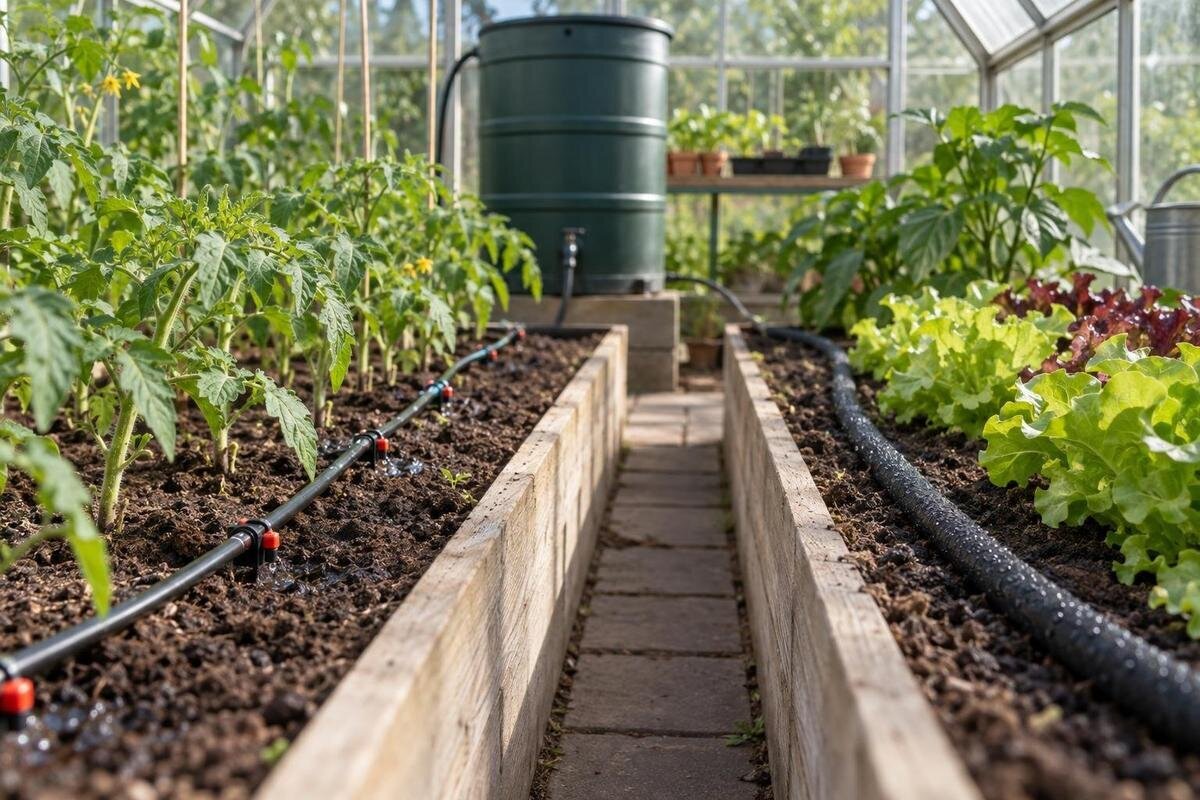
Choosing between drip lines and soaker hoses for a greenhouse bed is mainly a question of how water reaches the roots. Drip lines release it at spaced emitters; soaker hoses release it along a porous or perforated length. That difference affects how reliably you can match outlets to plant positions, how sensitive the setup is to filtration and pressure, and what you can inspect when a bed dries unevenly. Neither system guarantees uniform moisture by itself: the line length, water supply, soil and layout all matter.

How the two systems deliver water
A drip line is tubing with outlets, often called emitters, spaced along its length. Each outlet delivers water at a particular point, so its spacing can be compared with plant positions and the product's stated output. Some lines are designed to deliver similar amounts across a stated operating range; others are not. Check the technical information for the exact line rather than assuming all emitters behave alike. Water spreads from each outlet according to the soil and application conditions, so a damp spot at the outlet does not prove that the full root zone, or the area between two emitters, is moist.
A soaker hose releases water along a longer section through porous material or distributed openings, depending on its design. It tends to create a wetted strip rather than obvious separate points, but that does not mean the strip is equally wet from end to end. Pressure, total hose length, bends, blockages, wear and bed conditions can all affect release. Neither system automatically covers the full width of a bed: a single run may suit a narrow row but miss plants in a wide bed or several rows. Compare the wetting patterns in your soil rather than assuming that either point delivery or continuous seepage produces even moisture.
Map the greenhouse beds before buying tubing
Before ordering tubing, sketch the actual growing space. Mark each bed, crop row, plant spacing, aisle, doorway and route to the water supply; show where joins and filters can remain accessible. The page for the Classic aluminium greenhouse lists footprint options, but the product range is not a bed plan. Measure the chosen size and planted area separately from aisles or storage. The same floor area can be arranged with different row lengths and access lanes, changing how many lines you need and where they can run.
Note whether beds are straight and uniform, broken by paths, or different in width. A regular row may take a straightforward run; irregular planting needs more careful outlet placement or a different number of lines. Record the length of each proposed run, the plants it serves, any branches and its maintenance access. This map lets you compare the layout with the manufacturer's pressure, flow and maximum-length limits, and plan for shut-off points or flushable ends only where the system provides for them. If nearby crops need different watering, note that too; being in the same greenhouse does not make their schedules identical. Settle the route before cutting or joining tubing.
Drip lines for rows with defined planting positions
Drip lines are easier to match to crops planted at repeatable intervals. Compare the built-in emitter spacing with the distance between plants: if the intervals differ substantially, outlets may land between plants, or several may serve one root zone. With well-defined rows, lay out the line so outlets sit near the intended root zones, while following the line's stated length and pressure limits. For widely spaced crops, emitter spacing and output matter more than the fact that the tubing looks uniform. If bed spacing changes along a run, mark each section separately rather than extending one line by habit.
Individual outlets are relatively straightforward to sample, but a small blockage can affect one plant while nearby emitters keep the bed looking healthy. Do not treat a regular run of outlets as proof that every plant receives the intended amount. A greenhouse with built-in storage, such as the Limited Edition Aluminium Greenhouse with Built-in Storage, also makes it important to separate planted floor from non-growing space when counting rows and line lengths. Use the actual selected layout: the product name does not tell you how much bed area remains or what irrigation run the supply can support.
Soaker hoses for continuous planted strips
A soaker hose can suit a continuous planted strip when its route follows the row and the root zones lie within the wetted band. That can avoid aligning a separate outlet with every plant, but the hose still needs to match the crop row and bed width. Check the specified operating pressure and maximum length before laying it out, and avoid kinks or tight loops that can interrupt flow. If a bed contains several rows, do not assume one hose down the middle will reach them all; inspect soil near the outer rows or plan additional runs according to the product instructions.
A fairly straight route is easier to assess than one that branches or winds around pots and bed edges. The footprint choices on the listing for the Lean-to Greenhouse do not tell you the length of an individual bed; measure the selected bed and the full route back to the supply before choosing a hose. Keep couplings visible and avoid routing across the main aisle if there is a practical alternative. A hose that is hard to reach is harder to inspect for kinks, leaks and dry sections, whatever its nominal length.

Check operating pressure and line length
Uniform delivery depends on the pressure and flow available while the system is running, not only on whether water comes out of the tap. A no-flow reading alone does not show how the supply behaves during irrigation. Compare the source's operating conditions with the instructions for the exact drip line or hose, including any regulator or connection the manufacturer specifies. Do not assume a soaker hose and drip line use the same pressure, or that a fitting intended for one is suitable for the other. If the requirements or source performance are unclear, ask an irrigation supplier or qualified installer to check the proposed set-up.
Long runs, multiple branches and changes in level can contribute to differences between the first and last outlets; the effect depends on the tubing and system design. Follow the stated maximum run and pressure range for each line instead of copying a length used elsewhere. The Spacious Greenhouse listing covers greenhouse options from 47 to 70 m², but floor area alone does not determine irrigation-line length: rows may be divided, arranged across the space or interrupted by aisles. Draw actual bed routes, then check every proposed run against the irrigation components' limits. More water at the source is not a substitute for compatible specifications.
Choose filtration to suit the irrigation components
Drip emitters can have narrow passages, so fine sediment, organic particles or other debris may obstruct an outlet. A filter may be required, but the correct filtration grade and flow capacity depend on the emitters and the manufacturer's instructions. Use a filter intended for irrigation components and check its specification against the exact line; an arbitrary mesh choice may not protect the system or may restrict flow. Put the filter where it is accessible for inspection and clean it as directed. A partly blocked filter can change performance across an entire run, while a single blocked emitter affects a smaller area.
Soaker hoses are not automatically immune to blockage: pores or small openings can clog, and deposits may change how much water seeps through. Confirm whether the specific hose calls for filtration and what maintenance its manufacturer permits. If output declines or a dry patch appears, inspect the filter, hose and supply before trying a cleaning treatment. Water that leaves visible mineral deposits may call for a water-quality check, but do not use acids or other chemicals unless the hose manufacturer expressly approves the method. Cleaning approaches for one material or design may damage another.
Test moisture and output along each bed
After installation, compare delivery on each drip run under its normal operating arrangement. Place identical containers below comparable emitters near the start, middle and end, let the line run for the same interval, and compare the collected amounts. This is a practical comparison rather than a pass-or-fail standard, but noticeable differences can point to a kink, blocked outlet, filter issue or pressure problem. Sample more than one position before drawing a conclusion, and compare outlets with the same stated rating. A first emitter that performs well cannot stand in for the entire line.
With a soaker hose, assess moisture in the bed rather than trying to catch seepage from the hose surface. After a normal run, allow water to move into the soil, then check under the hose and between it and the plants, including the start, middle and end of the route. Check at the intended root depth as well as towards the bed edges, and repeat if the first inspection is inconclusive. When planning beds for a Bloomcabin Prestige Greenhouse, mark these checking points on the bed sketch. This makes it easier to compare the same places after adjusting the hose position or resolving a delivery problem.
Soil texture and line position affect wetting
Even similar outlet flow can produce different soil moisture across one bed. In broad terms, coarser soil tends to let water move downwards more readily, while finer soil often allows more sideways spread; structure, compaction, organic matter and how wet the bed already is can change that pattern. Drip outlets may form separate damp zones, while a soaker hose may wet a band whose width varies across the bed. Check beyond the visibly wet surface. The relevant question is whether moisture reaches the intended roots, not whether the soil immediately under the line looks dark.
Compare soil beneath, between and beyond the lines after watering, taking account of each crop row rather than treating a whole bed as uniform. Adjust placement or spacing only after checking for blocked outlets, kinks or pressure problems; adding a second line will not fix a fault upstream. For a proposed layout in the T-Model Orangery Greenhouse, mark the planting rows alongside the irrigation runs so you can identify which roots each run is intended to reach. Pay particular attention where rows diverge or bed width changes. Repeat the assessment if planting rows or bed contents change.

Keep filters, outlets and connectors accessible
Include routine checks in the watering plan. For drip lines, look for leaks, loose joints, flattened sections, dirty filters, and blocked or inconsistent emitters. If the line has a flushable end and the instructions allow flushing, use the manufacturer's procedure; not every line is meant to be opened or cleaned in the same way. Avoid poking emitters or applying household chemicals unless specifically approved. A quick look at one point can miss a blockage farther down, so inspect comparable outlets along each run and confirm suspect areas in the soil.
For soaker hoses, watch for kinks, visible damage, leaks and sections that stop wetting the bed as expected. Check again after moving plants, adding mulch or changing the route, since the hose may have shifted or become covered. Leave filters, connectors and any clean-out points where they can be reached without stepping into beds. If you are considering the Pyramid Greenhouse, include these access points in your proposed bed and aisle layout. Think about reaching connections once the plants have grown, not only while the beds are empty. Inspection should not depend on moving a planted row or pulling the hose out of position.
Which system fits your greenhouse beds?
Choose drip lines if plant positions are defined, emitter spacing can be matched to the rows, and you want to compare output at individual points. Choose a soaker hose when roots occupy a continuous strip, the route stays within the manufacturer's length and pressure limits, and soil checks show moisture reaching the target area. If the bed mixes crops, changes width or has sharply different soil conditions, neither choice removes the need to plan line placement carefully. Ease of maintenance matters too: a system that is hard to inspect can hide a small fault. Do not choose on an unqualified claim that one type always saves more water; a poorly matched layout can waste water or leave dry spots.
Before buying, compare emitter spacing or hose design, rated output, required pressure, maximum length, filter specification, fittings and cleaning instructions for the exact irrigation product. Confirm that the water source can meet its stated conditions, and use the finished bed map to estimate tubing and connections. If you are also choosing from the Limited Edition Aluminium Greenhouses range, keep the greenhouse choice and irrigation-component shortlist separate: a model name does not establish watering-system compatibility. Compare the proposed runs with the irrigation specifications once you have chosen the bed layout. Then test each line before relying on it for established crops.
Frequently asked questions
Are drip lines more uniform than soaker hoses?
Not automatically. Drip emitters provide separate outlets that can be compared, but their delivery still depends on pressure, run length, filtration and whether outlets are clear. A soaker hose can wet a continuous strip, but release may vary along its length. Check the actual bed rather than relying on the system type alone.
Does a soaker hose need a filter?
It depends on the hose and water source. Sediment or debris can block pores or openings, but the manufacturer sets any filter requirement and filtration grade. Check the instructions for the exact hose and use only an approved maintenance method; designs can differ.
Can I run either system from a garden tap?
Possibly, but it depends on the flow and operating pressure available while the system is running, as well as the product's requirements and fittings. Check the exact instructions. A tap connection alone does not confirm that the supply will support a long run or several branches.
How can I check whether a soaker hose wets the bed evenly?
After a normal watering run, allow water to move into the bed, then compare soil moisture at several points along the hose and across the bed. Check near the ends and between the hose and the plants, including the intended root zone rather than just the surface.
Can drip lines and soaker hoses be used in one greenhouse?
Yes, if each run has compatible pressure, flow, filtration and fittings. The two systems do not automatically belong on the same branch or watering schedule, so check both manufacturers' requirements. Beds with different crop needs may also call for separate control.
Choose according to the planting layout and the wetting pattern in your beds. A drip line's spaced outlets can suit plants at regular intervals; a soaker hose may suit a continuous planted strip. In either case, check moisture at root depth in several places, especially near run ends and bed edges. If moisture is uneven, revisit pressure, filtration, blockages and placement before simply watering for longer.
