
Glass Greenhouse or Polytunnel for Your Garden?
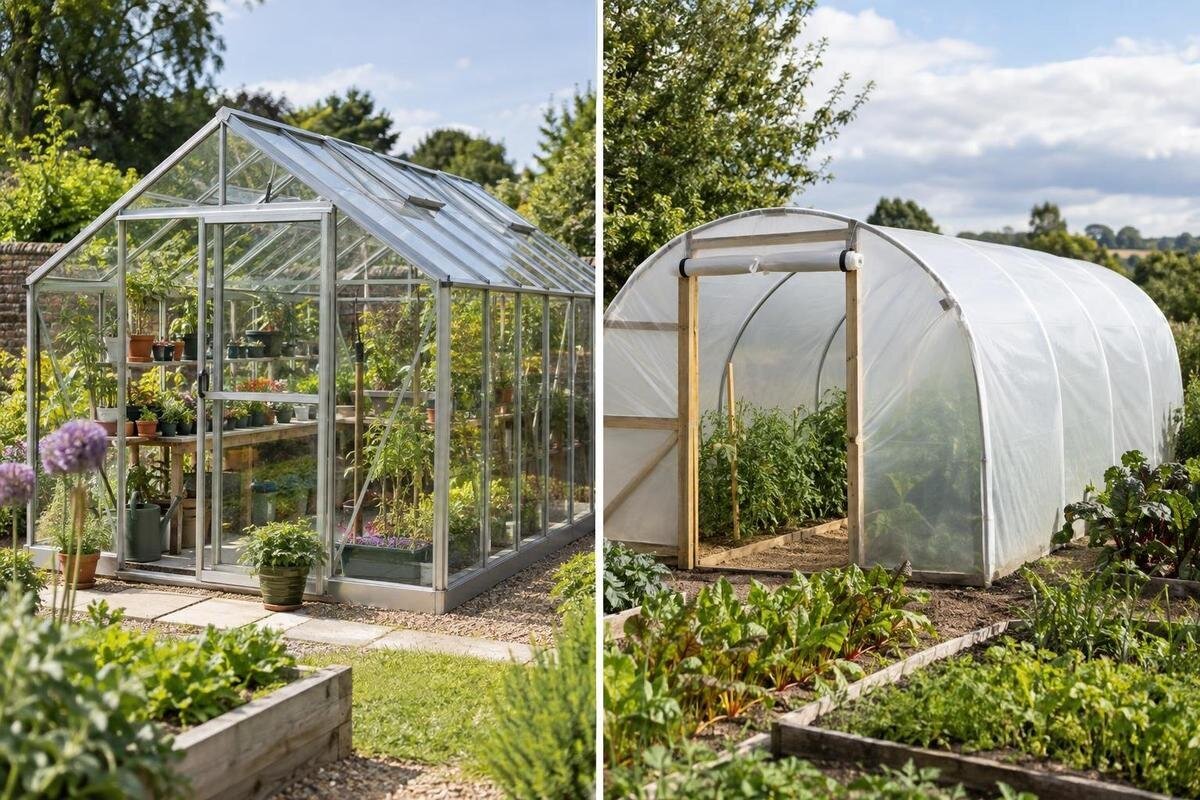
Greenhouse comparison
Choosing between a glass greenhouse and a polytunnel is not simply a choice between a permanent structure and a temporary one. The first has rigid glass panes; the second has a flexible film cover, but both can be configured in different ways and both need suitable siting, airflow and upkeep. The better fit depends on how long you expect to use the space, what you want to grow, how you will manage changing conditions, and which maintenance tasks you are prepared to take on. Compare actual specifications, not product names alone.

Glass panes and tunnel film are different coverings
A glass greenhouse and a polytunnel differ first in their covering: one uses rigid glass panes held by a frame; the other uses flexible plastic film stretched over a frame. The label greenhouse is used more broadly, so it does not guarantee that a listed model comes with glass. Frames, panel or film attachment, doors and vents vary between designs. Compare the exact version you can order, rather than treating either name as a complete specification. The covering affects handling and upkeep, but it does not by itself tell you how suitable the whole structure is for a particular crop or site.
Keep structure shape separate from cladding. A lean-to describes a layout against a wall; glass or film describes the outer covering. The Lean-to Greenhouse listing gives area options from 3.69 m² to 14.34 m², but its name does not identify the glazing. Check the specification for the actual covering, frame, included openings and available configuration. If a product image shows a particular version, use the written details to confirm what is included. Comparing a freestanding glass greenhouse with a film tunnel of a different footprint mixes several differences, rather than isolating the covering.
Decide how permanent the growing space needs to be
Think about how fixed the structure should be before weighing the materials. If it will occupy the same spot for years, it becomes part of the garden layout: beds, paths, trees and access all need to work around it. A polytunnel is not automatically temporary; some are planned as long-term installations. Equally, the word glass does not prove that a structure suits a particular site or will need no future work. Decide whether relocation matters to you, and ask what dismantling and reassembly would involve before treating a structure as easy to move.
For a long-term installation, check the exact model’s requirements for its base, support, anchoring and site preparation. Ask the supplier for the relevant details, and seek a qualified professional’s assessment if the ground or exposure raises questions. The Limited Edition Aluminium Greenhouses listing shows an area range from 3.77 m² to 28.08 m². Treat that as a scale reference only: it does not establish how a chosen configuration should be installed, whether it suits your site or what covering is included.
Assess the exact garden site
Observe the proposed site at different times of day and through the seasons. Buildings, fences and trees can cast changing shade, while growing foliage may alter conditions later. South African gardens span varied local climates, so national generalisations cannot replace a close look at your own plot. Note where direct sun falls at times that matter for your chosen crops, whether the site is sheltered or exposed, and whether nearby vegetation could affect light or access. A simple sketch with dated notes can help you distinguish conditions you have observed from those you still need to assess. If you are comparing two possible positions, record the same details for each rather than judging one on a sunny morning and the other on an overcast afternoon. Consider the space around the proposed structure as well as the ground beneath it. This gives both the glass greenhouse and the polytunnel a fair comparison against the same site conditions.
Look at drainage after rain, ground conditions, slope, nearby runoff and the route you would use to bring materials to the site. Leave room to tend the structure and reach the surrounding beds; a suitable growing space is harder to use if everyday access is awkward. Compare the site requirements for each exact model. If exposure or the ground makes suitability uncertain, get advice from a qualified professional rather than assuming that glass or film makes one option the safer choice.
Compare usable growing space, not just floor area
The outside footprint is only one measure of useful space. On a plan, mark where the entrance sits, how you will reach each bed, and how much room you need for paths, benches and the plants themselves. A curved tunnel wall can reduce standing height near the edges, while a greenhouse’s shape and frame also affect the space available inside. These details vary by design, so check internal dimensions and a cross-section if available. Think about carrying pots or tools through the entrance, and whether you can reach plants without stepping into a bed. Draw the layout for the crops at their intended growing size, not just as seedlings. Then trace an ordinary working visit: entering with supplies, reaching the farthest plants, tending a bed and taking material out again. If a bench or storage area blocks that route on paper, revise the layout before choosing a larger structure simply to solve an access problem.
The Bloomcabin Prestige Greenhouse page lists options from 3.77 m² to 28.08 m². That range is useful for comparing scale, but it is not a substitute for the dimensions and layout of the selected version. A stated area does not tell you how much space remains for crops after you allow for paths, shelving or storage. Compare the footprint and internal clearance with your own planting plan, and leave room for plants to grow rather than measuring only for the day you set up.

Light and warmth depend on the full specification
A transparent covering does not make all structures behave alike. The type of pane or film, its condition, the frame layout, shade and nearby buildings can all affect the light reaching plants. Do not assume that glass always gives more useful light or that film always diffuses it; the selected covering specification matters. Both enclosed structures can become warm in sunshine, and neither covering is a temperature-control system on its own. The conditions inside also depend on openings, shade and how the structure is managed as the weather changes.
Check which covering is included in the chosen configuration, and look for relevant information about its light transmission or other stated properties if those matter for your crops. The Aluminium Greenhouses listing gives area options from 3.77 m² to 28.08 m²; you will need the selected glazing details to compare light performance. Keep your proposed crop layout and surrounding shade in view when reading those details. A covering comparison is less useful if one option is assessed in an open position and the other beneath nearby trees. Consider how you would provide shade when needed, while accounting for the light that added shade would exclude. Separate the properties of the covering from the effects of the location and any shading you plan to use.
Ventilation needs deliberate planning
Ventilation is a practical part of the comparison because an enclosed structure can heat up and hold moisture. Check where the openings are, how they operate and whether their placement suits the way you will use the space. A tunnel may have openings at its ends or along its sides, but arrangements differ; the same applies to vents in greenhouses. Do not infer the ventilation design from a product category or photograph. Use the selected model’s drawing to locate the openings in relation to beds, benches and access routes. Think through the actual task of opening and closing them: where you would stand, what you would need to reach and whether the planned layout leaves that access clear. This makes ventilation part of the daily working plan rather than an item counted on a specification sheet. The number of openings alone does not explain how you will manage them.
The T-Model Orangery Greenhouse listing gives options from 16.52 m² to 30 m². For the version you are considering, ask for the size and arrangement of its openings and whether any automatic opening equipment or insect mesh is offered and compatible. Consider who will operate the vents when conditions change, especially if you are not usually in the garden during the day. If someone else will look after the plants during your absence, include their access and familiarity with the controls in your plan. Choose an arrangement you can manage consistently, rather than relying on a routine that your normal schedule will not allow.
Plan for cleaning, repairs and cover replacement
A film covering is a replaceable skin, so allow for inspection and the possibility of renewal. Its condition and service life can vary with the film grade, exposure to sunlight and weather, installation and maintenance; there is no reliable interval that applies to every tunnel. Glass panes do not have the same cover-renewal routine, but they still need attention. Check for damage and ask how repairs are handled. If a pane is broken or needs replacing, confirm what safe, qualified help is appropriate rather than assuming it can be dealt with like a film repair.
Before choosing, ask whether replacement film or individual panes are available for the exact configuration, and how the correct parts are identified. Do not assume a generic cover or pane will fit. If the Pyramid Greenhouse is on your shortlist, confirm what covering the selected version uses and what replacement information is available. Apply the same check to a tunnel’s film dimensions and attachment system. Distinguish replacing the covering from repairing the frame or operating parts, so you understand which task a quoted replacement actually addresses. Keep the chosen configuration and relevant part references with your purchase records. Also consider how you would reach the affected area without obstructing the surrounding beds, and who would carry out the work. These practical arrangements help you compare maintenance commitments without assuming a fixed replacement interval for either covering.
Include upkeep and storage in the ownership budget
Compare the overall commitment, not just the initial quotation. Depending on the selected structure, your costs and effort may include site preparation, delivery, assembly, ventilation or shading options, routine care and future repairs or cover replacement. Do not assume that a polytunnel will always cost less over time, or that a glass greenhouse will always require less maintenance. Request an itemised quotation for the exact configuration and distinguish included items from options. Group the figures into initial costs, routine upkeep and possible future replacement work. Where a future cost is unknown, mark it as unknown rather than treating it as zero. Use the same intended period of ownership for both options, without assuming that either will need a particular repair during that period. Keep the time commitment alongside the financial comparison: a maintenance task still needs to fit your routine even when you are willing to pay for the materials.
Decide where tools and supplies will go before allocating the whole floor area to crops. Separate storage can take space beside the structure, while a storage configuration may affect the space available for growing. The Limited Edition Aluminium Greenhouses with Storage listing gives options from 5.52 m² to 28.08 m². Confirm the layout of the version you are considering rather than inferring how its stated area is divided from the name alone. Include storage, access and planting space in the same plan so the finished structure works for everyday tasks.

Compare complete specifications like for like
A fair comparison uses a drawing and written specification for each exact model, not two products that merely have similar names. Check the external dimensions, internal height, covering material, frame details, doors, ventilation openings and base requirements. Ask which accessories are included, which are optional and what information is available about replacement parts. Use the same intended footprint and growing plan when comparing a tunnel with a greenhouse. Photographs can help you understand a design, but they are not a reliable source for measurements or a list of everything supplied.
The Spacious Greenhouse listing gives an area range from 47 m² to 70 m². Use that range to decide whether this scale belongs on your shortlist before comparing finer details. A substantially larger structure is not a like-for-like alternative to a smaller tunnel simply because both provide protected growing space. Compare dimensioned plans for versions that can accommodate the same beds, paths and working areas. If the listed areas are measured differently, use the drawings to understand what each figure includes. Keep any unresolved differences visible in your comparison rather than allowing a larger headline area to stand in for a more suitable layout.
Choose according to your growing routine
A glass greenhouse may suit a plan that calls for a rigid-pane enclosure in a fixed place, provided its specific installation and repair requirements work for your garden. A polytunnel may suit a plan built around flexible film, provided you are comfortable inspecting the cover and planning for its eventual renewal. These are ways to frame the choice, not guarantees about price, lifespan or performance. Ask yourself which maintenance pattern you would rather take responsibility for, and whether the structure’s openings and layout suit the crops you intend to grow.
Write down what you want the space to do, when you will use it, how you will access the beds and who will manage ventilation and repairs. Separate essential requirements from preferences. A layout that cannot accommodate your beds or a ventilation routine you cannot maintain should carry more weight than an appealing appearance. Where both options meet the essentials, compare the remaining trade-offs: the maintenance tasks you prefer, the amount of growing space you will actually use and the place each structure will occupy in the garden. Record why your preferred option suits those priorities. That gives you a clear basis for choosing without needing to claim that one covering is better for every gardener.
Frequently asked questions
Is a glass greenhouse warmer than a polytunnel?
Not automatically. The temperature inside either structure depends on its covering specification, openings, shading, ventilation and the conditions around it. The words glass and polytunnel alone do not tell you how much heat will build up or be retained. Check the selected model’s details and plan how you will manage ventilation.
Which is better for a South African garden?
There is no single answer for every garden. Sun exposure, wind, shade, drainage, crops and the time you can spend managing the structure all matter. Assess the conditions at your own site, then compare the exact greenhouse and tunnel specifications rather than relying on a general regional rule.
How often does polytunnel film need replacing?
There is no reliable interval that applies to every cover. Film grade, exposure to sunlight and weather, installation and maintenance all affect how it wears. Ask for the manufacturer’s guidance for the specific film, and include the possibility of future cover replacement in your ownership plan.
Can a polytunnel be used as a permanent structure?
Some polytunnels are intended to remain in place, but you should not assume that every design suits a permanent installation. Check the selected structure’s site, support and anchoring requirements with the supplier. If ground conditions or exposure raise concerns, ask a qualified professional to assess them.
Does a product called a greenhouse include glass?
Not necessarily. Greenhouse is a broad name for a protected growing structure, and a product listing may use another type of covering. Check the specifications for the exact configuration you are considering, including the covering material and what is included.
A glass greenhouse and a polytunnel offer different ways to create a protected growing space, not a universal ranking of quality or value. The useful distinction is how each complete structure fits your site, crops and routine. Choose the option with a workable layout, manageable ventilation and an upkeep commitment you are comfortable with. The right fit is the one you can use and maintain as intended throughout your gardening plans.
