
Choosing the Right Depth for Greenhouse Growing Beds
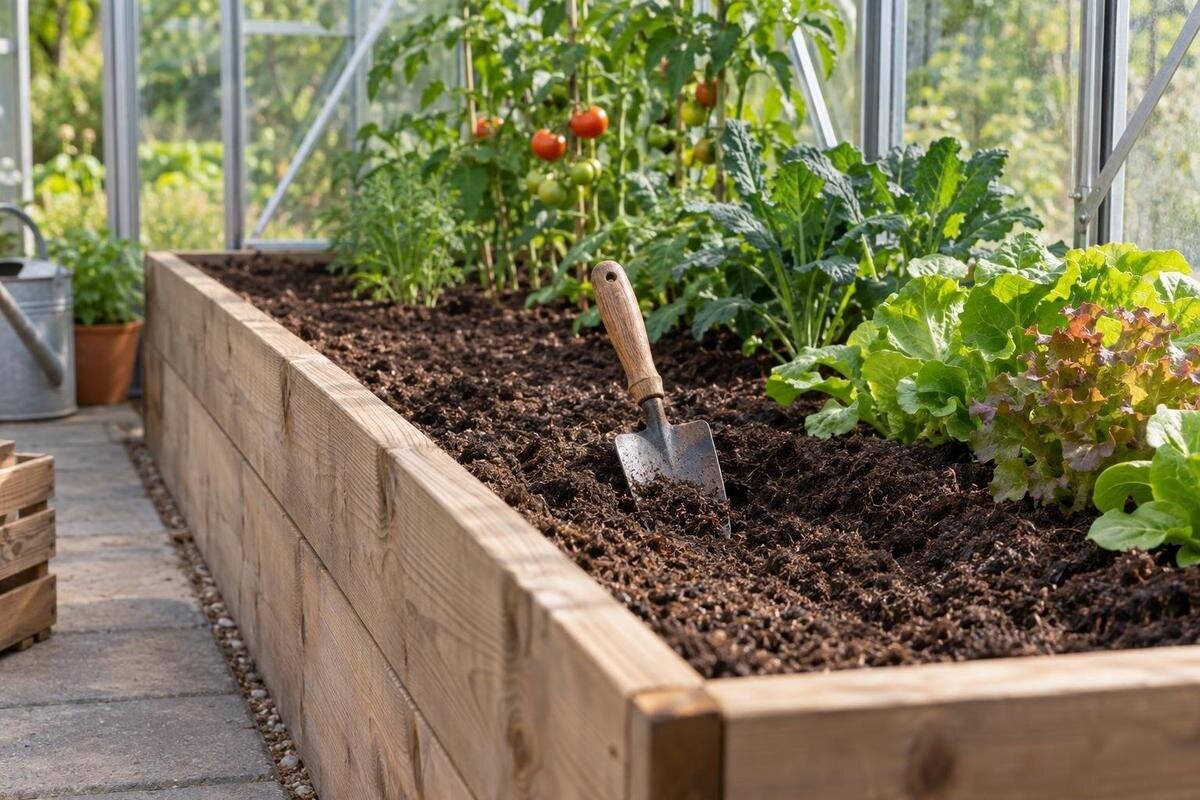
Greenhouse growing beds
A deeper greenhouse bed is not automatically more useful. The right depth is the amount of growing medium the chosen crops can use, with room for roots and a route for surplus water to drain. Whether a bed is open to the ground or contained above a hard surface changes the calculation as much as the crop does. This guide compares root requirements, explains drainage constraints and works through bed-volume calculations so you can estimate the medium needed before building or filling.

Measure the finished growing depth
Measure from the finished surface of the growing medium to the bottom of the filled layer; that is the bed’s usable fill depth. The plant’s total rooting depth may be greater if roots can pass into soil below, so record that separately. A frame’s outside height is not the same measurement: if a 35 cm wall is filled to 28 cm, the bed holds 28 cm of medium, not 35 cm. Leave any freeboard above the surface out of the calculation, and do not count a base, liner cavity or empty gap as root room. Where the bed floor is uneven or stepped, measure each section separately; an average can conceal a shallow strip that limits root crops. Marking the intended fill level inside the frame makes it easier to check the finished depth.
Where a bed sits on natural ground, record both the depth of added medium and the condition of the soil beneath it. Greenhouse floor area is a separate measurement again. The Limited Edition Aluminium Greenhouses are listed in floor areas from 3.77 to 28.08 m²; that range helps compare overall footprints, but does not specify bed depth or growing-medium volume. Use the chosen greenhouse plan and the bed’s internal measurements for those. If you are measuring an existing bed, check more than one point: settlement or a sloping base can leave less usable medium in one area than the frame height suggests.
Match the depth to the crops you plan to grow
Root systems do not stop at a standard line, and the same crop can root differently in loose, compacted or waterlogged medium. As a rough planning guide, many leafy crops can use about 20–30 cm of workable medium; larger, longer-season fruiting crops often benefit from 30–45 cm or more. Long, straight-rooted crops, including some carrot varieties, need enough uninterrupted depth to develop properly, so check the variety rather than relying on a generic label. These ranges are not fixed specifications. Soil structure, moisture and the ground below the bed all affect how much space roots can use. Plant height alone is not a reliable guide to root depth.
Choose the depth for the deepest-rooted crop you expect to grow in each part of the bed, rather than averaging the requirements across your crop list. If tomatoes, leafy greens and shallow herbs share a bed, either provide enough depth throughout for the larger root systems or allocate deeper areas to the crops that need them. A narrow, extra-deep pocket may not help if neighbouring plants also need that soil. Your crop plan may change between seasons, so note where you intend to grow deeper-rooting crops. Even with adequate depth, plants still need suitable spacing, a free-draining medium and care appropriate to the variety.
Open-bottom beds can use soil below the frame
An open-bottom raised bed is an added layer over garden soil, not necessarily a closed box. When the soil below is workable and drains adequately, roots can pass from the bed medium into it. Loosening the bed footprint beneath the frame may make that soil easier for roots to enter, without needing a deeper frame. Check for compacted layers, rubble or standing water first. If roots meet a hard or persistently wet layer, the apparent extra depth below the bed may not be usable. In your plan, note both parts of the profile, such as 30 cm of added medium over prepared ground, rather than describing the whole root zone as a 30 cm bed.
In a contained bed on paving or another solid base, roots cannot necessarily reach the ground below, so the filled depth must accommodate the complete root zone. A greenhouse’s base arrangement alone does not tell you whether a bed can connect to the underlying soil. The Prestige greenhouse with a metal base is identified by that model configuration, but its name does not establish what lies below the growing area at your site or how a bed could be installed. Check the selected model’s base and floor information against your proposed bed arrangement. If an existing structure will support the filled bed, confirm its suitability with the supplier or a qualified professional.
Drainage sets a limit on useful depth
Water must move through the growing medium and leave the root zone. Depth alone does not guarantee that: compacted or fine-textured medium, a blocked outlet, saturated ground below or excessive watering can all leave water sitting in a bed. A very free-draining medium may, in turn, dry quickly, so the crop still needs an appropriate watering plan. Think about the whole profile—the surface, medium, bed bottom and receiving ground—rather than choosing a depth as a fix for a wet patch. If different parts of the bed drain differently, investigate those areas before filling to a single assumed level.
Check where excess water can go before filling. In an open-bottom bed, observe how the underlying soil behaves after watering; in a contained bed, make sure any drainage route is present and unobstructed. A gravel layer beneath finer medium is not a dependable cure: the change in pore size can delay water moving into the coarse layer, leaving wetter medium above it. If water repeatedly remains pooled or the ground stays saturated, address that constraint before investing in a much deeper fill. Follow the growing-medium supplier’s guidance on filling and avoid compressing the mix as you work, since compaction can reduce the space through which water and roots move.

Calculate growing-medium volume from the bed interior
Use the bed’s internal length and width, together with the intended finished fill depth: length × width × depth gives cubic metres when all three measurements are in metres. Multiply the result by 1,000 to convert it to litres. For example, a bed measuring 1.2 m × 2.4 m with a 0.30 m fill depth needs 0.864 m³, or 864 litres. A second example, 0.9 m × 3 m × 0.40 m, needs 1.08 m³, or 1,080 litres. These are arithmetic examples, not standard bed sizes. Convert centimetres before calculating: 30 cm is 0.30 m.
Calculate each compartment separately and add the totals. For an irregular shape, divide the plan into simple rectangles, calculate each one, then add their volumes; do the same for sections filled to different depths. Use internal rather than outside frame measurements, and exclude any space you plan to leave unfilled. A greenhouse’s listed area is not a medium-volume figure: the T-Model Orangery Greenhouse range is listed from 16.52 to 30 m², which describes floor-area options, not how many litres your beds require. The calculated volume is also not a weight estimate. Compare it with the volume stated for the medium you intend to buy, including any supplier guidance about its delivered or settled yield.
Pots, benches and storage change the space calculation
A continuous bed and a collection of pots do not provide the same root space. A bed offers a shared volume of medium; each pot or grow bag has its own limits, so measure its internal dimensions and calculate its fill separately. A bench changes the height at which you work, not the depth of medium inside a container. Shallow trays may suit young plants, but they do not automatically provide the root volume needed for mature crops. If you plan to mix beds, pots and containers, list each growing area and its volume rather than treating all planting space as one large bed.
Storage also takes space that cannot be counted as growing area. If built-in storage is part of your layout, the Limited Edition Aluminium Greenhouses with Storage are listed in floor areas from 5.52 to 28.08 m². Use the specific plan to see how the selected arrangement affects your beds and access; the area range does not show how much floor space remains available for planting. Allow room for the items you actually intend to store, and decide where containers will sit when they are not being used. That makes the growing-medium calculation more realistic than working from the greenhouse’s total floor area alone.
Plan bed width and access together
Bed width affects whether you can reach the whole growing surface without stepping on the medium. A bed accessible from one side needs to be planned differently from one you can reach from both sides. Rather than relying on a single recommended width, test the plan against your own reach and working position. Include the space needed to sow, weed, harvest and handle tools; a deeper bed will not make an inaccessible centre easier to tend. Paths should allow you to move between beds and reach the areas you intend to work on, while doors, vents and other access points must remain usable.
The Lean-to Greenhouse range is listed in floor areas from 3.69 to 14.34 m². When comparing options, use the exact internal plan to establish which sides of each proposed bed you could reach from a path. Mark any edge that would be inaccessible, then consider whether the bed needs to be narrower or approached from another side. Include containers in this sketch, as they also occupy working space. Settle these widths before calculating the fill: changing a bed’s width changes the volume required even if its length and depth remain the same.
Choose greenhouse floor area around the full layout
Draw the complete layout before settling on the greenhouse footprint. Start with the inside dimensions shown for the model you are considering, then mark each bed’s length and width, paths, door access and any planned storage or containers. Leave room to work around the beds and to reach the crops at their mature size. If the growing system includes supports or equipment, note where they need to sit as well. The aim is not to fill every square metre with growing medium: a layout needs usable routes as well as planting space, and the available floor area cannot be converted directly into bed volume.
For example, the Pyramid Greenhouse range is listed from 5.53 to 18.9 m². Compare the exact plans for the options you are considering with the same set of proposed beds, paths and containers. This lets you assess whether each footprint accommodates your growing system without changing the bed depths simply to make a layout fit. Check internal dimensions rather than estimating from a photograph, and keep access to mature crops in the comparison. Two models with different floor areas may require different bed arrangements; the area figures alone do not show how your particular layout will fit.

Check construction, materials and support
Choose bed materials that the manufacturer confirms are suitable for continuing contact with damp growing medium. If you use a liner, check that it is intended for that purpose and does not block the planned drainage route. Do not assume that a material is suitable for growing crops because it looks like garden equipment or has been used outdoors before; be cautious with reused items whose previous treatment or contents are unknown. These checks concern the bed itself, not just its height. A suitable depth in an unsuitable or poorly drained container will not give roots a useful growing environment.
Filled growing medium can be heavy, particularly when wet. If a bed will sit on a greenhouse floor, bench or raised structure, verify that the support is intended for that use; do not infer a load capacity from a product name or floor-area figure. The Classic Aluminium Greenhouse range is one option to compare when planning a greenhouse footprint, but its listed area does not establish whether a particular structure can support a filled bed. Check the specific product information and consult the supplier or a qualified professional where support or installation is uncertain.
Confirm fill levels and order quantities
Before ordering, compare the intended fill level with the depth available in each growing zone. Pay particular attention to uneven bases and stepped beds: a single measurement may not represent the whole bed. Mark the agreed level inside each section so that it remains clear during filling. Keep a record of the internal dimensions, finished depth and calculated volume together, rather than recording only a total quantity. If you build the beds in stages, these notes will help you distinguish the medium already accounted for from the amount still needed, and make later adjustments or repeat orders easier to estimate.
For a layout with several beds, calculate each bed’s requirement before adding them together for the order. The Spacious Greenhouse range is listed from 47 to 70 m²; when planning within a larger footprint, keep separate quantities for beds with different depths or crop requirements. Include pots and other containers as their own entries rather than treating the whole planting area as one uniform layer. Compare the resulting total with the supplier’s stated volume and guidance on settled yield. This keeps the order tied to the growing areas you have actually planned, rather than to the greenhouse’s overall size.
Frequently asked questions
How deep should a greenhouse bed be for vegetables?
As a broad guide, about 20–30 cm of workable medium can suit many leafy crops, while larger or longer-season crops may need roughly 30–45 cm or more. Check the needs of the varieties you plan to grow, and consider whether roots can enter the soil beneath an open-bottom bed.
Can a 15 cm deep bed work?
It can suit some shallow-rooted crops, but it is not a universal depth for mature vegetables. A contained bed of that depth may restrict larger plants and long-rooted crops. If the bed is open to the ground, roots may have more room, provided the soil below is suitable.
Do roots use the soil below an open-bottom bed?
They can, if the soil is penetrable and drains adequately. Compacted ground, rubble or persistently wet soil may restrict roots. Treat the medium in the bed and the soil below as separate parts of the root zone when planning.
How do I calculate the growing medium needed?
Multiply the bed’s internal length by its internal width and the intended filled depth, using metres. The result is cubic metres; multiply by 1,000 to convert it to litres. Calculate irregular or stepped beds in sections, then add the volumes.
Will a deeper bed fix poor drainage?
No. Drainage depends on the growing medium, the bed’s outlet and the ground below. A deeper fill can still stay wet if water cannot escape. Check the whole drainage route before increasing bed depth.
Choose bed depth by considering the crop’s roots, the medium’s drainage and whether roots can use the ground below. Then calculate the fill from the bed’s internal dimensions and check that the greenhouse layout leaves enough room for access. A measured plan helps avoid paying for unnecessary depth while making sure the growing layer is not too shallow for the crops you intend to grow.
