
Greenhouse Brinjals Flowering but Not Setting Fruit
Greenhouse crop troubleshooting
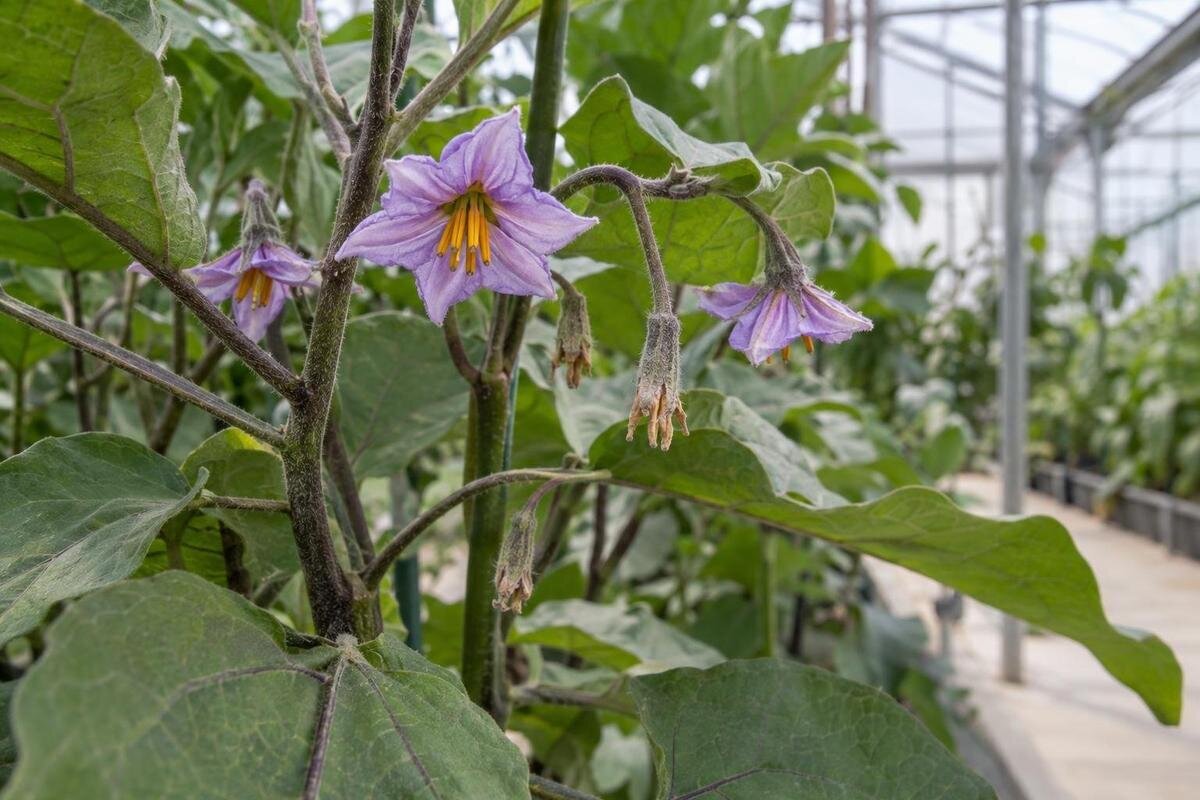
Greenhouse brinjals can produce a run of open flowers yet develop little or no fruit. The cause is not automatically a lack of insects: brinjal flowers usually contain both male and female parts and can set on their own, but pollen still has to be released and reach the stigma. Cool nights, hot spells, still or damp air, and stress at the roots can all interfere with set or with the retention of a young ovary. Start by watching what happens to a few marked flowers, then compare that pattern with temperatures and watering. One symptom rarely identifies the cause by itself.

01
Confirm what is happening to each flower
Choose a few open flowers on different branches and mark their stalks loosely with tags. Watch the green swelling behind the petals, the ovary: after fruit set it should begin enlarging while the petals fade, with the green calyx remaining around the young brinjal. If the whole blossom dries and drops before any swelling appears, it has not set or has failed to retain a very young ovary. If a tiny brinjal starts to grow and then stalls or falls, initial set took place; look for stress during early fruit growth as well as a pollination problem.
Repeat the observation across several flowers and more than one day. A single blossom can fail without indicating a wider fault, and petals can wilt normally after set, so petal colour alone is a poor test. Record whether flowers drop on one branch, across the whole plant, or only after particular weather; note whether new flowers open at the same time. Photograph an open flower from the front, its centre and its base, then take a later image of the same tagged bloom. If swelling is hard to see, compare the images rather than squeezing the flower base, which could damage it.
How brinjal flowers are pollinated
Brinjal flowers are generally bisexual: the same blossom carries pollen-producing anthers and the central stigma and ovary. A healthy plant does not normally need a separate male-flowered plant or a second cultivar for fruit to form; brinjals are usually self-compatible. That does not mean every flower will pollinate successfully without movement. Pollen must leave the anthers and reach a receptive stigma, and flower structure, vibration, humidity and temperature can affect that transfer. Seeing yellow pollen inside a flower is not proof that it has reached the stigma. Inspect the blossom before buying pollinators or adding another plant.
Look closely at the central style, the slender stalk ending in the stigma. Brinjal flowers can have different style lengths: in long-styled flowers the stigma projects beyond the cone of anthers, while in medium-styled flowers it is near the cone's top; both are more likely to set than a short-styled flower whose stigma sits inside or below it. Short-styled flowers may fail even when pollen is present. This is a useful species-specific clue, not a complete diagnosis: cultivar and plant condition matter, and the position can be difficult to see. Compare several open flowers in good light; a phone's close-up setting or a magnifying glass can help.
02
Use gentle vibration when greenhouse air is still
Outdoor breezes and visiting insects can shake a brinjal flower. Inside an enclosed greenhouse, air and insect movement may be lower, depending on the vents and how the space is managed. Brinjal anthers form a cone around the style and release pollen more readily with vibration. When a flower is fully open and dry, try a gentle tap on its stalk or the nearby support, rather than rubbing or pulling the petals. Repeat on a few tagged flowers and leave similar flowers untouched as a comparison. The aim is to make the bloom quiver, not to shake the plant hard or damage the stem.
Give the flowers a few days to show whether the ovary is swelling, and compare treated and untreated blooms under similar conditions. This small trial can suggest that pollen movement was limited, but it cannot prove it: the two groups may include different style types or experience different heat. If still air is widespread, use the greenhouse's existing vents as designed and avoid packing foliage tightly against openings. When comparing the Limited Edition Aluminium Greenhouses range, check vent positions and opening sizes against the proposed beds. Leave room around openings rather than planning to fill every available space with foliage.
Measure temperatures where the flowers are
Brinjal is a warm-season crop, but a hot greenhouse is not automatically a good fruit-setting environment. Cool nights can slow pollen function and early fruit growth; prolonged hot days can affect pollen viability and increase flower or young-fruit drop. As rough warning points rather than universal cut-offs, repeated nights below about 15–16°C or greenhouse peaks above about 32–35°C deserve attention. The response depends on cultivar, duration, humidity and the water available to the roots. A brief peak is not the same as several hours of heat, and an outdoor weather forecast cannot tell you the temperature at blossom height.
Use a min/max thermometer or data logger near the flowering canopy, shaded from direct sun and away from glazing or metal that could distort a reading; follow the instrument's placement instructions. Record the overnight minimum and daytime maximum at a consistent time for a run of sunny and cooler days. Note when vents or doors are open and whether flowers drop after a particular heat spell. Compare the pattern with cultivar-specific growing advice rather than applying a single online threshold. If considering the T-Model Orangery Greenhouse, use these records to identify what needs attention in your current setup before comparing specifications. A model name cannot predict temperatures at flower height on your site.

03
Look for humidity and ventilation clues
Humidity and heat often rise together in a closed greenhouse, so treat them as related clues. Look for condensation on glazing, damp leaves that stay wet, visibly wet blossoms and stagnant pockets beneath a dense canopy. Persistently damp flowers may make pollen less free-flowing, while very humid, poorly ventilated conditions can also favour plant disease. Condensation alone does not tell you the exact humidity at the flower or prove pollination has failed; it shows that moisture is condensing on a cool surface. Pair what you see with temperature readings and the time of day, rather than treating one wet morning as a complete diagnosis.
Manage existing openings according to the greenhouse's instructions and the outdoor conditions; do not simply leave doors or vents open overnight if that exposes the crop to a cold spell. Avoid wetting flowers when testing manual vibration, and if watering overhead is routine, check whether blossoms remain damp during the period they open. For a layout comparison involving the Pyramid Greenhouse, look at the published opening details alongside your proposed crop positions. Consider where dense foliage could obstruct those openings and whether you could reach them easily to adjust ventilation as conditions change.
Keep root-zone moisture even
Both a dry root zone and waterlogged roots can make brinjals shed flowers or young fruit. Check below the surface rather than judging from the top layer alone: soil can look dry while the root zone is moist, or look damp while a pot drains poorly. Note whether leaves lose firmness during the day, whether they recover, and whether the bed or container stays saturated after watering. Those signs are clues, not a diagnosis on their own. Aim for steady moisture in the root area and good drainage, adjusting from what you observe rather than alternating between severe drying and frequent soaking.
Review whether watering changed around the time flowers started dropping, including a missed watering during a hot spell or a change after transplanting. Container brinjals may dry at a different rate from plants in a bed, so do not copy a neighbour's schedule. Check that water reaches the root area and that drainage holes or bed drainage are not blocked. When reviewing the Limited Edition Aluminium Greenhouses with Storage, check the plan for the growing area separately from the storage space. Allow access to each bed or container so that checking moisture and watering thoroughly remain practical once the plants have grown.
04
Check light and canopy crowding
Brinjals need strong light to support steady growth and fruiting. In a greenhouse, shade may come from a tree, nearby building, tall neighbouring crops, a dense canopy or a change in the sun's path across the season. Observe the plant at different times rather than judging from one bright midday view. A plant that is lush but makes few flowers may be receiving too little light or excessive nitrogen, though neither appearance proves the cause. Check how much light reaches the flowering stems and whether leaves overlap so heavily that flowers stay shaded and air cannot move freely.
Keep enough healthy foliage to support the plant; removing too many leaves is not a reliable fix for poor set and can expose fruit to sun damage once it forms. Remove only dead or clearly affected growth using sound garden hygiene, and open up crowded plants gradually if their foliage is blocking access or airflow. If considering the Bloomcabin Prestige Greenhouse, use its dimensions to sketch the proposed beds and neighbouring crops. Compare that layout with the shadows you observe at different times of day, allowing for plants as they grow. A greenhouse model cannot compensate for a persistently shaded position.
Review feeding, pests and access
Review feeding history before adding fertiliser. Too much nitrogen can favour leafy growth at the expense of flowers and fruit, while a real deficiency or root problem can also weaken a plant; neither can be diagnosed from flower drop alone. Note what fertiliser or compost was used, how often, and whether symptoms began after a change. Pale or stunted growth may justify checking the soil or growing medium, but more feed is not a general remedy for failed pollination. Blossom-end rot is a problem on fruit that has already formed, not an explanation for flowers whose ovaries never begin to swell.
Inspect flowers, calyces and leaf undersides for feeding damage, live insects, webbing, spots or distorted new growth. Pests or disease can stress a plant, but seeing an insect does not automatically make it the cause; identify the problem before choosing any treatment and follow the product label and reliable local guidance. Crowded plants are harder to inspect, so keep access to the stems and the underside of leaves in mind. When assessing the Spacious Greenhouse, check the usable layout rather than relying on its name. Plan how you would reach plants at the back of beds without having to push through neighbouring foliage.

05
Use the pattern across plants to narrow the cause
Compare patterns across the greenhouse. If flowers fail on several plants after the same hot spell, temperature or humidity moves higher on the list; if one plant alone is affected, inspect its roots, watering, damage and leaf undersides first. If only a few flowers fail but others on the same plant swell, style length and normal variation may be involved. If failures cluster in one corner, check local shade, still air and temperature there. These are ways to prioritise observations, not rules that prove a cause; compare plants of similar age and cultivar where possible, because different varieties may not respond identically.
Change one factor at a time where practical. For example, mark a small group of open, dry flowers, gently tap some and leave comparable blooms alone, while recording temperatures and watering consistently. Avoid simultaneously adding fertiliser, pruning heavily, changing irrigation and altering every vent: if fruit set improves, you will not know which change mattered, and several changes may add new stress. If failures remain concentrated in one position, mark that area on a simple plan with your observations. When comparing the Aluminium Greenhouses range, use the plan to assess dimensions and vent placement rather than assuming that a different structure will remove the same site-related problem.
Keep a short record and know when to seek help
Keep the record simple enough to continue through another group of flowers: date opened, whether the stigma looked above or within the anther cone, whether the flower was tapped, day maximum, night minimum, root-zone moisture and what happened to the ovary. Add one whole-plant photo and a close-up of the same flower at opening and later. Note the cultivar too, if known. This gives a nursery adviser, horticulturist or experienced local grower information to work with, instead of a vague report that the plant has many flowers but no fruit.
Seek more specific help if plants also show rapid wilting despite moist soil, unusual leaf distortion, spreading lesions, severe stunting or a heavy pest problem. Share the cultivar name, planting date, greenhouse readings, watering and feeding history, and clear photographs; a symptom photo alone cannot establish the cause. A broader brinjal-growing guide can help with routine care alongside these fruit-set observations. If a recurring problem leads you to consider the Lean-to Greenhouse, compare the proposed position with your records of shade, temperature and access. Keep that purchase decision separate from the diagnosis: a new structure is not, by itself, a remedy for failed fruit set.
Frequently asked questions
Do brinjals need more than one plant to set fruit?
Usually not. Brinjal flowers generally contain both pollen-producing and fruit-forming parts, and are self-compatible. A second plant is not normally needed, although pollen still has to move from the anthers to the stigma. If flowers drop, check their structure and growing conditions before assuming another plant is needed for pollination.
Why do flowers fall even when I can see pollen?
Visible pollen does not prove that it reached a receptive stigma or that the flower retained its young ovary. Short-styled flowers may be less likely to set, and temperature, damp conditions, still air or root stress can also affect fruit set. Follow several flowers rather than diagnosing from one.
Should I tap or hand-pollinate every flower?
Not necessarily. Brinjals can set fruit without repeated hand-pollination. If the greenhouse is still, try gently tapping the stalk of a few open, dry flowers and compare them with similar untouched blooms. This may help show whether pollen movement is a factor, but it will not correct heat stress, poor watering or other problems.
What temperature should a greenhouse be for brinjals to set fruit?
There is no single temperature that applies to every cultivar and growing situation. Repeated nights below about 15–16°C or greenhouse peaks above roughly 32–35°C are useful warning points, not hard cut-offs. Measure at flower height and record both daytime highs and overnight lows, then compare with cultivar-specific guidance.
Will extra fertiliser or calcium make flowers set?
Not unless there is a diagnosed nutrient problem. Extra nitrogen can encourage leafy growth without fixing pollen transfer, while calcium does not make pollen reach the stigma. Blossom-end rot affects fruit that has already started growing; it does not explain a flower that never swells. Check feeding history and test the growing medium if other signs point to nutrition.
Flowers alone are not a promise of fruit, and one fallen blossom does not mean the crop has failed. Follow tagged blooms to see whether ovaries swell, compare flower structure and pollen movement, and track temperatures and root moisture before deciding on extra feed or a greenhouse change. A short record can show whether failures follow hot spells, affect only one part of the crop, or become less frequent after gentle flower vibration. That pattern gives you a clearer basis for an adjustment than guessing from one fallen flower.
