
Growing Cucamelons in a Greenhouse
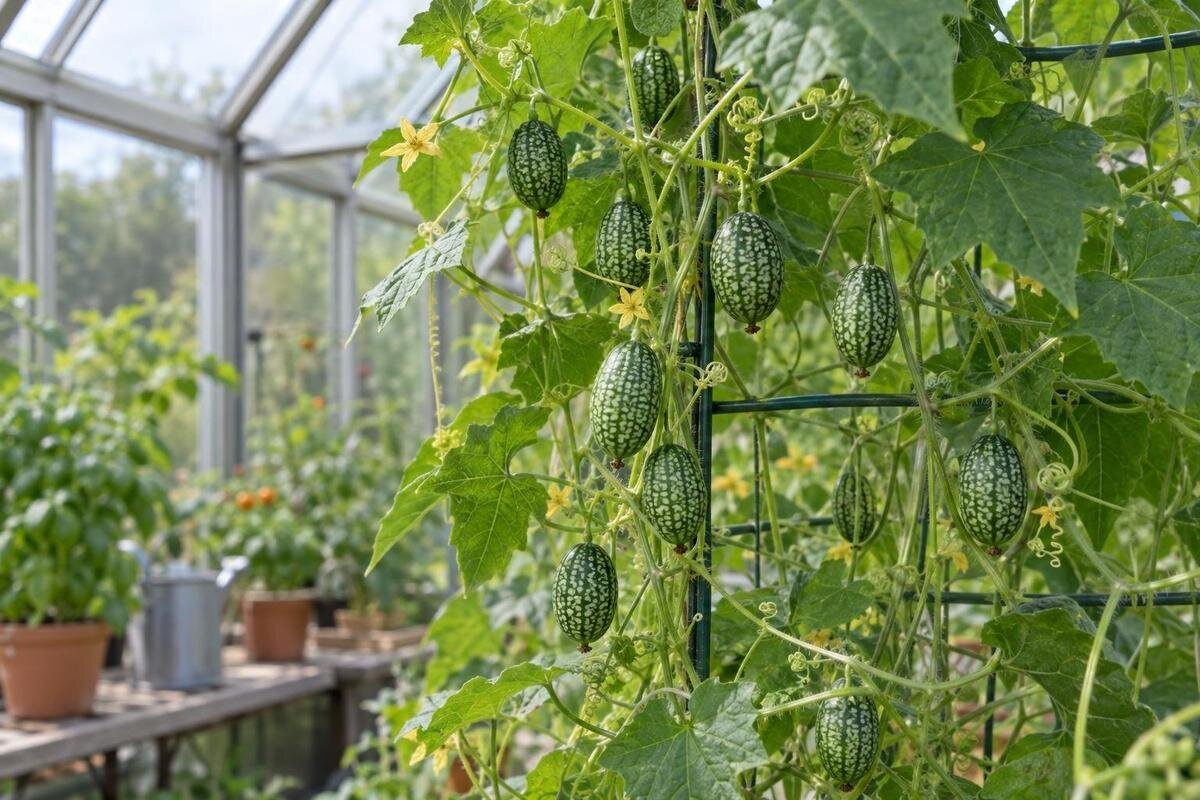
Greenhouse growing guide
Cucamelons are small, striped fruits on vigorous climbing vines, and a greenhouse can make their support and harvest easier to manage. In South Africa, the key is not a fixed month on the calendar but a warm, frost-free growing window: an unheated greenhouse can still become too cold at night or too hot by day. Plan a trellis before planting, give the roots room and keep the soil evenly moist. These steps help turn greenhouse height into growing space without crowding other crops.

What cucamelons need from a greenhouse
Cucamelon (Melothria scabra), often called the Mexican sour gherkin, is a warm-season cucurbit with climbing stems and small, green, striped fruits. It needs warm soil, bright light and enough time to grow, flower and set fruit; frost or cold nights can stall young plants or damage them. In South Africa, work from the conditions at your own site rather than a single national date: elevation, local frost history and greenhouse night temperatures all matter. Cucamelons can also grow outdoors in a warm, sheltered spot, so a greenhouse is most useful when it offers protection or a longer warm window that your garden otherwise lacks. A brief sunny spell is not a substitute for a steady growing season.
Cover is not the same as reliable warmth. An unheated greenhouse may warm quickly in the sun but cool sharply overnight, while a closed greenhouse can become excessively hot during the day. Check temperatures near the plants and ventilate during hot periods; delay planting if nights remain cold. Area is only one part of choosing a greenhouse: the Aluminium Classic Greenhouse is listed in sizes from 3.77 m² to 28.08 m², but floor area alone says nothing about night temperatures or the internal layout of each option. Compare the exact option with the conditions and space you need; a model name or size does not establish whether it will suit this crop.
Choose a bright site and plan the footprint
Choose the brightest practical position: cucamelons need good light, and deep shade can weaken growth and flowering. At the same time, strong sun through glazing can raise temperatures quickly, so include ventilation and access in the siting decision. Notice how trees, fences and neighbouring buildings cast shade across the intended bed during the growing season, not just when you inspect the site. Keep a water source within manageable reach, since container compost and the root zone can dry faster on warm days. Leave room around the greenhouse for access and for any ventilation features on the chosen structure to be used as intended.
Before setting out beds or pots, sketch the door, main aisle, support line, water route and neighbouring crops. A trained vine still needs room for tying, inspection and picking; foliage spilling into an aisle makes routine work awkward. Base plant numbers on usable trellis length, not just total floor area, and leave enough light for adjacent crops. The Lean-to Greenhouse is listed from 3.69 m² to 14.34 m²; compare the exact option’s plan with the intended bed, path and access to water. Leave turning space for a watering can or harvest basket, and check that a nearby wall or hedge will not shade the canopy for most of the day.
Set up vertical support before planting
Put the trellis in place before sowing or transplanting, while the bed is empty and roots are not at risk. Cucamelon vines climb with tendrils and can thread into nearby crops, so vertical mesh, a trellis or garden string gives each stem a route and makes fruit easier to see. Choose support with enough height and length for the space you have, and anchor it securely rather than relying on glazing bars, gutters or vents. Do not attach a loaded vine to a greenhouse component unless the manufacturer confirms that it is designed for that purpose. Guide young shoots gently and use loose ties only where needed; tight loops can pinch as stems thicken.
Allow for access as well as height. If a vine runs right up to the roof or behind shelving, flowers and hidden fruit become hard to inspect; plan a route you can reach from the aisle. A short horizontal run can be more useful than letting stems disappear overhead, particularly in a compact greenhouse. A trellis with openings tendrils can reach is easier to use than a smooth surface. Product area does not give clear wall length or internal height, so check the selected layout. The T-Model Orangery Greenhouse is listed from 16.52 m² to 30 m²; compare the exact option with your trellis run and walking space, keeping growth clear of doors and ventilation openings.
When and how to sow cucamelon seeds
In frost-prone parts of South Africa, plan sowing so seedlings go into their final position after local frost risk has passed and the soil has warmed. Spring is a useful seasonal guide, but altitude, weather and greenhouse night temperatures can shift the timing; use local experience or a local planting calendar rather than a fixed month. You can start seeds under cover about four to six weeks before the intended planting window if you have a warm, bright place for them. Sowing too early in a dim, cool greenhouse can produce slow, stretched seedlings that are difficult to manage. A consistently warm growing period matters more than a very early start.
Sow into individual small pots or cells filled with moist, free-draining seed compost, roughly 1 cm deep, and cover lightly. A separate cell reduces root disturbance when you transplant. Germination can be uneven, so resist unearthing seeds to check their progress; keep the mix moist but not saturated and give emerged seedlings the brightest available light. Avoid leaving trays in a closed, sunlit greenhouse where the compost can overheat. If the greenhouse will hold seed trays before the vines take over, allow for both stages when checking a footprint: the Limited Edition Aluminium Greenhouse is listed from 3.77 m² to 28.08 m², and the exact option’s plan should be considered alongside paths and permanent beds.

Transplant carefully and leave room for roots
Move seedlings into the greenhouse bed once they have several true leaves, a firm stem and suitable warmth; do not rush them into their final position while nights are still cold. If plants were raised indoors or in a sheltered propagator, acclimatise them gradually to brighter light and moving air over several days. This helps them adjust to changing conditions. Water the root ball before planting, handle it gently and keep the plant at its former depth. Avoid disturbing the roots more than necessary: rough handling can slow the growth of cucurbit seedlings, costing time during a limited warm season. Water the plant in after transplanting and keep it steady while it establishes.
Give each plant enough root volume for a vigorous vine and a clear route to its support. In a ground bed, use fertile, well-drained soil enriched with mature compost; do not let roots sit in a persistently wet pocket. In a container, choose a generous pot with drainage and expect to check moisture more often than in a bed. Follow the seed supplier’s spacing guidance, then adjust the layout so mature leaves are not packed tightly against neighbouring crops. The Limited Edition Aluminium Greenhouses with Storage is listed in sizes from 5.52 m² to 28.08 m²; compare the exact plan with the planted area and aisle rather than counting every part of a greenhouse as growing room.
Keep moisture even and prevent overheating
Cucamelons need steady moisture while roots establish and fruits swell, but waterlogged soil is not a substitute for regular watering. Check the growing medium below the surface instead of relying on a fixed daily schedule: a bed and a pot can dry at different rates, and conditions change with sun and ventilation. Water around the roots and let excess drain from containers. A mulch over the bed can slow evaporation if it does not touch the stem, but continue checking underneath so the soil does not stay too wet. If leaves droop during the hottest part of the day, check the root-zone moisture before assuming that more water is needed.
Heat management is as important as watering in a greenhouse. Use the structure’s intended ventilation during hot periods, and consider suitable shading if plants face intense sun for long stretches; do not leave a tightly closed space to trap heat. At the same time, avoid stagnant, damp air around a dense canopy. A simple minimum-maximum thermometer near the plants can show whether daytime peaks or night-time lows are the bigger problem. The Pyramid Greenhouse is listed from 5.53 m² to 18.9 m², but floor area does not indicate the ventilation arrangement; check the exact option’s details and assess its growing space separately.
Guide the vines and avoid excess pruning
Once the vine starts climbing, direct new growth along the support every few days rather than trying to untangle a mature mass. Guide stems gently around mesh or beside strings, securing them with a loose tie only where needed; brittle or pinched stems can break. Avoid trying to control every tendril: let the plant cling naturally and redirect shoots that head out of bounds. Prevent leaves from forming a dense layer across the trellis, especially around lower growth, so air and light reach the plant and you can see flowers and developing fruit. Regular, light guidance is easier than cutting through a dense canopy later.
Cucamelons do not need severe pruning to climb. Remove dead or diseased leaves and trim a stem only when it blocks access or extends beyond the planned support; heavy cutting removes productive growth and can expose fruit to sun. If growth is lush but flowers are scarce, check light, heat, watering and feeding before adding more fertiliser. Compost in the bed may be enough; container-grown plants may need a balanced edible-crop feed used according to its label, rather than repeated high-nitrogen doses. The Prestige Greenhouse is listed from 3.77 m² to 28.08 m²; use the selected plan to check trellis length and room to reach the canopy.
Check pollination inside the greenhouse
Flowers give a useful signal about fruit set. Cucamelons bear separate male and female flowers; the female flower has a small swelling behind the petals, while a male flower has no such swelling. Early blooms may be male, so a lack of fruit from the first flowers does not by itself mean the plant has failed. Look for healthy flowers and visits from pollinating insects, and avoid disturbing buds when tying stems. A greenhouse can limit the number of insects that reach flowers, so include pollination in your plan rather than assuming every bloom will set fruit.
If insects are scarce or fruit set remains poor, hand-pollination is an option. When flowers are open, use a small, clean, dry brush to move pollen from a male flower to the centre of a female one; first make sure you have identified both types. Avoid applying pesticides to open flowers where possible, and follow the product label because inappropriate use can harm pollinators. Allow room to reach the flowers when comparing larger greenhouse layouts, too. The Spacious Greenhouse is listed in sizes from 47 m² to 70 m²; check the exact option’s layout for practical access to flowering vines.

Watch for pests and fungal problems
Inspect new shoots and the undersides of leaves several times a week once the canopy thickens. Aphids often gather on tender tips, while spider mites can cause fine pale stippling and, in heavier attacks, fine webbing. Powdery mildew appears as pale, powder-like patches on foliage and can spread through a dense, poorly ventilated canopy. Early checks help you confirm what is happening before leaves are badly damaged. Look along stems and around lower leaves as well; flowers and fruit can be hidden beneath the foliage, and early signs of trouble may be easy to miss.
Give foliage room to dry and air to move: avoid crowding, remove plant debris and water at soil level. If you find a problem, identify it before treating the crop; removing a few badly affected leaves or rinsing pests may be enough for a small outbreak, but check the plant again soon. Yellow leaves alone do not identify a cause, so consider watering, root-zone moisture, heat and where the symptoms began before changing the feeding routine. Use only a treatment labelled for the intended edible crop and pest, follow its directions, and dispose of heavily diseased material rather than leaving it beside the bed.
Pick cucamelons while they are small and firm
Harvest when fruits are small, firm and green with clear stripes, around grape size rather than fully grown. Size can vary, so use colour and firmness as the better cues: softening or yellowing means the crisp picking stage has passed. Part leaves gently to find fruit tucked inside the canopy, especially along side growth. If you are unsure, pick one and taste it; cucamelons are enjoyed for a crisp, tangy, cucumber-like bite, not for reaching a large size. Once fruit begins to appear, regular checks are more useful than waiting for a single large harvest.
Use scissors or snips to cut the short stem rather than pulling on a vine, which can loosen the support or damage nearby growth. Pick every few days as fruit develops; new flowers and fruit can continue when conditions are suitable, but inspect the canopy so older fruit does not go unnoticed. Eat cucamelons fresh in salads or pickle them whole if you want to use a surplus. At the end of the warm growing period, remove spent vines and clear fallen leaves. This leaves the growing space easier to inspect and prepare for the next crop.
Frequently asked questions
How many cucamelon plants should I grow in a greenhouse?
There is no fixed number: base it on the length of trellis you can provide and how much access you need for watering and picking. A single vigorous vine can occupy more space than expected, so begin with one in a compact area rather than crowding several plants together.
When should I sow cucamelon seeds in South Africa?
Use your local frost history and greenhouse temperatures rather than relying on one date for the whole country. In frost-prone areas, plan for spring planting once nights and soil are warm. You can start seeds under cover about four to six weeks beforehand if you have a warm, bright place for the seedlings.
Can cucamelons grow in an unheated greenhouse?
Yes, during a warm, frost-free part of the year. An unheated greenhouse can still become cold at night, so check conditions near the plants and delay sowing or transplanting if they are too chilly. It can also overheat in strong sun, so plan for ventilation.
Why are my cucamelon flowers not producing fruit?
Male flowers may appear before female flowers, so give the plant time to develop. Female flowers have a small swelling behind the petals. If flowers are present but fruit set remains poor, check for pollinator visits; you can transfer pollen from a male flower to a female one with a small brush.
How do I know when cucamelons are ready to pick?
Pick them while they are small, firm and green with clear stripes, rather than waiting for them to grow large. Yellowing or softening means the crisp picking stage has passed. Check the vine regularly, as fruit can hide beneath the leaves.
Cucamelons are a practical greenhouse crop when warmth, access and vertical support are planned together. Sow only when seedlings can stay warm and bright, leave room to reach each vine, and watch day and night conditions rather than assuming cover removes seasonal limits. Keep moisture steady, allow for pollination and pick regularly so small fruits do not get overlooked. A compact growing area can work when the support route and aisle are planned before the vines take over.
