
Greenhouse Fans: Air Circulation or Heat Extraction?
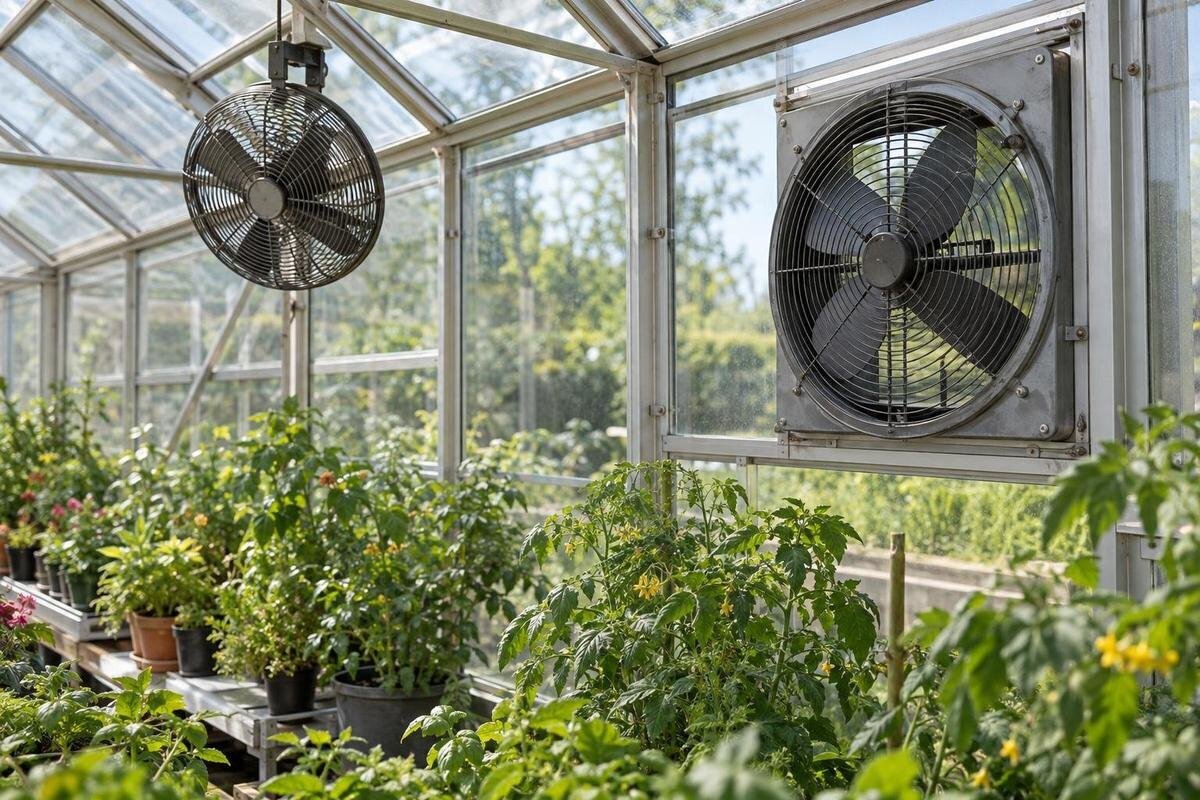
Greenhouse ventilation
Greenhouse fans solve different problems depending on where their air goes. A circulation fan moves air around the enclosed space; an extraction fan sends indoor air outside and depends on a replacement-air route. A breeze at leaf level does not prove that heat is leaving. Log conditions at plant height and near the roof, then sketch the openings before deciding whether either function, or both, is needed.

01
Air circulation and extraction do different jobs
Fans are often grouped together in greenhouse advice, but they do different jobs. A circulation fan moves air that is already inside the structure from one part to another. It can reduce local pockets of still air around foliage, benches or corners and help make conditions less uneven from one position to the next. It does not, by itself, send heat or moisture outside. A breeze at leaf level proves only that air is moving there; it does not show that the greenhouse is exchanging air with outdoors. Circulation can still be useful when vents are open, but it cannot create an outside-air route where one does not exist. Check a fan’s stated function and airflow direction rather than relying on the word fan alone.
An extraction fan, also called an exhaust fan, discharges indoor air outside. Air needs to enter through an intended opening to replace what leaves; a restricted or poorly placed inlet can limit actual airflow even while the fan runs. The incoming air may be cooler, similar in temperature or hotter than the air inside, so extraction is not refrigeration: it removes air, and any cooling depends on the replacement air and the heat entering. The Classic aluminium greenhouse listing gives floor-area options from 3.77 m² to 28.08 m². That range identifies footprints, not a fan requirement; plan around the exact selected configuration and its documented openings.
Diagnose the airflow problem before choosing a fan
Before choosing a fan, separate a local airflow problem from a whole-space temperature problem. Put temperature and relative-humidity sensors at crop height, near the roof, beside the intended inlet and towards the far end. Log outdoor conditions, time, sunlight, door and vent positions, and which fans are running. Keep instruments out of direct sun and away from surfaces that can distort a reading, and follow their instructions. If you have one logger, move it between marked locations under comparable conditions rather than comparing readings taken at unrelated times. Repeat the observations when the problem normally occurs; a single comfortable morning reading cannot describe a hot afternoon.
Repeated differences between positions can point to a local stagnant area; similar warmth across several positions calls for a different question about heat entry and air exchange. Relative humidity is affected by temperature, so it is not a direct measure of how much moisture an exhaust fan has removed. At an opening, a lightweight ribbon can show the direction of movement but not its volume; hold it safely away from moving parts and never feed loose material into a fan. On a lean-to greenhouse, include the wall side in the sketch and check the actual doors and vents: the listed 3.69–14.34 m² floor-area range does not show whether an inlet sits opposite the exhaust. Mark benches or partitions that may interrupt the route, as these can make two sensors behave differently.
02
Plan the replacement-air route
Draw the route for replacement air before deciding where an extraction fan belongs. Mark the openings through which outside air is meant to enter, then the exhaust point, and trace a line through the area where plants grow. A common concept is to separate inlet and exhaust, with the exhaust high where warm air tends to collect; this can encourage air to travel through more of the greenhouse. It is not a universal position rule: roof shape, side openings, doors and existing vents change the route. An exhaust beside a convenient inlet may pull air straight back out, leaving benches farther away with little exchange. On the sketch, mark the path that air should take, not just the location where a fan could be mounted.
Mark anything that can alter the route: screens, insect mesh, shade material, closed panels, shelves, partitions and dense crops. When these cross the airflow path, they can add resistance or divide the space, so an inlet that looks generous on paper may not provide enough replacement air once the greenhouse is in use. Read both the fan and greenhouse instructions for the intended opening arrangement; do not rely on accidental gaps as a designed inlet. The Limited Edition Aluminium Greenhouse listings cover floor areas from 3.77 to 28.08 m². Use the exact selected drawing to mark openings and obstacles rather than inferring them from the product range. If a route crosses a walkway, consider whether doors will stay in the tested position during ordinary operation.
Position the exhaust along the air path
Warm air often collects towards the top, which is why a high exhaust point may be considered. Height alone, however, does not determine the best position. The fan needs to draw air along a useful path, not merely clear the space immediately around its own opening. If a nearby door or vent is also open, the extractor may draw mostly from that short route. Check what happens at the far end and around the crop canopy as well as at the fan. A good sketch names the inlet, the exhaust and the areas that should receive fresh air. Also check the manufacturer’s airflow-direction marking: a fan configured to blow the wrong way will not perform the planned extraction. If the greenhouse also relies on open roof or side vents, include their usual position in the plan; a fan can change which opening serves as inlet or outlet.
Exhaust must leave the greenhouse without being drawn straight back through another nearby opening. The final position depends on the structure’s approved openings and the fan instructions, not on a general rule for every roof or wall. Do not assume a frame or glazed panel is a suitable mounting point; check the supplied guidance and have mounting or electrical questions assessed by a qualified professional. For the T-Model Orangery Greenhouse, the listed floor-area options run from 16.52 to 30 m², but floor area does not reveal roof height or outlet location. Consult documents for the chosen configuration before fixing an airflow route.

03
Use circulation fans to reach still areas
Circulation fans are useful when measurements and simple airflow observations reveal areas that remain still. Position and aim them so air moves through or along the crop zone and can return through the greenhouse, rather than blowing strongly at one small patch. Think of a loop: where will air travel after it leaves the fan, and how will it return? A moving leaf or a ribbon beside the fan is not proof that air reaches the back of a bench or the lower canopy. Check several positions, especially behind obstacles and within the crop as it grows. Gentle movement across a wider area is a more useful sign than a dramatic blast at one point.
Rows of benches, trellises, storage and tall crops can split an apparently open interior into separate pockets. A fan in a central position may circulate mostly around itself, while one aimed along the full length can miss sheltered corners. Use the selected structure’s plan and vertical dimensions to identify the areas to test; do not infer coverage from the product name or floor area. The Pyramid Greenhouse listing spans 5.53 to 18.9 m². Check the selected plan and clearances before deciding where a circulation loop can run, and use the fan manual for safe orientation and spacing. Reassess after plants or benches change position. Where fan direction is adjustable, make one change, then check at the farthest point before altering it again.
When circulation, extraction or both make sense
Choose circulation when the main issue is local stillness, and extraction when you need to discharge indoor air and bring outside air through an intended inlet. If logs show both sheltered pockets and a greenhouse-wide build-up of heat, the two functions can complement each other. They still need to be planned together: internal fans should distribute air through the growing space, while the extractor draws replacement air along a route that reaches it. Avoid assuming that adding more fans automatically improves the pattern; poorly placed units can make the nearest route dominate without reaching distant areas. Write down the problem each fan is meant to address before selecting equipment.
Sometimes the right response is not another fan. When incoming outdoor air is already hot or direct sun is adding substantial heat, extraction may exchange air without bringing the indoor temperature down as much as hoped; reducing heat gain through suitable shade or adjusting the opening pattern may also need consideration. The combination depends on readings and plant light requirements, not a universal fan count. The Limited Edition greenhouse with storage is listed in floor-area options from 5.52 to 28.08 m². On the selected plan, identify storage, benches and crop aisles before deciding where circulation needs to reach. Keep ventilation openings accessible rather than routing air behind a barrier.
04
Choosing fans for the greenhouse layout
Do not size an extraction fan from floor area alone. Relevant details include internal volume and shape, roof height, greenhouse length, the number of separated zones, inlet and exhaust openings, crop density, screens or other restrictions, and the outside conditions the system will face. A fan’s advertised free-air figure may not describe its flow once air must pass through a grille, mesh or restricted inlet. Compare the manufacturer’s guidance for the intended installed arrangement and ask the supplier or a ventilation specialist if the manual does not cover it. Avoid using a generic airflow-per-square-metre rule instead of model-specific information; no single rule accounts for every layout.
Circulation-fan selection asks a different question: can the proposed position and direction move air through the growing area without leaving the same still pockets? Check the fan’s intended use, operating controls, guarding, environmental rating and approved mounting method. Greenhouse conditions can expose equipment to moisture and debris, so confirm that its stated rating suits the actual location; a qualified electrician or installer should assess the electrical supply and mounting suitability. The Prestige Greenhouse listing includes floor-area options from 3.77 to 28.08 m², but that range cannot determine a fan rating. Match the chosen variant and documented openings to manufacturer advice, and consider whether access for servicing will remain clear.
Coordinate fans with vents and controls
Fans do not operate in isolation from doors, vents and automatic controls. If an extractor runs while its intended inlet is closed, replacement airflow may be restricted. If an opening beside the fan is wide open, air may take that short route rather than travel through the crop zone. Check which doors and vents are normally open during the hottest part of the day and which are controlled automatically. Record their positions when taking readings; an open door during a test can make the result different from ordinary operation. Follow the greenhouse and fan instructions when coordinating controls, and note any timer or thermostat settings that change the opening pattern.
Place temperature sensors where they represent the conditions you want to manage, rather than beside the fan motor, in direct sun or in a narrow jet of air. A single reading near an extractor can change quickly without describing the rest of the space. On the Spacious Greenhouse, the listed floor-area range is 47 to 70 m²; when assessing a broad footprint, compare readings at more than one position and mark each sensor and opening on a plan. Do not assume that one control point describes every growing area or that a model’s listed area specifies its ventilation arrangement. If a sensor controls a fan, locate it as the equipment instructions specify and check how the control responds during normal fan and vent operation.

05
Check the airflow after setup
After the chosen layout has been installed according to its documentation, check whether it solves the original problem rather than judging by sound or a breeze alone. Compare readings from the same marked places at similar times and under similar outdoor, sunlight and vent conditions. With circulation, look for fewer persistently still locations around the canopy; with extraction, check the direction at the intended inlet and whether indoor readings change relative to outside. Change one operating setting at a time, where the manual permits, so you can tell which adjustment changed the pattern. Record relative humidity alongside temperature, and interpret the readings together. A change in wind conditions or an open door may otherwise explain a different result.
Photograph the open vents, fan positions and crop layout from consistent viewpoints, and note fan status and weather with each log. A before-and-after image of a lightweight ribbon at an opening can help record direction, but it is not a measurement of air volume. Recheck the path as plants mature, benches move or screening is added. Keep openings clear as directed by the manufacturer. For damaged guards, unusual vibration, loose mounting or electrical faults, have the equipment assessed by a qualified professional rather than attempting repairs while it is running.
Know what ventilation cannot do
An extraction fan can only exchange indoor air for air available outside; it cannot cool the greenhouse below the temperature of that incoming air by itself. On a hot day, the incoming air may provide limited relief, and heat entering through the covering can continue to raise the indoor temperature. A circulation fan can make the air feel more active and help mix warm and cooler pockets, but it does not remove the heat load. If the main issue is excessive solar gain, ventilation and appropriate shading are separate parts of the plan; a fan is not a substitute for managing heat entry. The right balance varies with crop requirements and measured conditions.
If readings remain high even when air follows the intended route, consider whether heat is entering faster than it leaves. More internal air movement will not resolve that separate heat load. Where performance remains uncertain, discuss the recorded indoor and outdoor conditions with the equipment supplier or a qualified ventilation professional. Distinguish between a layout that fails to exchange air and one that exchanges air but cannot provide the cooling you expected.
Frequently asked questions
Can a circulation fan lower the greenhouse temperature?
It can mix air and change readings in a particular spot, but it does not remove heat from the greenhouse. If heat needs to leave, assess the ventilation route and extraction. The result also depends on the temperature of the incoming air and how much heat is entering.
Does an extraction fan need an open vent?
It needs a route for replacement air to enter. This could be an intended vent, louvre or other suitable opening, depending on the greenhouse design. If the inlet is closed or restricted, airflow can be reduced. Do not assume that incidental gaps provide a reliable route.
Should an exhaust fan be near the roof?
Warm air often collects higher up, so a high exhaust point may be appropriate. However, the inlet-to-outlet route matters more than height alone. Check that air can travel through the growing area and follow the greenhouse and fan instructions for approved openings.
When do I need both types of fan?
Consider both when observations show two different problems: still pockets around plants and a need to exchange indoor air. Plan the circulation pattern and the extraction route together. Adding fans without checking where the air goes may leave the original problem unchanged.
How can I tell whether a fan layout is working?
Compare temperature and relative-humidity readings at the same marked positions under similar outdoor, sunlight and vent conditions. Check airflow direction at the intended inlet and look for still areas around the crop. A breeze near a fan alone does not show that air is reaching the rest of the space.
Use your readings and airflow sketch to identify where air enters, how it travels through the crop area and where it exits. Choose circulation for persistent pockets of still air and extraction for air exchange; combine them when observations show that both are needed. Compare the results using the same sensor locations and opening positions. A useful fan layout does more than create a noticeable breeze: it addresses the airflow problem you identified.
