
How Much Does It Cost to Heat a Greenhouse in South Africa?
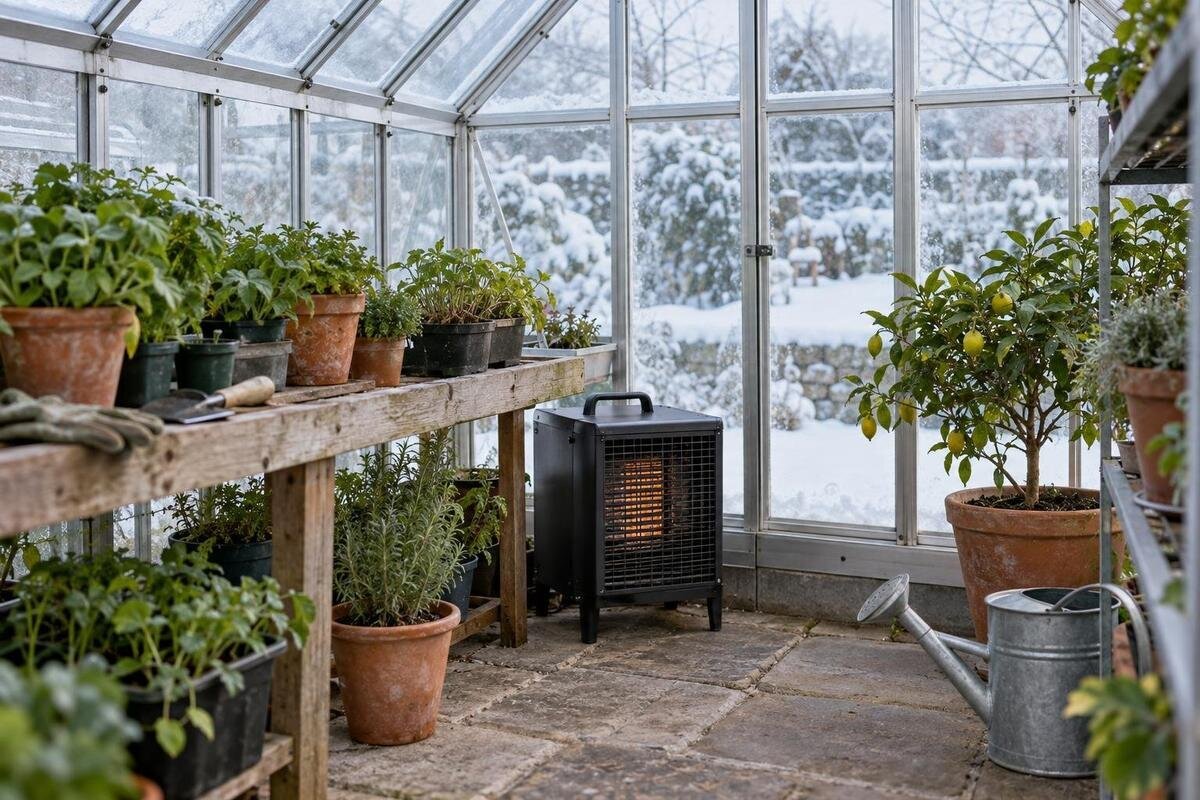
Greenhouse heating costs
Greenhouse heating costs in South Africa depend on the site and the nights you choose to model, so there is no dependable single monthly figure. A small temperature gap maintained briefly can use less electricity than a higher target held through a long, windy cold spell. The calculation below separates heat demand from heater size, then applies an electricity tariff in rand. Its numbers are deliberately hypothetical: replace them with local outdoor temperatures, the greenhouse’s actual heat-loss information and the rate on your own tariff schedule.

Why greenhouse heating costs vary
Heating cost follows electricity use over time, not just the heater’s nameplate rating. A 2 kW heater running at full output for one hour uses 2 kWh; if its thermostat calls for heat for only half that time, consumption is about 1 kWh. Multiply energy in kWh by the marginal tariff in R/kWh to estimate the variable charge. The heater’s rating tells you its power while operating, not how many hours it will run over a night or month. The first task is to estimate the heat demand the greenhouse must replace.
Floor area helps describe scale, but heat loss also depends on exposed roof and wall area, construction, gaps, doors and outdoor conditions. The Bloomcabin Prestige Greenhouse is listed in size options from 3.77 m² to 28.08 m²; those figures describe its footprint, not heat-loss coefficients or running costs. A taller or more exposed layout can lose heat differently from one with a similar footprint. Treat the exact size and construction as inputs to check, rather than using a product name or area as a ready-made bill estimate.
Choose a cold-night temperature for your location
Use outdoor temperatures for the greenhouse’s actual site, preferably hourly observations or a weather record from a reasonably representative nearby station. South Africa has varied elevations and exposures, so a broad national winter average cannot describe every garden equally. Wind exposure, nearby hills and local cold-air pooling can also make conditions differ from a regional forecast. Choose a cold night that is relevant to the plants you want to protect, and say whether it represents a typical budgeting case or a more severe test.
With hourly data, calculate the indoor–outdoor temperature difference for each hour and add the results. For a constant heat-loss coefficient H, the simplified estimate is: heat demand (kWh) ≈ H (W/K) × max(0, setpoint − outside temperature in °C) × hours ÷ 1,000. If the outside temperature changes, calculate each hour rather than applying the coldest reading to the whole night. Use representative weather for a monthly budget and a severe cold spell separately when checking whether the target can be maintained. This estimates heat demand before system efficiency and incidental heat gains.
Set the temperature target for the plants you are protecting
The setpoint is the indoor temperature a thermostat is asked to maintain, not a temperature the heater is guaranteed to deliver. Base it on the conditions needed by the plants you are protecting and whether you intend to heat the whole greenhouse or a defined growing area. A higher setpoint widens the indoor–outdoor gap for every hour it is held, increasing the simplified estimate. In the worked example’s assumptions, one extra degree for 12 hours adds 1.8 kWh of heat; at the example rate of R3.00/kWh, that is R5.40 for a direct electric heater. These are calculation inputs, not a recommended plant temperature.
Use a night-time target when estimating winter heating, rather than relying on a daytime temperature. The air reading at a sensor may not represent conditions where plants are growing, especially if the sensor is in direct sun, close to a heater or beside a door. If different plants need different minimum conditions, model separate zones only when the heating arrangement and any partition create distinct conditions. Lowering a thermostat setting is a useful saving only if the resulting conditions still suit the plants, so treat the setting as a deliberate input rather than an automatic way to cut costs.
Estimate heat loss from the greenhouse envelope
The total heat-loss coefficient H combines the main paths through which heat leaves the greenhouse. It is measured in watts per degree of temperature difference (W/K). A simplified calculation is H = Σ(Uᵢ × Aᵢ) + H_air: U is the heat-transfer coefficient of each surface in W/(m²·K), A is its area in m², and H_air represents heat carried away by air leakage or ventilation. In a basic air-change approximation, H_air ≈ 0.33 × n × V W/K, where n is air changes per hour and V is internal volume in m³. Use verified data where available; H is not a universal greenhouse constant.
Include the roof, walls, glazing, doors and other exposed boundaries according to the actual construction. Open vents, poor door closure and wind-driven leakage can add a variable air-loss term, so a value based on a tightly closed structure may not describe everyday operation. For a Lean-to Greenhouse, account for the adjoining building wall using its documented construction and the conditions on the other side; do not automatically count it as insulated or leave it out of the calculation. If trustworthy surface or leakage data are unavailable, use clearly labelled low, base and high assumptions for H and seek model-specific guidance instead of presenting a precise bill.

Worked example: one cold night
Suppose, purely to show the arithmetic, that a greenhouse has a combined H of 150 W/K, your setpoint is 10°C and the outside temperature stays at 0°C for 12 hours. The difference is 10°C, so the estimated heat loss each hour is 150 × 10 = 1,500 W, or 1.5 kW. Over 12 hours, 1.5 kW × 12 hours = 18 kWh of heat. This assumes H already includes the chosen envelope and air-loss allowance and stays constant through the night; it is not a heater-size recommendation or a rating for a particular greenhouse.
For a direct electric-resistance heater, use roughly 1 kWh of electricity per kWh of heat as a first-pass estimate, then use documented equipment information where available. If the tariff were R3.00/kWh purely for illustration, the night would cost 18 × R3.00 = R54. At R2.50/kWh it would be R45, and at R4.00/kWh it would be R72. These are hypothetical rates, not current South African tariffs. To apply this example to an Aluminium Classic Greenhouse, replace the assumed H with an estimate for the exact size and construction selected from its listed 3.77–28.08 m² range.
Turn the night estimate into a monthly bill
Repeat the hourly calculation across a representative run of winter nights, then add the resulting kWh. Do not multiply the cost of a severe cold night by every night unless that is the scenario you want to model. If 20 nights matched the worked example, the total would be 20 × 18 = 360 kWh, or R1,080 at the same hypothetical R3.00 rate. That is a scaling exercise, not a claim about how many cold nights a South African winter contains. A spreadsheet can record each night’s outside temperatures, setpoint, hours, H, calculated kWh and cost.
Use the marginal price on your tariff schedule for the hours when the heater is likely to run, rather than an average based on your whole household bill. Electricity tariffs and structures vary by supplier, municipality and account; time-of-use rates or monthly unit blocks can change the cost of extra consumption. Check that the rate you use treats taxes consistently, and leave out fixed charges that will not change with heating. If you are budgeting for a Spacious Greenhouse from the listed 47–70 m² range, use a heat-loss estimate for that version before applying the monthly calculation, rather than scaling the worked example by floor area alone.
Use documented details for the chosen greenhouse
Find the dimensions and construction details for the version you plan to heat: roof and wall areas, glazing or panel type, door arrangement, seals, vent configuration and any supplier-provided U-values or air-leakage guidance. Make sure the information matches the selected size and version. If there is no overall H value and not enough surface data to derive one, show the unknown as a range and ask the supplier or a qualified greenhouse professional for an estimate. A clearly labelled assumption is more useful than a precise-looking figure with no basis.
Ventilation affects a heating budget because replacement air carries heat away when the greenhouse is warmer than outdoors, but vents also need to be operated appropriately for the growing conditions. Model how you expect to use them on cold nights rather than assuming they will always be closed. When considering a Limited Edition aluminium greenhouse, use matching drawings and documented ventilation or insulation details for the selected model instead of inferring performance from the product name. You can also calculate a separate case for periods when vents need to be opened, keeping the other inputs unchanged to see their effect on the budget.
Separate heater running cost from heater size
A heater’s kW rating is a capacity, not a daily bill. If a 2 kW electric heater runs at full output for four hours, it uses 8 kWh; if a thermostat limits it to two equivalent full-power hours, it uses 4 kWh. A runtime estimate is useful only if it reflects cycling under the weather and greenhouse conditions being modelled. For a different heating technology, do not assume one input kWh gives one kWh of delivered heat; use documented performance data for the conditions you expect, rather than relying on a best-case headline figure.
This guide estimates running cost; it does not select the heater rating needed for a particular greenhouse. If available output is below the calculated heat loss, the heater may run continuously without maintaining the target, so a forecast based on holding that temperature will not describe actual conditions. Check documented output, energy input, controls and suitability for the intended use. For a T-Model Orangery Greenhouse, listed in sizes from 16.52 to 30 m², keep the heater’s output and the selected greenhouse’s estimated heat demand as separate entries in your calculation. This makes clear whether you are estimating energy use or comparing heating capacity with demand.

Include shape, doors and ventilation in the model
Once you have dimensions, calculate each exposed section instead of relying on floor area alone. Roof geometry, wall height, end walls and doors affect total surface area, while vents and openings affect air exchange. The simplified H method assumes the greenhouse can be represented by combined coefficients and a reasonably consistent indoor temperature; it cannot describe every draught, solar gain or cold corner. If the layout or boundaries are unusual, ask for a model-specific assessment rather than applying a generic heat-loss figure per square metre without a documented basis.
The Pyramid Greenhouse is listed in sizes from 5.53 to 18.9 m², but its footprint does not describe the sloping roof surfaces. Use the drawing for the exact version to identify those surfaces, then combine their dimensions with matching construction data. Account for doors and vents according to how they will actually be used. If you can only establish a broad H range, calculate both ends while keeping weather and setpoint unchanged: the lower value represents less heat loss per degree of temperature difference, while the upper value shows the budget under the higher-loss assumption. Model milder or colder weather separately.
Heating a smaller area and checking actual use
Before buying or increasing heater use, consider which area and temperature you truly need to protect. If plants occupy one part of a larger greenhouse, a separate heated zone may reduce the space included in the calculation only if the barrier and heating arrangement genuinely limit heat transfer and suit the plants. Do not assume a curtain, bench cover or storage partition creates a sealed thermal boundary without evidence. Keep planned ventilation and access in the model; closing every opening may change growing conditions even if it lowers estimated heat loss.
The Limited Edition greenhouse with built-in storage listing identifies a storage configuration, but the name alone does not show whether storage shares the same air volume or is thermally separated. Use the actual plan to decide which spaces are heated and account for a divider only when its construction supports that assumption. Once heating is in use, compare electricity readings over similar cold periods and note the setpoint, outside temperature, vent position and heater runtime. If heating shares a supply with other appliances, those loads can obscure the comparison; account for them where possible before changing the model.
Frequently asked questions
Is there a typical monthly greenhouse-heating cost in South Africa?
There is no dependable single figure: the weather at your site, the temperature you want to maintain, the greenhouse’s heat loss, the hours of heating and your electricity tariff all affect the total. Use local weather and tariff information with the calculation in this guide to build a budget for your own setup.
Does a 2 kW heater cost R2 an hour to run?
No. If it runs at full power for one hour, it uses 2 kWh. Multiply that by your tariff: at an assumed R3.00/kWh, that would be R6 for the hour. R3.00 is only an example, and a thermostat may mean the heater runs for less than a full hour.
Can I estimate the bill from greenhouse floor area?
Floor area gives a sense of scale, but it does not show the total exposed roof and wall area, heat-transfer properties, air leakage or operating conditions. Use the exact greenhouse dimensions and construction details where available; do not treat a listed footprint as a heat-loss figure.
Should I use the coldest night in the calculation?
Use a representative run of winter weather to estimate a monthly budget, and model a severe cold spell separately to see how demand changes. Applying one unusually cold night to every night can overstate routine use, while using a mild average can understate the cost of colder periods.
How should I calculate costs on a time-of-use or block tariff?
Use the price that applies when the heater runs and, for a block tariff, account for the applicable unit block as consumption increases. If you cannot tell which rate will apply, calculate a range. Avoid adding fixed charges that will not change because you use the heater.
A useful greenhouse heating budget combines a site-specific temperature profile, a defensible heat-loss estimate and the tariff charged while the heater runs. Keep uncertain inputs visible, calculate typical and colder cases separately, and compare the model with electricity use over similar nights. That gives you a more practical estimate than multiplying the heater’s kW rating by every hour in a month.
