
Why Greenhouse Pepper Flowers Fall Before Fruiting
Greenhouse crop guide
When greenhouse peppers shed unopened or recently opened flowers, it is tempting to blame pollination or reach for fertiliser. Flower drop is a symptom, not a diagnosis: daytime heat, cool nights, uneven root moisture, still or very humid air, and the plant’s growth stage can all affect fruit set. Useful clues include whether the whole flower falls, whether a tiny pepper has already formed, which plants are affected and what conditions preceded the loss. A short record is often more informative than a single inspection.

Greenhouse buying checks 1
What flower drop actually means
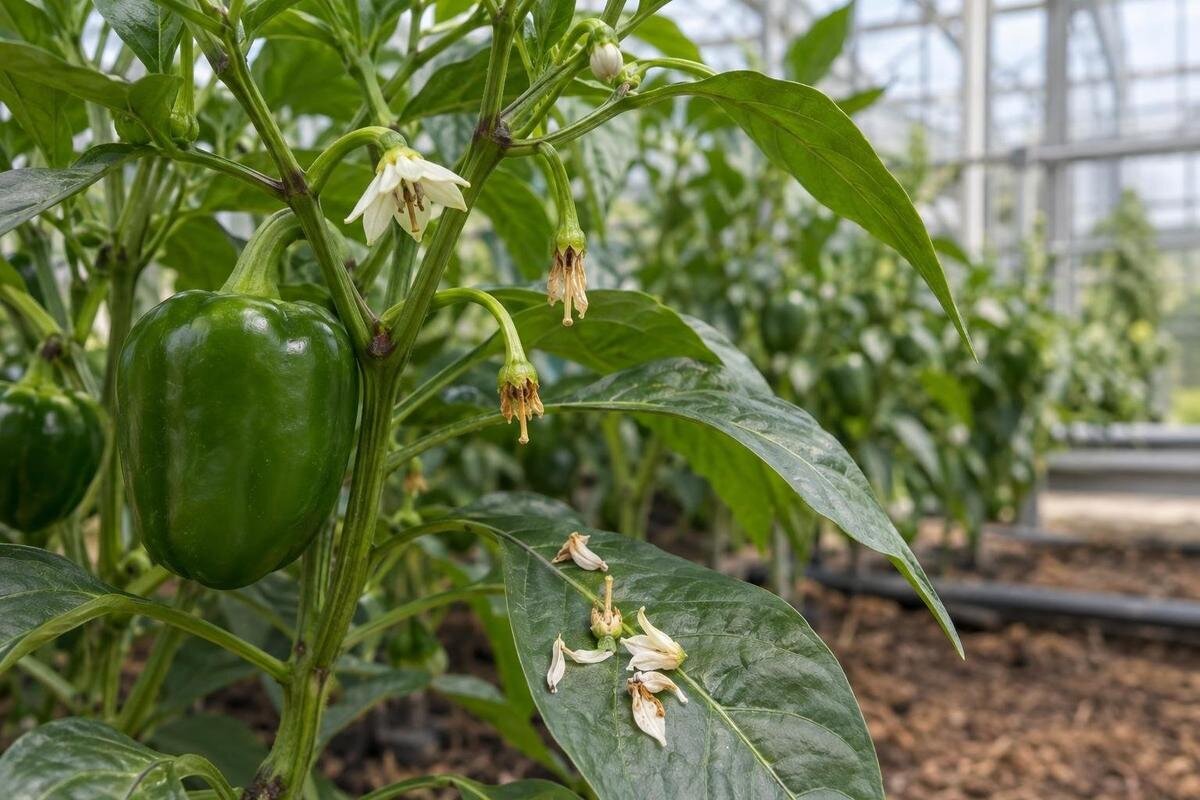
Not every pepper flower becomes a pepper, and a fallen bloom on its own is not a diagnosis. After successful pollination, the petals commonly wither and fall while the small green ovary at the flower’s base remains attached and starts to enlarge. That is normal fruit set. If the whole flower, or the short stalk carrying it, falls away and the ovary does not swell, that bloom has failed to set. A tiny fruit that forms and later shrivels or drops is a separate, later failure. Note which event you are seeing; both are often called flower drop, although they happen at different stages.
A few flowers failing while a plant establishes after transplanting or adjusts to changing conditions is not automatically a sign of disease. The concern is greater when many fresh flowers fall repeatedly, particularly if several plants are affected or the plant also wilts, stops growing or shows leaf damage. Cultivar, plant stage and the number of fruits already developing can all affect how many flowers set. Keep flower loss separate from small-fruit loss in your notes. The timing and order of events help narrow down what to investigate, but neither one identifies the cause on its own.
Compare flower loss across plants and days
Before changing the watering or feeding routine, note where the flowers are falling. Record which plants are affected, where they sit in the greenhouse and whether the loss follows a sunny afternoon, a cool night or a change in watering. Mark a few plants and record when buds open, when flowers fall and whether ovaries remain attached. Include an unaffected plant in the comparison, if there is one: recording only damaged plants leaves out a useful part of the picture. Use the same plant labels each time so that you can follow individual plants rather than relying on a general impression. If many plants lose blooms at roughly the same time, a shared condition such as temperature or watering deserves attention. If one plant is affected, check its own root moisture, stems and leaves before assuming the whole greenhouse is the problem.
Position can provide another clue: compare plants near a door, at the sunny end and beside a wall. A wall-mounted format such as the Lean-to Greenhouse is one greenhouse type to consider when thinking about site exposure; the model name cannot tell you how a particular wall or orientation will affect temperatures. Record the actual layout, shade and readings rather than making assumptions from the structure alone. A simple dated log can reveal a repeatable pattern that a single visit would miss.
Greenhouse buying checks 2
Check daytime heat at flower height
Peppers grow in warm conditions, but excessive greenhouse heat during flowering can interfere with pollen and increase flower loss. Outside air temperature is not a reliable substitute for a reading inside: the greenhouse can heat up quickly in sun, and conditions at plant level may differ from those near the door or roof. Use a maximum–minimum thermometer near the flowers, out of direct sunlight and away from glass or metal. If the greenhouse has distinct zones, take readings in more than one place and note the hottest period alongside the flowers that fall. Record whether doors and vents were open at the time and whether the plants were in sun or shade. This makes the readings easier to interpret later. A high reading without a note of its location tells you less about the affected flowers than one taken consistently beside them.
Repeated losses after the hottest afternoons make heat a plausible factor, especially if leaves also wilt temporarily or curl; those leaf signs are not proof by themselves. Use the ventilation openings already available when conditions call for it, rather than waiting until plants look distressed. If replacing a structure is already under consideration, the Limited Edition Aluminium Greenhouses listing is one model range to compare. Check the specifications for the particular configuration: the product name alone does not establish how much heat it can release.
Check overnight minimum temperatures
A warm afternoon does not show whether nights are suitable for flowering. Cool conditions can slow pepper growth and affect pollen or fruit set, while a large swing between daytime and night-time conditions may add stress. Take the minimum reading near the plants as well as the daytime maximum, and repeat it over several nights. A thermometer placed near the roof or against a cold surface may not represent what the flowers experience, so keep it at crop height and record where it is positioned. Keep the overnight minimum separate from a reading taken when you first enter the greenhouse in the morning; they are not necessarily the same. When comparing affected and unaffected plants, use readings from equivalent positions rather than comparing a sheltered corner with a thermometer mounted high above the crop.
Do not assume that a greenhouse will stay warm overnight simply because it was hot during the day. The T-Model Orangery Greenhouse listing gives area options from 16.52 to 30 m²; those figures describe size, not the minimum temperature a particular site will maintain. When comparing structures, check the actual specifications and consider the site and how the greenhouse will be managed. Larger floor area on its own is not a temperature-control measure.

Greenhouse buying checks 3
Keep root moisture steady
Uneven moisture can stress pepper roots and contribute to flower loss. A dry root ball followed by a heavy watering can create a different problem from roots that remain saturated, where poor drainage may limit the air available to them. Check the growing medium below the surface rather than relying only on its appearance or on midday leaf wilting. Pots and small containers can dry at a different rate from beds, and plants in separate containers may not all be receiving the same amount of water. For each affected plant, note both what the medium feels like and when it was last watered. Compare this with a plant that is setting fruit under the same conditions. That comparison helps you assess whether an apparently regular watering routine is actually producing reasonably consistent moisture around the roots.
Water according to the medium, container and conditions, not a fixed schedule that ignores changes in weather or plant size. Check several pots or parts of a bed, and make sure the water is reaching the root area consistently. A dated note of watering and flower loss can help reveal an uneven routine. When comparing a layout such as the Limited Edition Aluminium Greenhouses with Storage, include access to watering points and the plants themselves in your assessment. The listing identifies built-in storage; consider its position alongside your proposed beds or containers so that routine moisture checks remain practical.
Consider pollen movement and greenhouse air
Pepper flowers are generally self-fertile, so a second variety or visiting insect is not essential for fruit set. Pollen still has to move within the flower, however. Very still air may make that transfer less reliable, while unsuitable temperatures or very humid, damp conditions can also interfere with pollen movement. Look at the flowers as they open and note whether the problem is widespread or limited to blooms in a particular part of the greenhouse. Poor pollination is one possibility, not the automatic explanation for every fallen flower.
In a still greenhouse, a gentle tap on an open flower stem or cluster can help move pollen; it is not a guarantee of fruit set. Avoid rough shaking, and do not treat this as a substitute for checking temperature and watering. Note which flowers you have tapped so that you can follow their development rather than assuming that any later fruit set resulted from the intervention. For a layout comparison, the Pyramid Greenhouse listing gives area options from 5.53 to 18.9 m². Assess the proposed planting arrangement alongside the configuration’s ventilation details and your access to flowers; floor area alone does not answer those questions.
Greenhouse buying checks 4
Account for plant age, crop load and spacing
A recently transplanted or still-establishing pepper may shed some early flowers while it puts energy into roots and leaves. A plant carrying several developing fruits may also set new flowers differently from one with no fruit, but that observation alone does not prove that crop load is the cause. Compare plants at a similar stage and note how many fruits are already growing when new blooms fall. Record the cultivar too, rather than treating every pepper in a mixed planting as a direct comparison. A newly transplanted plant and an established plant carrying fruit have different histories, even if they stand side by side. Changes after transplanting, pruning or a sudden shift in conditions are useful context, not definitive explanations.
Crowded plants can shade one another and make it harder to inspect flowers or maintain air movement around the canopy. Look at the mature shape of the plants, not just how much space they occupied as seedlings, and avoid removing large amounts of foliage in response to flower loss alone. The Spacious Greenhouse listing gives area options from 47 to 70 m². When comparing that range, sketch the intended beds, containers and access routes within the available area. This keeps the buying decision focused on usable growing space and plant access rather than assuming that a larger footprint automatically resolves crowding.
Check feeding and the root zone before adding fertiliser
Excess nitrogen can encourage leafy growth at the expense of flowering, but a plant with falling flowers is not automatically overfed. Poor nutrition or an unsuitable root-zone condition can also weaken growth, yet flower drop alone cannot identify which nutrient, if any, is involved. Look at the plant’s overall growth and review what has been applied, how often and in what growing medium. Include the product names and application amounts in your notes, rather than describing the routine simply as regular feeding. If different plants have received different treatments, keep those histories separate. This gives you a clearer basis for deciding whether feeding is a plausible part of the problem. Leaf colour can be a clue, but it is not a reliable stand-alone test for a specific deficiency.
Check drainage and the condition of the soil or potting mix before adding a product labelled for flowering. Where a nutrient or pH problem is suspected, use an appropriate test rather than guessing from one symptom, and follow fertiliser label directions. If you are also comparing structures, distinguish their construction details from your growing-medium choices. The Bloomcabin Prestige Greenhouse listing identifies a metal base; assess that as part of the structure, while considering the soil or containers separately. It does not establish the pH, fertility or drainage of the growing area inside.

Greenhouse buying checks 5
Look for pest or disease signs beyond the flowers
Pests or disease are more plausible when flower loss comes with other visible damage. Inspect open flowers and buds for small insects or scarring, and check leaf undersides for pests, stippling or webbing. Look for damaged stems, leaf distortion, spots or unusual wilting as well. These signs can help direct an investigation, but they do not prove that a pest or disease caused the flowers to fall; heat and watering stress can occur at the same time.
Photograph the whole plant, affected flowers and the relevant leaves, including their undersides. A close view of the flower stalk can show whether the bloom or a developing fruit has fallen, while a wider image records the plant’s overall condition. Label each photograph with the plant identifier and date, and include recent temperature and watering notes. Where possible, photograph an unaffected plant for comparison and return to the same views when recording changes. Keep the original images so that details remain available if you seek advice. Photographs are useful records, but they cannot show what the root zone felt like or what the greenhouse temperature reached. If damage is spreading or you cannot identify the cause, seek advice from a local horticultural specialist before choosing a treatment.
Monitor new flowers after changes
Use the next flowering period to test a likely explanation. Keep a simple record of minimum and maximum temperatures, watering, affected plant positions and whether new ovaries begin to swell. Make one suitable change at a time, based on what the record suggests; changing ventilation, watering and feeding together makes it difficult to tell what helped. Write down the date of the change and which plants it affected. Continue recording conditions even if fruit set improves, so that you can distinguish the intervention from a simultaneous change in weather or plant development. Flowers that have already fallen will not recover, so judge the result by new blooms and fruit set rather than by looking for lost flowers to return.
If the pattern points to a whole-house issue, such as recurring heat or poor access to ventilation, review the structure only in relation to that specific constraint. The Aluminium Greenhouses listing includes area options from 3.77 to 28.08 m², but area does not establish opening arrangements or the conditions at your site. Check the specifications for the configuration you are considering. Persistent flower loss across successive flowering periods, despite stable care, is a good reason to ask a local horticultural adviser to help assess the plants and their growing conditions.
Frequently asked questions
Is it normal for a pepper plant to lose a few flowers?
Yes. A small number of flowers may fail to set, particularly while a plant is establishing or after conditions change. If the petals fall but the small green ovary remains and starts to swell, fruit is forming normally. Repeated loss of whole flowers across several plants or flowering cycles is a reason to check growing conditions.
Do greenhouse peppers need insects to pollinate them?
Usually not. Pepper flowers can pollinate themselves, so a second plant or visiting insect is not essential. Pollen still needs to move within the flower, though, and heat, cool conditions or unsuitable humidity can interfere with fruit set. Still air may also make pollen transfer less reliable.
Should I tap pepper flowers to help them set fruit?
A gentle tap on a flower stem or cluster can help move pollen in a very still greenhouse. Try it when flowers are open and dry, without shaking the plant hard. It may help with pollen transfer, but it will not correct heat, watering or other stresses.
Will extra fertiliser stop the flowers falling?
Not if the cause is heat, uneven watering or poor pollen transfer. Too much nitrogen can encourage leafy growth at the expense of flowering, and flower drop alone does not identify a nutrient deficiency. Check the growing medium and feeding history before changing your fertiliser routine.
How soon will I know if a change has helped?
A flower that has already fallen will not recover. Watch new flowers and record whether their ovaries begin to swell as conditions change. There is no single timeline for every cultivar or growing situation, so compare successive flowers rather than judging by one bloom.
Follow the pattern back from each fallen flower: check whether a fruit had started to form, which plants are affected and what the greenhouse conditions were like at the time. Then address the most plausible stress and watch the next flowers, rather than changing several routines at once. If the loss continues or other damage appears, a closer assessment of the plant and root zone can help distinguish environmental stress from pests, disease or a feeding problem.
