
Planning a Greenhouse for a Home With Pets
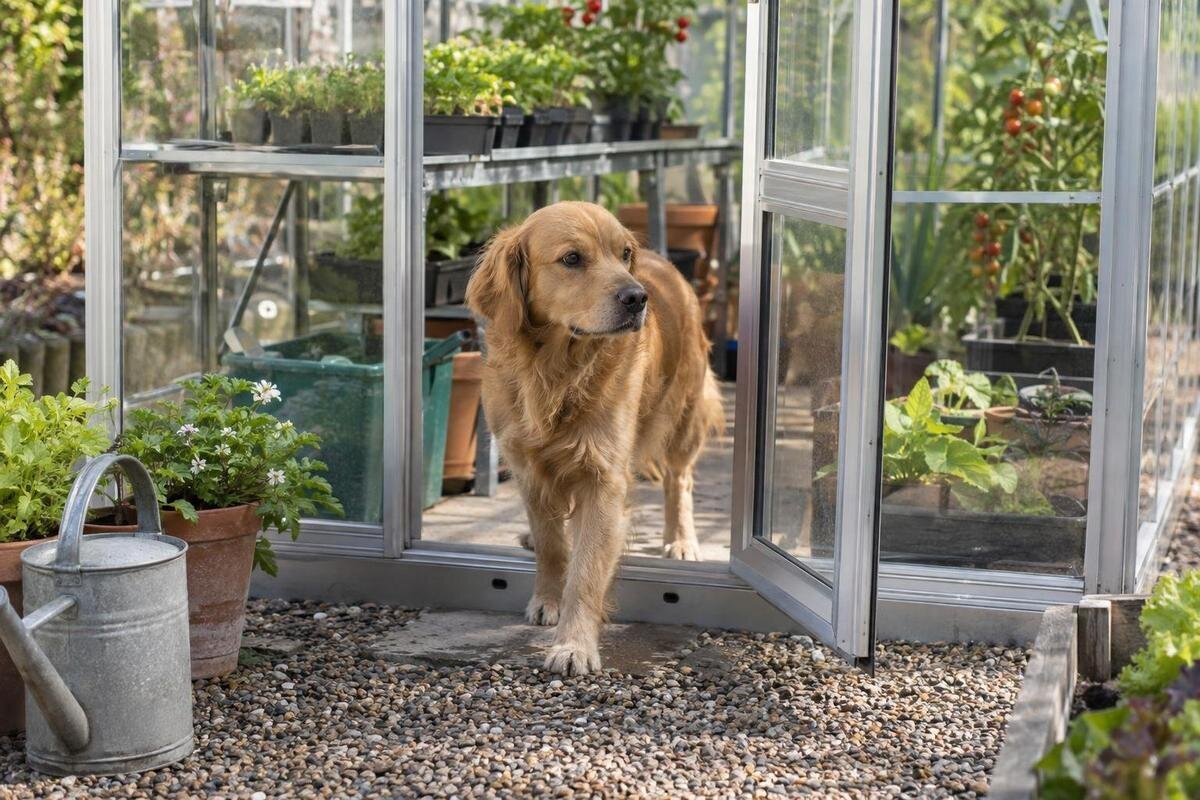
Pet-aware greenhouse planning
Planning a greenhouse in a pet household is less about declaring it “pet-safe” than deciding exactly who can enter, what they can reach and what must stay secured. A door left open during watering, a packet moved to the potting bench or a new seedling can change the risk picture. Start with each animal’s habits, then map access, plant checks and storage before choosing a layout. The aim is a growing space with rules the household can maintain every day.

Each pet’s behaviour and access rules
List each pet that uses the garden, including visiting animals if they are regularly present. Note what each one actually does: pushes at doors, follows people through openings, climbs, jumps, digs, chews, noses containers or slips into narrow spaces. Include size, age, mobility and any behaviour that changes how it moves around the site; a puppy, older pet or newly adopted animal may not follow the routine you first had in mind. If there is more than one pet, base the boundary on the animal most likely to test it, rather than an average. Species can guide what to investigate, but individual habits matter more than assumptions about a dog, cat or other companion animal.
Translate that list into a household rule: do pets remain outside the growing area, or may they enter while a responsible adult supervises them? Make clear who is responsible whenever the greenhouse is in use, rather than assuming someone else is watching. Everyone who gardens there should know which animals are allowed where and how to respond if one gets inside. Include family members, tradespeople and regular visitors in the explanation; not everyone will know the routine. Write the rule where garden users will see it, and make sure the pet’s normal route to the garden does not depend on passing through the greenhouse doorway.
Position the greenhouse around garden routes
Sketch the garden as it is used, not just the bare patch of ground. Mark the greenhouse footprint, door opening, paths, gates, pet run or favourite resting place, and the route people take with a watering can, compost bag or harvest basket. Note adjacent walls, steps, low ledges or stored items that could change how a pet reaches the structure. Include the route to a water point and the space needed to bring materials through. A greenhouse beside a busy passage can be harder to control than one placed away from routine traffic, even if both fit on paper. Do not obstruct a gate, escape route or the path needed to move equipment.
Test the sketch at full scale with string, chalk or a temporary outline, then walk through it carrying the items you expect to use. Include room for the door to open, a person to turn, and a tray or sack to wait without leaving a pet an easy route inside. For footprint comparison, the Bloomcabin Oasis Pyramid Greenhouse listing gives options from 5.53 m² to 18.9 m²; use the selected dimensions in your plan, not the model name as evidence of pet containment. Check the proposed position, door clearances and route for equipment against the supplier’s drawings before ordering.
Make the doorway a managed boundary
Treat the doorway as a physical boundary, not just a reminder to be careful. Check whether the pet can nose, push, paw, climb or otherwise operate the chosen closure; do not presume that a latch which suits one household will suit another. Look at the threshold and the spaces around the closed door as well as the handle. If a separate garden gate or barrier is part of the plan, assess it for the animal’s behaviour and check it for gaps. Consider how that barrier will work when the greenhouse door is open, since the main door cannot control access while people are carrying materials through it.
Before selecting a greenhouse, ask for the chosen configuration’s door position, opening direction, clear opening, threshold and any ventilation openings a pet could reach. Find out whether a suitable screen or access-control accessory exists and whether it is compatible with the structure and airflow. Ask about normal operation too, so a barrier does not make daily entry awkward. Do not cut, drill, cover vents or fit improvised mesh on assumptions: the supplier should confirm what can be fitted. The Aluminium Greenhouses page identifies a product range, not particular pet-control hardware, so check the specifications for the exact option you would order.
Check plant risks for each pet
Build a plant inventory before bringing seedlings or established pots into the greenhouse. Record the botanical name where possible, the name on the supplier label, and the plant parts you may grow, handle, prune or store as seed. Check each plant against the animal species in your home using an authoritative veterinary or plant-toxicity resource that is explicit about pets; a veterinarian can help when identification or risk is unclear. Do not assume a plant is suitable because it is edible for people, common in a vegetable garden or sold without a warning. Keep ornamental plants, crops and gifts on the same list instead of treating one group as automatically low-risk.
Look for guidance that covers the particular animal and the part of the plant it could reach, rather than a brief search result or an unqualified list of plants described as safe. If a source is vague about the plant’s identity, parts or animal species, mark the entry unresolved and keep access controlled until you have reliable advice. Record the source and date alongside the label and a clear photograph, so another household member can check the same identification. Revisit the list when you buy a new variety or receive a gift plant; common names can be ambiguous, and an old record cannot confirm the status of a new addition.

Keep propagation and plant waste under control
Plan for the whole life of a plant, not only the pot on a bench. Seeds, bulbs, cuttings, seedlings, fallen leaves, prunings and harvested material can be carried, dropped or left on a work surface. Decide where new plants are unpacked, where pruning waste is collected, and where bags or trays sit while you work. Keep any material that has not been checked for your pet out of reach; temporary staging is often the moment a careful routine breaks down. Include compost containers and the trip carrying trimmings out of the greenhouse, not just the plant bed, in your access plan.
Use a controlled plant-holding area rather than relying on height alone. A shelf may not stop a pet that can climb, jump, knock a pot down or reach through a gap; a small animal may fit where you would not expect. Match the barrier to that pet and avoid loose covers or netting that add opportunities for chewing or entanglement. The Bloomcabin Prestige Greenhouse range lists sizes from 3.77 m² to 28.08 m²; draw the selected footprint, benches and work route to test whether a plant area can remain inaccessible. Square metres do not by themselves create a barrier.
Store growing products away from pets
List every stored product, not just pesticides: fertilisers, plant feeds, growing media, seed treatments, cleaning products and any other substance used in the growing area. Read each label and the manufacturer’s storage directions, including any stated restrictions for animals, and keep products in their original containers so their identity and instructions remain available. Do not move them into food jars or unlabelled bottles. Keep pet food, treats and household medicines separate from greenhouse supplies, close containers as directed, and treat anything not yet checked as unavailable to animals. Include small sachets and partly used products in the inventory.
A listing that mentions built-in storage is a prompt to check the details, not proof of a lockable cupboard suitable for storing chemicals. For example, the Limited Edition Aluminium Greenhouses with Storage page identifies a storage feature; confirm what the chosen configuration includes, how it closes, and whether the manufacturer permits the particular products to be kept there. Ask whether the compartment is separate from the growing area and whether its size suits the containers you use. If it cannot prevent your pet’s access, plan separate secured storage in a suitable place and follow each product’s label. Do not assume a closed greenhouse door is an adequate substitute.
Secure tools, water and equipment
Give tools and small loose items a defined storage place so they can be accounted for after each task. Secateurs, blades, stakes, wire, clips, ties and labels can be sharp, tempting to chew or easy to scatter, depending on the item and the animal; keep them in closed containers or somewhere the pet cannot access. Store long-handled equipment so it cannot fall into a route, and keep loops of twine, netting and plant ties out of reach. Before finishing, check the work surface and floor for missing clips, broken pieces and dropped packets rather than putting away only the larger tools.
Include water containers, hoses, cables and powered equipment in the same review. Keep stored water covered or otherwise inaccessible where a pet could fall in, and ask the equipment maker or a qualified electrician about appropriate arrangements for pumps, lighting, fans or other electrical items in a damp growing environment; do not improvise wiring or protective covers. A Lean-to Greenhouse listing is a starting point for comparing a wall-style layout, not proof that the wall or adjacent fittings block pet access. Check the exact openings, cable route and service area in the plan, and keep loose hoses out of the route.
Plan for access during everyday jobs
Plan around the jobs that temporarily leave the entrance open. Watering, bringing in compost, pruning and harvesting can involve several trips or leave a tray on the path. Decide how the pet will be kept away for the whole task: in a separate secure area, or with another adult managing access. Identify where deliveries and garden supplies can be put down before you open the door, then work out the order for bringing them inside. Avoid relying on someone to hold a pet and a door while handling tools. Include interruptions in the routine, so an unfinished job does not leave the entrance unattended.
Use a dimensioned layout to separate the route for people and supplies from any area you hope to keep pet-free; check that benches, bins and equipment do not narrow the route or create climbable steps. The Spacious Greenhouse listing gives footprint options from 47 m² to 70 m², but extra floor area alone does not create a secure zone or guarantee a workable route. Compare the actual plan and door positions with the supplier, then consider whether the boundary can be maintained when several jobs are under way. If the arrangement depends on a perfectly empty doorway, revisit the placement or daily routine.

Check glazing, vents and modifications
Consider the greenhouse structure as well as its openings. If a pet may paw, lean against, jump at or chew a panel, ask the supplier about the exact glazing and other materials in the configuration you are considering; do not infer their properties from a photograph or model name. Note which surfaces a pet could reach, and ask what to do if a panel or fitting is damaged. Ventilation and access also need to be considered together: open vents, windows or doors may create a route for a pet, or let it reach an opening from nearby furniture or stored items.
Ask how each opening is operated and which screens or controls are approved. A screen is not automatically pet-proof: mesh may be within reach, chewed, climbed or damaged, so check the material, fixing and animal’s access with the supplier. Do not close or obstruct a vent to keep a pet out, or adapt the frame without product-specific guidance. When considering Limited Edition Aluminium Greenhouses, request drawings for the precise model and ask which screens, latches or other accessories are compatible. Confirm any powered equipment separately with the supplier and a qualified electrician.
Keep the plan current as things change
Record the plan where the household can follow it: the access rule, plant inventory and source notes, storage locations, and a quick closing check for the door, vents, tools and products. Review it when a pet arrives, grows more confident, loses mobility or starts using a different route, and whenever a plant, product or piece of equipment is added. A one-off inspection is not enough if benches move or a gate is left open. After each work session, make a final pass for dropped leaves, open containers and a door that has not been secured. Explain the boundary to visitors before they enter the garden.
Keep a record of the configuration you choose alongside the household plan. For the T-Model Orangery Greenhouse, the listed range spans 16.52 m² to 30 m², so note the exact option rather than recording only the range name. Retain the corresponding layout and opening details, together with the supplier’s answers about any screens, latches or storage you intend to use. This gives you a clear reference when benches move, equipment is added or someone else takes over the gardening. Update the working layout when arrangements change, so the plan describes the greenhouse in use rather than only the version you intended to buy.
Frequently asked questions
Can my pet come into the greenhouse while I work?
Keeping pets outside is often the simplest rule, but the plan depends on the animal and what you have checked. If a pet accompanies you, an adult needs to manage access and prevent it reaching unverified plants, products, tools, open water or vents. Do not use the greenhouse as an unattended sleeping area or pet enclosure.
How can I check whether a plant is suitable for my pet?
Identify the plant as precisely as possible, then check an authoritative veterinary or plant-toxicity resource that covers your pet’s species and the plant parts it could reach. Do not rely on a general label or a brief search result. If identification or advice is unclear, keep the plant out of reach and ask your veterinarian.
Are high shelves enough to keep plants away from pets?
Not necessarily. Some animals climb or jump, and a pot may be pulled down or reached through a gap. Consider the particular pet’s habits and use a barrier or storage arrangement that prevents access, rather than relying on height alone. Keep new or unverified plants out of reach while you check them.
Can I store fertilisers and pest-control products in greenhouse storage?
Only if the product instructions allow that storage and the compartment keeps your pet out. Built-in storage is not automatically lockable or suitable for every product. Check the exact compartment and follow each label’s storage directions. Keep products in their original containers, with pet food and household medicines stored separately.
What should I do if my pet chews a plant or reaches a garden product?
Prevent further access and contact your veterinarian promptly for advice. Share the plant’s name or a clear photo, or the product container and label, if available. Do not assume the exposure is harmless or try a home treatment without veterinary guidance.
A pet-aware greenhouse plan joins three practical checks: control the route in, verify every plant for the animals in your home, and keep equipment and growing products inaccessible. Test that plan against ordinary tasks, not just a closed door on a quiet day. With a clear boundary and records that change alongside the household, a greenhouse can remain a useful growing space without relying on unverified assumptions about pet safety.
