
Insect Screens for Greenhouse Vents: Mesh, Pests and Airflow
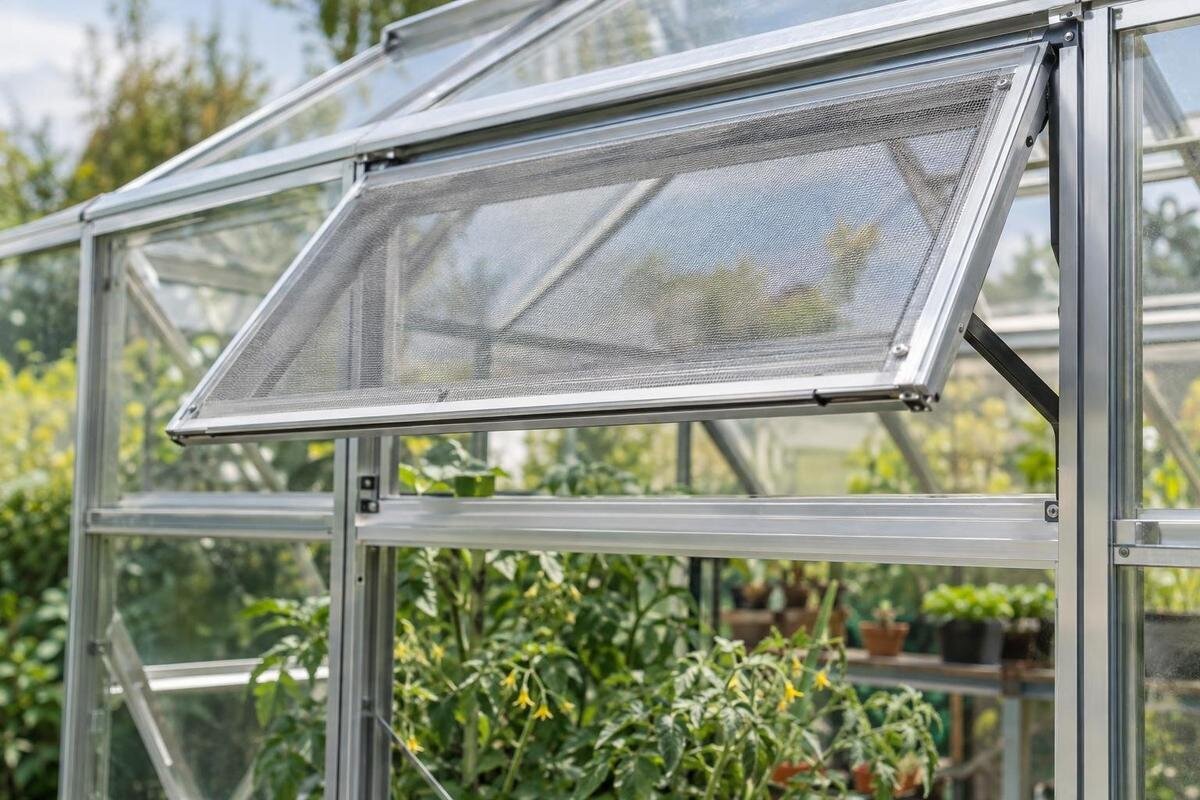
Greenhouse ventilation
An insect screen can close one route into a greenhouse, but each layer over a vent also resists moving air. A finer mesh may keep out smaller insects, yet it can reduce the opening's effective ventilation. The right choice depends on the pest and life stage, clear mesh aperture, available vent area, and a fit that suits the exact greenhouse model. This guide explains how to weigh those requirements, what to ask a supplier, and how to notice when a screen is restricting airflow more than expected.

Before you buy 1
How insect screens affect ventilation
A mesh covers part of the route through which air moves: air has to pass through its openings as well as through the vent. A tighter, denser weave usually creates more resistance than an open one, but the effect depends on clear aperture, thread thickness, total open area, screen size and how it is mounted. The same nominal mesh count can describe products with different openings, so count alone is not a ventilation rating. Smaller apertures may be needed for smaller target pests, while a denser screen can reduce air exchange through that opening. Even with identical mesh, a small vent and a large vent do not provide the same total passage area.
The effect matters most when screened vents provide much of the greenhouse's ventilation, when other openings cannot be used, or when an obstruction has already reduced the available opening. Dust and plant debris can further cover mesh openings as they accumulate. Wind, temperature differences, vent position and the route air can take through the structure also influence movement, so no mesh label predicts a particular internal temperature. Treat exclusion and ventilation as linked requirements, not separate product choices. The practical question is whether the proposed mesh suits both the target pest and the actual vent arrangement.
Identify the pest and its entry route
Start with pest identification rather than a mesh label. Note which crops or leaves are affected, where insects appear, and whether you have seen them near an open vent. Inspecting leaf undersides and new growth can help; a clear close-up photograph may also be useful when asking a knowledgeable adviser or supplier to identify a specimen. Feeding marks alone do not prove that a pest entered through a vent, and some plant problems are not caused by insects. Different pests, and different life stages of one pest, vary in size and behaviour. A flying adult may not be the smallest stage you need to exclude.
Choose the relevant target stage before comparing aperture. If a small immature insect is the stage entering from outside, a mesh selected around the adult alone may not be sufficient. Ask for the clear opening dimension and compare it with the target's approximate body width; a larger opening may allow passage, while a tighter opening generally increases resistance to air. This is a useful screening comparison, not a guarantee. Insects can use untreated doors, gaps around the screen or tears, and may arrive on plants or equipment. Note when sightings occur and which vents or doors are open. If the pest is uncertain, establish what it is before paying for the finest mesh.
Before you buy 2
Choose mesh by clear aperture, not count alone
Mesh count is only one way to describe a screen and does not necessarily mean the same clear opening across different suppliers. Thread thickness and weave affect the gap between strands, so two meshes with an identical count can have different open areas. Ask for the clear aperture, whether the stated size is nominal or measured, and open-area information if it is available. If openings vary, ask whether the aperture given is a minimum, typical or average measurement. Aperture helps compare a mesh with the pest; open area is more useful for assessing how much air may pass. Neither figure alone predicts airflow through the greenhouse, because the area and position of the vent also matter.
Do not judge scale from a photograph or rely on a label such as fine, standard or insect-proof. Request a technical sheet and find out what target pests or opening sizes the supplier's description refers to. If you are considering the T-Model Orangery Greenhouse, compare mesh specifications alongside the vent details for your chosen configuration. Keep the two sets of information separate: the greenhouse listing identifies the model, while the screen specification describes the mesh. Clear, comparable measurements give you a better basis for assessing pest exclusion and airflow than a mesh name alone.
Estimate the usable vent area
List the vents you plan to screen and note their type, dimensions and maximum usable opening. Check the relevant manual or drawing for the exact model and size, and record any sash that does not open fully, external obstruction or frame that covers part of the opening. The gross frame dimension is not the same as the clear area through which air moves. Floor area is not a substitute for vent area, and simply counting windows does not reveal how much air can pass. Also note which vents will actually be open when ventilation is needed; a closed vent is not available capacity at that time.
Map the ventilation route through openings that can operate together. The available flow depends on their position and on obstructions, as well as changing wind and temperature differences. This inventory is therefore a comparison aid rather than an engineering calculation. When considering the Pyramid Greenhouse, obtain the vent layout for the selected configuration and mark which openings you intend to screen. Compare their clear dimensions with the proposed screen arrangement, rather than using the greenhouse's floor area as a guide. If the layout does not provide enough detail, ask the manufacturer or a qualified greenhouse professional to help establish the usable opening area.

Before you buy 3
Match the screen to the exact greenhouse model
Compatibility is model-specific. Record the greenhouse manufacturer, exact model and selected size; then identify which vents are being screened and whether each screen sits over a fixed frame or interacts with a moving part. The profile of the frame, the shape of the opening and the available attachment points all affect whether a screen can be fitted without a gap. A roll of mesh that looks wide enough is not automatically compatible: its edges need continuous coverage, while the mounting frame and fixings must not unnecessarily narrow the clear vent opening.
Ask for a vent drawing or measurements for the exact version, the reference for any compatible accessory, and the supplier's approved fixing method. For a model from the Limited Edition Aluminium Greenhouses with Storage range, include the selected size when asking about screen fit; the range name alone does not establish compatibility. Clear photographs of the vent, frame and operating parts can help explain the proposed attachment position. Confirm that the arrangement leaves the vent able to open, close and be inspected. Do not cut or drill a frame on the strength of a generic illustration; follow the equipment manual or seek advice from the greenhouse supplier.
Keep the screen clear of vent mechanisms
Vents with hinges, sliders, latches or an opener need a screen that leaves their full intended movement unobstructed. A loose edge can catch; a frame placed over a moving joint can limit opening or prevent a sash from closing properly. Check what moves and what stays fixed before choosing where the screen will sit. If an automatic opener is fitted, confirm clearance through its full travel rather than assuming the mesh will remain out of the way. Check that the latch and handle remain accessible, too. A vent that cannot reach its intended position may provide less ventilation and leave a gap pests can use.
Follow the greenhouse and opener manuals for screen placement and any adjustment; do not modify the mechanism to make an unsuitable screen fit. If you are choosing a Bloomcabin Prestige Greenhouse, include screen clearance in your questions about the vent type and opener for the selected configuration. After fitting, check that the vent moves through its normal range and closes as designed, then inspect all edges for gaps. If an opener binds or an attachment interferes with movement, stop and ask the manufacturer or a qualified installer for advice. Only remove and refit the screen if its design and approved fixing method allow this.
Before you buy 4
Screening vents does not seal every entry route
Screening a vent only protects that opening when the mesh covers it continuously and fits without bypass gaps. It does not screen an open door, a torn join, a gap around a service entry or insects carried in with plants. If one vent is covered while another route remains open, the greenhouse is not sealed against pests. Treat vent mesh as one part of a wider exclusion plan, not as a guarantee that no insect will enter. Prioritise openings routinely left open; screening a rarely used vent may not address the route that matters most.
Walk around the greenhouse and note doors, other vents and visible joints that remain open during normal use. Consider how often doors are left open and whether plants or materials are brought inside; these are distinct entry routes requiring their own practical controls. If you are planning a Spacious Greenhouse, make this inventory from the chosen layout, including the openings you expect to use regularly. This helps you distinguish the vents covered by your screen plan from routes that still need attention. Preserve normal access and ventilation: a screen arrangement that gets in the way of everyday use is unlikely to provide consistent exclusion.
Measure conditions before and after screening
Create a baseline before fitting: record temperature and relative humidity in the growing area, using the same sensor, position and time pattern for later comparisons. Keep the sensor out of direct sun and note wind, sunlight, door position, vent opening and screen condition. Repeated observations under broadly similar weather are more useful than comparing one isolated hot afternoon with a cooler, windier day. If different parts of the greenhouse have noticeably different conditions, record a representative growing area and note the problem area separately, without changing the measurement position between comparisons.
After fitting, repeat those observations under comparable conditions and photograph the vent position and screen. Note whether the vent still opens fully, whether the mesh is dusty, and whether readings shift consistently. Temperature and humidity logs can show that conditions have changed, but they do not directly measure airflow or prove the screen was the only cause. For a model in the Aluminium Greenhouses range, keep the selected configuration's vent details with your baseline records so that comparisons refer to the same arrangement. If a repeated change concerns you, use those records when discussing possible blockage, restricted movement or screen resistance with the supplier.

Before you buy 5
Keep mesh clean and inspect the edges
Mesh needs periodic inspection because dust, pollen, plant debris and dead insects can close some of its openings. That reduces the effective open area even if the mesh itself has not changed. Look for clogged areas, stretched or bent strands, tears, loose corners and gaps around the perimeter. Where accessible, inspect both faces: a blockage can be local or less obvious from one side. Check the mesh and its attachment; an intact centre does not help if insects can pass around an edge. How quickly a screen needs attention depends on its material, exposure and greenhouse conditions, so there is no universal cleaning interval.
Use the supplier's care instructions; rough brushing, strong chemicals or an unsuitable wash may damage the mesh or its frame. When planning screens for a Lean-to Greenhouse, establish how you will reach both the mesh and its fixings for inspection and cleaning. Remove a screen only if its design allows it, and make sure refitting restores continuous coverage without restricting the vent. Photograph any torn seam or deformed section and repair or replace it using an approved method, rather than stretching another material across the gap. Recheck vent travel after maintenance: cleaning should leave both the screen coverage and the opening mechanism functioning as intended.
What to change if ventilation falls too far
Do not respond to warmer readings by immediately removing mesh, changing a mechanism or blocking a different opening. First compare similar conditions, inspect for dust or blockage, confirm the screen has not reduced the vent's usable travel, and check that other openings provide the expected route. If resistance remains too high, options to discuss include a more open mesh that still addresses the identified pest, a greater screened area, or a model-approved ventilation arrangement. Each change affects exclusion or airflow; none is universally right. Ask what evidence supports the proposed mesh and fitting rather than relying on a generic airflow figure.
Revisit the specification with the exact target pest, aperture, open-area details, vent dimensions and model manual in hand. If the required fine aperture leaves too little ventilation, consider complementary pest-entry controls rather than assuming one mesh will solve both needs. When comparing models in the Limited Edition Aluminium Greenhouses range, assess the proposed screen and ventilation arrangement together for each selected configuration. A model name is not a substitute for those details. If the trade-off remains unresolved, ask the greenhouse manufacturer or a qualified ventilation professional to assess the options. The aim is adequate pest exclusion without unnecessarily restricting the available ventilation.
Frequently asked questions
Will a finer mesh stop every pest?
No. A smaller clear aperture may exclude smaller insects, but gaps at the edges, tears, open doors and insects carried in on plants can bypass a vent screen. Identify the pest and its entry route, then check the whole fitting.
How much airflow does an insect screen reduce?
There is no single figure that applies to every greenhouse. The effect depends on the mesh's open area, the screened vent area, the fitting and other openings, as well as changing wind and temperature conditions. Ask for relevant specifications and compare conditions before and after fitting.
Can I use the same screen on every vent?
Not necessarily. Vents can differ in size, shape and movement, and a screen must not obstruct a hinge, slider or opener. Check the exact greenhouse model and vent configuration, and confirm that the proposed screen fits without gaps.
Should I choose mesh by count or aperture?
Compare the clear aperture with the pest stage you need to exclude. Mesh counts are not always comparable because thread thickness and weave affect the opening. Ask for the measured aperture and open-area information where available.
What should I check if the greenhouse seems hotter after screening?
Compare readings from similar conditions, then inspect the mesh for dust or blockage and confirm that the vent still opens fully. Check your model's manual and ask the supplier about the screen and fitting before changing the vent or mechanism.
A useful vent screen is the least restrictive mesh that still addresses the identified pest, fitted to suit the exact vent without bypass gaps. Decide from the target insect, clear aperture, open area and usable vent dimensions together; no single mesh count or label settles the question. Record conditions before and after fitting under broadly comparable weather, and check that the vent continues to move freely. If the readings shift or the mechanism binds, reassess the screen and fitting against the greenhouse manual rather than assuming a finer weave is always better.
