
Growing Cacti and Succulents in a Greenhouse
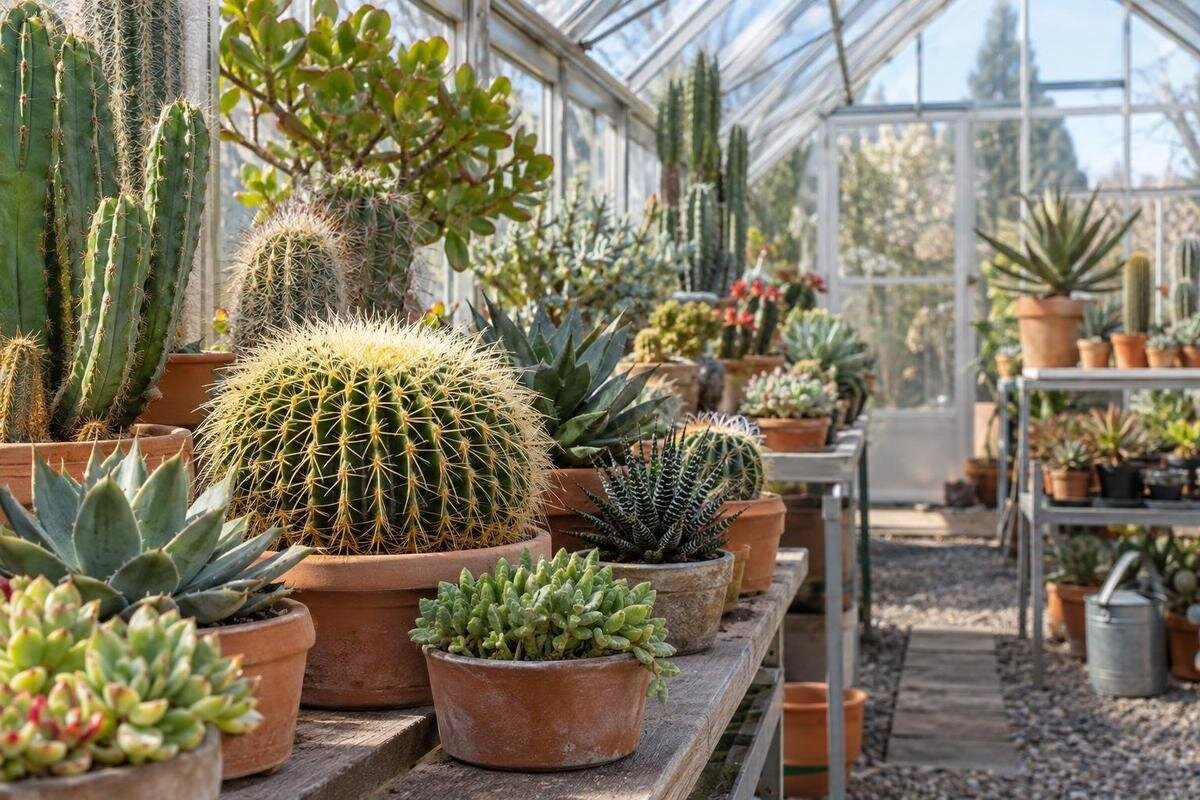
Greenhouse growing guide
A greenhouse can make rain protection and watering easier to manage, but it does not create one ideal climate for every cactus and succulent. A sun-loving desert cactus and a forest cactus such as Schlumbergera truncata need different light and winter conditions. Plan around the plants you own: record sunlight and overnight temperatures, ventilate before the house overheats, use pots with drainage holes, and group specimens by growth cycle and cold tolerance.

What a greenhouse changes for cacti and succulents
A greenhouse is useful for a cactus and succulent collection because it can reduce exposure to rain and give you more control over pot placement and watering. It does not automatically provide a suitable temperature: an unheated structure can heat quickly in strong sun and cool substantially overnight. Nor is a closed house necessarily dry; damp mix, standing water and poor air exchange can keep humidity high. Treat the greenhouse as a changing microclimate to manage, not a single ideal environment. Rain shelter helps only when containers drain properly and plants receive suitable airflow and seasonal conditions. Pots may also dry at a different rate from those outdoors, so check before carrying over an outdoor watering routine.
Begin with an inventory of botanical names, light needs, growth seasons and cold limits rather than shopping for a generic 'succulent greenhouse'. Estimate room for current pots, future additions and a working aisle; you need access for watering, labelling and inspection as well as space for display. The Lean-to Greenhouse range is listed from 3.69 m² to 14.34 m², which gives a footprint reference. Check the exact option's stated dimensions against your planned benches, and choose a position you can reach during routine care. The area figure is not the amount of shelf space available or proof that a plant will stay warm. Include a place to set down a tray while tending the collection.
Light requirements vary by species
Light needs follow a plant's natural habitat more closely than its label as a cactus or succulent. Many arid-land cacti and sun-adapted succulents, including Aloe vera and Crassula ovata, do well in very bright positions; forest cacti such as Schlumbergera truncata prefer bright filtered light and can scorch in prolonged, intense direct sun. These are useful contrasts, not rules for every species. Record the full botanical name and use a reliable species-level reference if its needs are uncertain, because a genus can include plants with different light tolerances. A plant raised in shade may scorch when moved directly into strong sun, even if it is a sun-adapted species.
Watch the sun at bench height through the day and as seasons change: a wall, tree or roof framing can shade one end while another gets stronger afternoon sun. Move newly acquired or overwintered plants towards brighter positions gradually, and use adjustable shade only where plants show a need rather than darkening the whole house by default. Bleached patches, dry tan marks or unusually stretched growth can signal that light needs reassessing, although each symptom can have more than one cause. Before fixing a greenhouse position, compare the site with the chosen model dimensions on the Limited Edition Aluminium Greenhouses listing. Recheck the light after the greenhouse and benches are in place.
Arrange plants by their growing needs
Arrange the collection by practical needs rather than by a simple cactus-versus-succulent split. Put plants with similar light and watering patterns together where practical, and leave enough space to inspect stems, pot surfaces and drainage holes. Keep full botanical labels; a general label such as 'cactus' does not identify a growth season or winter limit. If one specimen needs a cool, dry rest while another continues growing, treat them as separate groups even if both fit on one bench. Taller plants should not block the light falling on smaller ones, so use the observed sun pattern when deciding where pots go. A shallow tray can keep a compatible group together, but empty runoff rather than letting pots stand in water.
Draw the layout before installing benches. Mark the aisle, largest pot width, plant height and route for moving a plant in or out; measure pots with their saucers if you use them. Leave room to reach the back row without lifting neighbouring plants, which makes routine inspection easier and reduces accidental damage. The T-Model Orangery Greenhouse is listed from 16.52 m² to 30 m², but use the chosen option's actual dimensions to judge whether your collection fits. A larger footprint helps only if the arrangement still gives you clear access and keeps plants grouped by their needs.
Ventilation during hot, dry weather
In direct sun, greenhouse air can become much hotter than outdoor air, while still air may remain humid after watering. Ventilation lets warm, moist air leave and fresh air enter, but the result depends on opening size and position, wind and outside conditions. During a hot, dry spell, use the available openings early enough to limit heat build-up and keep air moving; do not wait for visible wilting. A dry period outdoors does not guarantee a cool or well-ventilated greenhouse. Check conditions during the warmest part of the day, not only when you first enter in the morning.
Airflow should not be confused with a need to dry every pot at the same speed. The aim is to avoid stagnant, persistently damp conditions, not to desiccate the collection. Keep benches and tall plants from blocking ventilation paths, and check how the selected configuration handles its openings. The Pyramid Greenhouse range is one model range to compare, but verify ventilation provision for the exact option in its specifications rather than inferring it from the shape or name. If the greenhouse cannot be aired adequately at your site, reconsider the layout before filling it.

Free-draining mixes and pot hygiene
Choose potting mix for the species, not just for a label such as 'cactus mix'. Many desert cacti and drought-adapted succulents benefit from an open, fast-draining medium with a substantial mineral component. Forest cacti such as Schlumbergera generally need a mix that holds some moisture while still draining freely. The right balance depends on the plant, pot and growing conditions, so one fixed recipe is unlikely to suit the whole greenhouse. Use containers with unobstructed drainage holes and do not let them sit in drained water. Pot size and material also affect drying, so check each plant rather than assuming adjacent pots will need water at the same time.
Keep growing surfaces tidy: remove fallen leaves and decaying material, clear runoff trays, and clean pots or tools when rot or pests have been present. A dry bench is not a substitute for a suitable root medium, but it makes damp patches easier to spot. If a separate place for supplies matters, the Limited Edition Aluminium Greenhouses with Storage range is listed from 5.52 m² to 28.08 m². Check the selected model's layout and specifications to see how storage is arranged and how much growing area remains; the name alone does not show how your benches will fit.
Watering by growth cycle
Water by growth stage and substrate condition, not by a fixed weekly schedule. Many desert cacti and drought-adapted succulents use more water while actively growing and need much less during a cool rest. The timing is not shared by every succulent: many Aeonium, including Aeonium arboreum, grow mainly through the cooler part of the year and slow or rest in hot weather. Check the plant's own cycle and the moisture in its root zone, because a greenhouse can dry one small pot quickly while a larger container beside it remains damp. New growth can help show when a plant is active, but use species-specific guidance too.
For a plant in active growth, water the mix thoroughly and let excess drain; then allow it to dry to the degree appropriate for that species before watering again. Check below the surface and consider pot weight rather than judging only by a dry-looking top layer. Reduce watering when growth slows, but do not impose a dry winter on a winter-growing species. The Bloomcabin Prestige Greenhouse is listed in sizes from 3.77 m² to 28.08 m²; compare the selected layout with the separate plant groups you need to reach and water without disturbing their labels or pots.
Winter cold tolerance varies by species
Cold tolerance is species-specific, and rain shelter is not the same as frost protection. A passive greenhouse may get close to outside conditions overnight, especially in an exposed position, so do not assume a plant is safe just because it is under cover. For example, Aloe vera and Schlumbergera truncata need protection from frost, whereas certain cold-hardy prickly pears such as Opuntia humifusa tolerate much colder conditions. These examples do not set a limit for other Aloe or Opuntia species. Check reliable guidance for each plant's minimum temperature, and leave a margin rather than aiming at the edge of its tolerance. Some plants also need a cool, dry rest; others do not.
Use a minimum–maximum thermometer at plant level through the coldest part of the season and compare its lowest readings with species-specific guidance. Keep plants with different limits in separate, moveable groups so frost-sensitive pots can be shifted or otherwise protected when conditions call for it. A bigger house creates more space, not a guaranteed warm zone: the Spacious Greenhouse range is listed from 47 m² to 70 m², but its area says nothing about overnight temperature. Plan the winter arrangement around measured lows and the plants' actual needs.
Monitoring greenhouse temperature and humidity
Build a simple record of greenhouse conditions before changing care. A minimum–maximum thermometer shows how far the temperature swings; a hygrometer can help you compare humid periods, particularly after watering or during overcast weather. Place instruments at plant height and out of direct sun, which can heat a thermometer and distort its reading of the air. Check more than one position if shelves sit in shade or near an opening. Note the date, ventilation and watering alongside changes in the plants. Readings taken in different weather conditions and across seasons reveal more than a single visit.
Use those observations to decide where benches belong and what a selected greenhouse must provide. Verify the chosen option's clear internal height, access and ventilation openings against your collection instead of treating overall area as usable growing capacity. The Aluminium Greenhouses range is listed from 3.77 m² to 28.08 m²; check detailed specifications for the model you are considering and compare them with the sun pattern and recorded temperatures at your site. If a specification does not explain an important feature, ask the supplier before purchase.

Greenhouse layout and model specifications
Compare shortlisted greenhouse sizes using the same scaled layout, rather than judging each by its advertised floor area alone. Include your bench dimensions, largest pots, working aisle and space for future additions in each comparison. This makes it easier to see whether a larger option would provide useful growing space or simply more floor space than the collection needs. Check the arrangement for tall specimens as well as trays of small plants: both must fit without making the back rows difficult to reach. Keep these practical requirements separate from display preferences so that an attractive arrangement does not make routine care awkward.
Compare the specification for the exact size and configuration, including clear height, opening dimensions, ventilation position and panel or glazing options. Product-family names do not confirm which fittings are included, and one model's dimensions should not be assumed for another. Check how the manufacturer describes the base and site requirements; where the ground or installation raises a technical question, ask a qualified installer rather than guessing. Choose a structure that makes ordinary access practical, because the ability to inspect and ventilate the collection matters throughout the year.
Signs of stress in cacti and succulents
Review plants regularly for changes that point to a mismatch between care and conditions. Long, pale or unusually narrow new growth may indicate too little light; bleached or scorched patches can follow an abrupt move into stronger sun. A soft, dark stem base or roots that stay wet can be consistent with excess moisture and poor drainage. Mealybugs and scale may hide in leaf joints or near the base, so inspect more than the visible tops of plants. Treat these signs as clues rather than diagnoses: check the species, roots, light, temperature and watering history before changing care.
Inspect new arrivals separately before placing them among established plants, and note any existing marks so you can recognise later changes. When one specimen is struggling, review its position and care rather than changing the watering routine for the whole greenhouse. Keep its label and record what you change, then observe new growth: old sun damage will not disappear, so judge the response from later leaves or stems. Comparing these notes with earlier observations helps you assess the individual plant without disrupting a routine that suits the rest of its group.
Frequently asked questions
Will an unheated greenhouse protect cacti from frost?
Not reliably. An unheated greenhouse can cool substantially overnight, so rain shelter should not be treated as frost protection. Measure the lowest temperature at plant level and compare it with reliable, species-specific guidance. Move or protect frost-sensitive plants when conditions approach their limits.
How often should I water cacti and succulents in a greenhouse?
There is no single schedule for a mixed collection. Check each plant's growth cycle and how quickly its potting mix dries. Many desert cacti need less water during a cool rest, while some succulents grow in cooler months. Make sure excess water drains away.
Do all cacti need direct sunlight?
No. Many desert cacti prefer very bright conditions, but forest cacti such as Schlumbergera truncata do better in bright, filtered light and may scorch in intense direct sun. Identify the plant and increase its exposure gradually rather than moving every cactus into full sun.
Can desert cacti and forest cacti share a greenhouse?
They can share a structure if you can manage their different needs. Place plants according to light, watering and winter requirements, and keep labels clear. A desert cactus that benefits from a dry rest should not be watered according to the needs of an actively growing forest cactus.
Should succulents be kept completely dry in winter?
Not all of them. Many desert cacti use much less water in a cool winter rest, but some succulents grow mainly in cooler months. Check the growth cycle of each plant and reduce watering when its growth slows; do not impose the same winter routine on the whole collection.
A successful greenhouse collection depends less on maintaining one temperature or watering schedule than on recognising what each plant needs. Use species-specific light and cold guidance, observe the conditions at plant level, and arrange pots so that watering, ventilation and inspection are manageable. With those differences built into the layout, a greenhouse can shelter a varied collection without treating every cactus and succulent alike.
