
Should You Heat a Propagator or Greenhouse for Seeds?
Seed-raising guide
Seeds do not all need the same conditions, and the best place to provide warmth depends on how many trays you are raising and what happens after germination. A heated propagator concentrates warmth around a small sowing area; heating a greenhouse creates a larger managed space. The useful comparison is not which option is universally better, but which one can meet the crop’s temperature needs without leaving you short of space or light later.

How a propagator differs from a heated greenhouse
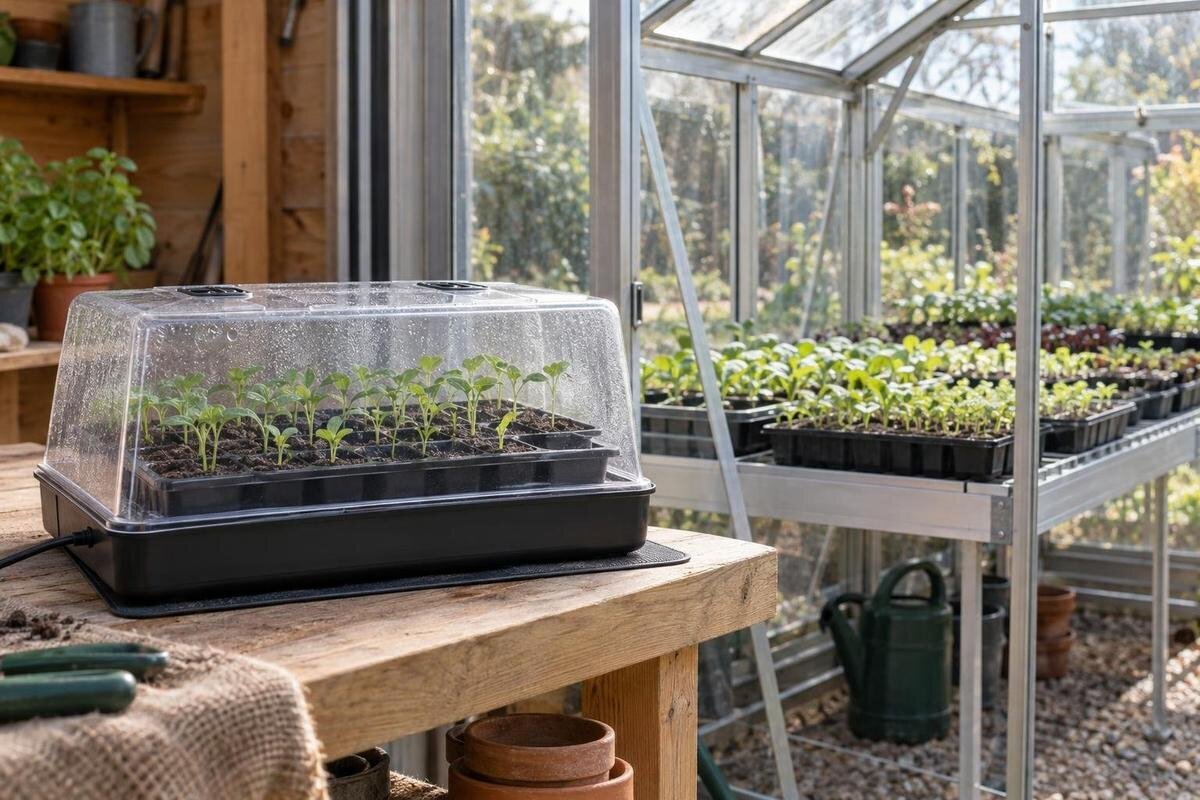
A heated propagator creates a small, defined warm zone for seed trays. Depending on its design, it may warm the tray or growing medium from below and may include a cover or thermostat; those features are not universal, so check the particular unit. Its main advantage is scale: you regulate warmth around a limited sowing area rather than altering conditions throughout a room. That can suit a modest batch or seeds with a higher temperature requirement, while nearby plants and the rest of a greenhouse remain at their ordinary temperature. You also avoid warming unused space solely to bring a handful of trays to the right conditions.
Heating a greenhouse changes a much larger air volume and affects conditions around benches, stored materials and other plants. A heater may warm the air before the compost in every tray reaches its desired temperature; a cold bench or changing conditions can widen that difference. Conversely, a covered propagator can warm the seed zone while greenhouse air remains cool. Compare the temperature your seeds need with readings taken where the trays sit, rather than relying on a thermometer elsewhere in the structure. These systems solve related but different problems, so a warmer greenhouse is not automatically a better seed-raising setup. If the greenhouse is already heated for another purpose, that changes the comparison, but tray readings still matter.
Check each seed’s germination temperature
Read crop-specific germination guidance on the seed packet or from the seed supplier before choosing a heater. Requirements differ by species and sometimes by variety: one sowing may need a warmer growing medium, while another can germinate at a lower temperature. A single greenhouse target can therefore be too high for some trays and too low for others. Note any stated temperature range and whether it refers to compost or surrounding air. If instructions are unclear, look for reliable crop-specific advice rather than copying a setting from another seed type. A germination temperature is not automatically the right setting for the later growing stage.
Group sowings with similar warmth needs and label each tray with the crop and sowing date. That avoids putting every seed on one compromise setting merely because the trays share a bench. If your propagator cannot maintain separate zones, sow different temperature groups at different times or use separate units, provided their instructions allow the arrangement. A greenhouse can hold several batches, but it does not remove the need to check individual trays. Local weather, shade and night-time temperatures affect conditions, so take readings where seeds are germinating. Simple records of tray readings and dates help you see whether the setup is meeting each crop’s guidance.
Count trays that need warmth at the same time
Plan for the peak number of trays that will need warmth at once, not the total number you expect to sow over a year. Put planned sowings on a calendar and note how long each batch is likely to occupy the heated space before moving to its next growing position. Overlapping batches, uneven emergence and a re-sowing can increase the peak. Count tray footprints, not only seed varieties: one crop may use several trays, while a mixed tray may contain several varieties. Include trays you need to keep warm while later sowings are under way. This quick count shows whether a compact propagator will be free when your next sowing is due.
Translate that count into a physical footprint. Measure each tray, leave room to lift and water it, and avoid assuming the whole greenhouse floor can become a bench. The Lean-to Greenhouse area range lists options from 3.69 m² to 14.34 m²; that indicates overall area options, not usable bench width or the number of trays. A floor-area figure cannot show whether particular shelf lengths fit or how much access remains. Treat the listing as one comparison point, then plan shelves, pathways and other uses of the structure before deciding that a greenhouse is needed for the sowing workload. If a greenhouse is already in place, use its actual bench measurements instead.
Choose a propagator by tray capacity and controls
When choosing a propagator, match its heated base and usable tray area to the trays you actually own. Check whether a thermostat is supplied, what range it controls, whether the cover can be vented and how the manufacturer expects a sensor to be positioned. A dial setting is not proof that compost in every corner is at that temperature, so use a suitable thermometer to confirm conditions at seed level. If you are considering a separate heat mat instead of a complete unit, check that it is intended for the tray and environment you plan to use; do not assume every mat can be covered or run in a greenhouse.
A propagator is a practical choice when the heated area is large enough for the current batch and you have somewhere appropriate for seedlings to move afterwards. If you are comparing that route with a dedicated greenhouse, the Limited Edition Aluminium Greenhouses listing is one catalogue range to examine; compare the chosen model’s measurements with your trays and intended bench layout. A greenhouse purchase does not automatically include heating equipment, so consider that separately when comparing the two options. Leave room to handle the propagator lid and reach its controls, rather than counting only the tray footprint. Choose by usable area and stated function, not just a nominal cell count, which can vary with tray format.

What whole-greenhouse heating involves
Heating a greenhouse is a different scale of job because warmth has to be managed across the enclosed air volume, not only at a tray. Heat loss depends on the structure’s size and construction, door use, ventilation, exposure and outside conditions. A greenhouse may warm in sunshine and cool once that solar gain disappears, so a daytime reading alone does not show how it will behave overnight. Height and layout matter as well as floor area. There is no reliable universal heater size based only on square metres; the exact structure and the temperature you intend to maintain are part of the selection. Consider the period when seeds need warmth, not only the warmest point of the day.
Use the selected greenhouse’s stated dimensions and construction details when discussing a heater, and match the device to the conditions it is designed for. The T-Model Orangery Greenhouse is listed in area options from 16.52 m² to 30 m², but those figures do not specify heat output, heat retention or bench area. They are useful for identifying scale, not for calculating a heater. For a fixed installation or a system serving a large area, ask a qualified electrician or heating professional to advise on the equipment and installation. Avoid adapting a domestic heater without confirming its suitability with the manufacturer. Whether you need warmth for germination only or for a longer seedling stage also affects the operating plan.
Measure bench space and access
Before buying a greenhouse for seed raising, sketch the working area as well as the outside footprint. Measure tray dimensions, the shelves or benches you plan to use, clear passage for carrying trays, and the space needed to open doors or work without knocking plants. A bench that looks long enough may still be awkward if its depth blocks access to the back row. Decide whether the propagator itself will sit on a bench, and leave room around active trays for watering and inspection. If tray sizes vary, draw the largest ones first and include the clearance needed to handle their covers. These measurements give a more useful capacity estimate than treating every square metre as growing surface.
Product area figures are only a first filter. The Pyramid Greenhouse size range is listed from 5.53 m² to 18.9 m², but the exact choice still needs to work with your bench plan and routes. Check the selected option’s dimensions against your actual tray and shelf sizes; do not use stated area to guess how many trays fit. If you also grow established plants in the greenhouse, reserve their space before allocating every bench to propagation. Mixed tray sizes can leave gaps that look usable on paper but are difficult to reach once other plants are in place.
Plan for seedling care after germination
When seedlings appear, reassess whether they still need the same warmth. Germination guidance and post-emergence care are not always identical: some crops benefit from a cooler growing stage, while others still need protection from cold. Follow crop-specific instructions and adjust conditions for the batch rather than leaving every propagator on one setting for convenience. If the unit has a cover, open or remove it as the crop guidance recommends and keep observing moisture; the sheltered space can remain humid. Do not let the first emergence prompt you to remove heat from a mixed batch whose remaining seeds are still germinating.
Make sure there is a destination before sowing more trays than the propagator can hold. Seedlings need a bright, suitable area with room to be watered and inspected, whether that is another bench or part of the greenhouse. If you are considering a greenhouse with storage, distinguish the space for supplies from the space available for growing. The Limited Edition Aluminium Greenhouses with Storage listing names a storage-equipped option; consider how the chosen layout divides growing and storage areas before counting bench capacity. If space is tight, stagger sowings rather than letting emerging plants crowd each other.
Light and ventilation still matter
Heat is only one part of successful seed raising. A heater does not supply the light seedlings need; if germinated plants stay warm in a dim position, they can become weak or stretched. Assess daylight at the actual bench, including seasonal shade from nearby structures or plants, rather than assuming the greenhouse receives even light everywhere. Keep labels and stored equipment from casting avoidable shade over trays. If natural light is insufficient, look into suitable supplementary lighting and follow the equipment instructions; increasing warmth cannot make up for low light. Some seeds also have light requirements during germination, which are separate from their needs after emergence.
Ventilation and humidity need attention too. A closed propagator cover retains moisture, while opening greenhouse vents changes air movement and can also change temperature. Use the cover’s venting instructions and crop guidance, and watch the trays rather than leaving a lid closed by habit. When comparing structures, consult the Prestige Greenhouse listing and the details of other models on your shortlist for information about glazing, openings and layout; those features cannot be inferred from a product name or photograph. Warmth without adequate light and air management is not a complete seed-raising setup. Make adjustments in response to the conditions at the trays, not just the greenhouse air.

Compare energy use and electrical requirements
Do not assume that a small propagator always costs less to run or that a greenhouse heater costs a fixed amount more. The result depends on the equipment’s power use, thermostat, actual running time, target conditions, greenhouse construction and weather. Before buying, compare the manufacturer’s stated electrical consumption and operating requirements with the period you expect to use it; your electricity tariff affects the final bill. A thermostat can control operation, but it does not remove heat loss or guarantee the same temperature at every bench. If the greenhouse is already heated for other plants, separate that existing use from the additional seed-raising demand rather than building the decision around an assumed saving.
The Spacious Greenhouse listing shows area options from 47 m² to 70 m². At that scale, do not infer heater capacity or power use from floor area alone; exact dimensions and the heater’s rated conditions are separate information. Choose equipment specifically intended for the environment where it will operate and follow the manufacturer’s instructions. Ask a qualified electrician about fixed electrical work or questions about supplying power safely; do not attempt wiring changes based on general gardening advice. For a portable unit, check its specified operating environment before bringing it into a greenhouse.
Match the setup to your sowing plan
A useful decision rule is to compare three things side by side: the warmth each seed type needs, the maximum number of trays needing it at once, and the space available once seedlings emerge. A compact propagator suits the plan when it meets the first two needs and you already have a suitable follow-on area. Whole-greenhouse heating is worth examining when several benches need a similar environment or the structure has another planned use that requires warmth. If only one group needs extra warmth, a propagator inside an otherwise unheated greenhouse can keep the heated area focused. The balance can change as your sowing batches change.
Some growers use both: the greenhouse provides general working and holding space while a propagator warms only the trays that need it. The right balance depends on site readings and equipment, not on the idea that one method is always more efficient. The Aluminium Greenhouses range is listed with area options from 3.77 m² to 28.08 m²; use the exact size you are considering when mapping the tray bench and post-germination space. If you have no clear need to warm the whole greenhouse, avoid making that larger commitment solely to germinate a few trays.
Frequently asked questions
Is a heated propagator enough to start seeds?
It can be, if the number of trays needing extra warmth fits its usable area and you have a suitable place for seedlings after germination. If batches overlap or the heated area is too small, tray capacity may be the limit rather than the heat itself.
Should I keep a propagator on after germination?
Not automatically. Check the crop’s post-germination guidance: some seedlings need less warmth than the seeds did, while others still need protection from cold. Vent or remove the cover as instructed, and avoid changing conditions for a mixed tray before the remaining seeds have germinated.
Will a greenhouse heater warm the seed compost?
Not necessarily. A greenhouse heater primarily affects the air, and compost can respond differently depending on bench temperature, tray position and changing conditions. Check readings at the seed tray as well as in the greenhouse, and follow the heater and seed instructions.
Which option uses less electricity?
There is no universal winner. A small unit warms less space, but its power use and running time matter; a greenhouse heater serves a larger area, with demand affected by the structure and weather. Compare stated consumption and expected operating hours rather than assuming a fixed saving.
Can I use a propagator inside a greenhouse?
Yes, if the equipment is intended for that environment and used according to its instructions. The greenhouse can provide working and holding space while a propagator warms selected trays. Check tray temperatures separately, since the greenhouse air reading does not confirm the compost temperature.
Choose the heater for the stage you are trying to manage. For a few trays of seeds needing extra warmth, a propagator keeps the heated area focused; greenhouse heating makes more sense when the broader space has a clear use and can be managed reliably. Count peak trays, follow the crop’s guidance and plan where seedlings will go after emergence. That keeps the equipment, growing space and follow-up care in proportion.
