
Should You Heat Seedling Benches or the Greenhouse?
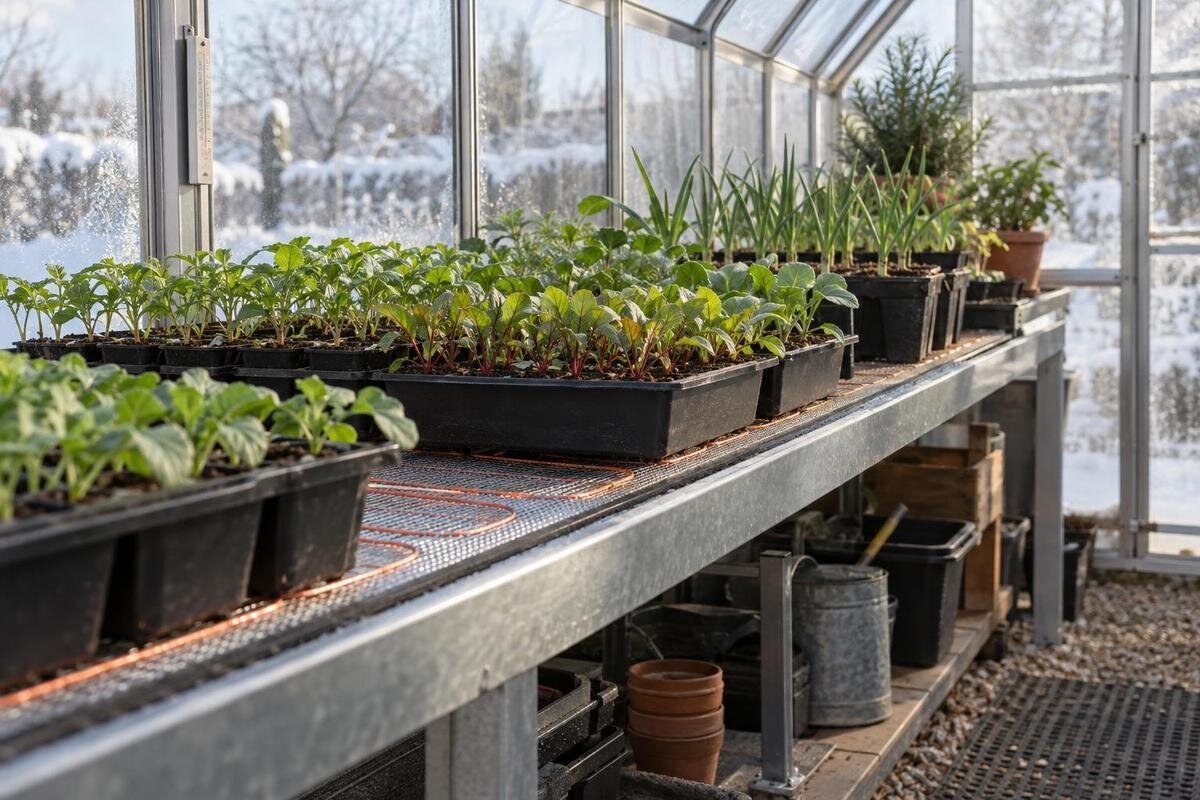
Seedling propagation
Seed trays may need a warmer growing medium even when the rest of the greenhouse does not need additional heat. That makes bench heating a possible targeted option, but it cannot replace suitable air conditions around leaves and other plants. The right choice depends on the crop’s stage of growth, the coldest conditions at your site, the greenhouse itself and how each heater runs. This guide compares root-zone and whole-space heating without assuming a universal temperature, energy saving or electricity cost.

Bench heating and whole-greenhouse heating
Bench heating, also called root-zone heating, warms a defined growing surface and the medium in containers placed on it. Depending on the system, heat reaches trays from beneath or through a bench; the important point is that the treated area is limited. A whole-greenhouse heater instead aims to change the air temperature across the growing space. Pots, leaves, shelves and the surrounding structure exchange heat with that air, and their temperatures may respond at different speeds. Neither approach guarantees an even reading everywhere. A thermostat reports what its sensor detects, not the condition of every tray or plant. A reading near a heater, doorway or sunny pane may differ from one at the crop.
Ask whether the growing medium is too cool for the crop, whether air around the foliage is too cool, or both. Germination depends partly on medium temperature, so local warmth may be relevant when the surrounding air already suits the crop. It cannot protect leaves, pots elsewhere or other greenhouse plants from cold air; a warm surface also does not prove that the medium at the centre of every container is warm enough. Conversely, heating the greenhouse air does not guarantee that the medium throughout each densely packed tray reaches the required temperature quickly or evenly. An average air temperature can hide a colder bench corner. Measure the zones that matter rather than treating one display as a reading for the entire greenhouse.
Heating needs at each propagation stage
For sowing, use crop-specific seed or propagation guidance for the medium temperature; the greenhouse air thermometer alone cannot tell you whether a tray has the right germination conditions. Different species do not share one ideal setting, and a value intended for germination may not suit an emerged seedling. If you sow mixed crops, grouping trays by their requirements can prevent the warmest requirement from dictating conditions for every seed. Record which crop is in each tray and where it sits, so you can connect results to the actual position and heating arrangement. This is especially useful when trays are moved or swapped.
After emergence, light, air temperature, watering, spacing and air movement become part of the picture. Root-zone heat alone does not determine whether young plants develop well; follow the supplier’s guidance for the stage you are growing rather than assuming that the germination setting remains appropriate. Extra warmth can also make the medium dry sooner, so check moisture in the actual trays instead of relying on a fixed routine. When seedlings are potted on, moved to another shelf or taken off the heated bench, their roots no longer receive the same local warmth. Reassess the conditions at that point, particularly if the new position is exposed to cooler air.
Bench size and usable growing space
Before choosing equipment, measure the tray area that actually needs warmth. Count the usable bench surface, not just the number of trays you hope to sow: leave room to handle, label, water and move plants, and consider whether trays occupy one level or several. A heat source designed for one continuous area may not serve spaced groups in the same way. Check the manufacturer’s instructions for supported bench dimensions and tray placement; do not assume that equipment can be cut, covered or altered. Plan access to controls and plants, and allow enough room to work without shifting trays every time you need to water or inspect them.
Floor area and usable bench area are different measurements. The Limited Edition Aluminium Greenhouses listing shows options from 3.77 m² to 28.08 m², which gives a footprint range but no bench dimensions or tray capacity. Work from the exact plan for the model you are considering: mark the bench, aisle, door opening and space needed to water or remove trays. Include the working area needed to sort trays and pot on seedlings, as well as their positions while growing. This gives you a realistic heated area without counting access routes and temporary working surfaces as permanent tray space.
When the whole greenhouse needs heat
Heating the air throughout the greenhouse is more relevant when plants need warmth beyond the growing medium in a few trays. It may be needed for seedlings already occupying several levels, crops that remain in place after germination, or a collection whose foliage and containers need suitable surrounding air temperatures. It also matters where the growing plan depends on keeping the wider area within a chosen temperature range. A heated bench can support that plan, but it does not replace an air-temperature requirement. Write down the crop’s minimum and preferred conditions before comparing equipment, and consider every group of plants that will remain in the greenhouse overnight.
Space heating responds to the enclosure, not just to the bench footprint. The air volume, exposed surfaces, door use and ventilation all affect how much heat is lost, so floor area alone is not a reliable measure of the heating task. For scale, the T-Model Orangery Greenhouse listing gives a range from 16.52 m² to 30 m². That is footprint information, not the height, heat loss or heater capacity of a particular configuration. Compare the exact greenhouse specification with the air conditions required by your crops.

How the greenhouse envelope affects heat demand
The enclosure and the conditions you want to maintain shape any comparison of energy use. Heat escapes through the structure and when air is exchanged; outside temperatures, exposed area, gaps, glazing, roof height, wind exposure and everyday habits can all change the demand. A warmed bench can still lose heat to surrounding air, particularly when the greenhouse is cold. Whole-space heating, meanwhile, has to offset losses across the enclosure. This is why a claim that bench heat will always use a particular share of the energy cannot be relied on without measurements and stated assumptions.
Do not infer thermal performance from a greenhouse’s name or product category. The Pyramid Greenhouse range is listed from 5.53 m² to 18.9 m²; that footprint information does not establish insulation, glazing performance, airtightness or heating demand. For a useful comparison, check the documented details for the exact configuration, note the site exposure and measure actual night conditions. Any estimate should state the outside conditions and target it assumes. A recommendation based on a milder night or a different enclosure may not apply at your site.
Ventilation in a heated propagation space
Ventilation still has a role when a greenhouse is heated. Watering and moist growing media add moisture to the air, and without suitable air exchange condensation or stagnant conditions can become a concern. Opening vents in cold weather can also lower the air temperature, so account for the crop’s air needs as well as the effect of ventilation. A root-zone heater does not control humidity throughout the greenhouse or refresh air around foliage. Keep the crop’s normal ventilation requirements in view when considering how often a space heater may need to run.
Check the details for the exact greenhouse configuration instead of assuming that its footprint tells you how it ventilates. The Limited Edition Aluminium Greenhouses with Storage listing spans 5.52 m² to 28.08 m²; that stated area range does not specify vent openings or insulation options. Ask for those details for the variant you are considering, and make sure the planned bench position will not obstruct doors or vents. A heating comparison based on a closed-house assumption will be unreliable if your normal routine involves frequent ventilation or access.
Combining bench heat and air heating
A combined arrangement can suit a greenhouse where propagation trays need a warmer medium but the surrounding space also has an air-temperature requirement. Treat the two sources as separate jobs: one serves the local growing area, while the other supports conditions around foliage and nearby plants. Do not assume they will coordinate simply because both are switched on. Check what each control measures, where its sensor is intended to operate and whether the manufacturer’s instructions permit the proposed use. If the equipment or connections are not straightforward, ask a qualified professional to review them rather than improvising.
Zoning also depends on where plants are, not only on total greenhouse size. One heated bench in a corner may be practical in a larger house, while several separated groups can make a single warm patch less useful. The Prestige Greenhouse listing covers options from 3.77 m² to 28.08 m², so compare the exact floor plan with the bench and crop zones you intend to use. Plan access and movement between those zones, and avoid warming unused surfaces simply because they share the same room.
Comparing running costs
Compare costs using the equipment and operating pattern you expect to use, rather than a general rule about bench or space heating. Note each unit’s documented input and how long it actually runs; a rated input by itself does not reveal seasonal consumption. A meter reading or utility data can help, especially if a thermostat cycles the heater. For a fair comparison, record the crop task, target conditions, ventilation habits and outdoor conditions over the same kind of period. Comparing a bench on mild days with a space heater during colder nights would not tell you which approach costs less for the same job.
Apply the tariff on your current electricity account, including relevant time-of-use periods if they apply; plans and rates vary, so an old bill or national average may not fit. The Spacious Greenhouse listing gives a footprint range from 47 m² to 70 m², but floor area alone cannot provide a power bill. You also need the heater’s documented input, actual runtime, enclosure conditions and applicable tariff. If you cannot measure use, describe an estimate as a scenario with clear assumptions, not as a guaranteed saving.

Measuring root-zone and air temperatures
Keep separate records for the growing medium and surrounding air. A suitable thermometer or probe in a representative seed tray shows what the root zone experiences; a second reading near the foliage helps reveal whether the air also meets the crop’s needs. A heater display reports its own sensor, not necessarily the conditions at every tray. Avoid taking a single reading beside the heat source or in direct sun. If the bench appears uneven, compare more than one position and note where each reading was taken so you can identify patterns rather than relying on an unexplained number.
Record minimum and maximum readings through both night and day, especially after changing a setting or moving trays. A warm afternoon can conceal a colder night, and a suitable medium reading does not prove that the air is also suitable. The Aluminium Greenhouses catalogue covers footprints from 3.77 m² to 28.08 m², but a listed area does not tell you whether temperatures are uniform in a particular house. Use readings from your own bench and plant positions to decide whether the local heat is sufficient or the wider air also needs attention.
Which zone needs to stay warm?
Make the choice by identifying the crop and stage first. Note the recommended medium and air conditions from a reliable seed or plant supplier, then measure what the greenhouse reaches overnight. If the medium is below its requirement while the surrounding air remains suitable, bench-focused heating may meet that propagation need. If foliage, other plants or several working zones also need controlled air conditions, compare whole-space heating or a planned combination. Include what happens when seedlings leave the bench: their growing conditions change, and the next stage may need a different arrangement.
Before buying, check the heater’s documented input, controls, sensor details and intended environment, then compare these with the actual greenhouse features rather than a product name. The Lean-to Greenhouse listing spans 3.69 m² to 14.34 m²; those footprints identify sizes to investigate, but you still need to assess the effect of an adjacent wall, site exposure and ventilation requirements. Ask a qualified professional about electrical or installation questions. If possible, keep records during a small propagation run so you can judge whether bench heat alone meets the crop’s needs before heating a larger air volume.
Frequently asked questions
Can seedlings germinate on a heated bench if the greenhouse is unheated?
They may, if the growing medium reaches the conditions recommended for the crop and the surrounding air remains suitable. Bench heat does not warm every tray evenly or protect seedlings from cold air around their leaves. Check the medium and air separately, and do not assume that a warm bench makes the whole greenhouse suitable for growing.
Is bench heating always cheaper than heating the greenhouse?
No. A bench can limit the area being heated, but the cost depends on the equipment’s input, how long it runs, greenhouse heat loss, ventilation, the conditions you need and your electricity tariff. A fair comparison uses measured consumption over similar periods and for the same growing task. There is no universal saving to apply.
Will a heated bench protect seedlings from cold air?
Not by itself. Bench heat warms a local growing area; it does not ensure that leaves, nearby pots or the greenhouse air stay within the crop’s requirements. Monitor the minimum air temperature around the plants as well as the medium. If the air is too cold, you will need another suitable plan, such as air heating or moving the seedlings.
Can I use bench heating and greenhouse heating together?
Yes, when the crop needs warmth in both zones. Treat them as separate jobs: bench heating serves the growing medium, while space heating supports the air conditions around foliage and other plants. Check each unit’s intended use, controls and instructions, and confirm that the two systems will not work against each other. Ask a qualified professional about electrical or installation questions.
What temperature should I set a seedling bench to?
There is no single setting that suits every seed or seedling stage. Use the crop-specific guidance from the seed or plant supplier, then check the temperature in the medium rather than relying only on a heater display or bench-surface reading. Also monitor air around the seedlings, since the correct medium temperature does not guarantee suitable air conditions.
Treat the bench and the greenhouse as two different temperature zones, then choose based on where the crop needs additional warmth. If a warm medium is the only unmet requirement and the air remains suitable, bench heating is a targeted response. If leaves, nearby pots or several crop groups also need warmer air, plan for air heating or a carefully planned combination of both systems. Measured temperatures, documented heater inputs and your current tariff make the comparison practical.
