
What Causes Plant Scorch on One Side of a Greenhouse?
Greenhouse troubleshooting
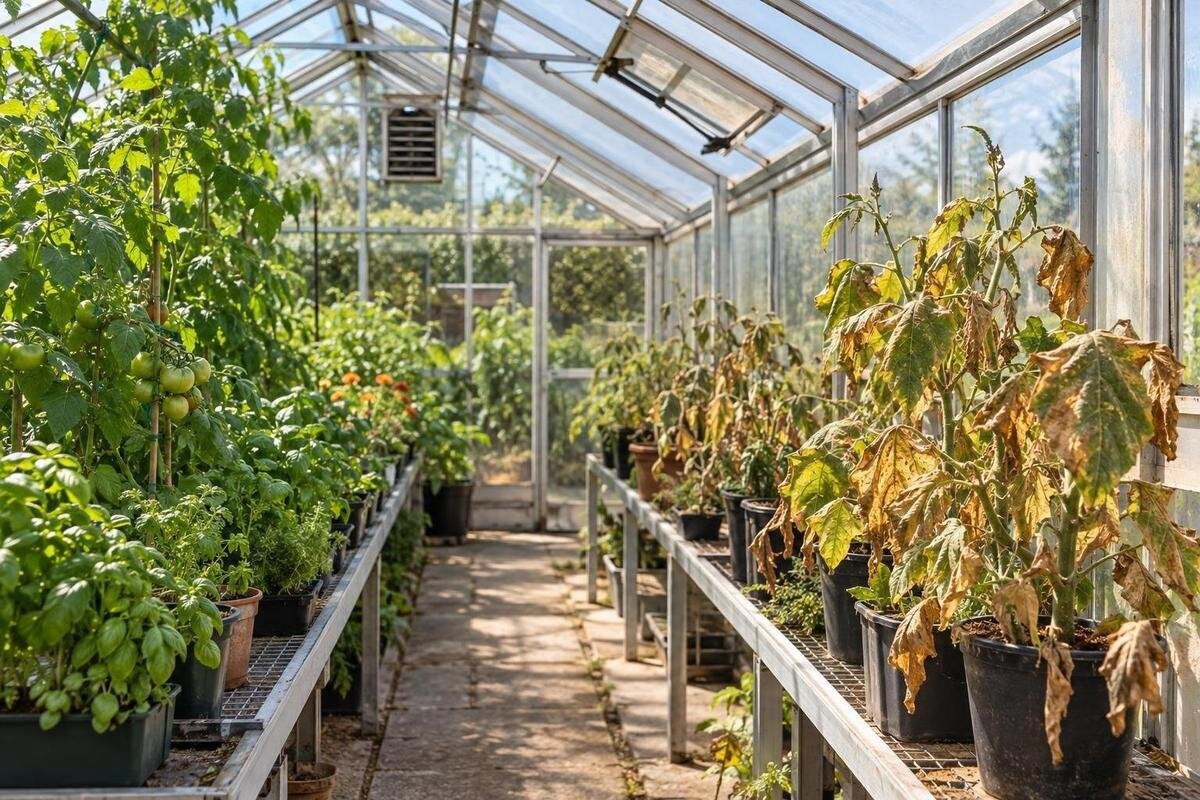
Scorch confined to one greenhouse wall, bench or row is a useful clue: those plants may be exposed to different sunlight, reflected light or air movement, or receive different amounts of water from plants elsewhere. It does not prove that the whole greenhouse is too hot. Map the injury and its timing, then compare local conditions before changing shade, ventilation or watering.

Start with the pattern of damage
Scorch is a description of damaged tissue, not a diagnosis. Leaves may look pale or bleached before patches turn brown and crisp, but that sequence is not unique to excess sun. When injury is limited to plants beside one wall, one bench edge or one row, the pattern suggests a local difference: direct or reflected light, air movement, or water reaching the roots. It can point to a hot spot even if a thermometer in the greenhouse centre shows an ordinary reading. One damaged leaf tells you less than a repeated pattern across several plants.
Record which side of each plant is affected, its height and age, and whether uninjured plants of the same kind sit nearby. Damage on leaves facing the same pane supports an exposure clue; whole-plant wilting, injury on shaded leaves too, or a problem crossing unrelated rows calls for wider checks. Species, leaf age and recent acclimatisation all affect sensitivity, so compare like with like. Take dated photographs from a fixed position and mark the affected bench area on a simple plan before moving plants or changing equipment.
Track sunlight at the affected bench
Observe the greenhouse around the time damage first appears, not only at midday. For several days, note when direct rays reach the affected wall, floor and leaves, when shadows cross the bench, and when the bright patch disappears. Distinguish the time you first notice a damaged leaf from the period when it was exposed: finding a brown patch in the morning does not establish when the injury occurred. Repeat observations in different weather where possible; a clear afternoon and an overcast one are not comparable tests. The sun's angle changes through the year, so a seasonal shift can expose foliage that used to sit in shade. Photographs from the same position at regular intervals help reveal a moving band of light that memory may miss.
Note the plant's orientation and how long its leaves receive direct light; an exterior view alone cannot show what reaches foliage inside. Roof framing, trees, screens and shelving can create narrow bands of light or shade. If taking readings, place comparable thermometers at canopy height on the affected and unaffected sides, shielded from direct sun, and read them at the same time. When comparing a new structure such as the Aluminium Classic Greenhouse, mark its proposed position and bench layout on your site plan. Use your sunlight observations to identify which growing areas need closer assessment. Check the chosen model's openings and shade compatibility separately, and distinguish what you have observed at the existing greenhouse from what still needs assessing for the proposed one.
Check for reflected light and nearby surfaces
A hot-side pattern may relate to light reflected from nearby surfaces as well as direct sunlight through the glazing. At the time the damage occurs, inspect the outside for pale walls, glossy windows, polished metal, light-coloured paving or reflective screens facing the greenhouse. Look for a bright patch that shifts onto a particular pane, bench or group of leaves. Do not assume that glass is acting like a magnifying lens: a reflection or an unshaded beam may increase local exposure, but you need to observe its path at your site rather than infer it from a material alone.
Check the inside as the sun moves, and compare the leaf faces turned towards the suspected source with leaves sheltered by other foliage. Record the suspected reflecting surface, the pane it faces and the plants reached by the bright patch, rather than simply labelling the whole wall as too hot. For a structure against a wall, such as a Lean-to Greenhouse, assess that wall and the wall-side growing area separately. Include nearby windows and paving in your observations, without assuming they are responsible merely because they look bright. A temporary change to the position of one affected plant can help test the theory, but keep other conditions stable. If its new position changes both the light and the airflow, note that you are testing more than one possible cause.
Look for a local airflow problem
The air in the greenhouse centre may not move in the same way as air around an outer bench. Check whether vents open as intended and whether stored items, shelving or dense foliage obstruct a route through the growing area. Observe the direction of air movement on both sides at plant height. A light ribbon held clear of moving parts can show direction, but it does not measure air speed or prove that ventilation is adequate. Warm, stagnant air and a dry air current can both stress leaves, so note whether damage coincides with an obstructed area or a particular airflow path.
Compare air temperature and relative humidity at matching positions and times, using sensors shielded from direct sunlight. A single centre reading or a probe in a sunbeam can mislead; record repeated readings during the periods when the affected bench receives strong light. Note which vents and doors are open with each reading, so you do not compare a closed greenhouse on one day with a fully open one on another. Look for plants or structures that block an otherwise open route, and check equipment operation against its manual. If considering a replacement, request the exact ventilation configuration for the Bloomcabin Prestige Greenhouse. Compare the opening positions with your proposed benches and access routes, rather than considering the openings in isolation. Do not dismantle or alter electrical equipment to investigate a suspected fault.

Compare plant position and canopy exposure
Within the same greenhouse, plants can receive different amounts of light because of their position. Compare those nearest the glazing with plants farther in, as well as upper and lower leaves, outer bench edges and the middle of a row. Tall or crowded plants may shade one group while limiting air movement around another. Check whether the damage is on the leaf face towards the light or whether it follows a particular plant position regardless of leaf direction. Recently moved plants may also be less acclimatised to their new exposure than established neighbours.
For a useful trial, move one representative plant to a less exposed position that still gives it appropriate light, label both its old and new positions, and record any changes. Existing brown tissue will not turn green again; look instead for the spread of damage and the condition of new growth. Photograph the plant before moving it so you can distinguish old marks from fresh injury. Keep its watering and feeding records with the trial notes rather than judging the result from position alone. When planning benches around a structure with built-in storage, such as the Limited Edition Greenhouse with Built-in Storage, check the actual layout before placing vulnerable crops. Mark the intended growing positions and access to stored items on the same plan, so the working layout is considered alongside plant exposure. Keep a note of where movable plants stood when symptoms first appeared.
Check root moisture and feeding
Uneven watering can affect a single row or side, especially when plants share an irrigation zone. Compare the potting mix or soil at the same depth and time of day; a damp surface does not always mean that the root area is evenly moist. Check whether emitters or hoses appear to be delivering as expected, and look for a kink, blockage or change in flow near the affected plants. A dry root ball can contribute to leaf damage, but adding extra water without checking may create a different problem if the roots are already saturated.
Consider recent feeding as well. Excess fertiliser salts can damage roots or leaf edges, and a change in feed may affect only the plants that received it. Note whether the affected plants share a container type, watering schedule or recent treatment; compare records rather than relying on memory. Separate a treatment given to the whole crop from one applied only to a particular tray or row. This helps establish whether the apparent wall-side pattern also follows a watering or feeding group. For a new growing space, map the benches and irrigation zones against the actual layout, whether you are reviewing a Bloomcabin Oasis Pyramid Greenhouse or another model. Identify which containers will be checked together and how you will reach them for inspection. If moisture and feeding appear consistent across both sides, return to the light and airflow evidence rather than adding more water or fertiliser.
Check for spray damage, pests and disease
Think about what has recently been sprayed, applied or changed. Droplets can leave marks in a pattern that differs from a patch of direct exposure, while fertiliser or other products may injure leaves if used incorrectly. Check the timing of any application against when the damage first appeared, and follow the product label for use and precautions. A problem confined to one side might reflect where a spray reached, but the appearance of a leaf alone cannot confirm that explanation. Keep the container or application details available if you need advice.
Inspect both sides of affected leaves and nearby stems for pests, webbing, deposits or signs of spreading lesions. Damage that continues into shaded positions, appears on new growth, or progresses independently of sunny periods is a reason to look beyond scorch. Some pests and diseases can be local at first, so a single unaffected row does not rule them out. Photograph the marks and note whether they are spreading. If you cannot distinguish exposure injury from a pest, disease or chemical problem, ask a local horticultural specialist to assess the plants rather than applying additional treatments at random.
Test shade before making it permanent
If the timing and location point to direct sun, try a temporary, local shade test during the hours when the affected leaves receive the strongest exposure. Keep the trial clear of vents, moving parts and other equipment, and compare the result with a similar plant or area that remains unchanged. A small, controlled trial is more informative than shading the whole greenhouse at once. Record where the shade falls and for how long; if the symptom is caused by an airflow or watering issue instead, shade may not address it.
Before making shade permanent, consider the light needs of the crop and the effect on unaffected plants. Shade arrangements can differ in how they affect light and ventilation, so follow the greenhouse and shade-product guidance for the exact setup; there is no universal shade percentage that diagnoses every hot spot. Keep a record of the area and hours covered during a successful trial. That gives you a specific requirement to discuss when comparing shade options, rather than asking only for more shade. If comparing a Bloomcabin Orangerie, verify current shade options and compatibility, including whether the arrangement can cover the identified growing area without obstructing ventilation. Check how it would be adjusted as the seasonal light pattern changes. Choose a permanent arrangement only after identifying the local cause and assessing the trial's effect on neighbouring plants.

Change one factor at a time
Before changing anything, keep a short baseline record: photographs, the affected positions, the time of direct sun, local temperature and humidity readings, root moisture, and the state of vents or fans. Then make one reversible change, such as testing shade over the affected patch or clearing an obstruction to an existing air path. If you change shade, ventilation and watering together, you will not know which change helped. Do not use one scorched row as a reason to make broad adjustments across the entire greenhouse.
Compare the result under similar conditions, ideally at the same time of day and after comparable weather. Brown or bleached leaves may remain damaged even if the cause has been corrected, so judge the trial by whether new injury appears, whether the patch spreads and how new growth looks. Record an inconclusive result as inconclusive: a cooler, cloudy day does not provide a fair comparison with the sunny conditions that produced the original damage. If the pattern improves, keep the change that made a difference and continue checking for unwanted effects elsewhere. If evidence points to a design limitation and replacement is being considered, request the exact ventilation and shading details for the Limited Edition Aluminium Greenhouse. Use your trial notes to explain the unresolved problem and compare the proposed configuration with your site map.
When to call a specialist
Seek a plant specialist's advice if damage keeps spreading despite a careful trial, affects new growth, or is difficult to distinguish from disease or chemical injury. For a suspected vent, fan or opener fault, consult the equipment manual, manufacturer or a qualified greenhouse installer. Keep photographs, dates, the affected positions, weather notes and any temperature or humidity readings together. Include watering and feeding changes too; this makes it easier for someone else to assess the pattern without relying on a description such as “the plants look burnt”.
For prevention, keep a simple seasonal map of sun and shade, and update it when plants, screens or greenhouse equipment move. Recheck the affected bench during the conditions that originally produced symptoms rather than assuming the same light pattern lasts all year. Retain the notes from successful trials as well as unsuccessful ones, so the reason for a particular plant position or shade arrangement is not lost when you reorganise the space. If comparing a new structure, such as the T-Model Orangery Greenhouse, ask an installer to assess its exact vent arrangement and shading options against the site. Show the proposed bench positions and the area where damage occurred. The useful comparison is whether the proposed layout addresses that identified problem, not simply whether the structure is different.
Frequently asked questions
Why are only the plants beside one greenhouse wall scorching?
Plants beside one wall may share direct or reflected sunlight, a different airflow path or the same irrigation zone. The pattern is a clue, not a diagnosis: compare the affected plants with similar plants elsewhere and note when the damage develops.
Can a normal temperature reading rule out a local hot spot?
No. A reading in the centre may not reflect conditions at an exposed bench, and leaf temperature can differ from the surrounding air. Compare readings at canopy height on the affected and unaffected sides, with sensors shielded from direct sunlight.
Should I shade the whole greenhouse if one side is scorched?
Not before checking where the direct exposure falls. A temporary, local shade trial can help test the cause. Shading the whole structure may reduce useful light for plants that are not affected.
Could uneven watering cause scorch on one side?
Yes. Plants in one row or irrigation zone may receive less water, while dry or waterlogged roots can both contribute to leaf damage. Compare potting mix moisture at the same depth and time before changing your watering routine.
How can I tell sun scorch from disease?
No single mark confirms the cause. Damage that follows an exposed leaf face and appears after a particular period of sun supports an exposure link. Spreading lesions, visible pests or damage that continues in shaded positions warrant further investigation.
Treat scorch on one side as a local problem to investigate before changing the climate across the whole greenhouse. Pinpoint when the affected patch receives sun, check what reflects light or interrupts airflow, and compare root moisture in affected and unaffected zones. Then make one reversible change and watch for fresh damage and healthy new growth. If the damage persists or spreads, seek a plant or greenhouse specialist's advice rather than repeatedly increasing shade or watering.
