
What Greenhouse Automation Is Practical Without Mains Electricity?
Greenhouse planning
Automation without mains electricity is possible, but most practical setups handle a limited task rather than run a greenhouse from end to end. A thermal vent opener can move a compatible vent mechanically; a battery can run a controller or sensor; stored water can feed an irrigation line if pressure and components match. Each arrangement has limits, and none removes the need to check airflow, water delivery and equipment condition. The useful question is not whether a greenhouse can be fully autonomous, but which task needs attention and what happens if its power, water or control fails.

01
What ‘off-grid’ automation actually means
Off-grid can mean no grid connection at all, or simply that one control must keep working when mains electricity is unavailable. Separate those cases before choosing equipment. A thermal vent opener moves a compatible vent mechanically; a battery thermostat and actuator draw stored power; a solar-powered controller is still an electrical system, with reliability tied to charging, storage and load. A hand-operated vent or watering can needs no power, but does not automate the job. These are different levels of support, not interchangeable versions of a fully self-running greenhouse. If mains power is present but unreliable, backup for an outage is a different design brief from a permanently off-grid site.
Write down the task, its trigger, the action you expect and the fallback: open a vent at a particular condition, run a valve on a schedule, or alert you to a fault. Then identify what might break the chain: a jammed opening, depleted battery, empty tank, blocked line, failed pump, disconnected sensor or lost signal. Decide how you would notice and respond. This task map helps distinguish a need for a mechanical device from a need for water storage, a clearer route to a vent or a regular manual check. It also gives suppliers a precise question to answer.
Passive ventilation does not need an electrical supply
Natural ventilation depends on warm air escaping and replacement air entering through open vents; wind and the position and size of the openings influence the flow. A thermal actuator, often a wax-cylinder type, can move a compatible vent as its mechanism warms and cools, without mains electricity or a battery. Check the maker’s stated opening temperature, movement, force and compatible vent type for the specific unit. These are device limits, not generic guarantees. A passive opener does not monitor every part of the growing space, and it cannot create airflow if openings are obstructed or shut. Without a fan, air movement remains dependent on the openings and conditions outside.
Before choosing an opener, count and locate the vents in the exact greenhouse configuration and check which can accept it. A product family’s floor-area range is not a ventilation schedule: the T-Model Orangery Greenhouse is listed from 16.52 m² to 30 m², but that alone says nothing about vent number, opening area or actuator fit. Compare the chosen plan and accessory details with the opener supplier. Consider how air can enter and leave, and whether shelves, stored items or dense planting could obstruct that route. Ask how you will reach each vent manually if the mechanism needs adjustment or fails.
02
A thermal opener is not complete climate control
Mechanical openers respond to conditions at the actuator, not necessarily to the hottest or most humid point among the plants. Movement can also be affected by vent weight, friction, dirt, damage, wind or a partly obstructed sash; only the device maker’s specifications can establish what a particular unit can move. Sunny weather, cool nights and rapid changes are different operating situations, so one passive opener cannot guarantee a stable temperature. It manages an opening; it does not measure humidity or guarantee that conditions stay at a chosen level. Read its operating and maintenance instructions, and reassess if you change the vent or add equipment.
Plan how you will open and close each vent manually if an opener sticks or needs attention, and test movement according to the maker’s instructions. Access matters before benches, shelves or tall crops make a handle difficult to reach. The Pyramid Greenhouse listing spans 5.53 m² to 18.9 m²; use the selected configuration to confirm its actual opening hardware rather than assuming the model name or area establishes compatibility. A simple thermometer near the growing area can help you compare what the control does with conditions among the plants. It is an observation aid, not a substitute for adequate ventilation or an automatic safety system.
Battery controls work best with one clear job
Battery equipment makes sense where an electrical action is needed but there is no mains supply: a thermostat can signal an actuator, a timer can switch a valve, and a sensor may send a local alert. Every item in that chain needs a compatible supply and signal; a battery controller cannot run an incompatible motor or pump just because both are described as low-voltage. Check the output type and limits against each device’s instructions, and confirm whether a local manual control remains available. If remote alerts matter, check which sensor, gateway, network and phone connections the system needs. An app alone cannot carry out the physical job.
Small equipment needs a suitable location as well as a battery. The Limited Edition greenhouse range with storage is listed from 5.52 m² to 28.08 m², but the product name and floor area do not establish the storage space’s dimensions or its suitability for batteries and electronics. Ask about the exact configuration and product instructions, and place sensitive components only where their maker permits, away from splashes and conditions outside stated limits. Keep controls clear of routine plant work and possible leaks. Wireless does not mean maintenance-free: remote sensors may need replacement batteries and a reliable connection to their receiver. For fixed wiring or a pump, have a suitably qualified installer assess the requirements.

03
Check battery demand and failure behaviour
Ask for each device’s supply voltage, standby demand, active demand, startup current, operating limits and battery type. Ask how long the full setup is expected to operate under its intended pattern of use, rather than relying on a generic battery-life claim. A motor that moves repeatedly, a sensor transmitting often and a controller left awake may use energy differently. Put the specifications for all components together and have the supplier or a qualified installer check the combination where needed. Greenhouse floor area by itself does not determine battery capacity; the load comes from the equipment and how it is used. Also ask how low charge is indicated and what happens when power runs out.
The Bloomcabin Prestige Greenhouse is listed in options from 3.77 m² to 28.08 m², so identify the exact configuration before asking which vents or devices a controller can operate. The listed range does not establish which controls are included or how many openings a chosen model has. Request instructions and compatibility details for every actuator, switch, sensor and battery, and ask what happens if a sensor disconnects, supply voltage falls or a switch fails. Check whether the equipment has a manual override and whether its behaviour during a fault is documented. Decide who will notice a fault; do not assume every device responds to a depleted battery in the same way.
Plan water independently of electricity
An automated valve cannot supply water. Identify a dependable source, its availability, how often it must be replenished and how much can be stored; allow for interruptions, leaks and missed refills. A piped supply can have availability or pressure constraints, while stored rainwater varies with catchment and season. Do not count a greenhouse roof as a catchment surface unless the structure and collection arrangement are expressly designed for that use. Tank level, water quality, filtration and location all affect whether irrigation equipment will work. If the supply or pressure is uncertain, ask an irrigation supplier to check the proposed components. Recording actual use can help you plan refills without relying on a guess.
Gravity feed avoids a pump only when the available elevation and delivery pressure suit the filter, valve, tubing and emitters. Some drip components have a minimum pressure requirement; others may not suit a very low-pressure setup. Check the actual specifications and test the whole route, including the last outlet. The Lean-to Greenhouse listing gives an area range of 3.69 m² to 14.34 m²; use the selected growing footprint to map beds and water routes, not as evidence of a water connection, roof catchment or irrigation kit. If water must be moved by a pump, include its power source, maintenance and failure response in the plan.
04
A timer cannot verify irrigation delivery
A timer repeats a schedule; it does not know whether the reservoir is empty, an emitter is blocked, a line is leaking or every plant has received water. A moisture sensor reads at one position and depth, so it may not represent differences between containers, beds, growing media and crop stages. Match controls to the way plants are grouped, the irrigation method and the sensor’s instructions. Avoid treating one probe or a calendar setting as proof that all areas are watered evenly. An alert for a low tank or loss of flow may help, but only if the sensor, controller and power source are compatible and the alert reaches someone.
In larger or mixed-use spaces, separate irrigation into zones only when different areas genuinely need different delivery; extra zones also mean more valves, connections and checks. The Spacious Greenhouse is listed from 47 m² to 70 m², but floor area alone cannot tell you how many zones, emitters or litres your crops need. Draw the beds, containers and hose paths, then confirm pressure, filtration and controller capacity with the irrigation supplier. After setup, observe each outlet and the growing medium, check for leaks, and record adjustments. Keep a manual shut-off and a way to water by hand accessible so you can respond if a timer or supply fails.
Solar charging and connectivity add dependencies
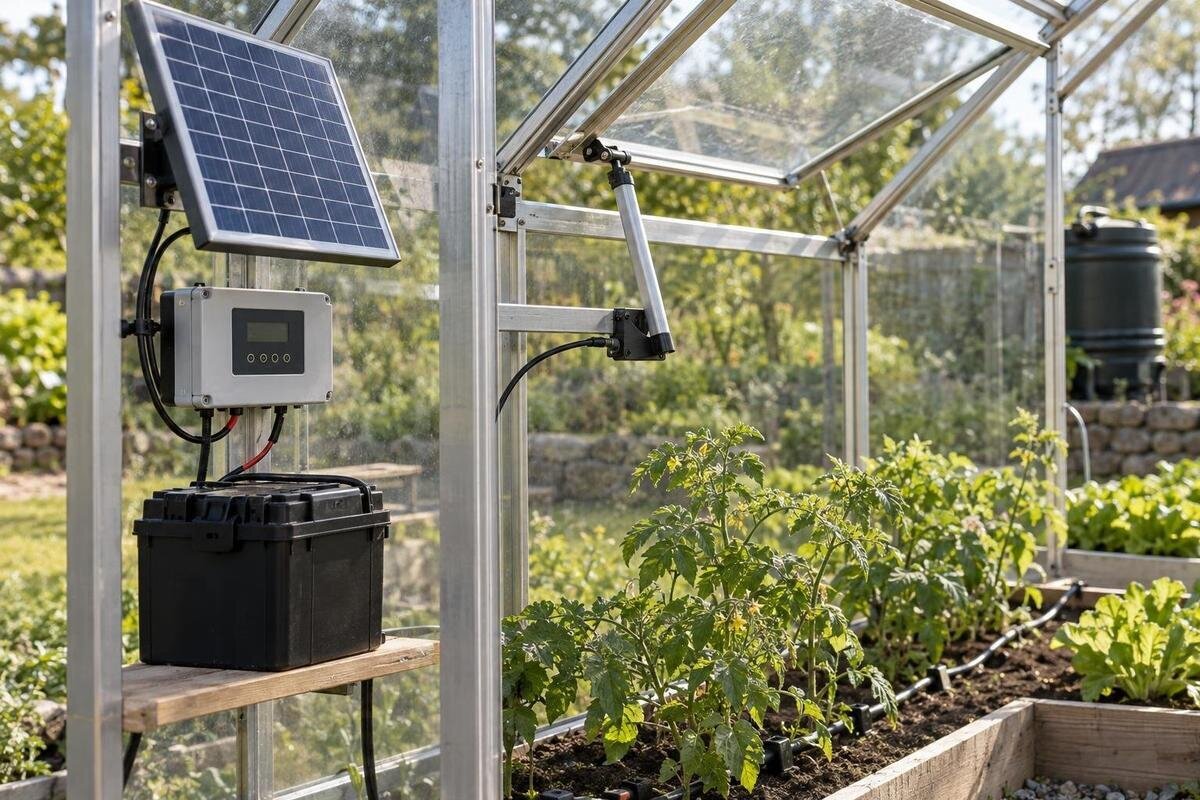
Where there is no mains supply, a solar-charged battery may run selected controls, but the panel, charging equipment, battery and connected devices need to be planned together. Shading, panel orientation, seasonal sunlight, dust on the panel, battery storage and device consumption all affect reliability. Ask the supplier to specify a compatible panel, charge controller, battery and load, and confirm that the proposed equipment location is suitable. Do not assume a greenhouse structure is designed to carry a panel. A suitably qualified specialist should review the system and its installation. Keep a manual fallback for periods when a component fails or the battery is not charged.
Connectivity is another dependency. An app can display a reading or send an alert only if its sensor, gateway, network and phone connection are available; it cannot water plants or open a vent unless a working control path can do so. Check whether the controller keeps operating locally when internet access is lost, what happens to saved schedules, and whether alarms identify a low battery or disconnected sensor. The Aluminium Greenhouses range is listed from 3.77 m² to 28.08 m²; sensor numbers and positions should be based on the chosen floor plan and equipment instructions, not that broad range. At a site with unreliable connectivity, choose basic operation that does not depend on an app.

05
Keep manual checks in your growing routine
Choose the first automation by recording work rather than guessing. Note which task repeats, when you intervene and what follows if it is missed; distinguish a ventilation problem from dry growing media or an unreliable water supply. A passive opener can reduce manual vent movement, while a timer can repeat a watering schedule, but neither confirms that the entire greenhouse is in a suitable condition. Keep a short record of readings, manual adjustments, water refills, battery changes and faults. Your notes show whether the control saves effort or simply adds another device to maintain, and help you review its settings for your site and growing conditions.
The Limited Edition Aluminium Greenhouses listing covers 3.77 m² to 28.08 m². Record the exact model and floor plan alongside your chosen sensor locations, irrigation zones and actuators so that your notes describe the equipment actually in use. During testing, note the trigger, the expected response and what the equipment did: did the vent move, the valve switch or the alert arrive? Compare this with the operating instructions and stated limits, rather than simply recording that a device switched on. Keep those instructions and replacement-battery details easy for whoever does the checks to find. Clear records also make it easier to explain a fault to the supplier.
What to confirm before buying
Ask for the exact greenhouse configuration and openings; compatibility of passive actuators; manual access; battery controller voltage and load limits; standby and active demand; battery replacement or charging requirements; solar compatibility if proposed; water source and pressure; filtration; irrigation valve and sensor support; and fault indication or override. Request relevant instructions before equipment is installed. Do not infer control features from a model name, product image or floor-area range. For pumps, fixed wiring or a combined battery-and-solar system, have a suitably qualified installer assess the electrical requirements and installation. An irrigation supplier can confirm that pressure and components suit the proposed water route.
Then define what remains manual: vent inspection, reservoir refilling, checking that water reaches the plants, battery maintenance and responding to alarms. Decide how often each check is realistic at your site and who can do it. Use this division of work to judge whether the proposed equipment will actually reduce your workload. A tested mechanical opener, clearly specified battery control and dependable water supply each address a particular task; additional connected devices should have an equally clear purpose. For every essential task, know how you will notice a failure and what you can still do when power, signal or water is unavailable.
Frequently asked questions
Can a greenhouse vent open without electricity?
Yes. A compatible thermal actuator, such as a wax-cylinder opener, can move a vent mechanically as it warms. Check its stated operating range and fit against the actual vent. It still needs inspection, and it cannot guarantee suitable conditions throughout the greenhouse, so keep manual access available.
Can a battery controller operate a greenhouse indefinitely?
No. Runtime depends on the connected equipment, how often it operates, standby demand and battery or charging conditions. Check the full system’s specifications, find out how low charge is indicated and plan for replacement or recharging. Remote monitoring may also depend on a network connection.
Can I water a greenhouse without mains electricity?
Often, yes: you can water by hand or use a compatible gravity-fed system. Check that the available pressure suits the filter, valve and emitters. A pump needs its own power source, and a timer cannot confirm that water reached every bed. Plan for refilling and manual watering if the system fails.
Will solar panels make the setup self-sufficient?
Not by themselves. Solar can supply selected controls when the panel, charge controller, battery and connected load are designed to work together. Shade, seasonal sunlight, dust, storage and faults can affect power. Solar does not remove the need to check the water supply, equipment and plants.
Which greenhouse task should I automate first?
Choose a repeated task that takes time or creates a problem when missed. Record what you do now, what should trigger the control and how you will take over if it fails. A passive vent opener or a battery-powered irrigation control may help with different tasks; the right choice depends on your site and equipment.
Without mains electricity, practical automation usually combines passive vent movement, battery power for defined controls and irrigation tested under actual conditions. Choose each device for a specific task, understand its limits and keep manual alternatives accessible. Regular observations of the plants, water delivery and equipment will show whether the setup is providing useful support and where it still needs your attention.
