
Scratches in Greenhouse Powder Coating: Repair Options
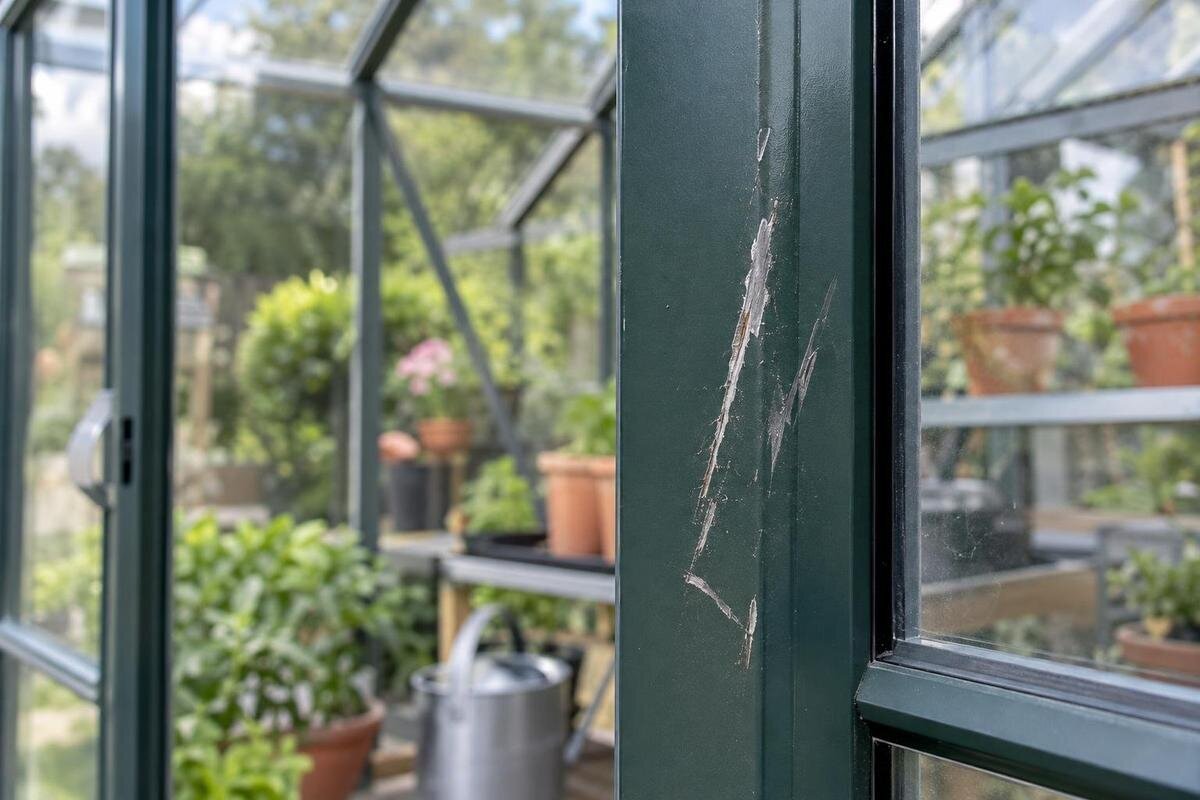
Greenhouse repair
A scratch on a powder-coated greenhouse frame may be a surface rub, transferred dirt or a break in the finish. The right response depends on what remains after approved cleaning, where the mark sits and what the manufacturer permits. A little documentation before buying paint can prevent a poor colour match or an unsuitable repair.

A scuff, a stain or a break in the coating?
Powder coating is the coloured surface finish on a frame, but not every mark is a cut through that finish. A grey or pale line may be dirt, rubber, plant residue or packaging transfer; a shiny streak may be a scuff that catches the light. A deeper gouge can show a contrasting layer or substrate, yet colour alone does not prove that aluminium is exposed. Look for an actual interruption in the surface, such as a sharply uneven edge or flaking, without lifting or probing it. Treat appearance as a clue rather than a diagnosis, particularly on textured or light-coloured frames. A difference in reflection can make an intact surface look marked, so view it from more than one angle.
Look at the mark before choosing a repair. If the manufacturer's care instructions allow it, clean the area with the specified cloth and cleaner, then dry it and inspect again. A mark that disappears may have been surface transfer; if it remains, it could still be a scuff in the coating rather than a breach. Do not test it with a fingernail, blade, coin or abrasive pad. Scraping can enlarge a small defect and make it harder to judge what was originally there. If the guidance does not say how to clean the finish, ask before trying a household cleaner, especially where seals or glazing are close.
Inspect the frame without disturbing it
Inspect from a stable, accessible position, with good natural light or a bright lamp; do not lean on the frame or reach across glazing to see a mark. View it straight on and from a slight angle, then compare it with an undamaged part of the same member. Note whether the finish looks continuous, whether the edge is raised and whether nearby marks share the same shape. Keep the inspection visual: do not pick, rub hard, sand or press on a rail to test it. Avoid climbing on greenhouse components or standing where a slip could bring you into contact with glazing. If the mark is high up or awkward to reach, take a photograph from the ground or leave the close inspection to an installer.
Take a wide photograph that shows which side, rail or corner is affected, and a close photograph with the mark in focus and little glare. Put a ruler or other scale beside the frame, not against the scratch, if its size matters. Record the date and any recent event that may have caused contact. Write down the product name exactly as it appears on the invoice, manual or identification label, along with any serial or order reference. A current Bloomcabin Prestige Greenhouse listing may help you recognise a catalogue name, but your purchase records are needed to identify the actual version. Keep the original images unedited so the supplier can assess the mark accurately.
What the scratch pattern and location can tell you
Location and pattern help you decide whether the mark appears to be a finish issue alone. One short line where an object has rubbed against a frame is different from repeated scratches on several rails, a strip of peeling coating or marks around the same connection. Note whether the damage is limited to one member or continues across more than one, and whether it is new or longstanding. Consider possible contact with a pot, tool, hose or stored item, but do not assume that the nearest object caused it. Moving a loose item away may prevent another scuff; it will not repair a coating breach. Avoid attaching padding or hooks to the frame unless the manufacturer approves them.
Pay particular attention to signs that the mark is not just cosmetic: a bent or loose frame member, coating lifting over a wider area, visible corrosion, a shifted joint, or glazing or hardware that no longer sits as it should. Do not adjust a connection or remove a panel to investigate. Send photographs and location details to the manufacturer or a qualified installer instead. Include the greenhouse type as written on your records; a current Lean-to Greenhouse listing shows a catalogue name, but it cannot confirm the age or exact version of an existing unit. Where a profile or joint is involved, ask for an assessment before applying paint.
Choosing between cleaning, touch-up and professional repair
There are three possible responses: leave a superficial mark alone, request an approved local touch-up for a confirmed small coating breach, or seek professional advice for damage that is broad, repeated or associated with a component. The visible size of the scratch is not the only factor. Its depth, location, the condition of the surrounding finish and the manufacturer's repair guidance all matter. An intact coating with a faint rub may need only the permitted cleaning method; adding paint could create a more obvious patch. A local breach may be suitable for touch-up only if the maker confirms a compatible product and method for that greenhouse.
If coating has lifted, bubbled, flaked or discoloured over a larger area, a single dab may hide the appearance without addressing the cause. The same applies if the frame is bent or a joint, fixing or glazing component is involved. Ask whether the maker recommends local touch-up, refinishing by an approved contractor or a replacement profile; these are different jobs and should not be treated as interchangeable. If the advice is to compare a new greenhouse, an Aluminium Classic Greenhouse listing is product information, not a repair part or proof that it will match an existing base. Keep the repair decision separate from the replacement decision.

Clean carefully before any touch-up
Clean only according to the care instructions for the exact greenhouse. Removing loose dust and surface transfer can make the extent of a mark easier to see, but do not assume that every general-purpose cleaner is suitable for a coated frame. Check the manufacturer's stated cleaner, cloth or brush, and any rinsing or drying directions first. If those instructions do not cover the product you have, ask the supplier rather than trying it on the scratch. Do not test a cleaner where it could run onto seals, glazing or another finish. Use the same gentle method across the inspection area so a newly dulled patch is not mistaken for the original damage.
Scouring pads, wire wool, blades, abrasive paper, polishing compounds and improvised scraping can cut or dull the finish. Solvents, paint stripper, strong degreasers and metal-cleaning products may also be unsuitable for the coating or nearby components, so use them only if the greenhouse maker specifically approves them. Do not sand the edges of a scratch, apply rust treatment, or cover it with clear varnish or generic metal paint as a default preparation. These steps change the surface and may make an approved repair harder. Keep cleaners and repair products away from glazing, seals, drainage gaps and moving parts unless the instructions explicitly allow contact.
Match the touch-up product to the original finish
Matching the colour involves more than finding a paint tin with a familiar label. Gather the greenhouse's exact model name, version or purchase date, finish name or code, and any serial reference available; check the invoice, manual, order confirmation or identification label. A colour-family name may cover finishes that differ in gloss, texture or tone, and a photograph on a screen cannot verify a code. The existing frame may also have aged, so even a nominally identical touch-up can stand out. Do not infer a match from a current catalogue image, including the Limited Edition Aluminium Greenhouse page; its product name is not a code for your greenhouse.
When you contact the manufacturer, ask for a touch-up product specifically approved for your exact powder-coated frame and whether it is intended for a small scratch or a larger repair. Confirm the colour and finish code, permitted surface preparation, applicator, coverage, number of coats, curing instructions and any limits on where it can be used. Ask whether the product can be applied with the greenhouse assembled and how nearby glazing, seals and hardware should be protected. If the maker cannot confirm a match, a professional assessment may be preferable to buying several near-matches and layering them over the finish.
Follow the approved touch-up procedure
Once a suitable product and procedure are confirmed, follow the supplied instructions in order rather than combining advice from different paint labels or online discussions. The approved method should tell you what to clean with, whether any preparation is permitted, where the product may be applied, and how to apply it and leave it to cure. Do not invent a drying time, add a primer or thin the product unless the instructions say to. If the directions omit a step that matters to your mark, pause and ask the supplier. Include the exact model wording in your request; a T-Model Orangery Greenhouse listing gives a product-family name, but your own records must establish which greenhouse you have.
Before starting, check the product label and manufacturer's precautions, including any stated weather, temperature, ventilation or protective-equipment requirements. Apply the product only when the surface and working conditions meet those requirements. Do not compensate for unsuitable conditions by changing the mix, coating thickness or curing time. Shield nearby surfaces only by the method the maker recommends, and avoid splashes or overspray on glass, seals, vents, fasteners, plants or paving. Leave glazing in place; do not dismantle the frame to improve access. If the area cannot be reached and protected as directed, ask an installer to assess the work.
When a replacement part or installer is the better option
If a scratch sits on a member that is bent, loose, badly pitted or peeling across a large area, ask whether the frame needs repair or a replacement part; touch-up paint cannot restore a component's shape or attachment. The same caution applies when a mark runs through a joint or close to glazing or hardware: what looks like a finish problem may need an installer to inspect adjacent parts. Do not loosen bolts, remove glass, reshape a profile or make a new hole to reach the damage. Those actions can change how the greenhouse is assembled and go beyond cosmetic maintenance. Keep the area undisturbed until you receive advice.
For a parts enquiry, send the model and serial details, purchase reference, clear wide and close photographs, the exact rail or location, and the maker's spare-part identifier if you have it. Ask the supplier to confirm the part number and whether installation requires an experienced installer; do not order by appearance alone. If your records name an Oasis Pyramid Greenhouse, use that wording, but still include its exact version and any serial information. A product-family name is not an identifier for a particular profile, fixing or length. Do not remove a component to compare it unless the manufacturer or installer asks you to do so.

Check warranty and service records before repair
Before using anything beyond the routine care method or buying paint, check the warranty and service documents supplied with your greenhouse. Terms differ by model and seller, so do not assume that a coating mark is covered, excluded or unaffected by a home-applied product. Ask the manufacturer in writing whether the proposed touch-up product and process are approved and whether they want photographs or an inspection first. Save the response with your order record and repair photographs. A current Spacious Greenhouse listing can identify a catalogue name, but it does not set the terms for an earlier purchase.
Keep a clear record of the enquiry and any subsequent work. Note the mark's size and location, whether the finish appears broken, how you cleaned it and whether any frame or glazing part seems displaced. Save the original photographs alongside the supplier's response so that the advice can be read in context. If photographs are insufficient, arrange an in-person assessment rather than sending increasingly close images. Retain the written repair instructions and any confirmed finish code or spare-part identifier, particularly if an installer or replacement component is involved. These records show what was reported and which advice was followed; they do not establish what the warranty covers.
When replacement is worth comparing
Replacement is worth comparing when damage affects several members, the coating is failing over a broad area, an essential profile is unavailable, or an installer finds a wider problem. Before deciding, compare the repair scope with the greenhouse's remaining condition: glazing, doors, vents, fasteners, frame alignment and part availability all matter. Ask for an itemised assessment rather than judging by appearance alone. If replacement would involve dismantling or reusing existing elements, have a qualified installer assess feasibility; do not assume that old glazing, fittings or a base will fit a different model. A finish repair may still be sensible if the damage is limited and the maker can support it.
If you compare a new greenhouse, treat each product page as new-product information, not a promise that it fits the current site, matches an old frame or accepts the same parts. For example, the Limited Edition Aluminium Greenhouse with Storage listing identifies one current model family; verify dimensions, configuration, base requirements and compatibility from its technical documents and with an installer before planning a change. Compare what the replacement includes, which parts can be sourced, and what would need new preparation or installation. Consider that full scope alongside the proposed repair, rather than comparing the price of touch-up paint with the greenhouse alone.
Frequently asked questions
How can I tell whether a scratch has gone through the powder coating?
Clean the area only as the greenhouse maker permits, then inspect it in good light. A visible change in colour is not proof that the coating is broken. Look for an interruption or flaking at the mark, but do not scrape or pick at it to test the depth. If you cannot tell, send photographs to the manufacturer or ask an installer to assess it.
Can I use car touch-up paint or generic metal paint?
Not unless the greenhouse manufacturer confirms that the product is compatible with your exact finish and approves the method. A product intended for another metal or coating may not match the colour, texture or application requirements. Ask for the correct product and instructions before buying paint.
What details should I provide when I ask for touch-up paint or a part?
Give the exact model name and any version, serial or order reference you can find on your paperwork or identification label. Include the finish or colour code if available, clear photographs showing both the mark and its location, and a brief description of what you have done so far. For a part, ask the supplier to confirm its exact identifier.
Will colour-matched touch-up paint make the scratch invisible?
There is no guarantee that it will disappear. The texture and sheen can differ, and the existing finish may have changed with age. Ask the manufacturer what appearance to expect from an approved repair and whether a professional assessment is more appropriate for a prominent or larger mark.
Can I repair a scratch near a joint or glass panel myself?
Do not dismantle a joint or remove glazing to reach a mark. If the coating is lifting, a member is bent or loose, or glazing or hardware appears displaced, ask the manufacturer or a qualified installer to assess it. Keep the inspection visual and provide photographs rather than adjusting the frame.
A mark on the frame does not automatically call for paint. First establish whether it is surface transfer, a scuff or a genuine break in the coating, then check the model and finish information before choosing a response. For a small, confirmed defect, manufacturer-approved touch-up may be an option; broader damage or a mark associated with a joint, frame member or glazing calls for professional assessment. Keeping photographs, purchase details and written instructions together makes the repair decision clearer and helps avoid an unsuitable product or unnecessary work.
