
Preventing Hard-Water Blockages in Greenhouse Emitters
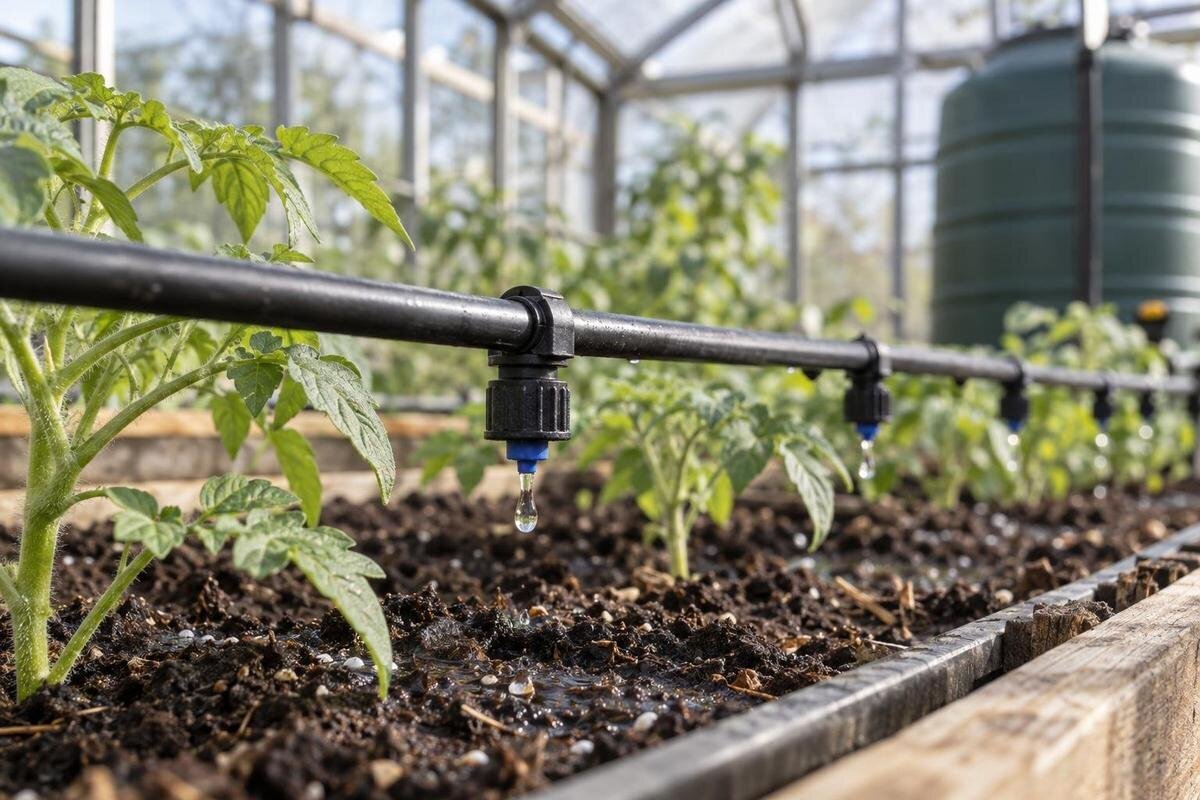
Greenhouse irrigation
Hard water does not automatically block a greenhouse emitter, but dissolved minerals can form deposits in narrow passages and gradually reduce output. The same weak or uneven flow can also come from sediment, a dirty filter, a kink, a leak or a pressure problem. The useful response is to test the water that actually reaches the irrigation line, compare output at fixed points and clean only as the equipment maker permits. This guide explains what to measure, how to interpret the results and when to involve a water-treatment specialist.

How mineral scale can restrict an emitter
Hardness is mainly dissolved calcium and magnesium. While those minerals remain dissolved, they are not scale; if the water chemistry and operating conditions allow them to precipitate, deposits can collect on internal surfaces or around an emitter outlet. A dripper passage is narrow, so a small amount of build-up can alter its output before the device looks heavily crusted. Whether that happens depends on the full water chemistry, emitter design and how the system operates over time. The word “hard” alone does not predict a blockage, and there is no single threshold that applies to every emitter. A hardness result is a risk clue, not a measurement of residue inside each device.
Scale is only one possible cause of low output. Fine sediment, rust particles, plant debris or biological growth can obstruct an outlet or filter, while a leak, kink or poorly operating valve can produce similar symptoms. A pale crust may be a clue, but appearance alone cannot identify its composition; the absence of visible crust does not rule out a partial blockage. Keep the greenhouse choice separate from the water-quality assessment. The Bloomcabin Prestige Greenhouse, for example, is listed in size options from 3.77 to 28.08 m². Those dimensions help with planning beds and pipe routes, but investigating a blockage still requires information about the water supply and irrigation equipment. Neither the structure’s size nor the appearance of one outlet explains the cause.
Test the water that reaches the irrigation line
Take a sample from the water point that feeds the irrigation system, because a result from a different tap or source may not describe what the emitters receive. If you use more than one supply, sample each separately. Where water passes through a tank, filter or treatment unit, a raw-water sample can help explain the source, but a sample taken after that equipment shows what is delivered to the line. If supplies are blended, test the blend as used. Label each sample with its source, collection point and date so later results can be compared fairly.
Follow the laboratory’s instructions for the container, collection point and sample handling; do not assume an ordinary household bottle is suitable. For a fuller picture, ask for total hardness or calcium and magnesium results, alongside supporting information such as alkalinity, pH and conductivity or total dissolved solids. A basic hardness kit can be useful for screening, but it does not provide a complete diagnosis. If blockages recur, or the source is a tank or borehole, tell the laboratory what you are investigating and ask whether suspended solids, iron or manganese should also be included.
Read hardness alongside the rest of the report
Hardness, alkalinity, pH and electrical conductivity describe different aspects of water quality. Hardness mainly relates to calcium and magnesium; alkalinity describes the water’s capacity to neutralise acids; pH records how acidic or alkaline the sample is at the time of testing. Conductivity or total dissolved solids indicates the overall presence of dissolved ions, but does not identify which minerals are present. A conductivity result therefore cannot confirm hard water on its own, and a pH result is not a substitute for a hardness test.
Check the units and reporting basis before comparing results with equipment guidance. A report might express total hardness as calcium carbonate equivalent or list calcium and magnesium separately. Give the emitter and filter manufacturer the report, not just a description such as “very hard”, and ask how it relates to their stated requirements. Keep the water results with the irrigation specifications so that advice refers to the equipment you actually use. If you are planning a new installation in the Aluminium Classic Greenhouse, listed in sizes from 3.77 to 28.08 m², include the selected size and proposed line layout in that enquiry. These describe the installation; they do not establish a suitable flow rate or a universal pass-or-fail hardness limit.
Set a baseline for emitter flow
Before a problem develops, draw a simple map from the water source to the outlets. Mark the filter, any regulator or control valve that is actually fitted, each zone, the main line, its laterals and their ends. After installation or a manufacturer-approved clean, collect from a selection of emitters at the beginning, middle and end of representative lines. Use comparable containers, the same collection period and the normal operating setup, then record the amounts, locations and date. Give each sampled outlet a clear reference on the map so you can return to it without relying on memory. Record individual amounts rather than combining them into one total: the purpose is to compare outlets as well as track changes over time. Keep the collection duration and measurement units beside the results, rather than writing down an amount without context. Note which zone was running and whether anything about the usual setup had changed. This gives you a usable reference for later checks; it does not replace the emitter’s stated performance requirements.
If the equipment has designated pressure test points, record readings there and compare them with the manufacturer’s operating information. Repeat checks at the same points and under similar conditions; output from a single emitter cannot establish the pressure throughout a system. Note changes to the source, filter, valves or line arrangement beside each reading. For a Lean-to Greenhouse, listed in sizes from 3.69 to 14.34 m², add the pressure test points to the plan for the selected footprint. Keep these references distinct from the outlet labels so that a pressure reading and a collected volume cannot be confused in the log.

Trace uneven output before cleaning
Compare outlets within one zone before dismantling anything. If one emitter delivers less than nearby units, investigate that outlet and its branch. If output falls towards the end of a line, consider the line layout, pressure and filtration as well as possible deposits. If every outlet in a zone changes, check the supply, filter, valve and controller before assuming that all the emitters have scaled up. These patterns narrow the search but do not prove a cause. Use the same collection period and operating conditions as your baseline so the comparison is meaningful.
Look along accessible tubing for a sharp bend, crushed section, loose joint or visible leak, and inspect the filter for captured debris. Record what you find before cleaning or replacing parts, especially if the problem returns. Describe the observation separately from the suspected cause: “pale deposit at outlet” is more useful than labelling every deposit as confirmed scale. Photographs can support that record, but should identify the outlet and date so they can be matched to the flow results. When planning irrigation for the Limited Edition Aluminium Greenhouse, listed in sizes from 3.77 to 28.08 m², use bed and line labels that will still make sense once crops fill the space. That makes it easier to trace an affected branch rather than repeatedly inspecting unrelated outlets.
Choose filtration for particles, not hardness
A standard irrigation filter traps particles, not dissolved calcium and magnesium. Select filtration according to the emitter manufacturer’s stated requirement and the material present in the source water; do not guess at a mesh or rating, or assume that the finest option is automatically best. A suitable filter may help with sand, sediment or plant debris, but it cannot by itself soften water or prevent mineral scale. The T-Model Orangery Greenhouse is listed in sizes from 16.52 to 30 m², but floor area alone cannot set a filter’s capacity. Check the actual system flow and equipment specifications.
Inspect and clean the filter at the interval and by the method in its manual, and record whether it loads up again quickly. Where the system has manufacturer-provided pressure indicators or test points, compare readings as directed; a restriction at the filter can reduce downstream output. Check a screen, disc or housing only in the way the maker permits. If the filter repeatedly catches grit or organic matter, investigate the source, tank and intake rather than simply cleaning more often. If it remains clear while emitter flow declines, scale or another restriction remains possible, so return to the water report and line checks.
Flush and clean only as specified
Flush only if the irrigation system is designed for it, and follow the specified sequence and operating conditions. Use a designated end or flushing point if one is provided; do not assume every line can be opened or that flushing will dislodge scale inside an emitter. Check the collected water as the system instructions describe. If sediment clears but output stays low, another restriction may remain in the emitter or elsewhere in the line. Keep service points reachable when planning benches and tubing: the Pyramid Greenhouse is listed in sizes from 5.53 to 18.9 m², but the selected floor plan determines whether a particular flush point remains accessible.
Remove an emitter only if its design is user-serviceable and the manual describes the process. Do not push pins, wire or abrasive tools through a small opening; they can damage the passage and change its output. Avoid vinegar, household descalers, acids, bleach, solvents or other improvised solutions in a line or soaking bath unless the exact equipment maker approves the product and method. Materials and seals differ. If deposits return soon after an approved clean, keep the sample results and flow log, then ask the manufacturer or an irrigation professional to identify the cause before trying a stronger treatment.
When is water treatment worth discussing?
Consider water treatment when tests and repeatable flow checks point to a mineral problem, not simply because one outlet is blocked. Share the water report, source details, emitter model, filter specification and measured pressure or flow with the irrigation equipment maker or a qualified water-treatment professional. Explain whether the problem affects isolated outlets, line ends or a whole zone, and whether output recovered after approved maintenance. This connects the proposed treatment to the problem you have recorded. Ask which constituent an option addresses, what remains in the treated water and whether the resulting composition suits the crops and equipment. Ask also what result would demonstrate that the proposed treatment is addressing the identified problem. Any treatment capacity must match actual demand; a general “hard-water” claim does not establish compatibility with your irrigation system.
Ask how performance is checked at the system’s operating flow, what servicing is required and whether the treated water will be retested. Treatment can change water composition, so have the output assessed for the intended irrigation use rather than looking only at the hardness figure. The Limited Edition Aluminium Greenhouse with Storage is listed in sizes from 5.52 to 28.08 m²; if planning a service area, verify the selected dimensions and access instead of assuming that a storage feature is suitable for treatment equipment. Avoid unapproved chemical dosing or changing water chemistry on a guess.

Access to filters, valves and flush points
Emitter care is easier when components can be inspected without shifting crops or taking apart fixed benches. On the greenhouse plan, mark the water entry, filter, valves, measuring points and any flush ends, then keep them accessible enough to read, clean or replace parts as their instructions require. Follow the equipment maker’s location and environmental requirements; the manual, not the greenhouse’s name, determines whether a component can sit in a particular place. Leave room to collect a sample and compare outlets consistently, and keep the system map updated if the layout changes.
Plan around the actual growing layout as well as the advertised area. The Spacious Greenhouse is listed in size options from 47 to 70 m², but the selected footprint, beds, benches and water routes determine where filters, line ends and sampling points can be reached. On the plan, distinguish components that need routine attention from tubing that only needs an accessible inspection route. Consider where you will stand to read a gauge, collect water or remove a serviceable filter part without disturbing plants. Do not infer zone count, water demand or accessory compatibility from floor area alone. Before buying an irrigation kit or replacement emitters, confirm the system diagram, connection type, filtration requirement and operating conditions against the supplier’s specifications. For replacements, keep the original emitter identification with the order enquiry so the comparison concerns the actual component, not just a similar-looking outlet.
Retesting after a water-source change
Water quality can change when you switch between a municipal supply, borehole, collected rainwater or a tank, and it can vary within one source over time. Rainwater may carry dust, leaf matter or other particles from collection and storage, while another supply may have a different dissolved-mineral profile. Neither source label tells you exactly what reaches the emitter. If supplies are mixed, test the mixture; if they feed separate zones, keep their results and labels separate. Do not assume a familiar source has the same quality after storage or a seasonal change.
Repeat testing when the source, blending or treatment changes, or when recurrent blockages do not match the existing report. Pair each result with its date, source, filter condition and flow measurements so you can tell whether a change in output followed a change in water or equipment. For a variable source, ask the laboratory or irrigation professional what sampling pattern is appropriate rather than treating one result as a permanent description. This record gives a supplier a clearer basis for advice than a photo of a blocked outlet alone.
Frequently asked questions
Does hard water always block greenhouse emitters?
No. Hardness indicates dissolved minerals, but it does not mean they will form scale in every system. The risk depends on water chemistry, emitter design and operating conditions. Sediment, biological growth, leaks or low pressure can cause similar symptoms, so test and measure before choosing a fix.
Will a finer filter prevent mineral scale?
Not by itself. A standard irrigation filter catches particles within its specified range; dissolved calcium and magnesium pass through. Choose filtration to suit the emitter and the particles in the source water, then investigate possible scale through water testing and equipment-approved advice.
What should I ask a laboratory to test?
Ask for total hardness or separate calcium and magnesium results, with the reporting units, and consider alkalinity, pH and conductivity or total dissolved solids for context. Depending on the source and the symptoms, ask whether suspended solids, iron or manganese should also be measured.
Can I descale emitters with vinegar or an acid cleaner?
Only if the exact emitter or line manufacturer approves that product and method. Vinegar, descalers, acids and bleach are not interchangeable, and an unapproved cleaner can damage materials or seals. Follow the manual or ask the supplier rather than guessing a concentration or soaking time.
How can I tell a blockage from low pressure?
Collect output from several emitters in the same zone for the same period and compare it with a baseline. Check the filter, valve, leaks and kinks, and use the system’s intended pressure test points if available. A pattern helps narrow down the cause, but one weak emitter or a deposit’s appearance cannot confirm scale.
Preventing hard-water blockages starts with evidence, not an assumed cleaning treatment. Test the water delivered to the system, compare the report with the emitter requirements and establish a repeatable flow baseline. When output changes, check the whole line and follow the manufacturer’s maintenance instructions before deciding that mineral scale is responsible. If the cause remains unclear, water results and measured flow give an irrigation professional a much better basis for advice than a blocked emitter alone.
