
Root Barriers for Greenhouse Beds Near Established Planting
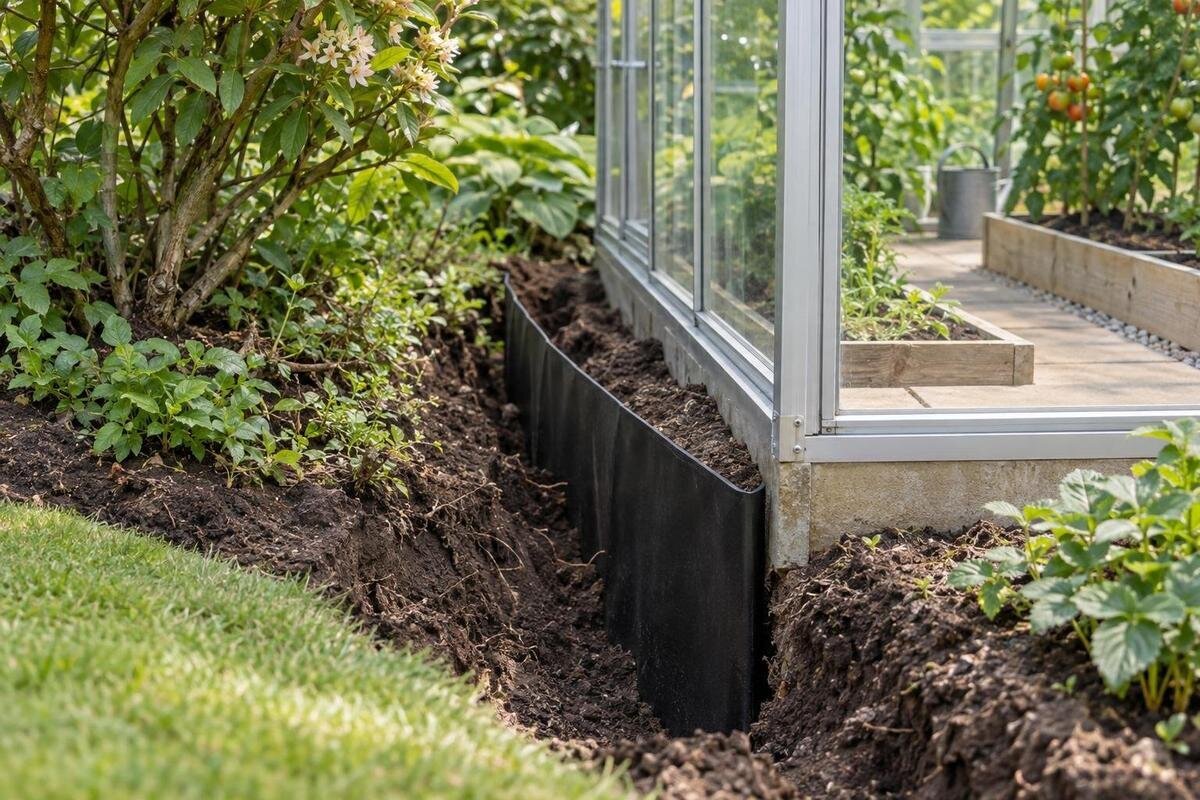
Greenhouse beds and roots
A greenhouse bed beside a mature tree or dense shrub can attract roots from nearby planting, sometimes before the problem is obvious above ground. But uneven growth or soil that dries quickly is not proof of root intrusion. A suitable barrier may limit root entry, yet digging a trench through important roots may harm the planting or affect its stability. A sound plan starts by confirming what is happening, mapping the planting and greenhouse footprint, and choosing a boundary that protects both crop space and established roots.

01
Why roots reach greenhouse beds
A greenhouse protects crops above ground, but an in-ground bed remains connected to the surrounding soil. Tree and shrub roots can extend beyond the visible canopy; how far they spread depends on the plant, soil conditions, available moisture and obstacles. Fine roots that absorb water and nutrients may enter loose, regularly watered bed soil if it is accessible. A nearby tree does not automatically mean the bed has a root problem, and the canopy edge is not a reliable line for predicting where roots stop. An established shrub may also have roots beyond its visible stems. The size of the planting above ground therefore cannot show the full extent of roots beneath or beside the greenhouse.
An ordinary bed frame, kerb or strip of edging defines the cultivated area, but it is not necessarily a root barrier. If a bed is open to native soil, roots can enter from below as well as from the sides. That remains true under a greenhouse: cover above the bed does not disconnect the soil beneath it. Root intrusion is different from crop roots spreading within the bed, so identifying which roots are present matters before changing a boundary. A barrier may redirect growth rather than remove the surrounding root system, and roots may find a route around it. Treat the boundary as part of the site layout, not a stand-alone cure.
How to confirm root intrusion
Look first for direct evidence: roots crossing the cultivated soil, running along the bed base or reappearing at an edge after routine surface maintenance. Record their position and apparent size rather than pulling them out. Fine roots may belong to a crop or weed, while a woody root may come from nearby planting; direction alone does not reliably identify its source. A single fine root at the perimeter is not proof that the whole bed is affected. If a root seems connected to a tree or substantial shrub, do not expose more soil simply to trace it. A photograph and a marked location are safer records to use when seeking an assessment.
Plant performance is a less reliable clue. Soil that dries faster near a tree, or uneven crop growth, could reflect root competition, but similar patterns can follow irregular watering, shade, compaction, drainage or nutrient conditions. Compare the affected area with another part of the same bed and check moisture at growing depth, not just at the surface. Note watering, crop position and any visible roots over a few normal maintenance visits. Avoid increasing irrigation automatically: extra water may mask the cause or create a different problem. The aim is to establish whether roots are present, not to diagnose from wilting alone.
02
Map the greenhouse, beds and established planting
Before choosing a barrier, sketch the whole growing area rather than measuring only the bed edge. Mark tree trunks and shrub bases, the greenhouse’s outside edges, proposed beds, paths, doors and any bed-side irrigation. Include the route used to carry growing materials or harvests; a boundary placed hard against an access route can make routine work awkward. Note changes in ground level and where water moves after rain or watering, but do not treat either observation as a root map. The plan helps reveal conflicts between established planting and proposed work. Mark areas where ground preparation may be needed for the greenhouse as well as where beds will sit, so the assessment covers more than the growing soil.
A canopy line is a useful visual reference, not a safe excavation line or a dependable boundary for roots. Where the plant identity or root spread is uncertain, leave a working buffer rather than assuming the ground is clear. Compare greenhouse options after making the site map: the Limited Edition Aluminium Greenhouses are listed from 3.77 m² to 28.08 m², but that area range does not give the exact footprint or show where a bed will fit. Check the dimensions for the specific option against roots, paths, door access and planned bed edges. This prevents nominal floor area from being mistaken for usable growing space.
Protect important roots before digging
Roots have different sizes and functions, and a root’s visible portion does not reveal whether it is important to a tree’s support. Roots near an established tree can contribute to anchorage as well as water and nutrient uptake. Cutting roots to fit a barrier, bed or greenhouse base can damage the planting and may affect stability. There is no universal safe distance or cut depth that can be judged from a photograph or trunk size alone. The same caution applies to a valued mature shrub where a trench would pass through its main root area. Avoid treating every root as expendable simply because it lies below a proposed bed.
If digging uncovers a thick, woody, branching or otherwise uncertain root, pause the work instead of cutting, levering or burying it beneath a new edge. Photograph it in place and ask a qualified arborist to assess it, particularly when the tree is valuable, close to the proposed structure or showing signs of decline. A greenhouse installer can discuss the footprint and base, but tree-root assessment is a separate question. If you are considering the Bloomcabin Prestige Greenhouse, mark the selected model’s footprint and proposed base on the site plan. Show where preparation would overlap the root’s position, so the discussion covers the work involved rather than just the finished bed.

03
Choose a boundary that matches the bed
Choose a bed boundary for the job it must do. A raised-bed frame, kerb or ordinary edging can hold growing medium and mark an edge, but it does not automatically stop roots reaching an open-bottom bed. A layer intended to suppress weeds or separate soil types should not be assumed to exclude woody roots either. If the purpose is root control, look for a product specifically described for that use and check its intended installation conditions, material, joints and expected soil contact. The visible frame and an underground barrier may be separate components. A tidy edge is not evidence of an unbroken boundary below ground; check how the barrier is intended to meet the bed sides.
An isolated container or bed with a root-resistant base may limit entry from native soil, but a closed base changes drainage and needs a suitable outlet or drainage design. An open bottom can drain into the ground but leaves the bed connected to nearby roots. Weigh root exclusion against drainage, usable growing depth, crop requirements and ease of maintenance. Measure the bed’s internal length, width and usable depth separately: a frame or liner can reduce the available growing space, and crops differ in their root-volume needs. Use crop-specific growing guidance when checking whether a contained bed is adequate; greenhouse floor area is not a substitute for bed volume. The T-Model Orangery Greenhouse is listed from 16.52 m² to 30 m², but total area cannot tell you how much room remains after paths and boundaries are allowed for. Confirm the selected model’s layout before deciding on bed dimensions.
What a root barrier can and cannot do
A root barrier can block or redirect roots, depending on the product’s design; the two functions are not identical. It works only if roots cannot readily pass through, beneath or around the intended boundary. A product sold as weed fabric, ground cover or a general landscaping membrane is not automatically suitable for tree-root control. Check the maker’s stated use, installation conditions and how joints and ends are meant to be treated. The material must suit long-term contact with soil and the expected site conditions. If the specification does not explain those points, ask for clarification rather than assuming that a plastic sheet or leftover membrane will work.
No barrier makes the surrounding root system disappear. A gap at a join, an unprotected end or a depth that does not suit the site can leave a route beneath or around it. Roots may also redirect their growth, so a barrier in one place can shift the point of competition rather than end it. Appropriate depth, placement and end treatment depend on the plant and site, so avoid relying on a universal measurement. When planning beds for the Pyramid Greenhouse, draw the proposed barrier line onto the selected model’s footprint. Include its ends and joins, rather than marking only the stretch beside the nearest tree.
04
Plan drainage and watering separately
Root exclusion changes more than the line on a plan. A solid underground panel can alter the movement of water through soil, while a bed with an enclosed base can hold water if drainage is not planned. Conversely, a bed separated from surrounding soil may depend entirely on the greenhouse’s irrigation. Trace where rain, watering and runoff are likely to go, and consider whether a barrier could leave a bed too wet or too dry. Keep drainage arrangements distinct from the root-control decision; a barrier is not a drainage channel. Do not assume that simply increasing irrigation will compensate for roots competing with crops.
After choosing a boundary, assess moisture inside the cultivated bed according to the crops and growing medium, rather than judging by surface appearance alone. If one end dries much sooner, check irrigation coverage, soil condition and nearby roots before changing the schedule. Include access to water lines when laying out beds and storage. If you are comparing the Limited Edition Aluminium Greenhouses with Storage, check the storage position on the selected model’s plan alongside the irrigation route. Allow for routine access to those lines without having to disturb the bed boundary or move stored items every time you inspect them.
Fit beds and paths inside the greenhouse footprint
Set out beds after deciding which ground should remain undisturbed. If roots limit one side of a greenhouse, a shorter bed, an unplanted access strip or a different path position may be more practical than forcing a long barrier through a root zone. Keep the route from the door to each bed clear and allow room to tend and harvest without stepping on cultivated soil. If the available area leaves too little workable bed, consider fewer in-ground beds or movable containers. The full floor area is not all growing space once paths, doors, turning room and storage are included, and a corner that has no bed may still matter if ground work is planned there.
The Spacious Greenhouse is listed from 47 to 70 m². Use a dimensioned drawing for the exact model to sketch each bed, path and barrier, then compare the layout with the marked root constraints. Check the space between beds as carefully as the cultivated area: it must accommodate the access and maintenance tasks identified in your plan. A larger overall area does not resolve a conflict at one particular edge. If the greenhouse position itself overlaps a root zone that should be protected, moving the structure or changing the growing system may be safer than installing a barrier after the build.

05
Check the boundary after installation
Treat the barrier as something to monitor rather than a one-time fix. Keep a sketch or photograph of its line, joints and ends before they are covered, along with notes about the planting and bed arrangement. During normal maintenance, look for roots reappearing at the bed edge or entering from below, and note whether a particular patch dries unusually fast. Record the date and crop position so you can compare later observations with the same part of the bed. Do not lift the barrier or dig along its length simply to inspect it; that may create unnecessary disturbance. A new root is a reason to check its route and the boundary, not an instruction to cut it.
If roots pass the boundary, review its stated purpose, continuity and depth, together with watering, soil moisture and the likely source planting. A second trench is not automatically the answer, especially close to an established tree. Ask a qualified arborist to assess the risk before revising the bed or greenhouse position. Keep these observations with any layout comparisons for the Aluminium Greenhouses, so a proposed change can be assessed against the places where roots have actually appeared. Distinguish between repairing a gap in the boundary and relocating the growing area; changing the greenhouse model by itself will not resolve root competition.
When to involve an arborist or change the plan
Professional advice is particularly worthwhile before excavation where planting is mature or valuable, a large or woody root crosses proposed work, or the greenhouse base and root zone occupy the same area. A qualified arborist can assess the likely significance of the root and discuss the effect of proposed work on the tree. A greenhouse installer or suitable building professional can assess the structure footprint and base; these are separate questions. Do not use a general depth from the internet, a root’s apparent thickness or a bed supplier’s description to decide that a root can safely be cut. Share the intended work line and site plan before changing the layout.
If a compatible boundary cannot be placed without putting important roots at risk, revise the growing method or site plan. The bed might be moved, reduced or replaced with a container, or the greenhouse could be positioned elsewhere. If the Lean-to Greenhouse is among the alternatives, include its exact dimensions and wall or base requirements in the discussion with the relevant professional. Compare the ground preparation needed for that position with the root assessment, rather than choosing it solely for its smaller area. The revised plan needs to protect the established planting while leaving enough usable space for the intended crops.
Frequently asked questions
Will an ordinary raised bed keep tree roots out?
Not necessarily. An open-bottom frame holds the sides of the bed but leaves its soil connected to the ground, so roots may enter from below. To limit root entry, choose a system designed for that purpose and consider drainage and the crops’ growing requirements.
How deep should a greenhouse root barrier be?
There is no reliable universal depth. The right design depends on the plant, soil and site, the barrier’s purpose, and the routes roots could take around it. Check the product instructions and ask a qualified arborist or installer before digging near significant roots.
Can I cut a root that has entered a bed?
Do not cut a substantial or unidentified root just to clear the bed. It may be part of an established tree’s support or water uptake. Pause, photograph it in place and ask a qualified arborist to assess it before changing the boundary.
Can roots grow around a root barrier?
Yes. Roots may pass beneath a barrier, find a gap at a join or go around an unprotected end. A suitable, continuous barrier can limit entry, but it does not remove roots from the surrounding soil or guarantee that they will never reach the bed.
Do wilting crops mean tree roots are in the bed?
No. Wilting or uneven growth can have several causes, including watering, shade, drainage or soil conditions. Check for direct evidence of roots and compare soil moisture in affected and unaffected parts of the bed before deciding that a barrier is needed.
Root barriers are most useful when they respond to confirmed root entry and suit the bed, site, irrigation and drainage. Record what is happening, map the greenhouse and established planting, and protect substantial or uncertain roots from casual excavation. Choose a barrier only when its intended use and installation requirements are clear. If it cannot be placed without putting important roots at risk, adjust the bed or growing system instead. A workable greenhouse layout gives crops suitable growing space without treating established planting as an obstacle to cut away.
