
How to Size a Greenhouse Heater for Cold Spells
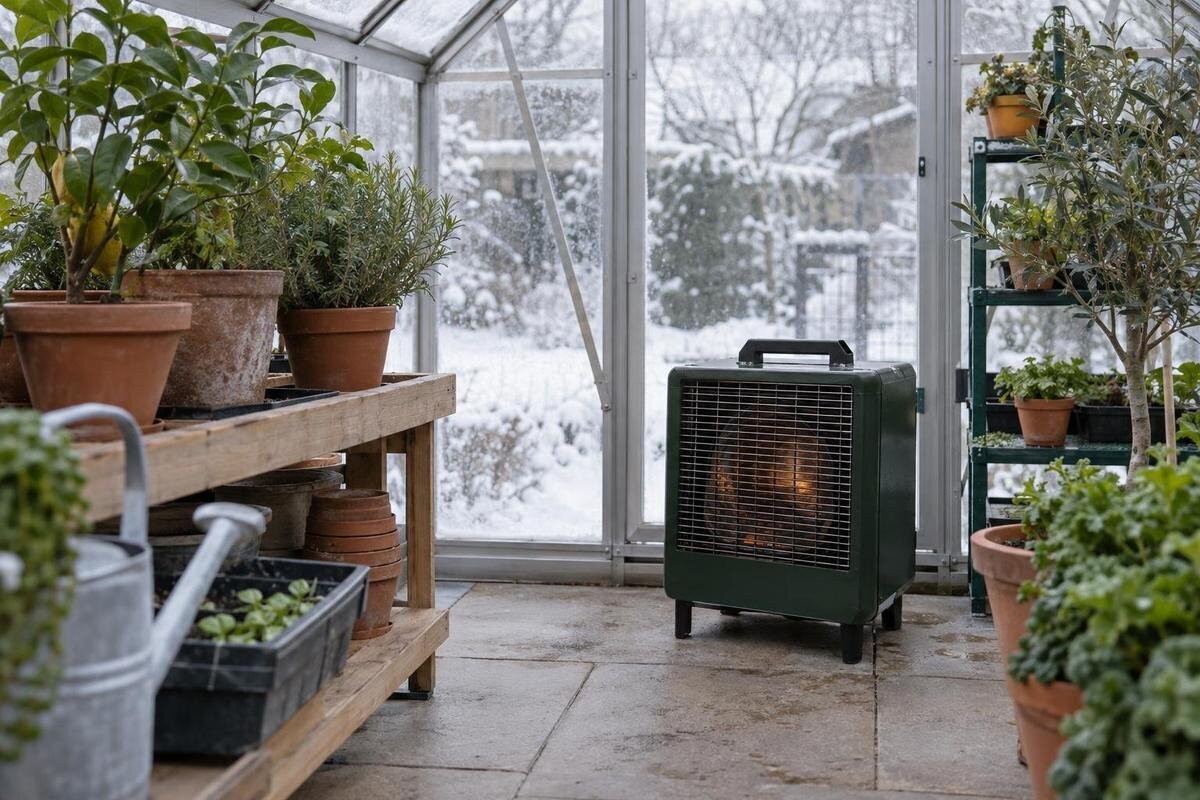
Greenhouse heating
Sizing a greenhouse heater for a cold spell is a heat-loss exercise: estimate how quickly warmth escapes at a chosen outdoor design temperature, then match that peak demand with the heater's documented heat output. The main inputs are the indoor target, exposed surface area, covering performance and air exchange. A watts-per-square-metre shortcut may help with an early comparison, but it hides assumptions. Keep capacity separate from the bill: kilowatts describe a rate of heat output, while kilowatt-hours describe energy used over time. Energy use depends on weather and controls; the tariff determines what that energy costs.

Set the indoor temperature you need to maintain
Begin with the minimum indoor air temperature you want to maintain during the cold spell being considered. The right target depends on the plants, their growth stage and whether the aim is simply to limit cold damage or to support active growth. Use a reliable growing reference for the plants in question; there is no universal greenhouse set-point. If plants with different requirements share the space, decide whether the whole greenhouse needs the higher target or whether you intend to heat a defined zone.
Write down the target and whether it applies to the whole greenhouse or a particular area. The basic heat-loss calculation uses the difference between that indoor target and the outdoor design temperature, not the indoor figure on its own. If you are considering separate zones, identify which plants belong in each and which boundary you will use for each calculation. Do not calculate heat loss for a small area while expecting the result to cover the entire greenhouse. Also distinguish the chosen air-temperature target from the conditions required by the plants: air around the thermostat can differ from conditions at leaves and benches. The calculation estimates the heat needed to maintain a stated target under stated assumptions; it cannot promise that every plant will experience that exact temperature.
Choose a cold-spell outdoor design temperature
Pick an outdoor design temperature for the cold spell you want the heater to handle, rather than using a seasonal average or a daytime reading. A typical night may understate the load on the nights that matter. Use reliable weather records relevant to the site and decide deliberately how severe an event the design should cover. Designing for an all-time record may require a larger heater; using an average may leave the target unmet during a colder spell. Record the figure and why you selected it, including how often you are prepared for conditions to fall below it.
A nearby weather-station reading is useful evidence, but it may not match the greenhouse site. Elevation, wind exposure and nearby terrain can affect local conditions. If suitable records are limited, seek local weather information or collect minimum and maximum readings through cold periods, recognising that a short record may not include the coldest event. With the indoor target and outdoor design temperature recorded, calculate ΔT as indoor temperature minus outdoor temperature. That difference is the input used in the heat-loss equations.
Measure the boundary of the heated space
Draw a boundary around the space you intend to heat, then measure each surface on that boundary: roof slopes, walls, gable ends, doors, fixed panels and any base or floor that exchanges heat with the ground. Measure a sloping roof along its surface, not from its horizontal footprint. Classify each part once. For example, count a door separately using its own area and heat-transfer value, rather than counting both the door and the panel area it replaces. Keep different surface types separate because they may lose heat at different rates. A simple measurement table can record the surface, its dimensions, calculated area and the adjoining space. This makes it easier to spot a missing gable or a door counted twice. Keep base and ground areas identifiable rather than combining them with the covering before deciding how their losses will be assessed.
A listed greenhouse area is not automatically the area of its roof and walls. The Spacious Greenhouse range lists sizes from 47 to 70 m², but those figures alone do not provide the exposed covering area for a heat-loss calculation. Use the drawings for the exact configuration you are considering. If one side adjoins another building, do not automatically treat it as an outdoor surface or as a no-loss surface; the adjoining temperature and construction determine how it should be handled.
Calculate heat loss through the covering
For each surface, estimate transmission heat loss with the equation P = U × A × ΔT. U is the heat-transfer value in W/m²K, A is the area in m² and ΔT is the indoor–outdoor temperature difference. The result is watts. A temperature difference of 1 °C has the same numerical value as a difference of 1 K, so the units work directly in this calculation. Add the results for all the surfaces that form the defined heated boundary. Keep a separate line for each surface type, showing its U-value, area, temperature difference and resulting loss. This lets you revise one input without rebuilding the whole estimate. Where a boundary adjoins another space rather than outdoor air, use the temperature difference appropriate to that boundary.
Use a U-value for the full relevant assembly where one is available, rather than guessing from a material name. Frames, panel joints and other details can affect the result. If a manufacturer supplies an overall heat-loss coefficient for a defined greenhouse, use it only for the parts it covers; add other losses only when they are excluded. The Classic aluminium greenhouse range lists sizes from 3.77 to 28.08 m², but that area range does not state a U-value. Check documentation for the exact configuration instead of assuming that the product name or size supplies thermal data.

Include air leakage and ventilation
Heat also leaves when warm greenhouse air is replaced by colder outdoor air. If the airflow is known in m³/h, a useful approximate calculation is P_air ≈ 0.33 × Q × ΔT, with the result in watts. If you know air changes per hour instead, multiply that rate by the greenhouse volume in m³ to estimate Q. Keep these quantities clearly labelled: air changes per hour describes how often the enclosed air is replaced, whereas cubic metres per hour describes the volume exchanged. Entering the air-change rate directly in place of Q would omit the greenhouse volume. Record the volume alongside the rate so that this conversion remains visible in your workings. The 0.33 factor is an approximation; a detailed estimate can use the appropriate air properties and measured or specified airflow.
Do not invent an air-change rate simply to complete the calculation. Leakage at doors, joints and vents varies with the structure and conditions, while intentional ventilation may also be needed during cold weather. Estimate the greenhouse as it will actually operate, rather than assuming required vents can stay shut. The Lean-to Greenhouse range lists sizes from 3.69 to 14.34 m²; if considering a wall greenhouse, use its actual layout and documentation to identify the heated boundary. Its listed area does not establish how airtight it is or how much heat an adjoining wall will lose.
Work through an illustrative heat-loss estimate
Consider a hypothetical enclosure with 48 m² of exposed covering, an effective average U-value of 3.0 W/m²K, airflow of 40 m³/h and a 12 °C difference between the indoor target and outdoor design temperature. The covering term is 3.0 × 48 × 12, or 1,728 W. The approximate air-exchange term is 0.33 × 40 × 12, or about 158 W. Together they give about 1,886 W, which rounds to 1.9 kW before any separately assessed base or ground loss, thermal bridge or justified allowance.
These figures demonstrate the arithmetic only; they are not a recommended greenhouse specification, a South African climate value or a product performance claim. If the same assumptions apply but ΔT rises to 17 °C, the two terms total about 2,672 W, or 2.7 kW. Only the temperature difference has changed in this comparison: the covering area, U-value and airflow remain fixed. Keeping the cases side by side shows how the chosen cold-night condition affects the required output without confusing it with a change in greenhouse size or construction. The Limited Edition Aluminium Greenhouse range lists sizes from 3.77 to 28.08 m², but those figures cannot be substituted for the example's exposed covering area. A calculation for a selected model still needs its own surface measurements, U-values and airflow estimate.
Match the calculated load to heater output
The total heat loss is the heat-output rate needed to hold the target at the design condition, expressed in watts or kilowatts. Compare it with the heater's documented heating capacity under relevant operating conditions. Do not assume that an electrical input rating is the same as available heat output for every heater type. Where output varies with surrounding conditions, check the capacity at the outdoor temperature used in your calculation, not only a more favourable rating point.
If the estimated load is 1.9 kW, the heater needs to deliver at least that much heat at the stated conditions before any explicit allowance for uncertainty. Keep the calculated load and the allowance as separate entries, then show the combined output requirement used for selection. That distinction makes clear whether extra capacity addresses an identified uncertainty or simply reflects the available heater sizes. Avoid adding a fixed percentage without knowing what it covers. If airflow, base loss or another input is uncertain, calculate how that uncertainty could change the load and document the allowance. The T-Model Orangery Greenhouse lists sizes from 16.52 to 30 m²; that range is not a heater rating. Use the selected greenhouse's dimensions and documented heat-loss information, and assess heat distribution if you plan to maintain different zones.
Account for shape, wind and local temperature differences
A steady-state estimate assumes a particular temperature difference and airflow. A windy night, an open door or a different ventilation pattern can change the actual load, so avoid applying a universal wind correction without supporting data. Daytime solar gain is not a dependable contribution on a cold night. Thermal mass may slow how quickly temperatures change during a short spell, but it does not remove the ongoing heat loss once the greenhouse has settled at a steady temperature. The length of the cold spell therefore matters as well as its lowest temperature.
The Pyramid Greenhouse range lists sizes from 5.53 to 18.9 m². For a selected model, use its actual drawing to measure sloping roof surfaces; the listed area alone is not the roof area required by U × A. Air temperature can also vary between the thermostat, benches and corners. A single reading cannot confirm uniform conditions throughout the space. After installation, readings at relevant points during cold weather can help reveal uneven distribution, although they do not replace a heat-loss calculation.

Keep heater size separate from running cost
Define the heated boundary consistently when estimating both capacity and energy use. The Limited Edition Greenhouse with Storage lists sizes from 5.52 to 28.08 m², but the listing does not establish whether a particular storage area will be kept at the greenhouse target. Use the exact layout to decide whether that space is inside the heated area, separated from it or outside it. That decision affects which surfaces and volume belong in the calculation, so keep the same boundary when estimating how long the heater may operate.
Heater capacity is a rate of heat output, measured in watts or kilowatts; electricity use accumulates in kilowatt-hours. For example, an electric heater drawing 2 kW for a full hour uses 2 kWh in that hour. A thermostat may switch a heater on and off, so actual use depends on its operating time as well as the rated input. The heat-loss total is therefore not, by itself, an estimate of the energy used over an entire night. Keep two separate results in your notes: the output needed at the design condition and the energy expected over a stated period. Estimate electricity cost by multiplying expected kilowatt-hours by your actual tariff. For another energy source, use its documented consumption and the units in which you are billed; heater output alone cannot provide a running-cost figure.
Know where a quick estimate stops being reliable
A watts-per-square-metre rule compresses many assumptions into one number: greenhouse shape, covering, target temperature, outdoor condition, air leakage and sometimes ventilation or ground loss. It is useful only as an initial screen when you know what structure and conditions the rule describes. If those details are missing, the result may not transfer to your greenhouse. A precise-looking figure calculated from guessed inputs is still uncertain. Where data is incomplete, compare plausible low and high values for the uncertain inputs and see how much the heater load changes.
The Prestige Greenhouse with Metal Base listing identifies a model with a metal base and gives sizes from 3.77 to 28.08 m²; neither the model name nor area range specifies heat loss through the base. Ask for documentation that matches the selected greenhouse configuration and the heater's output at your design conditions. Where airflow or ground loss cannot be established, have a qualified greenhouse heating professional review the estimate. If the heater is electrically powered, ask a qualified electrician to confirm that the supply and controls can support the selected equipment.
Frequently asked questions
What is the basic greenhouse-heater sizing formula?
Estimate heat loss through the covering as the sum of U-value × surface area × indoor–outdoor temperature difference. Add air-exchange losses and any separately assessed base or ground losses. The result is a heat-output requirement in watts for the conditions you chose.
Can I size a heater using only the greenhouse floor area?
No. Floor area does not tell you the total area of the roof and walls, their heat-transfer values, or how much air escapes. It can help identify a greenhouse size, but accurate heater sizing needs the actual heated boundary and its heat-loss inputs.
Which outdoor temperature should I use?
Choose a cold-spell temperature that you intend the heater to handle, using reliable weather information relevant to the site. An average night may understate the load, while an all-time record may be more severe than your design needs. State your choice clearly.
Should I add a safety margin to the calculated load?
Allow for uncertainty, but do not apply an unexplained percentage as a universal rule. Identify which inputs are uncertain, such as air exchange or ground loss, and estimate their effect. If the result is close to the heater's available output, get the missing values reviewed.
Does a larger heater necessarily cost more to run?
Not on its rated capacity alone. Running cost depends on the energy the heater actually uses over time, how often it operates, the weather, the target temperature and your tariff. Use the heater's input or fuel-consumption data and your own energy rate to estimate a bill.
A useful heater estimate is tied to a stated indoor target and a stated cold-night condition. Measure the whole heated boundary, use reliable covering and airflow data where available, and make unknowns visible. Then compare the calculated peak load with documented heater output at those conditions. Estimate energy use separately, using likely operating time and your actual tariff. A transparent calculation is more useful than a universal wattage rule because you can see which assumptions may need to change.
