
Buying a Small Greenhouse on Black Friday: Choose a Size You Won't Outgrow
Greenhouse buying guide
When comparing greenhouses on Black Friday, it is easy to focus on the word “small” and the advertised offer. Neither tells you whether the structure will suit your garden. Decide what you want to grow, measure the complete footprint and plan how you will reach the plants. Then make room for the next change you genuinely expect, such as more containers or another crop. This approach keeps a compact greenhouse practical without choosing extra floor area simply because it might be useful one day.

Before you buy 1
Decide what “small” needs to hold
Treat “small” as a description, not a measurement. Two gardeners can mean very different things by it: one may want a few seed trays and pots, while another needs room for taller crops, propagation and a walkway. Write down what the greenhouse must hold during an ordinary week, not only at its busiest point. Include how many pots or rows you expect, whether plants will stay in containers and whether you want to store tools or a watering can inside. Also note which activities happen at the same time, such as potting up while established plants are still inside. This turns a vague preference for a compact greenhouse into a practical capacity requirement and stops a sales label setting your expectations.
Separate current essentials from later possibilities. Mark each item as necessary now, likely within the next year or two, or merely appealing. Give room to plants you already grow and changes you have actually decided to make; do not size a permanent structure for every crop you might try once. At the same time, do not count only the seedlings you have today if you intend to raise them on to larger plants. Think about the point when the greenhouse will be fullest. That distinction helps you plan for credible growth without letting a long list of “maybe” plants push you towards an impractical footprint.
Measure the full greenhouse footprint
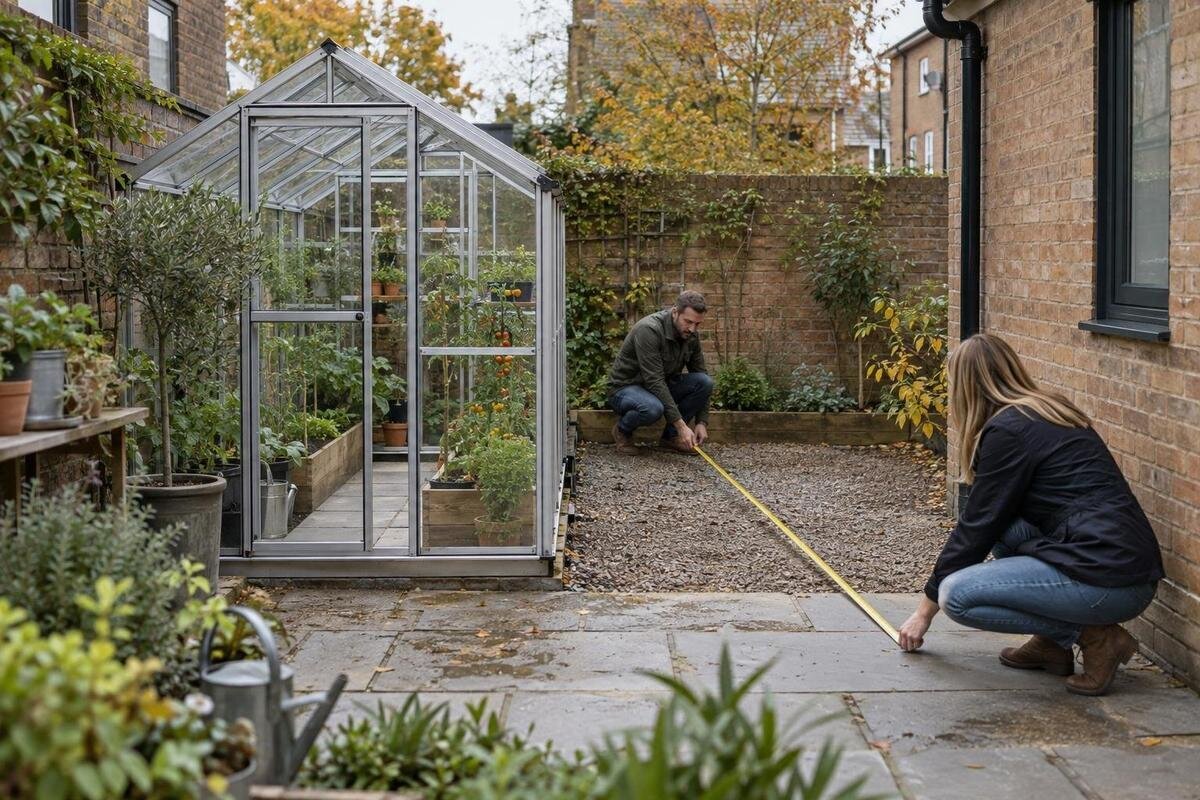
Measure the place where the greenhouse will sit, then compare it with the product’s stated overall assembled width and length. The footprint is the space occupied by the structure; it is not the same as the clear floor area available for pots, beds or a path inside. Record the longest and shortest usable sides, and note fixed limits such as a fence, wall, gate or existing garden bed. Write the figures down in metres. Account for corners that are cut off by paving, planting or an uneven boundary, rather than treating the whole area as a perfect rectangle. A rough estimate from a photograph or a phrase such as “compact” will not tell you whether the structure’s corners clear the boundaries.
Draw the outline to scale on paper, or mark the proposed corners on the ground with string or removable markers. Check that you are comparing the same points on your plan and in the product details; outside measurements are more useful for checking fit than a guess based on growing area. If the listing distinguishes a base or another projection, include whichever measurement changes the space you must reserve. For the Prestige greenhouse listing, use stated dimensions to plot the footprint rather than trying to infer it from the model name. If a key figure is missing or unclear, ask for clarification instead of treating a product image as a scale drawing.
Before you buy 2
Plan the route to your plants
A greenhouse can fit within your garden boundary and still feel too small if you cannot reach the plants comfortably. Plan the entrance and the route from it to each growing area. In a narrow layout, a central aisle may use a substantial part of the floor; in another arrangement, reaching across rows may make routine jobs awkward. Sketch where you will stand, turn, carry a tray and set down a watering can. Consider the order of a normal task: entering, placing supplies down, tending plants and leaving without having to move several containers. Leave room for the way you actually tend plants rather than assuming every metre of floor will be available for growing.
Think about the approach from outside as well. A gate or path may affect how you bring in plants and supplies, while a tap or other fixed feature may limit where you can stand. Include any space needed for the entrance to open as described in the product information; do not draw the structure flush against a boundary if that would block access. For the Orangerie listing, as with any option, compare the stated dimensions and entry arrangement with your sketch. Neither the model name nor an image tells you how much clear aisle space you will have.
Draw the interior layout before choosing a footprint
Sketch the inside before choosing between two options with a similar total area. Length may give you more planting positions, while width may determine whether a route can run between them; the useful balance depends on how you arrange pots, beds and shelves. Draw each item at the size you intend to use, then add a path that lets you do routine work and move a tray. Mark where taller or wider containers will go, because a layout that works with empty pots may be difficult to use once plants have filled out. If you plan to place containers along both sides, map the gap between them rather than counting only the outer walls. A simple plan can reveal bottlenecks that an area figure hides.
Decide which items need to be inside and which can stay elsewhere. A bench, seed trays, stored compost or hand tools all take up floor space, even when they are absent from a product photograph. Do not assume shelves or other fittings are included unless the listing says so. Assess the Classic Plus 385 listing using its stated internal and external measurements, if supplied, and add the proposed layout to your sketch. Do not interpret the number in a model name as a dimension. Keep the plan honest about the space taken up by people as well as plants.
Before you buy 3
Allow for likely additions, not every possibility
To reduce the risk of outgrowing a small greenhouse, plan for the next change you can explain: adding another crop, raising seedlings for more of the season, or replacing a few pots with a bed. Estimate the area those plants will occupy when established, not just the space their trays use now. If you hope to grow plants that spread sideways or need individual containers, allow for that arrangement in your drawing. You are not trying to predict every future hobby; the aim is to identify one or two likely changes that would otherwise make today’s layout crowded.
Set a minimum, preferred and maximum footprint. The minimum covers today’s essentials; the preferred size accommodates those needs and the additions you expect; the maximum is the largest outline that still leaves your garden usable. Keep all three in the same units and test each against the site. If a proposed increase goes beyond your limit, decide what would change: fewer varieties, a different arrangement or some growing space elsewhere. Assess the T-model greenhouse listing against the same limits, using dimensions provided for that model rather than assuming its name indicates how much planting room it offers.
Match the space to the plants you intend to grow
Plant choice affects the layout as much as plant count. A dozen small pots may use less floor area than a few large containers, while plants with broader growth habits need room around them. Tall crops may call for a different arrangement from seed trays; include both at the size they will occupy when you expect to use the greenhouse. Group plants by the space they occupy and by whether they need frequent attention, rather than assuming every container can be placed at the edge. List the crops you genuinely intend to grow and note whether each needs to be reached from the aisle or can be tended from an edge. That makes your space estimate more useful than simply counting plants.
Consider how long each item will stay inside. If seedlings move elsewhere once established, their busiest period may be temporary; if containers remain in place, they compete for the same floor area over a longer stretch. Map a busy growing period, not just a quiet day, and allow room to move trays without shifting every pot. Compare the stated dimensions for the pyramid greenhouse listing with that plan. A product name or photograph does not establish whether your particular mix of containers and plants will fit.
Before you buy 4
Compare measurements before considering Black Friday offers
Make your size decision before weighing any advertised Black Friday offer. Labels such as “small”, “compact” or “spacious” are not comparable measurements, and a promotion does not change the space a greenhouse occupies. Put your required footprint, preferred width and maximum length beside each listing. Compare the figures in the same units and rule out an option that exceeds your site limit, even if its description sounds suitable. This keeps a sales label from nudging you towards a greenhouse that cannot be placed or used as planned.
Read the product information for the assembled structure’s dimensions and, where shown, distinguish outside measurements from internal ones. Check a diagram for the orientation of width and length: rotating a footprint may change how it fits, but it can also alter your access route. Do not assume a model number is a size code. For the Classic greenhouse listing, check the stated measurements against your preferred range. If a figure is absent, unclear or seems inconsistent with the details, ask for clarification rather than relying on a guess.
Check how the footprint fits the shape of your garden
A useful footprint depends on the shape of the site, not only its total area. A narrow strip beside a boundary, an irregular corner or established garden beds may leave less usable room than an open rectangle. Draw the limits of the area you can genuinely set aside, including paths you intend to keep. Then place the greenhouse outline in different orientations on your plan. Keep access to other parts of the garden in the drawing, so that adding plant space does not make everyday movement awkward.
If a product is described as a wall greenhouse, check its own stated dimensions and positioning information against your plan; the label alone does not show how much floor space it will occupy or whether it suits a particular site. Measure only the area genuinely available and note any nearby feature that affects access. Use the wall-greenhouse listing as a separate outline on your drawing rather than borrowing measurements from another model. If fitting the structure involves site or fixing decisions you are unsure about, ask a suitably qualified professional to assess them instead of guessing from a sales image.
Before you buy 5
Confirm the fit before placing your order
Make a final fit check using one consistent set of measurements. Confirm that the quoted size refers to the assembled greenhouse, note which side is the width, and check whether an entrance or projection changes the space you need to reserve. Compare the outline with your marked site and with the route from the gate or delivery point to its position. A structure may fit in its final spot but be difficult to move through a narrow access route. If dimensions are missing or unclear, obtain clarification before ordering so you are not relying on an assumption that could be difficult to correct.
Check what the product information says is included, because an optional fitting or other item may affect the layout you have planned. Do not assume that everything in a photograph comes with the greenhouse. Assess the limited-edition greenhouse listing by its stated assembled dimensions and included items, not by its title. If the product details do not answer a size or fit question, pause and ask. Black Friday timing is not a reason to skip a check that determines whether the greenhouse will work in your garden.
Choose the smallest size that meets your real plan
Once several greenhouses pass your measurements, compare what each layout lets you do. The better fit is not automatically the one with the largest footprint: a larger structure can leave too little room elsewhere, while a very tight one may force you to remove plants or work areas you had planned. Compare the number of growing positions, the route through the space and the future addition each layout can accommodate. If two options have different shapes, draw both on the same site plan and test the entrance and plant arrangement in each. A consistent comparison is more useful than choosing by a label alone.
Use a simple rule: choose the smallest option that meets your current essentials and credible near-future plan, while staying within the garden’s footprint and access limits. If none meets all three conditions, adjust your planting plan or wait for an option whose measurements do; do not stretch the site just to make an offer feel worthwhile. Before checkout, confirm that you have selected the model whose dimensions you mapped and have not confused an internal figure with an outside one. That final check keeps the decision grounded in usable space rather than a Black Friday headline.
Frequently asked questions
Is there a standard size for a small greenhouse?
No. “Small” is a description, not a standard measurement. Compare the greenhouse’s stated outside dimensions with your available space, then check how much room remains inside for plants and access.
How much room should I leave for access?
There is no single clearance that suits every site and layout. Allow for the entrance to open as described in the product information, the route you need to reach and tend plants, and any access you want to keep around the structure.
Should I buy the largest greenhouse that fits?
Not necessarily. The largest footprint may leave too little usable space elsewhere, while a very compact option may not accommodate your plants or a practical working route. Compare your growing plan with both the site limit and the interior layout.
How can I allow for plants I may grow later?
Choose one or two likely additions rather than trying to plan for every possibility. Estimate the space they will need when established, add them to your busiest-period layout, and compare that plan with the space you can actually set aside.
What should I check on a Black Friday greenhouse listing?
Check the assembled outside dimensions, distinguish them from internal measurements, and confirm which way the width and length are shown. Compare the figures with your site plan and access route; an offer does not change the space the greenhouse occupies.
Choose a small greenhouse around the plants you will grow, the space you need to tend them and a realistic next addition. Measure its full outside footprint, draw the interior layout and confirm the assembled dimensions against your site and access route. Set your maximum size before comparing Black Friday offers, then choose an option that fits both your garden and your gardening plan. That is a more dependable way to reduce the risk of outgrowing the structure—or buying space your garden cannot spare.
