
How Much Can Water Barrels Warm a Greenhouse Overnight?
GREENHOUSE HEATING
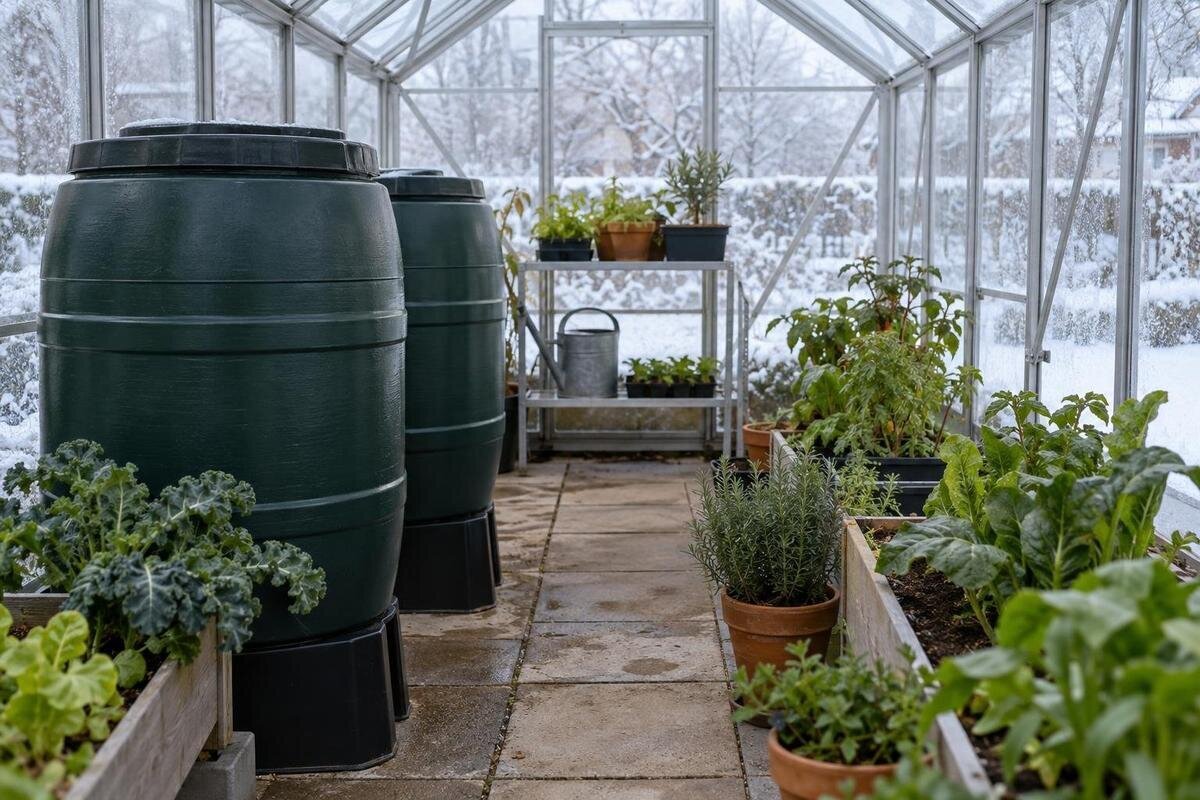
Water barrels can slow a greenhouse’s overnight temperature drop, but the number of barrels alone cannot tell you whether plants will stay above a required minimum. Water stores heat as it warms and releases some as it cools. The amount available depends on the litres and the water’s actual temperature change; the amount needed depends on heat escaping from the particular greenhouse during those hours. A heat-capacity calculation gives an ideal energy figure, while temperature records show what happened on site. Used together, they help you judge whether barrels provide a useful buffer or whether a separate frost-protection plan is needed.

What to verify 1
What water barrels can do overnight
Water in barrels can absorb heat during the day from sunlight that enters the greenhouse and from warmer air around the container. When the surroundings cool, warmer water gives some of that heat back. This is thermal storage, not an independent heat source: a barrel cannot add energy that was never collected, and it cannot release more than the energy represented by its actual water-temperature fall. A cloudy day, shade or a small daytime rise in water temperature can leave little reserve by evening. A large barrel that barely warms may therefore have substantial theoretical capacity but little newly stored heat to contribute that night.
The release may slow the fall in greenhouse air temperature, but it does not hold every part of the space at one temperature. Air, soil, benches, plants and the structure exchange heat at different rates, so a thermometer near a barrel can differ from one in the crop area. Barrels are passive and do not respond to a minimum-temperature setting. Check the minimum each crop needs using reliable growing information, then treat the barrel effect as a buffer to measure, not guaranteed frost protection. If a minimum is critical, plan for monitoring and suitably specified backup heating. Results will also change when weather, starting water temperature or ventilation changes.
Calculate the heat stored in the water
Use Q ≈ V × 1.16 × ΔT, where Q is in watt-hours, V is the total water volume in litres and ΔT is the fall in water temperature in °C. This uses water’s specific heat capacity, approximately 4.18 kJ per kilogram per °C, and treats each litre as about one kilogram. For example, 200 litres cooling from 20°C to 10°C gives 200 × 1.16 × 10 = 2,320 Wh, or 2.32 kWh. This is an ideal quantity of thermal energy released by the water, not a predicted greenhouse temperature, plant temperature or guaranteed useful output.
The calculation scales directly with volume and temperature change: 100 litres falling 5°C represents about 0.58 kWh, while 500 litres falling 10°C represents about 5.8 kWh. These are examples of arithmetic, not recommended water temperatures or a promise that all the energy reaches plants. Insert the actual filled volume and measure the water at dusk and again before dawn; do not substitute the air-temperature drop. If the water cools by only 3°C, use 3°C even if the air has fallen much further. For barrels with different volumes or temperatures, calculate each separately and add the results. Take readings at the same depth and place each time, particularly with tall containers, and round sensibly because measurements are approximate.
What to verify 2
Compare stored heat with overnight demand
A kWh figure cannot be translated into a fixed number of degrees for every greenhouse. The same 2.32 kWh may have a different effect depending on how quickly the barrel transfers heat and on the structure’s exposed area, air leakage, outdoor weather, and the temperatures of soil, benches and plants. If water is still warm at sunrise, it may not have released its full theoretical reserve; if it cools quickly, the greenhouse may also be losing heat quickly. Consider barrel, indoor and outdoor readings together over the same hours, rather than treating water volume as a temperature setting.
If a defensible whole-structure heat-loss coefficient H is available, a simple estimate is H (W/K) × average indoor–outdoor temperature difference (°C) × time (h) ÷ 1,000 = kWh lost. For illustration only, a hypothetical H of 100 W/K with a 10°C average gap over eight hours gives 8 kWh; this is not a typical or measured greenhouse value. That would exceed the 2.32 kWh ideal from the 200-litre example, before allowing for timing or transfer limits. The Bloomcabin Prestige Greenhouse is listed from 3.77 m² to 28.08 m²; its area range alone does not provide H or promise an overnight temperature.
Estimate heat loss from the greenhouse
If no whole-structure coefficient is documented, do not replace it with floor area or a guess based on frame material. Heat escapes through the roof, glazing, doors and other exposed parts, and through air exchange. A defensible estimate therefore needs data for the selected structure and its boundaries, including the areas and verified heat-transfer information for those parts, as well as the ventilation state. A single average temperature difference simplifies a night when indoor and outdoor readings keep changing, so note that an average has been used or compare shorter time intervals. Keep the estimate consistent with normal door and vent settings rather than using a configuration you would not actually use.
Model footprint can help identify the configuration being assessed, but it is not exposed surface area or a heat-loss rating. The Aluminium Classic Greenhouse is listed in sizes from 3.77 m² to 28.08 m². Use the exact selected size and measured layout when checking documented figures; do not assume every size loses heat at the same rate. If product information does not include enough detail for a reliable estimate, state that limitation and prioritise monitored overnight results instead of assigning an invented heat-transfer or air-leakage figure. A result from one vent setting should not be treated as the result for another.

What to verify 3
Record a representative overnight test
Record three temperatures at matching times: greenhouse air where plants are kept, water in a barrel and outside air. A logger that records at intervals shows both the lowest reading and how long cooling lasts; two spot readings can miss a short dip. Put the indoor sensor in shade at representative crop height, away from direct sunlight, barrel surfaces, glazing, door gaps and any heater, so it does not report a local hot or cold pocket. Shelter the outside sensor from direct sun and rain. Use the same instruments and positions each night, and note reading times. If several barrels are used, measure the same barrel consistently or take readings from each.
Alongside temperatures, write down the water volume and dusk temperature, observed outdoor minimum, cloud and wind, and whether doors, vents or heating changed during the test. Repeat across several nights; a mild, sunny day followed by a calm night is not a sound proxy for a colder, windy night. If testing with and without barrels, compare nights with similar conditions where possible and record the differences rather than claiming a controlled result. In a wall-adjoining layout, note conditions on both sides of that boundary. A Lean-to Greenhouse is listed from 3.69 m² to 14.34 m²; the name and footprint do not tell you how a particular adjoining wall affects heat loss.
Plan barrel volume, position and support
Work out the actual filled volume and sketch barrel positions before bringing water into the greenhouse. Keep doors, paths and vents unobstructed, and leave enough room to reach and water crops. A barrel in shade may not warm as much as one exposed to sun. Adding volume increases ideal stored energy for the same water-temperature rise, but does not necessarily increase the rate at which heat reaches the crop area. Container surface area, placement and air movement affect transfer. Keep a thermometer accessible and record the arrangement, because moving a barrel changes sunlight exposure and local air circulation. Check for leaks and avoid positions where a spill could obstruct access or damage equipment.
Water is heavy: 200 litres add roughly 200 kg before the container, concentrated over the area it occupies. Do not assume a greenhouse base, paving or floor can carry that local load merely because it supports the structure. Follow the relevant structure and floor guidance, and ask a qualified professional if the support is uncertain; this is not something to estimate from a product name. The Limited Edition Aluminium Greenhouse with Built-in Storage is listed from 5.52 m² to 28.08 m², so compare the actual plan for free floor area. Built-in storage is not a verified barrel position or load rating.
What to verify 4
Relate barrel volume to greenhouse size
Litres per square metre can be a rough way to compare two setups, but it cannot establish how warm either will be. This ratio divides water volume by floor area, not by the greenhouse’s actual heat-losing surface area. Floor area also does not give the full air volume. Height, roof form, glazing, doors, vents, adjoining walls, air leakage and surrounding exposure all affect how much heat must be replaced. A fixed barrel volume is a starting point for a test, not a standard allowance that transfers from one footprint to another.
The Spacious Greenhouse is listed from 47 m² to 70 m². That area range shows how far a greenhouse footprint can vary, but does not disclose air volume, exposed envelope area or overnight heat loss. Do not infer that a particular number of barrels will keep any size warm. For a meaningful comparison, use the chosen dimensions, count all the water, measure its actual temperature drop and observe the crop-area minimum under the weather you need to plan for. A different size or layout needs its own assessment, even if the barrel volume is unchanged.
Check product information for heat-loss details
Before selecting a greenhouse for winter use, ask for the exact variant’s dimensions, glazing specification, ventilation arrangement and any documented insulation or whole-structure heat-loss data. A model name or frame material does not establish a heat-transfer value, airtightness or heating requirement. If thermal figures are supplied, check which surfaces and operating conditions they cover, including whether vents and doors are open or closed. A number without those conditions cannot be compared fairly with an overnight test at your site. When verified data are unavailable, say so and avoid filling the gap with a generic assumption.
The Limited Edition Aluminium Greenhouses are listed from 3.77 m² to 28.08 m². When comparing options, keep the selected size, glazing and ventilation details together so that any thermal information relates to the configuration you intend to buy. The listing establishes product identity and an area range; it does not establish included insulation or overnight heat retention. Check those features separately rather than treating the range name as a thermal specification.

What to verify 5
When stored heat needs a backup
Barrels have no thermostat and cannot hold a chosen minimum. If repeated tests show the crop area falling below the crop-specific threshold, adding water might increase stored energy only if it can be warmed by day, safely accommodated and release useful heat during the night. If a minimum must be maintained, assess a suitable greenhouse heater using its documented heat output and operating requirements against actual heat-loss evidence. Ask a qualified professional to advise on selection or installation where needed; barrel arithmetic cannot establish a heater size or safe installation.
Heat output and energy use answer different questions, and a stated power rating alone does not establish an overnight cost. For an electric heater, use logged kWh or documented consumption with the electricity tariff on your current bill; for another fuel, use its documented consumption and actual billed tariff. Do not assume barrels reduce a bill by the full theoretical kWh they contain, since that energy may not replace heater use when it is needed. The T-Model Orangery Greenhouse is listed from 16.52 m² to 30 m², but footprint alone cannot identify a heater requirement or suitable equipment.
Judge the result against your plants’ needs
Set the test against the minimum temperature the particular plants need, using reliable growing information rather than a generic greenhouse target. Review the lowest crop-area reading, how long it lasted and whether the water still held heat; a brief dip and several hours below a threshold are not the same result. Include the outdoor minimum, wind, cloud, daytime charging and door or vent settings so you know what conditions the record covers. Test more than one relevant night, including a cold spell if available. A single warm-night result cannot establish performance during a colder period.
If crop-area readings remain above the chosen threshold on representative nights, the greenhouse met that threshold under the recorded conditions. That result alone does not isolate the barrels’ contribution or guarantee performance in colder weather. If readings fall short, use the measured water-temperature drop and overnight record to decide whether to retest a different volume or arrangement, improve heat retention using verified options, or add suitable monitored heating. A Pyramid Greenhouse is listed from 5.53 m² to 18.9 m²; keep each test record tied to the selected size and setup when comparing results.
Frequently asked questions
How many litres of water do I need to keep a greenhouse warm overnight?
There is no universal volume. Estimate the ideal heat released with 1.16 × litres × the water’s actual temperature drop in °C, then compare that energy with the greenhouse’s overnight heat loss or its recorded temperatures. The same volume can have a different effect in a different structure or in different weather.
Does a water barrel need to be black?
A container’s surface can affect how much sunlight it absorbs, but colour alone cannot tell you how much heat will be stored. The useful figure is the water’s measured temperature rise during the day and its fall overnight. Record those readings rather than assuming a particular colour will deliver a specific result.
Can water barrels prevent frost?
They may slow a temperature drop, but they cannot guarantee frost protection or a particular temperature. Check the minimum each crop needs using reliable growing information, then compare it with readings from the crop area on several relevant nights. If that minimum must be maintained, assess suitable monitored backup heating.
Should I use the air-temperature drop to calculate stored heat?
No. Use the change in the water’s temperature from the start to the end of the period you are assessing. Air and water can cool at different rates. If barrels have different volumes or temperatures, calculate each one from its own volume and temperature change, then add the results.
Can I apply one test result to a different greenhouse size?
Not reliably. Floor area alone does not show the air volume, exposed surface area, heat loss, ventilation or weather conditions. Treat a test as evidence for the greenhouse and arrangement you measured. Recheck the water volume, vents, doors and crop-area temperatures if the size or layout changes.
The useful figure is not simply the number of barrels, but how much heat the water releases and whether that release coincides with the crop area’s need for warmth. Calculate the released energy from measured water temperatures, then assess it alongside documented heat-loss information or a record of overnight conditions. Several relevant nights will give a more useful answer than a single mild one. If the readings show a shortfall, they also give you a clearer basis for reviewing the greenhouse setup or assessing suitable backup heating.
