
Blossom-End Rot in Greenhouse Tomatoes: Why Extra Fertiliser Can Miss the Cause
Greenhouse tomato problems
Blossom-end rot is one of the most misleading problems on greenhouse tomatoes: the dark, sunken patch at the end opposite the stem looks like proof that the plant needs more calcium. It is not proof of that. The disorder develops when the fruit does not receive enough calcium while its tissues are forming, but the growing medium may still contain calcium. Uneven moisture, impaired roots, rapid growth, salt build-up or an unbalanced feed can all disrupt uptake. Adding fertiliser before checking these factors may miss the cause and increase root-zone salts. Start with the lesion, then trace how consistently water reaches the roots.

Greenhouse footprint note 1
What blossom-end rot looks like
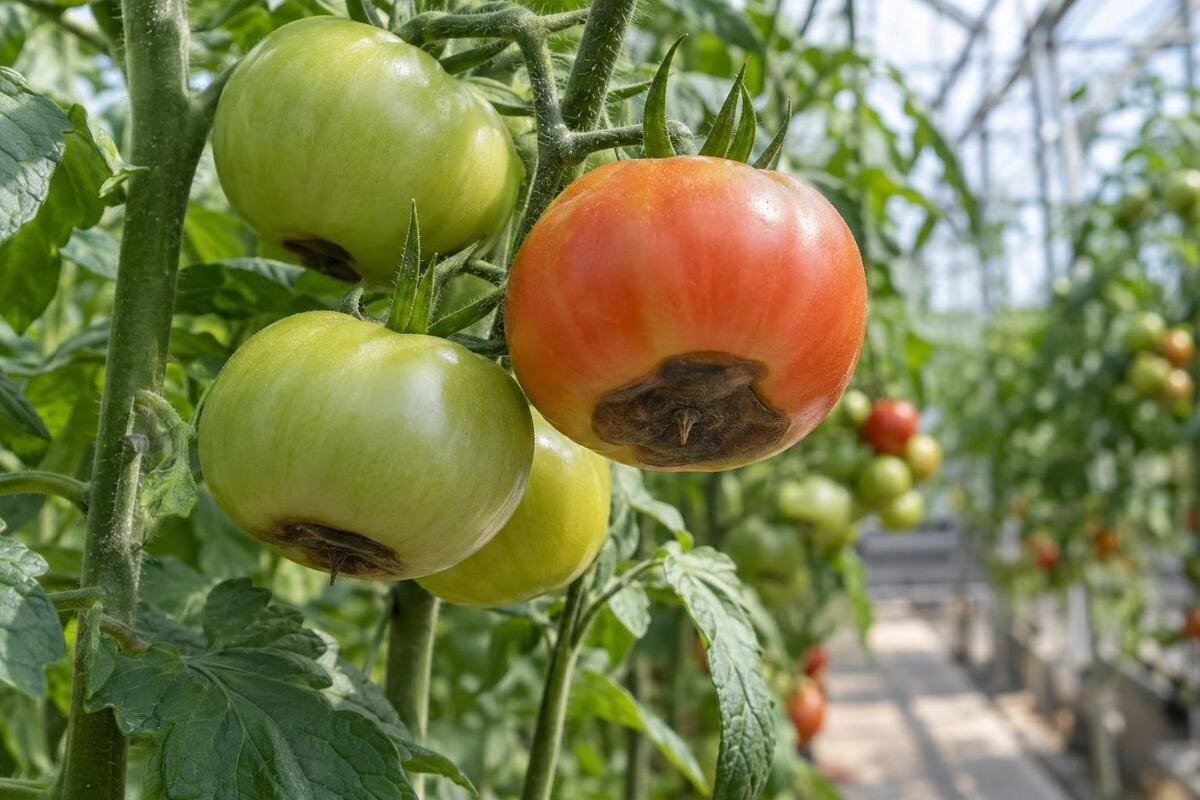
A typical blossom-end rot lesion begins as a small, water-soaked mark at the blossom end—the end opposite the stem. It turns brown or black, enlarges and sinks into the fruit; the surface is often dry and leathery once the tissue has died. The mark may appear while a tomato is still green and remain as it ripens. Its position and sunken appearance are more informative than colour alone. The affected area will not turn back into firm, unmarked flesh as the fruit develops.
Blossom-end rot is a physiological disorder, not a contagious disease. It may affect one fruit, several fruits on the same plant or fruit at a particular stage of development, while nearby tomatoes remain unmarked. That uneven pattern does not rule it out. Look at the position, shape and texture of the mark, and note whether it grows or changes. A dark patch in a photograph can suggest blossom-end rot, but it cannot always distinguish it from another injury or decay.
How calcium reaches a developing tomato
Calcium helps build and maintain plant tissue. Roots take it up from water in the growing medium, and it moves around the plant mainly in the water-conducting xylem. Calcium is poorly redistributed from mature leaves to developing fruit, so a tomato relies on a continuing supply through its own vascular connections as it grows. Leaves generally transpire more than fruit, which means calcium is not distributed evenly to every part of the plant. Fruit tissue can therefore receive too little even when the leaves look healthy.
A low calcium level in affected fruit is not the same thing as a lack of calcium in the soil or potting mix. For uptake and delivery to work, roots need to function, water must be available and the fruit must receive enough calcium as its tissue expands. Drying, waterlogged roots, root injury, high soluble salts, rapid growth and nutrient imbalance can interrupt one or more parts of that process. A test result is useful, but it needs to be interpreted alongside how the crop is growing and being watered.
Greenhouse footprint note 2
Uneven moisture can interrupt calcium supply
Tomato plants need a reasonably steady supply of water through the root zone. Repeated drying followed by heavy watering can disrupt uptake, and a large watering does not reverse damage that has already started in fruit tissue. Containers, shallow beds and areas with different soil conditions may dry at different rates. In a greenhouse, rain often does not reach the crop, so irrigation has to provide the water roots depend on. This matters when planning growing space as well as managing an existing crop. The Oasis Pyramid Greenhouse size range runs from 5.53 m² to 18.9 m². When comparing those options, sketch where the beds or containers would go and how you would check moisture in each group. Total floor area alone does not tell you whether all the plants will receive consistent watering.
Check moisture where roots are active rather than relying on the surface, which can dry while the soil below remains damp. Compare several plants and positions in the greenhouse. If one bed or group of containers is consistently drier, inspect how water reaches that area before changing the whole crop’s watering routine. A wilted plant is not proof of dry soil: roots in saturated or damaged conditions may also struggle to supply water. Check the medium and drainage as well as the leaves.
Root problems and greenhouse conditions
Roots need both water and access to air. Long periods in saturated soil or potting mix can leave them unable to function normally, while compacted ground, damaged roots or a blocked drainage outlet can create local stress. Check whether water is pooling, draining unusually slowly or bypassing parts of a bed. Keep access to drainage outlets in mind when arranging the greenhouse: a problem is harder to investigate if stored supplies hide the area you need to inspect. For a layout that includes storage, the Limited Edition greenhouse with built-in storage is listed from 5.52 m² to 28.08 m². Compare the intended growing and storage areas on your plan, leaving room to inspect the beds rather than treating the entire footprint as planting space. Storage provision does not replace a drainage check.
Temperature, humidity and airflow affect water loss and the pace of plant growth, so greenhouse conditions can change the balance between water uptake and demand. Their effects depend on how those conditions combine; one setting is not a universal remedy for blossom-end rot. Note whether symptoms follow a period of unusually rapid growth, heat stress or changing moisture, and review ventilation or shading if the crop is struggling. Treat those observations as clues, not proof that one environmental factor caused the lesion.

Greenhouse footprint note 3
Fruit damage that can look similar
Sunscald is more likely to appear on an exposed side of the fruit as a pale, bleached or papery patch, rather than as a dark lesion centred at the blossom end. Cracking is an open split in the skin, not a sunken patch of dead tissue. A small, dry scar can also be left where a flower was attached; compare it with the expanding, leathery area typical of blossom-end rot. These distinctions are useful, but real symptoms do not always match a textbook photograph exactly.
Other fruit rots can become soft, sunken or discoloured, and decay may develop on tissue already damaged by blossom-end rot. Mould, spreading wet patches or an unusual smell should prompt caution rather than a confident diagnosis from appearance alone. Photograph the fruit from more than one angle and note whether nearby leaves or stems are also affected. Include a close view of the lesion and a wider view showing its position on the fruit, so the record captures more than its colour. If symptoms are spreading or remain unclear, ask a local horticultural adviser or plant diagnostic service to assess them. When comparing a new enclosure, such as the Prestige greenhouse range from 3.77 m² to 28.08 m², allow space to examine fruit on both sides of a row. Being able to reach and see the crop is a useful layout consideration, though it does not establish the diagnosis.
Record the pattern before changing fertiliser
Before changing feed or watering, record which plants and fruit are affected, where they are in the greenhouse and how far the fruit has developed. Note whether symptoms cluster in one bed, container group or irrigation zone, or appear across the crop. Compare affected fruit with healthy fruit on the same plant and on nearby plants. A simple map or dated photographs can make a pattern easier to spot than memory, especially if several conditions changed around the same time. Label the beds or container groups consistently so that later observations refer to the same places. For anyone planning a larger growing area, the Spacious Greenhouse footprint options range from 47 m² to 70 m². Use a proposed layout to identify the areas you would monitor separately; a single note saying that the greenhouse was watered gives little detail about differences between its beds.
If the problem recurs, consider testing the soil or growing medium for pH, available nutrients and soluble salts, and assess irrigation water if its quality may be a concern. Use a test suited to the way the tomatoes are grown; a bed and a container mix are not necessarily assessed in the same way. Sampling only one spot can miss differences across a greenhouse. Explain which areas are affected when seeking sampling advice, and keep the results linked to those locations. Record the feed used and any recent changes alongside the results, rather than trying to reconstruct the feeding history afterwards. Interpret findings with crop-specific advice: one reading should not become a complete explanation for every affected fruit, particularly when the moisture pattern also varies.
Greenhouse footprint note 4
Steady the root-zone moisture
Once you have checked the root zone, aim to keep its moisture more consistent without leaving it saturated. Adjust watering to the growing medium, container size, crop growth and how quickly the greenhouse dries; a fixed calendar does not account for all of these. Water should reach the roots rather than merely wetting the surface. In a new layout, consider how you will get water to each bed and reach the watering equipment for inspection. The Aluminium Classic Greenhouse sizes range from 3.77 m² to 28.08 m². Compare your intended bed positions and access route with the space available instead of choosing solely by the amount of planting room. Leave yourself a practical way to check delivery at the far end as well as near the water supply; the listed area does not specify an irrigation arrangement.
Inspect the whole watering setup for blocked emitters, leaks or uneven delivery, and compare containers or bed sections rather than assuming they receive the same amount. Check drainage after watering and avoid trying to compensate for a dry patch with one excessive soak that leaves roots flooded. Make a manageable adjustment, then observe the root zone and later fruit. Changing several things at once makes it harder to learn whether the moisture pattern, drainage or another factor was responsible.
When calcium or other fertiliser is appropriate
Extra fertiliser is not a reliable treatment for blossom-end rot when roots cannot take up water properly. Adding soluble nutrients can raise salt levels in the root zone; excess potassium, magnesium or ammonium can also interfere with calcium uptake. Too much nitrogen may encourage leafy growth without solving the fruit’s supply problem. These nutrients are necessary in appropriate amounts, so their presence alone does not prove they caused the disorder. Avoid adding lime, gypsum or a general feed based only on a dark patch. Keep feeding decisions separate from enclosure size when budgeting for a crop. The Lean-to Greenhouse footprint range is 3.69 m² to 14.34 m², but floor area is not a basis for choosing a calcium treatment. Base any amendment decision on the growing medium and crop assessment, not on how much greenhouse space you have.
Consider calcium supplementation only when a suitable test or professional assessment indicates that calcium is unavailable or insufficient and the cause has been investigated. Soil pH affects nutrient availability, so adding a product without understanding the growing medium can miss the problem. Foliar calcium should not be assumed to fix poor root uptake: calcium moves poorly from leaves to fruit. If you use any product, follow its label and crop-specific advice; do not improvise a dose or combine amendments simply because the first application did not change the fruit. Keep a record of what was applied and when, including the existing feed programme. That helps distinguish an intentional adjustment from an accumulation of treatments, and gives an adviser a clearer account if the problem continues.

Greenhouse footprint note 5
What affected fruit can and cannot tell you
The damaged tissue will not heal, so do not wait for a dark, sunken area to disappear after changing the watering routine. The lesion may remain visible or enlarge as the fruit grows. Remove badly affected fruit if it is deteriorating, and do not assume that a fruit with mould or spreading soft decay is simply showing uncomplicated blossom-end rot. The disorder itself is not contagious, but secondary decay is a reason to handle questionable fruit separately and use caution.
Later-developing fruit provides better evidence of whether conditions have improved, although fruit already developing when you made a change may still be affected. Look for a pattern across later fruit rather than judging the whole crop from one tomato. Date your observations so that you can distinguish fruit seen before the adjustment from fruit checked afterwards. Keep normal crop care steady and avoid drastic pruning as an attempted cure. When planning future growing space, include access for these follow-up checks rather than allowing only for planting. The Limited Edition Aluminium Greenhouse sizes range from 3.77 m² to 28.08 m². A useful comparison is whether your proposed arrangement leaves the developing fruit within reach for inspection; a larger footprint alone cannot predict fruit health or show whether a watering change has worked.
Plan greenhouse space for easier crop checks
A greenhouse’s size does not prevent blossom-end rot, but the way you organise a crop affects how easily you can inspect plants and water the root zone. Bring the practical requirements together on one layout: access to beds or containers, watering equipment, drainage inspection points and room to examine fruit. Then compare that arrangement with the available footprint. The T-Model Orangery Greenhouse area options range from 16.52 m² to 30 m². Those figures provide an initial space reference, not a tomato-bed layout or a promise of crop performance. When comparing sizes, identify what the extra space would actually be used for rather than assuming it should all hold more plants. An arrangement that remains accessible during the crop makes the moisture, root and fruit checks described here easier to carry out consistently.
During the crop, look over young fruit regularly and note the first appearance of any lesion alongside watering and greenhouse conditions. If the same pattern returns, use those records and appropriate test results to narrow down the cause before changing fertiliser. Blossom-end rot is a useful warning about the balance between fruit growth, calcium delivery and root function; it is not, on its own, a verdict on the soil or a reason to feed more.
Frequently asked questions
Does blossom-end rot mean the soil lacks calcium?
No. It means developing fruit has not received enough calcium, but the cause may be poor water uptake, root stress or nutrient imbalance rather than a shortage in the soil. Check moisture, drainage and root health before deciding whether a soil or growing-medium test is needed.
Can blossom-end rot spread from one tomato plant to another?
Blossom-end rot is a physiological disorder, not a contagious disease, so the lesion itself does not spread between plants. If several plants are affected, look for a shared factor such as uneven irrigation, drainage problems or a feed issue. Secondary decay on damaged fruit is a separate concern.
Will affected tomatoes recover if I correct the watering?
No. The damaged tissue will not return to normal. More consistent moisture may help later-developing fruit, but fruit already forming can still show symptoms. Judge any change by checking new fruit, not by waiting for an existing lesion to disappear.
How often should I water greenhouse tomatoes?
There is no single interval that suits every greenhouse, container and growing medium. Check moisture where the roots are active, then adjust for conditions and how quickly the medium dries. Aim for steady moisture without leaving the roots waterlogged.
Should I use a foliar calcium spray?
Do not treat a foliar spray as a reliable substitute for healthy roots and steady water uptake. Calcium moves poorly from leaves to fruit, so spraying may not correct the underlying problem. Consider a calcium product only when test results and crop advice support it, and follow its label.
Blossom-end rot is best treated as a clue about fruit development and calcium delivery, not as an automatic prompt to add fertiliser. Check the fruit carefully, look at moisture and drainage where roots are active, and use test results before changing the nutrient programme. Judge any improvement by later-developing fruit, while remembering that tissue already damaged will remain damaged.
